As I was finishing up Brand Gamblin's follow-up to the excellent
Tumbler
, a thought kept occurring to me that I couldn't shake: If my buddy Brand (for buddy he is, on
Twitter and from Balticon) keeps it up, he could be a 21st century L. Frank Baum. I can think of no other writer whose work can beguile a precocious pre-tween and a cynical old grown up to this degree. And I have evidence: my friend's ten-year-old daughter has read
Tumbler at least three times since I gave to her in December, and all of my grown up friends who have read or listened to it seem to enjoy it just as much.
The comparison doesn't stop there, though. Brand tells charming and fanciful stories with a lot of wide-eyed innocence and just a smidgeon of jeopardy -- and the jeopardy is as likely to be social as it is physical. That's as true of
Tumbler as it is of
The Hidden Institute, though they are otherwise very different books:
Tumbler concerns a young woman struggling to make her way as a beginning asteroid miner, while
The Hidden Institute concerns a young man dealing with a more earthbound -- but also more fanciful -- situation.
At the heart of
The Hidden Institute is a chillingly possible (and becoming more so almost daily) future society in which our own near class-wars have been mostly settled and the extreme divide between the haves and have-nots has gelled into what amounts to neo-feudalism. A new cadre of aristocrats has seized control of the economic and political levers of a neo-Victorian society that may remind readers of that in Neal Stephenson's staggering
The Diamond Age: Or, a Young Lady's Illustrated Primer
, but has a heaping helping of a slightly grittier version of Baum's Land of Oz thrown in.
Our hero is Cliffy, an extremely lower class youth who blunders into a bizarre chance to better himself when he witnesses and records what appears to be a murder at the hands of an aristocrat. To hush him up, the seeming criminal gives Cliffy entree into a special, extremely secret, school (no, not Hogwarts) where he can train up to be a gentleman, then seek placement as a higher-level servant in an aristocratic household -- even though even these rather menial posts are reserved for the lower nobility (in this world, aristocrats'
servants must be nobly-born or at least ennobled by the King. And yes, this takes place in America!).
Cliffy's journey through the school, with his lessons in history and culture, his deportment lessons (one day it takes three hours to get through a bowl of soup!), self-defense classes, and his foray into bear polo -- hold the phone!
BEAR POLO -- it's exactly as it sounds, it's polo played riding bears instead of horses! -- is peppered with very acute observations on what it really means to be an upperclass gentlemen: obeying your servant is at least as important as learning to affect that
je ne c'est quoi.
And Cliffy's interactions with his servant Whister, a seemingly omnicompetent robot valet, that give
The Hidden Institute most of its Ozziness. I couldn't help picturing Tik-Tok, though Whister does not seem to share in any of his predecessor's limitations; say half Tik-Tok, half Tin Woodman, yet never fearing water or rusting. Such a robot is probably impossible any time soon, but Whister is totally plausible within the narrative because he's just part of the craziness of the story.
But what happens, you might ask, besides the school thing? Quite a lot. Cliffy runs afoul of not one but two conspiracies, either of which could quite easily get him killed. I won't spoil these except to say that fans of the podcast have already nicknamed the distaff conspiracy the "Silk Goon Squad."
The only thing that spoils this delightful read (and this is only problem if, like me, you're sensitive to usage/grammar issues), is a problem that I cannot 100% lay on Gamblin's door because I strongly suspect it's a technology issue. While yes, there are occasional flubs that illustrate again how completely the English language's many homophones are the bane of modern writers who rely on computer spellcheckers("discrete" is used where "discreet" is meant a couple times, with unintentionally humorous consequences), what really drove me nuts is the preponderance of the wrong "its." Every instance I found where either "it's" or "its" might appear, it was always the former, the contraction for "it is" rather than the latter, the possessive form of "it" -- and usually it was the possessive that was wanted. It's a small quibble but it highlights something I think lots of writers and aspiring writers need to be wary of.
I'm not certain that Gamblin has an iPad but he runs with an iPad-loving crowd, and I know a lot of them enjoy writing novel drafts on the device. That means, of course, that a little feature, much complained of, called AUTOCORRECT is a factor, and one of that feature's most annoying habits is always insisting on changing "its" to "it's" because, you know, it knows better than you. I curse it often when I send tweets via my iPod Touch and shudder at the thought of trying to compose a novel-length piece while constantly fighting it off. This is just my theory about what happened though.
The screechy brake sound my brain made whenever I encountered that small issue (and I'm sure your brain has made it in some point reading this blog entry; I type really fast and don't always see my errors until after I've hit "publish") notwithstanding, I cannot recommend this book highly enough. Read it yourself and give it to a ten-year-old. Talk about the bear polo and you might even get your teenager to read it. Then you can all have a good sit-down and talk about economic injustice, opportunity and the importance of a good education. Bravo!
A final note. Gamblin has been hinting to me via Twitter that he's contemplating a sort of companion short story or novella centering on a doping scandal in the wild and wooly world of bear polo. If you're at all fond of me, or if you read this book and enjoy it, please join me in urging Gamblin to stop teasing and write the damned thing.
I lied. This is the final note. If you are e-book challenged, you can stil enjoy this one, either as a free audio podcast at
the author's website or you can order a copy on dead tree
HERE. It says pre-order but I got mine right away.
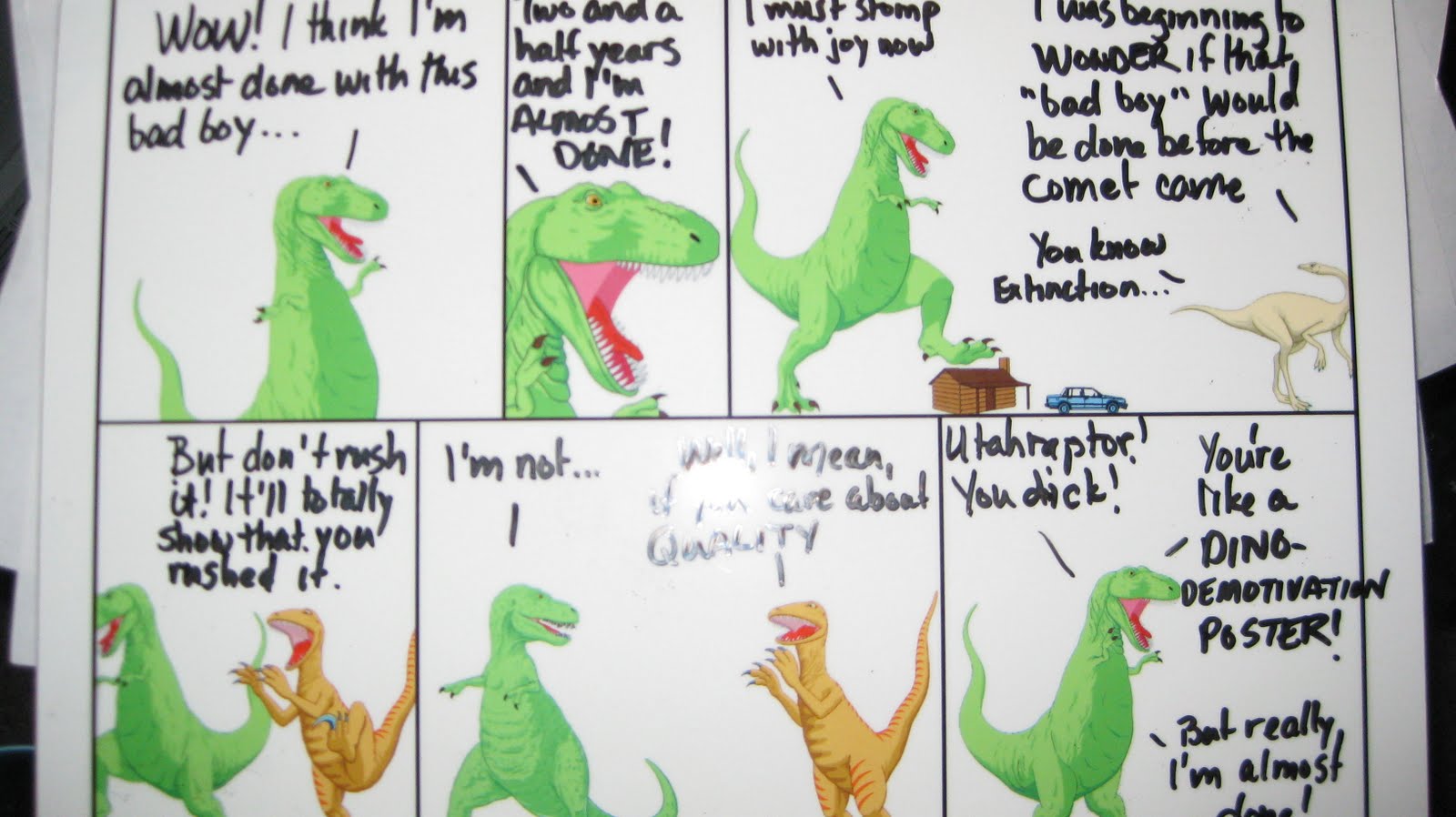 OK, it's hard to photograph a whiteboard, especially when you're in a hurry. Lots to do tonight. But since it's probably hard to read even if you click on the image to Dino-size it, a quick transcript:


 -- to the swinging soundtrack music, full of deep, heavy bass plunks and fruity vocals, to the climactic Battle of Bosworth Fields (about which more anon) (also highly dog-startling) this is a film to match aurally the bombastic dreams of a would-be tyrant. Zounds!
 , even other dialogue). For this Richard III Loncraine and McKellen have imagined a sort of alternate Edwardian England for this tale of the last Plantagenet (Edwardian as in Edward VII, in the early 20th century; not as in Edward IV, Richard III's brother, who reigned in the mid 15th. I found the superimposition of the Yorkist's reign over that of the first Windsor an odd one, but as it gave an excuse for lots of lovely cars and Art Deco sets and costumes I let it go). Thus the opening scenes, in which Richard murders Edward of Lancaster and his father, King Henry VI can feature an opulent Art Deco study and library being destroyed by a great big tank smashing through its outer wall, from which Richard emerges with a machine gun, blowing Edward to bits and then firing out the movie's title letter-by-letter. One thinks of Pulp Fiction. Richard III was a Bad Motherfucker.
 , much-needed to play a woman who not only loses her husband but also her two sons, the latter to a fabled murder plot in the Tower of London, in the course of the play. I give Bening points for not even trying to fake an English accent.
 . I think I can hear Lee's teeth grinding from here...

 , in which the convict laborers building a railroad through the badlands of Mieville's baroque and unsettling fantasy universe of Bas-Lag seize control of the works and turn the train and the railroad into a perpetually moving city that disappears into the physics-defying Cacotopic Stain; it shows up again in Alastair Reynolds'
  in the form of a parade of mobile cathedrals traveling a planet's equator in order to keep an astronomical anomaly always in view. It's a deeply weird thing and if you, my few but wondrous readers, know of other examples, please share them!