Showing posts with label memoir. Show all posts

Wednesday, December 4, 2024

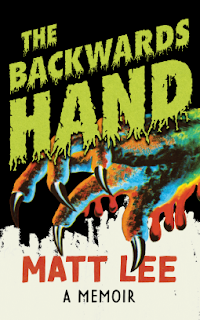
Matt Lee's THE BACKWARDS HAND: A MEMOIR

My E-ARC copy of Matt Lee's The Backwards Hand: A Memoir has, presumably as an anti-piracy measure, undergone a blanket text edit in which all "fi" and "ff" letter combinations have been replaced with two taps of the spacebar. So, for example, "film" has become " lm" and "effect", "e  ect" through the whole book. It's jarring at first, but shortly my brain adjusted to it and just took it in stride. 

The possibility has occurred to me, of course, that this is not just a factor in my copy from Netgalley but an intentional gimmick in the text as a whole, to make a point about neuroplasticity or human adaptability or something, but probably not. Lee isn't interested otherwise in being either subtle or gimmicky; he is here to tell you, very plainly and without sparing anyone's fee-fees, what his life with a very unusual congenital difference has been like.

Lee was born with bilateral radioulnar synostosis; the two bones in his forearms, which actually rotate and cross over when an unaffected human rotates their hands front to back, are fused together in the crooks of his arms. Surgically un-fusing them, at least back when this was offered to him, would unavoidably damage a cluster of nerves located right where the bones are fused, leaving him with constant pain (something I know all about and wouldn't wish on Elon Fucking Musk, for all that he wants to put chips in the brains of people like Matt Lee and myself and maybe all of us because of reasons) and a still-deeply limited range of motion that wouldn't even approach "normal." Not exactly a win-win proposition.

There are notes of existential terror in this text, much of which is devoted to famous disabled people and other "freaks" from history and how they were depicted in art and treated by their families and, most importantly, by the authorities. Lee spends a lot of text, for instance, to the Nazis' euthanasia program, which targeted the mentally and physically disabled; eugenics is never far from the discussion when societies discuss policy toward us. This fear has only grown with the results of the recent U.S. election, of course, but that development was still in the future when this book went to press. 

Lee's own story is far less bleak, however. He has married and has a child who does not share his disability, has had an acting career and has developed a clear and concise prose style and a dedication to thorough research that should serve him well moving forward in life -- and, as he takes care to emphasize in The Backwards Hand, he doesn't owe all of the setbacks he has encountered on the way to this state to his disability. Some of it is attributable to his own immaturity, infidelity, or general assholery. Disabled people are neither monsters nor saints; it just took him a while to realize that his disability did not automatically make him a monster. 

But man, this book has made it a little harder to go into 2025 with anything like a sanguine attitude. But, like that was going to happen anyway, amirite?

Who knows, maybe we'll end up in the same camp and I'll get to tell him in person that I appreciated this book and told all my friends to read it. Except I'm housebound because nobody will take basic precautions against diseases that could kill us, so instead of actual friends, I'm telling whoever still reads this blog. Read this!

Saturday, July 20, 2024

M. John Harrison's WISH I WAS HERE: AN ANTI-MEMOIR

My first and still favorite M. John Harrison read was The Sunken Land Begins to Rise Again, in which the speculative fiction elements take place so far in the background of the story that they're barely noticeable. The focus instead is on a pair of mostly dysfunctional characters, barely competent at living their own lives, utterly incapable of even paying a little attention to the bizarre changes taking place to the landscape and society around them, which feels faintly like a prequel to J.G. Ballard's The Drowned World might -- if we're interpreting the subtle and widely scattered clues, clues like a sudden and seemingly culture-wide obsession with Charles Kingsley's Victorian era children's book The Water Babies -- at all correctly.

Author and editor and all around badass M. John Harrison's new book, Wish I Was Here: An Anti-Memoir, works on much the same principle. The details of Harrison's life and career are present mostly in the negative (with the exceptions of some anecdotes about an aging cat and about his obsession with rock climbing); the positive space is filled with the figures and ideas and opinions and bits of imagery that have occupied his mind while all of that was going on. It's a fascinating and original way to approach the arts of biography and memoir that I, only the most casual reader of these genres, have never encountered before, and I love it! 

Thus instead of "I" and "me" and banal narratives of mere events in Harrison's life, we get accounts of a sort of dream-self he calls "Map Boy" (everybody writing about this book is going to remind you that "the map is not the territory, blah blah blah, how anti- do I have to get, here?), exploring remembered landscapes and word games and dreams, and of "Beatrice," Harrison's "writer friend" to whom he attributes various mini-manifestos about genre and character and why world-building is pretty bad, actually, and other matters of writing and inspiration and work. Were we to create an image in which these two constructions face one another in profile, the space in between them might in some way be a portrait of Harrison -- but it would be a pretty weird and distorted one. Just the way he wants it, I suspect.*

I can't say for sure that I like Wish I Was Here; I found it beautiful on a purely aesthetic level, full of striking ideas and images, and the very concept of it fascinates me. I do plan to read it again a few times as I become more acquainted with the rest of his work, though. I think it will resonate much more strongly for me when I recognize more of the material in it from his fiction, as it did on this first read when I kept recognizing notions and locations from The Sunken Land, like this: 
We find that, pinkish and surrounded by brand new wire netting, the surface of the tennis court is already sinking into the mud, so that the drainage channels around it, which are still to be filled in, look more like the remains of a half-hearted rescue attempt. Someone has scratched the mileage off the nearby road signs, as if to hide the town or perhaps deny its existence.
I mean, I didn't really feel like I got The Vorrh on the first reading but now it's very likely my favorite of all trilogies.

I have a very strong feeling that Wish I Was Here will grow on me like that. But I don't mean to use it as a sort of key to all his mysteries, which I'm pretty sure was not remotely what he set out to, or indeed did, write. As he pointed out several times in this text, he deliberately cultivates ambiguity and sets out to leave much to his readers' imaginations. Guys like that don't write Dummy's guides.

What they do write, apparently, is the kind of "huh, look at that" narrative that I most associate with (again) Ballardian protagonists, though Harrison has shown a lot more agency than those passive and detached observers of their lives. Ballard protagonists don't cultivate habits like base jumping in middle age, for instance! I mean, if Harrison ever wants to write a whole big non-fiction book about what that's like, I'll sure as hell read it. For I have at least concluded this: I'm down to read whatever he cares to write, and I'm very excited to read his back catalog, much of which has occupied space in my to-be-read piles, sometimes for decades. Sometimes it just takes something special to make me yank them out of the heap and let the stuff that was on top of them fall as it may. Wish I Was Here was more than adequate to that job, if nothing else.

*But can't say I know, because I'm still very much an M. John Harrison newb, for all that much of his career has had significant impact on much of what I've enjoyed the most in my reading life. But, I mean, I haven't even read all of the Virconium tales yet!

Sunday, June 5, 2022

Toby Ferris' SHORT LIFE IN A STRANGE WORLD: BIRTH TO DEATH IN 42 PANELS (narr by Jot Davies)

Jot Davies is one of those audio book narrators whose name on a project automatically makes that project a likely listen for me, but put him on something like Short Life in a Strange World: Birth to Death in 42 Panels, which turns out to be the answer to "what if John Berger and W.G. Sebald were merged into a literary/art historical Brundlefly (and also freakishly made the same allusions to the same cultural touchstones I'm thinking of right as I think of them!) and wrote a book about Breugel the Elder" and that becomes a dead certainty. 

Author Toby Ferris set about the project that gave rise to Short Life in a Strange World after being seized by a "mania for [Pieter] Breugel" as he mourned his recently dead father. Short narratives from that father's life are intertwined with biographical sketches of the author's trip to all of the museums and private collections that possess  definitively proven works of Breugel, and accounts of what is known of Breugel's own life as Ferris minutely observes Breugel's works and the settings in which they exist circa the early 21st century.

Along the way, Ferris winds up writing both lyrically and informatively (the lyricism greatly enhanced by Jot Davies' precise diction and rich and sonorous intonation) about diverse subjects such as the process by which paintings are restored nowadays versus in the 19th and 20th centuries, the aims and ambitions of medieval alchemists, the economic and cultural realities of life in what was, in Bruegel's time, the Spanish Netherlands, the arrangements of modern museums, the English phonetics pose to native speakers of Asian languages (that must have been particularly fun for Davies to narrate), and the occasional wilderness adventure undertaken in the company of Ferris' brother on the author's extended visit to the United States.*

Entertainingly, each chapter begins with a note about how much of the total "Bruegel Object", as calculated by a spreadsheet the author created as he first began contemplating this odd and lovely project, is discussed in that chapter.** From that starting point, Ferris can go in any direction as the imagery in each painting or group of paintings inspires speculation about the change of the seasons, the medieval understanding of death and new life, the difference between painting on wood versus canvas... anything goes, which is where the book most evokes W.G. "Rings of Saturn" Sebald for me and makes me wish Jot Davies could narrate that book someday.

What really stands out for me, though, is an odd little interval late in the book, the short but arresting 11th chapter, "Singularity." Here Ferris pauses to consider a sliver of the "Breugel Object" that has disappeared from public knowledge after being sold at Christie's early this century. This little roundel was a rather recent attribution after careful study with 21st century technology, this as much for its material faithfulness to Breugel's era as for its image, and so Ferris wrestles a bit with how much it should actually bother him that he has no way of seeing the original (the John Berger bit of the Bergbald Brundlefly). It's not part of the canon of classically-understood-to-be-Breugel, after all, and copies, made by one of Breugel's sons and by an engraver that somewhat altered the depicted image to make it more suitable as an engraving, are publicly held where he can see them. Ultimately, concluding that completism is an unrealistic and undue standard for him and his decidedly not academic approach to Breugel, Ferris decides to just let it be, man. After all, he's not trying to hunt down Breugel's drawings or misattributed works, etc, either. Framing matters. 

I, who have several uncompleted "survey all the things" type projects all over this here blog, respect this decision a whole lot, and take a kind of comfort in it, too. I may not get around to reading all of the Doctor Who novels or ever finish my cheeky and irreverent close study of Gene Wolfe's Solar Cycle, but that doesn't mean that what I've competed of these are worthless for not being 100% COMPLETE COMPLETE COMPLETE. I mean, people wouldn't bug me to resume them if they didn't like what I've done of them so far, right?

And so with this book. While Ferris may have drawn the target around where his arrow hit rather than hitting an objectively established mark, what came of his effort is a lovely meditation on life and death and art, on landscape and memory (hey, Simon Schama!), how material objects such as paintings get scattered around the world,  and on how it feels to be in the same room with a famous masterpiece in our age of image reproduction and reduction. 

What a delightful listen! I think, though, that if I were to read it again, I'd want to sit down with a hardcover edition. The audiobook had an accompanying PDF to allow the listener to examine images of the paintings under discussion, and of course there are any number of ways to look at art on the internet,  but looking at them on the tiny screen of my phone was not very satisfying. As with most art books, of which this is certainly one, the luxury of glossy full color reproductions of the art is highly to be preferred.

But hardcovers don't sound like Jot Davies. Decisions, decisions...

*This is how I wound up having an amusing Twitter conversation about bear spray and, er, used bear chow, with narrator Davies (quite forgetting that the author was still included in the reply chain after Davies had clued him in to my early praise of this book as I was getting started with enjoying it). Sometimes the internet is still a boon to mankind, even in this dumb decade.
**The insights he derives from this supremely nerdy creation of his are weird and amusing. For instance, by Ferris' calculations, 74% of the "Breugel Object" contains a depiction of people in crowds. As someone who spent four years taking all my meals with the famous "Timer" of Phish fame, Zyzzyx, keeper of the Phishstatistics page, I can't help loving attempts like this to quantify art's impact on us.