Showing posts with label science fiction. Show all posts

Sunday, June 7, 2026

Ursula Whitcher's NORTH CONTINENT RIBBON

Sometimes there's a better way to show me the society, the world an author is imagining than via a single piece of narrative fiction. If you've created a truly richly developed culture that really differs from ours, it can be more effective, by which I mean both more efficiently communicative and more interesting for me as a reader, to show me facets, via vignettes or mini-biographies or, most gracefully, short stories about different characters occupying different roles in that society. And the stories need not necessarily overlap or interact, nor do they have to depict earth-shattering crises or huge personality conflicts or major civilizational turning points, either. An older example of this is Lucius Sheperd's story cycle surrounding the vast corpse of The Dragon Griaule; but I've found an even better one here.

Ursula Whitcher's phenomenal story suite, North Continent Ribbon, where, as the cover explains to us, "every contract is a ribbon, and every ribbon is a secret," depicts one of those imagined worlds that would feel like a fantasy setting if the tales within were read out of order; several of them involve no science fictional wizardry or even much-beyond-medieval era technology. Were it not for its opening matter, which declares that it comes from a larger work named Cross-Planetary Investment: A Practical Vraselian's Galactic Opportunity Handbook and informs us that the planet on which most of these stories take place is an important source for "faster-than-light vehicular components sourced from a high-orbit E-type singularity," the society on the North Continent of Nakharat would be all but indistinguishable from one of the weaving planets in Andreas Eschbach's The Carpet Makers, for instance.

But amidst its tales of ribbon-crossed lovers and sundered families and somewhat shady business dealings, we get hints that there's a lot more going on than just trade and agriculture and the many different ways love can come and go in human lives. There's the question, for instance, of how those aforementioned vehicular components, once assembled into faster-than-light vehicles that navigate through what this culture refers to as the deep*, are sourced. And what they even are. Which, it might seem as one pages through this slim little volume, are questions that might not get answered? At least not explicitly?

At least, not if you're not well versed in the kinds of science fiction and fantasy that I love best, where what's going on between the characters is not the whole of what's going on in the book, might even be a distraction from that, actually. See also Gene Wolfe and M. John Harrison and Frank Herbert and Alastair Reynolds.**

But even if you're not willing to plumb the weird and somewhat distressing secrets of this world, Whitcher still has plenty of rewards for your attention in store; these stories feature deftly drawn characters facing dilemmas that are delicately fantastic yet still mundane enough to be believable, from clandestine business machinations by rival corporations vying for profit, to local political scandals, to estrangement between children and parents, to inappropriate workplace love affairs, to secret labor union conspiracies, to the threat of imminent invasion by military forces that might just be coming to restore peace and safety, but might also come to impose new tyrannies over old -- all amidst some stunningly good line-for-line science fiction writing, like this in an earlier story, "The Fifteenth Saint":
The new text began with a litany: an electron's internal spin, the electron dancing around a nucleus, the shiver of atoms within a rock, all the way up to the slow rotation of the galaxy's arms and the slide of entire galaxies. Twisted behind and within and around all of these things was the deep, that other space where starships cut between stars. At every shift in scale, the book said, we experience a loss. But at every shift in scale there is the deep, thus at every shift in scale we find eternity; at every shift in scale there is the beloved, who has always been the beloved.
The text under discussion in the above, by the way, is a sort of samizdat that is buried in a book that has found its way into the hands of one of a district's hard-working political officials, who is starting to suspect that some of his co-equals in power and responsibility not only aren't holding up their ends -- he has just had to spend a whole day solving what should be a trivial problem for somebody else's constituent, only to be stymied repeatedly by layers of bureaucracy that he didn't even know had been imposed because things have been so compartmentalized -- but might actually be corrupt! But the culture of Nakharat is far too subtle for a samizdat to just come out and say things like that; far better to do so indirectly, poetically and above all memorably.

But also, and this is what makes Nakharat feel truly fantastic to a 21st century reader in most of the English-speaking world, the situation that official just had to deal with is really more of an exception than the rule, because Nakharat has a fundamentally different conception of how a civilized society runs. Among other things, the military forces on this world do not exist primarily to fight wars or extend or exercise the domination of a particular polity. No. As two characters in a later story, "Ten Percent for Luck," discuss as one explains to another why she's chosen the career path she has:
"But why the military?" Because it sounded like Inkar hadn't just taken a Contract with Otter Company. Her parents might have had actual shares. People with that sort of income didn't join up, not usually, not even with a paid commission.
"Because I wanted to build something."...
"Don't Companies build things?"
"For themselves. So they can take tolls. The army, we protect everyone. It doesn't matter who you are."

And I haven't even gotten into the lovely grace-notes present throughout these stories, like the whole ribbon thing. Almost everyone on the planet wears their hair in braids decorated with colorful ribbons that show their various personal and professional affiliations. Look at a person's hair and you can see where they went to school, to what professional societies they belong, if they are married and/or have children, if they're a high official in a Company or a public servant or a member of the military or a sex worker -- but only if you are on close enough terms with them to see them without their turban. Every contract is a ribbon, and every ribbon is a secret. And yes, there are some people who have no braids, no ribbons at all, and who flaunt this with loose, flowing hair not wrapped up in a turban. Those are very special people indeed, and yes, we meet one, kind of. But that person is maybe not as unencumbered as his hair suggests, hmm?

All in just 154 pages. My goodness!

Lots of people have had a good chuckle at the fact that North Continent Ribbon was short-listed for the 2025 Ursula K. LeGuin Prize for Fiction, and that the author is also named Ursula, as though the fix is in. But her own prose above and Your Humble Blogger are here to assure you that Whitcher deserved the honor, actually. And she's just revving up; this is her first book. And whether she chooses to continue writing, publishing and collecting Nakharat stories, or tries her hand at something else entirely, I'm here for it. Though I reckon I'll have to be patient, as she is a working mathematician, too.

I'm gonna choose to believe that she's taking her poet's ribbon at least as seriously as her math one, though. Because I definitely want to see more of her stuff. I'll put one in my hair, too, if need be. I've been growing it out again. And hey, it's grey now, so whatever color she chooses, it won't clash! Lemme know, Ms. Whitcher!

*Which I think is basically what most science fiction calls hyperspace or wormhole space or folded space. Use your favorite hand-waving term for how we cross the stupefying vastness of space without wasting human lifetimes in generation ships here. "The deep" seems just fine. I like, too, that it's treated as nothing special, so that it doesn't even get capitalized.

**What? You didn't know that the secret of the Revelation Space universe's Conjoiner Drives is explicitly revealed within that series? Tell me you haven't read Reynolds' short stories without telling me you haven't read his short stories. My goodness!

Tuesday, May 19, 2026

Ann LeBlanc's THE TRANSITIVE PROPERTIES OF CHEESE

Whomst among us hasn't been here: you're the very best cheesemaker (curd nerd in the parlance) outside of Earth's gravity well, famous for your unique, creamy and full-flavored products on every space station, asteroid and shuttle plying the solar system (and possibly beyond? You really don't pay much attention to matters of trade; you've built yourself a body perfect for stirring, curd cutting, measuring and tasting, and hacked your brain decades ago so you can tune out absolutely everything else in the universe and just concentrate on making that beautiful RedOrion), you've got an entire asteroid hollowed out, moved into a stable orbit, kept at the perfect temperature, humidity and gravity and inoculated long ago with the perfect population of beneficial microorganisms to assist in the fermentation and aging of your famous handiwork... and then suddenly one day you happen to hear a snippet on the news about how a big shot businessman has announced that an asteroid he owns and manages for his silent and reclusive genius of a business associate is going to be let go and allowed to crash into the Sun. It will burn up with all its contents in about two weeks. Wow, sucks to be that sucker. But hey wait, which asteroid was that again?

Such is the plight of Millions Wayland, cheesemaker of, in, among and to the stars, or at least the bodies orbiting this one, whose life's work is currently careening sunward on a collision course for financial reasons beyond her comprehension, in Ann LeBlanc's stunning little novella, The Transitive Properties of Cheese. And of course there's no time to handle this the way most artisans of her caliber would; she's going to have to cross a rather large volume of outer space to even begin to lodge a complaint, and meanwhile there's these batches of cheese she just got going here in her workshop (not in the hollow asteroid-cum-cheese cave, not aboard the space station where that irresponsible jerk of a managing partner is, either, but another third place where crewed spaceships don't even go, just automatic cargo shuttles that periodically bring in supplies and bring out fresh wheels of space cheese to transport them to be aged in the cheese cave with the suddenly curtailed life span).

So, Wayland does what any of us would do: she makes a perfect cognitive duplicate of herself, memories, personality, connectome and all, and shoots it in a tight-beam to the space station in near-Earth orbit where the restaurateur, who didn't even bother to warn her about her cheese cave's imminent demise before she heard it on the news, lives and works and maintains contact with the financial, military, civic and religious authorities of Earth. She -- or rather, this newborn version of herself -- is going to give that chucklehead a piece of her/their mind, even if she has to confront, head-on, the scene of the greatest trauma of her past, and of his -- and of all the other versions of themselves that are out here in space.

Versions? 

Yep. This is a trans-human soap opera, kids, and all of the characters except a few heavily armed thugs recently come up from Earth are cyberpunk interations of one of the first people ever to decide to upload himself to the Net and start making custom bodies for himself -- work bodies with extra arms, business bodies that look good in suits and are focused on the bottom line, party bodies for various recreational pursuits (mostly food and sex) and oh, by the way, before most of the copies of this character came into being, the original made a male-to-female transition, which is why I've mostly used female pronouns in this post but switched to male ones for this paragraph. There is trans-humanism and then there is trans-humanism. Which I should maybe call trans-trans-humanism? Except that would be silly? I mean, some of the bodies containing versions of the Millions character are more like giant robot millipedes than anything else, and are capable of directly metabolizing starlight and thrive in conditions of hard vacuum, because at some point in Millions' life they decided the best way to explore beyond the solar system would be just to become the spaceship!

Which is to say that, title aside, this book is only superficially about cheese, though in addressing the question of whether or not future batches that Wayland Millions may make in the future, without her cheese cave, could be regarded in any way as the same cheeses she was making with it, The Transitive Properties of Cheese takes on lots of bigger questions about how far the society in which she lives -- and the one she left behind when she left Earth -- are going to be willing to stretch the idea of "humanity," and how much that is even going to matter.

All in just over 100 pages. Because LeBlanc is a goddamn storyteller, who makes every sentence count for "world building," character development, plot advancement and the conveyance of exquisite sensory detail. In an age of 800-page doorstops, half of which seem to be devoted to that first (and least interesting) element of a piece of fiction, LeBlanc's talent for the tight and pithy novella is cause for considerable celebration. And The Transitive Properties of Cheese deserves to sell many, many, many more copies than any of those doorstops. What are you even doing? Go! And while you're at it, have a look around the publisher's site. They have a lot of good stuff there.

Friday, May 8, 2026

Ernest Hogan's CORTEZ ON JUPITER

I don't know about you guys, but if we have to have a Palmer Eldritch figure in our damnable future, I would much rather it be a Latinx visual artist than Elon Musk. Can we live in Ernest Hogan's World instead of Philip K. Dick's? Just as a treat?

Think before you answer. 
Allow me to elaborate. 

It's going to be very hard not to drift into the incredible bilingual slangy brilliance that is every word out of the mouth, pen or spray can of Pablo Cortez, the hero of Ernest Hogan's early cyberpunk should-be classic, Cortez on Jupiter, because I've been trying to improve my Spanish lately by reading the Oz books translated into that language, and the weirdness of that experience easily bleeds over into the demented delight of this tale of a graffiti artist in space!

Pablo is more than "just" a graffiti artist though; once he gets into space by a circuitous route involving the overworked criminal justice system and the jaded art world of a near-future greater Los Angeles, our man only goes and invents an entirely new art form! One that takes his already highly developed color sense and love of movement for its own sake and adds the novelty of zero gravity to what he does and to what the paint does -- and how it makes his "canvas" a truly three-dimensional sphere of influence, as it were, muchachitos.

"Working in freefall," he tells a news camera invading his studio at the center of a space station, "Has added a new dimension to my work."

If you can't tell, I kind of like this book. 
 
I had to feel -- and create -- ways of flinging paint and moving in freefall. It was like magic, flying and dancing with colorful matching creatures: the protomorphic beastery of a new mythology. This was a second ritual for outer space. I was a shaman for the new frontier. (Italics mine)
While Pablo makes his zero-gravity splatter paintings* in defiance of the arts foundation board who paid his way up the gravity well (they liked his sketched ideas for what amounted to ascemic writing, the beginnings of an imaginary alien alphabet that i can't help but imagining the Beltalowdas of the Expanse series using for secret communications sprayed in plain sight someday -- but aren't too keen on what he's chosen to do instead), another artist works on a "viral graffiti robot bomb" and other less probable contraptions, the kind of work that might someday inspire a new generation of industrial designers working on machines our species hasn't imagined a need for yet; another of the artists is a floating bombshell of a woman who occasionally remembers to sculpt something between press interviews and photo shoots and three-day drug binges because artists gotta artist.

The sculptor tries having a fling with Pablo to keep the paparazzi excited -- if they get bored, her career could sink her back down to the Mudball after all -- but Pablo is in the Zone, work-wise and anyway, doesn't do drugs. When he was a little boy in East L.A., his parents got a little too deeply absorbed in a neo-Aztec subculture** and got addicted to a new-old drug called ATL and overdosed, leaving little Pablito to discover their bodies. All part of the legend, but he stays true to it and doesn't even really drink alcohol. 

All of this by itself would make for a unique and intriguing novel (as far as my reading has gone, we won't really see much attention paid to the idea of art in zero-gravity until the very early 21st century, when Alastair Reynolds will consider the possibilities of vast and intricate glassblown confections that would only be possible in space stations), and there's more than enough character drama with these artists and patrons to have kept me happy,  but Hogan had more on his mind.  This isn't "just" about what if we sent a graffiti artist into low earth orbit to make art on a space station. For one thing, this is a future in which humanity has started spreading through the solar system -- and encountered another life form right in our backyard. The planet Jupiter, a vast gas giant that could contain 1300 Earths in its volume, and that doesn't have what we could regard as a solid surface except deep in its core where it's subjected to pressures that make the floors of Earth's oceans feel both easy and peasy, has something weird living in its famous Great Red Spot! But so far, we have utterly failed to make contact with it. Or have we.

Before you can say "volatile and mercurial artist beefs with his patrons," Pablo has manipulated (or been manipulated into; opinions differ, and this story is told from many divergent points of view) his way onto the weird team of volunteers who have agreed to be lowered via special modules into that giant atmospheric storm to try to talk to the beings known to us as the Sirens. Pablo won't be the first; several others have failed and come back as mind-wiped vegetables. He isn't the most qualified; the OG "Sirenaut" was a seasoned spacer with a system-wide reputation, after all. Until he came back with zero control over his bodily functions and whatnot...

No, what Pablo is, is the strangest, the most stubborn and the most egotistical of the candidates. So when he shows up in Jupiter's orbit, the scientific reasearch/entertainment conglomerate*** in charge is ready to launch him on the mission immediately! But first he has to meet the love of his life, telepath and fellow Sirenaut Willa Aboid, whose fate is weirdly bound up with his even though they're not very successful as a typical couple and their romance does not satisfy the audience back home. Once again, Hogan has much more interesting things in mind for this pairing, things that are impossible to discuss without spoiling the fun of discovering what all the weird little hints and foreshadowings sprinkled through the novel actually mean. And while Cortez on Jupiter largely does exist as a self-spoiling text, there's no point in robbing you of the fun of what discovery there still is. Though if I haven't convinced you to check this one out as yet, maybe you deserve it.

Hmm.

Anyway, I'm delighted to see that Hogan, who is a practicing visual artist as well as a Gonzo science fiction writer, is still at it after all of these years, even to having just recently published a short story collection that I'm going to rush to get just as soon as my current embargo (I'm trying to read down a huge accumulation of the evidence that when it comes to buying new books, I have no self-control at all, even if I'm down to my last head of lettuce in the fridge. You may not see my tsundoku room. The fact that I have a tsundoku room is bad enough) conditions are met, aka I have read at least 100 of the print, ebook and audio books that I already own. But then, yeah, Guerilla Mural of a Siren's Song will be mine. Oh yes, it will be mine.

*And yes, of course I'm thinking of that OK Go video. 

**Anticipating Hogan's next novel, the psychedelic cyberpunk splendor that is High Aztech.

***Why yes, Ernest Hogan anticipated reality TV just like D.G. Compton did

Friday, December 19, 2025

William T. Vollmann's YOU BRIGHT AND RISEN ANGELS

Oh, ants, my sisters, good old honeydew-seekers! From close up you are sticky and shiny and gristly; and your nymphs have parasitic red mites stuck to them. You are too intent upon your chewing and gathering to listen to me, but I tell you that despite my warm feelings I really do not like you, and I cannot feel sorry for you in any way because there are too many of you and you are not cute at all. You eat too much of my forests; you are a rebellious tribe, and I will destroy you; I will poison your nests with sweet-smelling traps.
Man, I've known of the existence of this book for decades. I had a vague idea of what it's about and that it was probably going to be something I would love, but I never came across it in a bookstore, back when it was new and a physical store selling physical books, or a public library, was the only way to get them, so I never picked it up for my personal collection or checked it out. Later on, online booksellers became a thing and I went bananas, just like everybody else did, but by then a lot of newer books were on my radar, and then e-books happened and then...

But really? I couldn't tell you why it took me so long to get around to You Bright and Risen Angels, apart from its still never turning up in any bookstores I've managed to hit when I've a bit to spend. And there not being an ebook or audio edition. And there being millions and millions of other books vying for my attention. 

Sigh.

But so, better late than never. And also, thank goodness for my having a few dozen high brodernist friends, many of whom are obsessed with Billy TV and his oeuvre, who selected his Europe Central as a book club read (which I loved and consider one of the best books I read this year, but I'm not ready to write about it yet and think I'm gonna read it again before I do)* and I was jolted into remembering that back in the 90s when I was temping my way around the Greater Boston area (so many bookstores! But I never saw this in any of them. And anyway, Infinite Jest happened, etc.) I was kind of always on the lookout for this big chunk of literary speculative fiction about insects and revolution and hey, online booksellers still exist, and not all of them are avatars of pure evil...

So, anyway, You Bright and Risen Angels is finally in my life. And, as I often but don't always say, it feels like it was written just for me. Well, except for all the gun stuff. There's a fair amount of gun stuff. Which isn't really for me, but I'll put up with it if an author makes it worth my doing so. 

Billy TV sure did! Though he also kind of tricked me in some pretty inventive ways, like providing a rather untrustworthy, though vividly descriptive, table of contents. As such.

This book was written by a traitor to his class. It is dedicated to bigots everywhere. Ladies and gentlemen of the black shirts, I call upon you to unite, to strike with claws and kitchen pokers, to burn the grub-worms of equality’s brood with sulfur and oil, to huddle together whispering about the silverfish in your basements, to make decrees in your great solemn rotten assemblies concerning what is proper, for you have nothing to lose but your last feeble principles.
I'm coming to dislike the phrase "late-stage capitalism" almost as much as I do all the Underpants Gnome-ish fantasizing about the neo-Nuremberg Trials that are surely just around the corner for the current crop of bigoted,  authoritarian oppressors who have come to power in so much of the world. Both memes presuppose that these regimes so obviously carry the seeds of their own destruction that it's just a waiting game for the rest of us; we don't really have to do anything. We certainly don't have to get nasty or violent. We just have to keep the popcorn ready for when the imaginary good guys who are going to swoop in and save us show up and clean house, like they did in World War II. Except somehow, we all seem to think that we're gonna get to skip the war part this time? Or at least that somebody else is going to do the arduous stuff? But on what basis do we think that?

Anyway, YBARA is an elaborate, baroque and challenging allegory of what it's most likely really going to feel like when everybody's finally had enough of the manipulations and empty promises of our current socio-economic systems that keep everyone too scared or hopeless or indoctrinated to be be willing to even imagine a slightly better world anymore. Couched as a giant revenge plot of bugs against bug zappers. 

But that sounds a bit dry and no-fun, doesn't it? But see, those are two things this book ain't, especially if you like weird shit like giant, freakishly long-lived anthropomorphic insects who have teamed up with their more conventionally sized and life-spanned brethren to fight back against human domination and destruction; like sentient agglomerations of electricity that, for their part, seek to preserve the status quo except with themselves in charge instead of stupid humans; like a handful of sinister, immortal oligarchs who both embody the status quo and believe the aforementioned agglomerations of sentient electricity are actually their willing servants and weapons; like a tiny cadre of passionate revolutionaries who were already ready to take matters into their own hands and fight, despite their paltry numbers, and then accept surprise offers of tactical, strategic and actual support from the very gnats that ordinarily would be tormenting them in swarms in their secret lair above the Arctic Circle!

Oh and there's also another oligarch, shadowy, sinister and remote, manipulating affairs from his base of operations on Mars? And a secret race of plant-people who can dramatically alter their own biochemistry to incorporate some industrial products and by-products to give themselves really weird superpowers like remote viewing via developing photographic film at a touch? I mean, you can't say Billy TV is unimaginative. 

All of this is related to us, by the way, by an unreliable narrator who seems to at least *believe* he is the last human survivor of the resulting conflict, who in his loneliness has programmed an elaborate computer simulation** depicting "resurrected" versions of all of the important actors in the scenario (helpfully listed for us with notes on their interrelationships and alignments in a Dramatis Personae at the beginning of the book right before its wild and rather fanciful table of contents). As he boots up his system for the latest iteration of the game, he addresses the personality constructs inhabiting it as his "Bright and Risen Angels" with a melancholy air. But is he really a lone survivor wistfully reliving the actual past of the narrative, or just a frustrated Infocom employee? Heh.

And it is because of this that YBARA often gets categorized as proto-cyberpunk. As this is really barely just a frame narrative, though, I think so promoting it is a mistake. You're not going to see any console cowboys, expensive razorgirls, or Rastafarian satellite-dwellers here,  but nor are you going to get the funky, vaguely creepy pseudo-biopunk of, say, Bruce Sterling's more interesting offerings, or the intensely insect-focused action of "antasy" works like Clark Thomas Carlton's output to date,  which I must confess to having vaguely hoped for back in the early days of my knowing this book exists.

I am by no means disappointed by what I got, for all that it does not even contain what the second half of the table of contents suggests that it will. Because what it's actually in these pages is fascinating in its own right, with its alternate history of the industrialization of the United States, its vision of cryptoterrestrials (again, rather before even most fringe communities were even really talking about certain phenomena in those terms) and its depiction of how rebels are made, not born. This is that rarity of rarities, a genuinely unique book, and one I'm profoundly glad to have finally gotten to read.

Interestingly enough, I seem to have stumbled into what feels awfully like a spiritual sequel to YBARA. Stay tuned right here to find out what it is. 

By the way, I think there's going to be a lot more Billy TV content on this blog in the new year, but don't worry: I'm pretty sure this one is still going to prove to be unique, because this guy's restless intelligence and creativity have legendarily led him never to write the same, or even the similar, book twice. Dayum!

*Yes, I'm in a book club now, at long last, halfway through my sixth decade on this warming, dessicating planet. 

**Recall that this book was first published in 1987, when most high schools in the U.S. boasted, at most, a few Apple IIes awkwardly situated in the library for a handful of nerds to play typing games on. Oregon Trail was still in the unimaginable future for most of us who weren't in the industry or attending a handful of schools adjacent to it. But guess who was working in the industry as a programmer back then? Billy TV!

Wednesday, December 10, 2025

Rick Moody's THE FOUR FINGERS OF DEATH

What happens when a writer with exceedingly literary pretentions wrangles a contract to novelize a B-movie of the kind most of us nowadays can only imagine watching with the silhouettes of a nebbishy guy and two iconic robots bopping around in the lower right corner of the screen?

Has anyone ever asked this question before?

Well, Rick Moody did. And the results are bananas.

The Four Fingers of Death, for much of its considerable length, directly answers this question by serving us a smorgasbord of pulpy goodness ranging from a crewed mission to Mars (conceived as the last grasp at relevance for a NASA and a United States on the brink of destitution, third world-caliber exploitation by actual world powers, and a concomitant brain drain that has brought us into the world of Mike Judge's Idiocracy but without that film's unfortunate eugenics arguments) to a suddenly self-aware chimpanzee whose pages-long speeches display a surfeit of internet-gleaned erudition*, to an amputated human arm infected with alien bacteria that's mindlessly crawling around Arizona committing murder and a few sex crimes while spreading its disease. Helpful servant Thing, of Addams Family fame, this ain't. 

Oddly, the narrative doesn't really play this for laughs, though it acknowledges on nearly every page that its every premise is ridiculous. I mentioned that the fictional writer of this madness, whose own career forms a frame narrative for his novelization of The Four Fingers of Death (a 1960s Technicolor remake, we learn, of an older black and white schlock-classic, The Crawling Hand), has serious literary pretensions; our man Montese Crandall, previously only known for flash fiction so brief that he only ever actually published single sentences, explores in depth and with sensitivity the inner lives of the astronauts on their journey to and through their tragic, pathetic and farcical experiences as the first humans on Mars, the dawning sentience of the experimental chimpanzee, Morton (alas, unable to perform a Caesar and uplift other apes with whom to be strong together), and the plights of the many earthbound humans, at many strata of society, whose lives are affected by the titular hand and its disease. 

While also treating us to some over-the-top gross and bawdy sex scenes, very much the funniest I've ever read.

Meanwhile, Moody pulls a kind of The Corrida at San Feliu of a trick, considering and expressing considerable emotion upon different aspects of a common problem -- most prominently, how gifted but emotionally stunted men deal with the loss, to death or desertion, of their wives -- through different narrative layers. In the frame narrative, Crandall is watching his wife slowly waste away and die of chronic disease; in the astronaut layer, Major Jed Richards is kind of in denial of the fact that his long separation from his wife started long before he blasted off for Mars and he's probably not getting her back if he makes it back to earth; and in the chaotic Crawling Hand account, a scientist whose wife died some time ago is keeping her body in cryonic suspension while he experiments on lab animals using cells from her body as he works on a cure for what killed her -- and hasn't leveled with his teenaged son about any of it. The son, meanwhile, often looks poised to repeat his father's emotional mistakes, except he has a girlfriend who is way more healthy and dedicated to making their relationship work than any of the wives in the novel. Seriously, if you don't come out of this with a deep love for Vienna Roberts, I am starting to doubt your commitment to Sparkle Motion.

That this book doesn't collapse under the weight of all of these premises is a source of wonder to me, even weeks after having compulsively read its over 700 pages almost without stopping (after a false start with the audio book, which is so poorly done in so many ways that I didn't even make it halfway through before my spleen erupted and sprayed bile all over a bunch of my Discord buddies, who I think were ready to beg me to switch to any other format when I did just that). Even if I hadn't been deeply emotionally invested in all of these characters and strapped in for all of their plots and subplots, I would have hung in just to see how the hell Moody was going to bring all of this madness to a close, even before I realized he was going to do so in the middle of a howling mad latter day Burning Man analog. But damn me if he didn't stick the landing. And earn a perfect 11 from all of the judges except for that one who actually is just really afraid of apes.

Utterly batshit. And brilliant. 

*Obviously this book was written back in the days when web searches were still useful and AI slop not even imagined by the likes of your Corys Doctorow or your Williams Gibson. Ever the peril of science fiction is this race against actual culture towards dystopiae.

Saturday, November 8, 2025

Andreas Eschbach's THE CARPET MAKERS (Tr by Doryl Jensen)

Andreas Eschbach has not been on my radar before now, but I'm determined to make up for all the time I've missed knowing his work, for if The Carpet Makers, his mid-90s pseudo-medieval space opera stunner that seems only to have finally gotten translated into English because of Orson Scott Card,* is anything to go by, I'm going to need to read everything of his I possibly can, and may even have finally to try learning German so I don't have to wait around for translators. Yeah, it's that good.

The pseudo-medieval element turns out, of course, to be a bit of a red herring, for while the story starts in a very low-tech, materially impoverished and superstitious society, we soon learn that it is but one of many planets, star systems, even galaxies that, along with the rest of known space/humanity, exists under the rule and on the sufferance of a far-away Galactic Empire. Which empire is ruled by an absolute monarch everyone worships as a god, believes to be immortal and omnipotent, and demands a very peculiar form of tribute from the planet where our story starts: carpets that are elaborately and intricately hand-knotted from human hair.

Creating these carpets is the sole driver of economic activity on this planet, which has a very rudimentary government and civil society and trading network, all in service of bringing thousands of these exquisite handicrafts to the planet's Port City every year for transport off-world to, they have always understood, decorate the Emperor's palace. Which must be very, very large and very, very fancy to even have room for all of the carpets they have been sending over tens of thousands of years.

A special class of artisans makes these carpets, which are about the size of a nice area rug, very, very slowly and very, very precisely. The culture of these artisans is one of generational obligation and strict hereditary status and privilege, in which a carpet maker, upon reaching manhood, is presented with a money chest meant to support him and his entire family over his entire life, the proceeds from the sale of his father's sole produce, one single, perfect carpet, created over the father's entire lifetime, knotted from the hair of the elder carpet maker's wives and daughters. Each carpet maker can only have a single son which he raises to adulthood, but unlimited daughters. If additional boys are born to any of the carpet maker's wives, the carpet maker must kill the infants (we get rather a shocking incidence of this to kick off the book). His daughters provide what raw material his wives don't, wives being chosen chiefly for the quality and natural color of their hair; ideally each carpet maker has at least one black-haired, one brown-haired, one red-haired and one blonde wife.

The son of the carpet maker, who will become a carpet maker himself, thus begins his career benefiting from a debt to his father that he can never repay; his father has worked his entire lifetime to make and sell a single carpet, for which he will be paid enough to keep his son and daughters-in-law in housing and food and chattels for the new carpet maker's entire career, until the son in turn finishes and sells a carpet, the proceeds of which will support the next generation of his line.

Once a year, a vast caravan completes an even vaster circuit of a large swathe of the planet, collecting that year's supply of newly-completed carpets and bringing them to the Port City, to be taken away by increasingly decrepit starships piloted and crewed by conscripted citizens of the planet, who have learned to fly by rote and have no idea how to repair or maintain the ships beyond the basics of flying them. Their cargo is thousands of carpets, whisked away once a year.

The entire rest of the planet works to provide basic material support for the carpet makers' families and the "shipsmen" who crew the creaky old transport vessels. The only form of culture we learn of is a weird and fascinating musical tradition of playing something referred to as a "triflute" -- a musical instrument that comprises three wind instruments twisted into one and deftly manipulated by the talented player, who is the only form of actually skilled class that exists apart from the carpet makers'. I found this sub-culture more interesting than the carpet makers' (of course I did) and a sub-plot involving a child prodigy at the triflute being conscripted to become a shipsman instead of continuing to develop his talent greatly enriches the novel but is not allowed to develop as the parallel story it should have been, ultimately kind of going nowhere except to create a red herring in the main plot, which I'll get to in a moment.

But so, the DNA of this novel is pretty evident and distinguished: the craft-as-sacrifice and service element of the Bright Carvings of the first Gormenghast novel, spliced in with a Galactic Empire that owes more to, say, God Emperor of Dune than to the Foundation series, but with a greater sense of mystery than either of these settings have to offer. What is being done with all of these carpets when they reach their destination? How did this weird tradition start, and why does it continue? What kind of weirdo demands millions and millions of carpets made out of human hair as tribute from a distant, conquered world?

Unlike a lot of the books I tend to gravitate toward, The Carpet Makers does answer all of these questions; we do get to observe bits of the greater empire, which has undergone considerable upheaval in the time it has taken one man back on Carpet Planet (we never do get an actual name for this planet) to perform his life's work. There has at least been a rebellion, and the Emperor has been proven to be less immortal than everybody thought, for all that he has provably lived and reigned for over a hundred thousand years. The Rebellion that took him out is struggling to assemble a government that is not just another absolute monarchy, but faces the threat of a new emperor arising in the person of the hero who murdered the old one and enjoys considerable prestige and adoration among the populace of the imperial planet and the worlds close to the former empire's center.

And there's one other thing: there's not a carpet in sight, for all that the palace is more than big enough to accommodate quite a lot of them.

And no one at the empire's core has ever heard of the Carpet Planet or its produce, until a scouting expedition stumbles upon it and a disobedient member of the crew decides to land on it and look around and maybe spread the word that the empire is no more. Which is, of course, heresy on that planet. Uh oh.

Another sub-sub-plot (this is a big picture novel rather than a character study; I couldn't tell you the name of a single person in it. We just get sketched-in stories, told briskly in individual chapters and then never visited again) involves the empire's staggeringly huge and complex archives, which have been re-organized so many times over millions of years (the emperor that was recently offed was the tenth of this empire, and it's implied that most of his predecessors were also functionally immortal) that almost nobody knows how far back in time the records go, let alone what's in them all. A laughably small team has been assigned by the new government to find out what they can about a number of questions, including why this weirdo Carpet Planet claims it's been sending carpets to decorate the palace for millennia -- and why, although this weird planet's inhabitants are absolutely certain that they are the only such planet, exploratory teams out in the far reaches of space have discovered that the whole galaxy (one of many ruled by this empire) which contains the Carpet Planet also contains tens of thousands of other Carpet Planets with identical cultures and missions!

All of these wild ideas and intricate plots are rendered by translator Doryl Jensen into some pretty exquisite prose, with an emphasis on describing scenes of dreary beauty and not a little pathos:
The narrow street was still sleeping. A light early-morning fog hung suspended between the squat gables and was mixed with cold smoke from hearths in which the fires had gone out in the night. When the first Sundays flicked across the roof ridges of the crooked little houses, everything seemed bathed in an inappropriately dreamy and delicately misty light. Like little piles of dirt, beggars lay in some dark corners, sleeping on the bare ground, ragged blankets twisted up over their heads.
As I said, we do get a solution to the mysteries posed, which is, by the way, devastating. It doesn't quite demand a complete re-read of the prior text, but it will change the way you've been thinking about the carpet makers, their world, the empire they serve, and the myriad ways giving any one guy absolute power is a very bad idea.

And so I find myself in the position of owing a debt of gratitude to, of all people, Orson Scott Card, who used his clout to get this amazing novel translated into English and published by Tor. I'm still pretty annoyed with the man, but there you go. We are complicated creatures.

And now, I'm off to hunt down some more of Eschbach's work.

Saturday, July 5, 2025

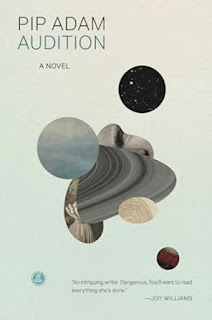
Pip Adam's AUDITION

I am thinking very hard for a moment but trying not to go quiet like we did the last time we tried to think very hard.
One of the sillier, yet rather profound, bits of The Hitchhikers Guide to the Galaxy concerns the Belcerebons of the planet Kakrafoon. Formerly a highly civilized and quiet race, their perceived smugness about their civilization annoyed the rest of the galaxy into afflicting them with the dread social disease of telepathy. Once so punished, in order not to broadcast their every stray thought to the rest of the world, Belcerebons had to keep up a constant stream of chatter, at the expense of all other activity. Their planet thus became a very noisy and inane place.

I mention this because a similar fate, though not under similar circumstances, has seemingly befallen the crew/passengers aboard the star ship Audition, a craft powered by sound. And while any sound would originally have done, these crew members soon have to resort solely to talking because, well, they're not on the Audition because of their superior skills or merits, but because they are afflicted by a freakish and continuous growth. This growth, which has resulted in our characters all having been about three times normal human size in every dimension at the time of the ship's departure from Earth, has left them, as Pip Adam's touching, inventive and at times weirdly theatrical novel, Audition, begins, confined to the three largest spaces on board ship, into which they now barely fit so they can't move anymore, can't make the sounds of footsteps or opening and closing doors or rustling fabric; the only sound they can make is by talking, calling out to one another by way of a continuous babble of conversation, which at first is just status reports on how their legs are losing circulation and maybe gonna die and fall off or how the big skylight on the basketball court where one is trapped is now just a keyhole relative to the size of their still-growing eye. When that runs out, they start trying to piece together how they got there, but are quickly thwarted by a big problem: they don't seem to remember anything from their pasts except that they had been launched into space because they were too big to stay on Earth.
They were the unwanted. That was clear to them, perhaps it had been from the start. They took up too much room.
Then we start to get a little more information about the crew members - Alba, Stanley and Drew - from the perspective of one of their earthside trainers in an extended flashback. The Giants, as they came to be called, have been herded to a big sports stadium in Europe to be trained for their special mission: they are to be sent in giant spaceships to explore and maybe colonize other parts of the galaxy. A joke is made that this will make room for 540 regular sized humans, as many jokes are made at the Giants' expense, for as they have grown, so have the distances that their nerve impulses must travel. Like the dinosaurs to which these poor people are often compared, they seem slow and stupid to the rest of us, and dangerous, and greedy for resources, and did I mention dangerous? People who are different are always dangerous, you guys. Even if they can't accidentally step on you and squash you like a grape.

But so before these Giants get launched into space, they must be "trained" -- really, conditioned, brainwashed even -- to follow patterns of behavior and belief set by the normal-sized humans (though, the Giants always tell us, they hate being called that), and to forget as much as possible their lives before the stadium they've been taught to call the "Classroom." Presumably this is so they don't develop resentments over how they were treated prior to the "launch 'em into space" solution was adopted, but also in general to make them more biddable. Thus all their prior habits of speech in the book's introduction begin to make sense as programmed responses. They've really done a beautiful job with the ship, you guys. The Classroom was beautiful, too. The teachers were so kind. The food was so delicious.

And so they all find themselves in space, unable to recall anything about their previous lives as ordinary human beings, compulsively responding to lights and sounds like trained monkeys and unable to hold on to the simplest thoughts once a behavioral trigger is activated. It's horrible to behold, even just in print, a real tragedy that seems inescapable even before they come up with a seemingly doomed idea: 
We thought if we broke the ship, we'd remember,' Drew says. 'That we'd get it back. Ourselves before the classrooms.' The ship settles again, suddenly, and the sound levels out. 'And we were wrong,' Alba says.
It's pretty much the most tragic observation I've seen made in speculative fiction, and remember, I've read stuff like The Sheep Look Up multiple times. But...

About 2/3 of the way through this gently strange and obscurely distressing book, Audition morphs into a kind of first contact story, and once if the best, in terms of conveying the truly alien, that I've encountered that was not written by Peter Watts. Because what our trio encounters at first adjusts them/itself into something in accord with Alba's and Stanley's and Drew's senses and understanding, accommodating them so beautifully they think they're maybe in Heaven, but then starts pulling them along to meet the new universe and awareness halfway in a very subtle and convincing manner:
Stanley and Drew are beside her and they’re under the tree where they spent the first night. It is changed. Some kind of autumn has come over it. Its branches reach the ground now and it’s a different colour. The sky around it has also turned. Everything is shifting from the pastels into much more saturated colours. The brightening has been happening, Alba now realises, gradually the whole time they’ve been there. But now it’s at a point where it affects everything. The whole world sings in the bath of the colour field that comes from the sky but the tree has definitely changed colour, it isn’t an effect of the sky. The three newcomers who aren’t that new anymore shade their eyes from the brightness but T.J., A.J. and R.J. look at them with open eyes, waiting for them to sit down. The locals are stiffer in their movements and possibly taller. They sit in a more anchored way than the first day they sat together. They are taking up a different space. Alba looks at Stanley and then at Drew and none of them have changed in the same way. No physical change has come over them at all. They are the same as when they first arrived. Which surprises her because her insides feel completely rearranged.

I can't say much more about this aspect of the novel without giving too much away, so I'll just take a moment to marvel at how it transforms the entire rest of the story, including some pretty distressing material that comes up once our trio manages to break their conditioning and remember how they knew each other before the Classroom, before they even became Giants. Audition isn't here to coddle us and our delicate little feelings (though it's not here to brutalize us, either), you guys.

What it is here for, is to ask us to ask ourselves how certain we are that the world has to be the way it is now, that people have to have the relationships that they have, that what we know now about the universe is all that we can know, and that we are right about what we think we do know. That's all a pretty big job for a novelist, but judging from this book, my first read from both author Pip Adams (and from her fascinatingly off-beat U.S. publisher, Coffee House Press, which, more from them very soon!), Pip Adam is up for the job.

I think I'm going to need to read this one again sometime soon.

Saturday, May 31, 2025

Antoine Volodine's RADIANT TERMINUS (Tr by Jeffrey Zuckerman)

Recently I indulged in a buddy read with my old pal, the Popqueenie, of one of my favorite Philip K. Dick novels, Dr. Bloodmoney, so that tale of post-nuclear-apocalypse and mutant psychic superpowers was very much on my mind as I settled into my second foray into the one-man genre of post-exoticism* that comes to us from the many-named author who invented it.

Radiant Terminus has cemented my interest in the work of Antoine Volodine/Manuela Draeger/Elli Kronauer/Lutz Bassman/Infernus Johannes. And damn it, I may have actually to learn French at some point because only some of his books have made it to English translation.

It's also very much an exploration of what life would have been like in post-nuclear Marin County in Dr. Bloodmoney if [REDACTED] hadn't [REDACTED] [REDACTED].** Except instead of the remains of luxurious and affluent northern California, we're in what's left of an old collective farm from the heyday of the world-encircling Second Soviet Union, and instead of the aftermath of a nuclear war, we have a world slowly devastated by Chernobyl-type accidents as the Second Soviet Union, under constant attack by pockets of fascists, slowly receded from its high water mark, leaving collective farm/village complexes like Radiant Terminus to fend for themselves without regular and competent maintenance of their neighborhood nuclear power plants. 
Oops!

We begin our story following the desperate retreat of a trio of survivors of the battle that lost the fictional territory of the Orbise. Slowly dying of radiation sickness and out of food and water, the three have one hope left: if the most able-bodied among them can make it to the next settlement and bring back some water and food.

Unfortunately for this barely-survivor, Kronauer (yes, one of the author's heteronyms), the next settlement is Radiant Terminus, where the nuclear plant has not only failed catastrophically but its core has completely melted down and later sank deep into the earth. The residents now use it as a sort of all-purpose garbage disposal, which they can only do thanks to the heroic efforts of "one of the most valiant figures of the second Soviet union, a legendary survivor, sagging under medals and highlighted in various enlightening stories," the Gramma Ugdal. The Gramma Ugdal, who is only ever referred to this way, has mutated into an immortal woman who cannot be harmed by radiation and thus has become famous for rushing in to help after countless nuclear accidents. Since this is so, she can safely handle contaminated carcasses, bits of furniture and farm equipment, whatever needs disposed of, and push it down into the melted-down core to its destruction. She has found, furthermore, a way to, at least partially, heal radiation damage in some others by the use of various altered waters. And that's not all. Sometimes she can bring them back from the dead. And if she can't with her waters, there's someone else around who probably can.

For the Gramma Ugdal is not the only immortal in Radiant Terminus! Her former husband from her long-ago (like 100 years long ago) youth, Solovyei, is also immortal and their reunion was unexpected and consequential, for he has powers even greater than hers*** for all that he has lived in obscurity where she became an international hero. But see, Solovyei is this novel's Hoppy Harrington, a figure of menace and bizarre psychic powers, who absolutely dominates Radiant Terminus and its environs by dominating the minds and bodies of its people. None of whom has the first idea of how to revolt against their god-king, all of whom have at least been led to believe that they literally owe him their lives, and many of whom are pretty sure that they only even exist because Solovyei has, Borges-like, dreamed them.

Solovyei also has a special hell set aside for any man dumb enough to involve himself, even in the most innocent way, with one of his three weirdly beautiful mutant daughters by "unknown mothers." Take poor Schulhoff, who legally married one of them and seemed genuinely to love her, but whom Solovyei has made to forget her utterly and roam the earth, as he explains upon meeting our veteran, Kronauer: 

Solovyei has made sure it will never pass. He makes me walk from forest to forest, from lake to lake, and when the absence of the woman I love seems a little less unbearable, when the loss makes me suffer a little less, he reintroduces himself in my head and he revives my urge to remember. He whistles in my head until I collapse. He keeps whistling, he sings his sorts of poems. It lasts for days and nights. I can't escape it. I can't die. I'm stuck within his clutches. Within his dreams. No death is available to me. I also wonder if maybe I'm actually inside one of his dreams. It won't pass and I can't escape.
Thus while we might have been expecting a tender reunion between the Gramma Ugdal and her Solovyei,  and a nice autumn twilight love story, what we get instead is a Twilight Zone episode. The one with Billy Mumy as a terrifying and omnipotent child. Except this time he's a gigantic full-grown man with yellow eyes and an axe in his belt and three beautiful mutant daughters and a conviction that no male human being ever born has ever meant anything but harm to the female of the species and must be punished for his bad intentions. And if a man Solovyei encounters actually doesn't have bad intentions towards those daughters, well, not only does Solovyei not believe it but he'll actually warp reality to make his preconceptions true. And then administer "appropriate" punishments.

Yikes.

So, half Hoppy Harrington and half Palmer Eldritch, let's say. Or maybe, the malevolent supercomputer I AM. And a little bit of Prostetnic Vogon Jeltz - Solovyei loves to inflict his poetry on the entire village via a loudspeaker system.

But come to think if it, what Solovyei reminds me of the most is Dr. Haber, the subtly-terrifying-until-he-abandons-subtlety villain of Ursula K. Leguin's The Lathe of Heaven, who parlays his hypnotic control and medical/psychiatric power imbalance over poor George Orr to dream his way to world domination. Like Haber, Solovyei appears to have swollen his physical dimensions to match his massive self-conception; the first thing everybody notices upon meeting him is that he is simply huge, with a big axe shoved through his belt for extra intimidation. It's a classic diversion on both characters' parts, minimizing their actual threat by distracting their victims with the display of a quite different one. Few are guarding against a psychic attack when the likelihood appears to be that the opponent is going to just step up and tear one to pieces with his bare hands.

For all this, though, what Radiant Terminus seems most concerned with is the impact of literature, of Volodine's imagined post-exotic canon, on the people who have read it. The literary star of this novel is one Maria Kwoll, a post-exotic feminist whom even Andrea Dworkin might consider extreme. Because one of Solovyei's daughters is the village librarian and grew up on Kwoll's works, she has made sure that nothing written is left to be read except those works and things like machinery repair manuals and agronomy pamphlets. The result is a village of people, not only utterly under Solovyei's control, but also under Kwoll's influence: to them, sex is inherently aggressive and gross, it's impossible for a male human to think about anything else anyway, and everything such a creature says or does is in "the cock's language."

Which means that yes, even Solovyei is a Kwollite. Kwollian?

There's another element of Radiant Terminus that I can't help but single or for praise: its inventiveness in dealing with the altered landscape of a world that has suffered a thousand nuclear accidents. Volodine conjures up a whole alternate herbarium for his world. It's as if he decided that the Voynich manuscript was an accurate rendering that had just come unstuck in time. We get to learn a bit about them through the character of Kronauer, whose wife was busy on a project to identify all the weird new flora before the fascists murdered her, and about whom he thinks as he mentally catalogs what he sees on his journey to Radiant Terminus: 
Molle-guillotes, malveinés, ashrangs, smallglory captives, willow benaises. Damsels-in-flight, masquerats, four-o’clock beauties, pituitaines, sweetbalers, or midnight Jeannes.****
Like I said, I might have to start working on my French, which I can already kind of parse because of years farting around with Portuguese, Latin and Spanish, just so I can explore the rest of Volodine et al's works set in this bizarre world.

I hope there are lots more Crones in it.

*My first being Manuela Draeger's Eleven Sooty Dreams, another book with a prominent and formidable grandmother-who-isn't-a-grandmother figure -- which I simply love. As for what "post-exoticism" is, it's a sort of Marvel Cinematic Universe but for a group of imaginary and revolutionary writers who form the cultural milieu of a worldwide Marxist-Leninist society, the Second Soviet Union, that was hugely successful and utopian until it wasn't. The post-exotic works of Volodine et al are now its autopsy in print, melancholy and lovely and weird as hell. So, you know, pretty close to being my ideal reading material.

**If you know, you know. If you don't, go read Dr. Bloodmoney.

***Oddly, this gives an author the best excuse ever to use an omniscient narrator, for Solovyei can read minds even at infinite distances in addition to his other uncanny abilities, as is made plain when, almost exactly halfway through the novel, he is revealed to be possessing a crow that has been following some of his banished citizens around. These passages are written in the first person omniscient, but most of the rest of the book is in a very traditional third, which seems like a missed opportunity to have one of the best bastard narrators of all time. Le sigh.

****Those "Jeannes" have a longer name, by the way; they are Jeanne-of-the-Communists. Volodine is nothing if not committed to the Second Soviet but.

Sunday, April 20, 2025

D.G. Compton's THE CONTINUOUS KATHERINE MORTENHOE, aka THE UNSLEEPING EYE

If there was one thing she hated, it was people who thought and talked of morning but their health.
We are reminded of this fact about the heroine of D.G. Compton's The Continuous Katherine Mortenhoe (originally published in the U.K. as The Unsleeping Eye, which I think is a better title for reasons I'll get to in a bit) many, many times as circumstances slowly and inexorably force her to become just such a person as she considers herself to hate. Plagued by vague symptoms for a few years -- while living in a world that has conquered illness and injury to such an extent that old age is the only thing that kills most people -- Katherine learns in the very first chapter that she, aged a mere 44 years, is that great rarity, someone who will die young. In four weeks, in fact. 

But The Continuous Katherine Mortenhoe (I really do prefer the other title, but this is how it's more generally known, especially since NYRB published the edition that I read, with the above cover and an insightful-as-always introduction by Weird Fiction Connoisseur Jeff Vandermeer) is not merely about a dying woman and how she chooses to spend the time she has left. That would be a fine read on its own, but it's probably not something I would choose, even with the added angle that this novel has, that Katherine is, in our modern parlance, a generator of A.I. Slop -- she cranks out romance novels to order at terrific speed by entering numerically coded prompts into a computer, which then spits out the text. The result is then published under several different pen names based on sub-genre rubrics, market trends and existing fan base expectations. Cough.*

This novel was originally published in 1974.

But no, it is neither our heroine's terminal status nor her so-of-the-moment-it-hurts profession that drew me in to this work. For in addition to experiencing her sudden and unexpected twilight with a loving and compassionate husband, Harry, by her side, Katherine Mortinhoe is, basically, The Truman Show. Except instead of living in a giant domed TV studio populated with actors in on the secret, Katherine's intimate agonies and kinder moments are being documented by a single camera. Well, two cameras. 

Implanted in the eyes of a journalist who is stalking her and her husband.

Without their consent. 

Yeah.

Beautiful Katherine Mortenhoe and her beautiful husband make a beautiful couple doing beautiful things in a beautiful world, while she prepares beautifully to die. It's also beautiful..

The story of a dying woman navigating her last days in a society unused to death being anything but a dramatic accident that kills too soon for medical intervention (as we get to see, a bit graphically, at one point) or what discreetly awaits the end of a long life, that would be a fine novel to read, but that really isn't this novel. And this is why the original title, The Unsleeping Eye, is better. Because this book is as much about Roddie, the "Man with the TV Eyes" as it is about Katherine, and it is also, to a lesser degree, about the hungry attention of that "pain-starved public," though not as much so as I'd expected. 

See, since Roddie just had the cameras implanted in his head (it's left ambiguous whether they have fully replaced his eyes as cybernetic prostheses or have just been grafted onto and into them) his body and the "TV Eyes" are still integrating, and for the time being he cannot spend any time with them closed, nor in darkness. He literally is the unsleeping eye. "Weren't the latest sleep deprivation drugs amazing?"

But Katherine, too, has unsleeping eyes of a kind, except when her condition makes her lose consciousness for a while. But, very aware that she's only been given a month to live, she's very, very conscious of time passing and lying in bed at home is both a waste and, due to her society's sense of entitlement to her as a spectacle, not really an option. Other unsleeping eyes want to witness.

I was expecting a lot more from this perspective, that of the television audience, but apart from the way a few people react on meeting Katherine, either with her husband or with Roddie, in person is pretty much the sum of what we get. We are just meant to understand that the public is always watching, always waiting, tapping their feet impatiently and glancing at the clock, eager for their daily dose of vicarious misery. No, D.G. Compton did not anticipate the demise of appointment television. But we all know how I feel about evaluating science fiction based on the accuracy of its predictions, don't we?
The thing is, beauty isn't in the eye of the beholder. Neither is compassion, or love, or even common human decency. They're not of the eye, but of the Mind behind the eye. I had seen, my mind had seen, Katherine Mortenhoe with love. Had seen beauty. But my eyes had simply seen Katherine Mortinhoe. Had seen Katherine Mortinhoe. period.
Well, of course Roddie develops a certain affection for his subject, which she almost seems to return -- platonically, platonically; she is married and Roddie is still very emotionally, if not domestically, involved with his ex-wife and their child. But friendship, respect, appreciation and, yes, compassion. His TV eyes are still what is actually seeing Katherine, but it's his mind, still very much his own no matter into how much hock he has gone to his employees for his body, who is observing her. And starting to feel a certain kind of a way about what he is in the process, simply by being around her, of doing to her.

Two other really fascinating aspects of this terrific little novel are worth touching on here. One is the seriousness with which personal privacy is taken in its world; upon realizing just how much her experience is in danger of becoming public property, Katherine goes to the authorities and gets a "three day personal grief" certification, which takes the form of a badge she can wear and a sticker she can put on the threshold of her apartment. Universally, this badge and sticker are respected by members of the public and the press, even as the latter scheme to get around the letter of the law behind the emblems. But for the three days its in effect, Katherine and her husband can invoke "PG" and everybody back off, even the most intrepid of paparazzi. To read about this in our own year 2025, in which we cheerfully and thoughtlessly violate our own privacy dozens, if not hundreds of times a day, for no reward but clout and maybe a hint of fellow feeling, is quite an experience. One might almost envy Katherine and her co-nationals.

The other notable thing is the disease which is curtailing Katherine's life. It's given a fancy syndrome name I can't recall any longer (or look up because it was a library book for which others were waiting), but what it boils down to is a severe and fast-acting neuro-degenerative condition caused by the overwhelming input of too much information by too many means into a simple human brain that evolved to work with good old Dunbar's Number of people and information sources and experiences and means of communication. As a person whose entire career has been spent manipulating information with computers to a degree unusual for her society, she's one of only a handful of people who have ever manifested with the full-blown syndrome, making her a profound medical curiosity as well as a social one. Suddenly, her situation doesn't seem so enviable, does it?

Or as improbable? Except, of course, we still live in a world where health care is only sometimes successful in staving off death, unfairly rationed, etc., etc.

But so, a question: would it be a worthwhile trade off to have people wandering around with TV Eyes who can record and broadcast our every move and utterance to the world without our knowledge or consent, in exchange for universal healthcare and longevity for most?

Oops, I see what I did there. Ha.

*Because this novel was written back when the basic assumption about our culture was that we would always have standards for our art, even our machine-assisted art, she spends more time editing and proofreading the computer's output than she does on the prompts. Ah, me...

Tuesday, February 11, 2025

Robert L. Forward's DRAGON'S EGG (Narr by Todd McLaren)

One of the extra and unintended joys of reading vintage/older science fiction (in the case of Dragon's Egg, physicist Robert L. Forward's fiction debut, dating to 1980) is, when one sees a particularly egregious forecasting error on the part of the only kind of author whom the reading public routinely expects to predict the future, imagining what would have to have happened, to have always been true, for one of a novel's more noticeable conceits to be plausible. 

In the case of Dragon's Egg, for instance, the Soviet Union and the Cold War are both still very much real and unignorable facts in its fictional 2020 -- but that's not the interesting thing to think about really, at all, at least as far as this novel is concerned: the Iron Curtain is treated as a throwaway bit of background noise in the idle thoughts of a character and that's pretty much that. 

But what is interesting to think about in terms of this novel and how it differs from our reality is its assumption that the early economic and, possibly, physical realities of how digital computing power is allocated, used and accounted for would have continued to very much resemble how such matters were understood and employed in the earliest days of electronic computing. 

In Forward's 2020, we can't be sure that computers haven't gotten much smaller than the enormous room fillers of the 1960s and 70s, but it is a fact integral to the earliest developments of Dragon's Egg's plot that computer time is expensive and thus must be rigidly controlled and accounted for, to the degree where, as we first come to meet our first point of view character, Jacqueline, the completion of her doctoral thesis research is suddenly threatened by the international currency markets! Her advisor is Russian and his work is funded by his government, his lab's computer time paid for in rubles. If the value of the ruble suddenly plummets, its purchasing power does, too, and so the amount of computer time budgeted for a given piece of research shrinks unless a fresh infusion of rubles is diverted toward that resource.

We can smile indulgently at this notion, of course, treat it as a quaint aspect of a novel written just before most of us had ever heard of Moore's Law, but is it really that goofy? We consider computing power to have gotten cheaper, but I suspect that most of us who think that don't consider much beyond the cost of the materials that make up the machines. As chips got smaller, they required less stuff to manufacture, so of course they got cheaper, but did they? How many rare earth elements went into the IBM behemoths from the punch cards days versus the nosy little snoop machine broadcasting all of your data from your pocket? And what are the environmental costs of acquiring the materials in such a manner as to keep them cheap? How many workers in the supply chain are barely making a living wage? To say nothing of the energy consumed in mining, manufacturing, shipping, marketing and then finally running your jeejahs?*

What if Forward's alternate 2020 is just as technologically sophisticated as ours but is more upfront and honest about the tech's actual cost and makes everybody involved actually pay their fair share to employ it? Then it's not so very inaccurate about the actual 21st century as we might have first assumed, eh? See, this is way more fun than just pointing and laughing at how William Gibson didn't anticipate cell phones or whatever.

But now I'm way out in the weeds as far as this novel is concerned, which is not about economics or social justice or the evolution of the tech sector, but about an exceptionally cool and fairly uncommon idea or set of ideas about what space aliens might actually be like!
Spoiler: they're really, really not like us, and they're really, really not that easy to think about. We're in Greg "Clockwork Rocket" Egan and Neal "Anathem" Stephenson and Peter "Blindsight" Watts territory, here. As in hard science fiction, but hard science fiction that is a lot more than "we're going to throw orbital mechanics or fuel calculations or subatomic particle physics at you for a few hundred pages so you don't notice that it's really just cowboys and injuns in spaaaaaace."

Not that there's anything wrong with that. 

Anyway, Jacqueline's work employs a space probe that is humanity's first to travel orthogonal to the elliptic of our solar system, meaning that, if we regard the sun and its planets and other rocks and clots of stuff as all on one flat plane, as we do, this is our first probe that has gone up "above" it to examine it from the new angles that position affords. The Sun presents a whole new face to us when viewed from there, for instance. 
While Jacqueline is looking, not so much at images as at the kind of massive streams of raw data that NASA and Co. use to generate those (simulated and cosmetically enhanced) images, she has found some weird distortions in the numbers. And, because she is brilliant (but also pretty, slim, young and French), she manages to commandeer the probe to take a closer look and maybe determine what's really going on up/out there. 

And before you can say Big Ben, Jacqueline and her new friend/admirer Donald have found that there's a pulsar plowing through our neighborhood!

But wait, there's more!

Honestly, I can understand where a lot of readers would be all but tapping their feet and checking their phones with increasing frequency through these early chapters, but I would have been perfectly happy with this stuff as the whole novel. I am a scientific washout as a person, having flamed out in grad school because I kept getting distracted by various opportunities to learn new languages (which should have been my course of study in graduate school, but was not), but I still absolutely love the kind of minutiae of discovery described here, the process of applying reason and precedent and new intuition to the interpretation of the massive dumps of indirect data that we use to make up for the vast inadequacies of our own evolved kluges we call our senses. Like, we can't see, for instance, X-rays, but we can cobble together machinery that measures them anyway and work from the numbers that generates to concoct an approximation of what it would be like if we could see them, and then monitor changes in that approximation and extrapolate from that more about the nature of other things we can't "see" and build up a considerable body of pretty good information about the rest of the world we can't directly perceive. And from that we can sometimes manipulate these unseen things into doing work for us or answering questions like "Is this lady's collarbone broken?" or "Does that star that is so far away from us that we're actually only seeing what it looked like thousands of years ago, have some planets orbiting it? Planets like ours?"

I mean, come on!

Interconnected between the chapters detailing the discovery of the pulsar and, as the novel's time frame races ahead, the arrival of a crewed spaceship in orbit around the pulsar waiting for robots to build the infrastructure that will allow the crew (including a son of Jacqueline's named Pierre) to explore its mysteries, are chapters that give us glimpses of another community. At first they seem very like us and to inhabit a world like ours, as a point of view character tries to catch a swift. It's only after we've enjoyed a few moments of failed swift-catching efforts that we discover that the swift is not a pretty little bird flying around, and that our new character has a body even less like ours than the swift's is like a specimen of  Apus apus! We're not in Kansas anymore; our guy has many more eyes than you or I do, and has a much more protean body. Oho!

As more chapters unfold, we watch this other population develop culturally through the discovery of things like agriculture, and mathematics and optics, and begin to cultivate a much more sophisticated understanding of their world and how it works, through processes of investigation and discovery that are as enjoyable to observe as Jacqueline's and Donald's have been. Forward shows here a talent for speculative biology, sociology and, yes, physics that I would compare to many better known writers.

Here I'm going to digress again, because while I'm never one to scream about spoilers and would remind my readers once again that this here blog carries a "ware spoilers" up there in its header, but man, this novel would have been even more fun if the jacket copy didn't give away the nature of this other community, so that I didn't know in advance how these two narratives actually fit together. I would love to have been surprised by the answer, so I'm not going to spoil it for you, either. And if this post has already made you think about grabbing a copy of this to enjoy, I'd urge you to do your best to avoid the blurbs and marketing copy so that you can enjoy the discovery the way that I think Forward actually intended you to. I mean, it's still great anyway, but file this story's secrets under "would have been more fun to uncover alongside the characters instead of just getting to watch them figure out what we already know." Le sigh.

And now, excuse me. There is a sequel to this called Starquake, but it appears to be out of print, or at least not yet published in digital form. But hey, I've been looking for an excuse to visit my local used paperback store again anyway!

*By the way, though, even this point about allocating scarce resources vis a vis scientific research isn't necessarily all that retro-anachronistic, because Jacqueline's work doesn't just require computational power but also employs one of six existing-in-her-universe X-Ray telescopes. I'm sure that, even in that age which Forward depicts as even less interested in astronomical observation and study than our actual 2020s are, there are probably lots of graduate student types and senior scientists, too, jockeying for telescope time, just as they are in our world.