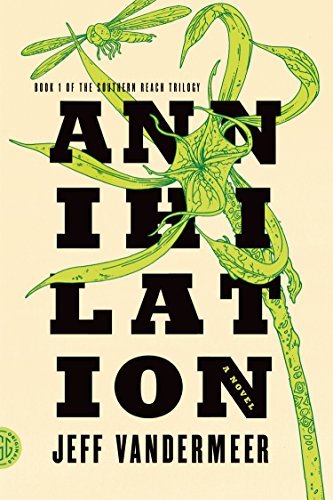
It's proven impossible for me to regard the Southern Reach trilogy (Annihilation, Authority and Acceptance) as anything but an inversion of the Strugatsky Brothers' Roadside Picnic and, by extension, Andrei Tarkovsky's Stalker.
Both story worlds feature a section of territory that has been mysteriously alienated from the rest of the planet, reverting to an appearance of pristine nature while also becoming a place where the laws of that nature as we know them do not necessarily apply. As I detailed in a prior post, in Strugatsky's, the area seems to have been created by careless accident and its interaction with the rest of the world is based mostly on people sneaking into it and retrieving objects with strange properties, some useful, some harmful, and some unfathomable, for scientific research or for profit. Paramilitary authorities exist that seek to curtail this trade in Alien Crap but aren't terribly successful. A scientific bureaucracy exists to try to unravel the area's mysteries and origin (the Roadside Picnic metaphor being only one of many theories about the place), but it's mostly just reverse-engineering Alien Crap or otherwise trying to find practical human applications for it.
As I dove into Annihilation, I was quick to conclude that the Southern Reach, which is a scientific bureaucracy with strong ties to both the military and intelligence services, was basically the Strugatsky's Institute and that I would be getting it's side of the story to counter-balance the Strugatsky focus on ordinary schmoes trying to make a living off the Zone.
But then I realized there are important differences. The Zone in Vandermeer seems to have an intent, for one. Something or someone deliberately caused it. And while much human effort is made keeping the riffraff out of it, the Zone does a pretty good job of it all by itself. There is only one way in, though there might be many ways out. And while people sneak into Strugatsky land and bring stuff out, the Vandermeer Zone sends stuff out on its own accord, for its own mysterious reasons, by its own unknowable ways. A lot of the time the stuff it sends out is people, or seems to be. As in sometimes members of the official expeditions come back, but not through the entrance, and they're physically, medically and psychologically altered. Maybe it's not really them. Maybe it's copies of them, sent back to perform particular functions, with the expedition members' identities as camouflage.
What the Zone intends is never really made clear, nor are many theories put forward by the Southern Reach, for all its thrity-some years of study. But to read these books as whodunnits or whydunnits seems to me a mistake; these are works of speculative phenomenology, more interested in the people trying to figure it all out and what their efforts do to their lives, than in the Truth.
Each of the three books concerns itself with different people, though there is considerable overlap. A biologist we only come to know as Ghost Bird (her husband's nickname for her) tells us first-hand (sort of) of her adventures on what turns out to be the very last Expedition into the Zone, in the company of a Psychologist whom we learn in the next book is actually the Director of the Southern Reach. They find a "tunnel" that Ghost Bird insists on thinking of as a "tower" that has simply been sunken into the ground. The Anomaly is its official term in Southern Reach-speak, and its inhabited by, among other things, a long and discursive, vaguely sermon-esque stream of consciousness written on the walls in letters picked out by living masses of plant and fungal material, material which periodically dusts visitors in a pollen that is more than pollen, and begins to colonize those visitors and transform them for the Zone's purposes. There is also a Creature, but it's so central to the trilogy and yet so unfathomable that I can't even find words to talk about it right now.

Then there's, apparently, nobody's favorite of the trilogy, Authority, which concerns itself with the guy chosen to take over as Director of the Southern Reach after the last Director disappeared on the expedition in Annihilation. Trained from childhood to think of himself as, and to ask others to call him, Control, this new Director has his work cut out for him. Nobody's cleaned up after the last Director, physically (her office is a cluttered mess full of weird stuff) or bureaucratically (her assistant director is none too pleased to find someone else got the job she thought would naturally fall to her), and then there's his own weird background to contend with, as he's a third generation public servant in that special cloak-and-dagger way, but it's his mother who was the apogee; he's just some schlub who gets by on being her son. Authority largely concerns itself with bureaucratic struggles as Control tries to find out what really happened to his predecessor, what his job is really supposed to be, and what the Southern Reach, long in decline, underfunded and raided periodically for talent, is actually for. A lot of people found this book unbearable, but I wound up liking it quite a bit. Even more than Annihilation, it felt like one of those maddening early computer games like Myst, long on mystery but, in my experience, short on solution (I sucked at Myst and have never finished it, yo). The Biologist, or something strongly resembling her, makes an appearance, as a subject Control must question endlessly but fruitlessly for explanations as to how she survived, how she got out of the Zone, and why she was found just sort of aimlessly hanging out in a nearby vacant lot. She becomes his obsession, even as he comes to realize that she's actually just some kind of copy of the person who went with the last expedition (partially in pursuit of her own answers about what happened to her husband, who "returned" from a previous expedition as an imperfect copy of himself that died of cancer, just like all the other returnees from his group).

The final novel, Acceptance, divides its narrative into three pieces, in three different time frames. Control and, eventually, the Biologist, in the overall narrative's "present" meet up in the aftermath of the last novel's climax, which involved, among other things, the Zone overflowing its previous boundaries behind the triumphant striding return of a copy of the Director who has become larger than life in more ways than one, and decide to follow a weird pathway back into the Zone the Biologist literally coughs up into the ocean and see what they can discover there, now that the Zone might well be everywhere.
In other narratives, the Director's own story, including her childhood in the exact region that became the Zone and later career with the Southern Reach (under an assumed identity because we're all pretty sure they wouldn't let an actual native of the Zone head up Zone studies because who knows how those people have been affected), unfolds in the middle-past, and a figurant from the first novel, the Lighthouse Keeper, becomes a proper character as his story unfolds in the more distant past. And yes, the Director knew the Keeper when she was a little girl and he was a man in his late middle-age. He went on to become the Creature in the Anomaly, once the Zone became the Zone; she was removed from the area by external circumstances just days before it happened, and always wondered what happened to her friend the Keeper.
We meet the Biologist again, the original one, unmistakeable but irrevocably altered (and freaky), and we get some answers, but not all of them, about what's been going on with this place all these years. I'm still making up my mind about whether or not I'm satisfied with it all, but I did read the trilogy straight through, non-stop, and that says something about its quality. I'll probably return to it again after I've seen the first movie. Stay tuned.


