Saturday, April 15, 2023

Andrus Kivirähk's THE MAN WHO SPOKE SNAKISH (Tr Christopher Moseley, Narr Aaron Landon)

I first learned about Andrus Kivirähk via the film adaptation of his novel November, which introduced the world to perhaps the greatest folk horror monster ever, the kratt, a wholly unique monster that starts out life as a pile of junk before animating it via a few drops of blood dedicated to, of course, the devil. Once animated, a kratt will help you with your farm chores and whatnot, but you have to keep it busy or else it will turn on you. In the movie, and so I presume, the novel, one kidnaps a calf and flies it through the air forming with it cinema's very first cowlicopter! Plus, there are werewolves! 

Alas, as of this writing, that novel of his does not appear to have been translated into English yet. But the film is occasionally streaming and was popular enough here that your local public library might have it on DVD, as mine did. So until the book is rendered in English (or you learn Estonian) this will have to do. But wait!

Another of Kivirähk's novels, The Man Who Spoke Snakish is so beloved in the author's home country of Estonia that it has been adapted into a board game there, and has been translated into many languages including English! And it's even available as an audio book, decently performed by new-to-me narrator Aaron Landon, who has a voice in the higher range that isn't the most delightful to hear in straight up narration but Landon did a wonderful job on the many characters' voices, many of whom aren't even human so I'm still pleased with and gladly recommend the audio edition.

Set in medieval Estonia right around the time that land is becoming Christian and adapting its culture along the lines of the rest of Europe, The Man Who Spoke Snakish is chiefly a novel of culture clashes. Our title character and narrator, Leemet, has been raised among a handful of hunter-gatherer forest people, where he fed on a diet of  roast venison, wolf's milk and owl's eggs and listened to stories of his mother and the bear that was her lover (prefiguring Leemet's sister Salma's own relationship with and eventual marriage to another bear) until accidentally killing Leemet's father the day daddy caught them in flagrante. The bear, Leemet learns, was a gentle soul and so regretted killing Leemet's father that it castrated itself and vowed never to see Leemet's mother again. 

And we're off!

We quickly learn that Leemet's people are unusual for much more interesting reasons than their diet or habit of, err, bear-loving; some are still staunchly clinging to a very strict and proscribing paganism centered around "sprites," which beings demand a lot of sacrifices at all times and have very short tempers; others have focused on maintaining a fascinating and useful tradition: the language called "Snakish." A reasonably fluent speaker of the language can, of course, befriend snakes, as Leemet quickly does, acquiring a charismatic and practically-minded adder named Ints for a best friend, but what most of Leemet's people seem to use it for nowadays is to command animals. They summon deer to lie down and allow themselves to be mercifully and humanely killed for meat and hides; they keep herds of wolves in barns like cows and tell them when to sleep and when to meekly allow themselves to be milked and when to allow humans to ride them like horses for their sylvan wars, though those wars are nearly as much a thing of the past as is the Frog of the North, a giant flying amphibian who protects the forest people but who can only be summoned by a large number of fluent Snakish speakers calling it down in unison. Nearly, but not completely; we do get a bit of wolf-riding in The Man Who Spoke Snakish, but it's only one swift element in one of the novel's most exciting and action-packed and anguished scenes.

Meanwhile, "progress" has happened to most of the rest of Estonia. Most of the region's people live in villages, have converted to Christianity (though maybe not as sincerely as the colonizing knights and monks might wish; most of them treat it more like a matter of fashion than of faith), and speak German. And they are very, very keen on proselytizing to the forest people and trying to shame them into moving out of the forest and into the villages, giving up their weird diets and freewheeling ways for lives sowing, tending and harvesting grain, making it into bread, and eating that instead of owl's eggs and wolves' milk. And of course, obeying the foreign monks and soldiers ("Iron Men" as the locals call them) who have subjugated everybody else.

While Leemet is still a boy learning his first Snakish words, he meets a village girl named Magdelena and through her comes into contact with her father, Johannes, the village elder, who barely lets the Lemeet and the boy he was exploring with get a word in edgewise before he's commanding them to go tell their parents that they must move into the village and be christened with new, biblical names and give up their culture altogether, really. Cowed, Leemet kind of agrees but doesn't wind up actually obeying; he'd much rather hang out with his uncle, the greatest still-living speaker of Snakish, who sees in Leemet perhaps the last person who will carry his people's traditions into the future -- even though, because Leemet's father once fell under the sway of village life and wanted to eat bread, Leemet was actually born in the village, and is thus shunned as a village person by about half of the dwindling population of the forest.

He soon comes to have more unusual companions, befriending a pair of local "primates" -- possibly some last remnants of the Neanderthals or Homo Erectus? -- who treasure other animals, especially lice, which they have carefully bred until they have one as big as a child. It loves to go for walks and to go swimming in a nearby lake, becoming a new source of friction among the forest people. 

The giant louse also loves Leemet's childhood tagalong, Hia, a plain and meek little girl whose parents are the most ardent remaining devotees of the sprite cult and force her to behave at all times as a paragon of forest virtue, toiling to exhaustion every day to butcher all the meat needed to feed the hundreds of wolves her family keeps in a gigantic barn, and being force-fed wolf milk even though she can't digest it. The scenes between this giant louse and Hia are some of the most charming in a book that is long on charm -- but also on violence. 

The violence in this book is mostly at least indirectly Leemet's fault; his fascination with the villagers brings his world into more direct conflict with theirs as he discovers to his horror that all the former forest people now living there have not only forgotten Snakish but regard snakes as servants of Satan and mostly refuse to believe that Leemet himself is not a werewolf preying on their pitiful flock of sheep. 

Leemet spends most of the story trapped between orthodoxies and struggling to be left in non-observant peace. The villagers (save one) harangue him to give up his wicked "pagan" ways while the hard core forest people maintain he'll never be good enough for them, either, no, not even when he emerges as the last living human who can speak Snakish. And just when he thinks he's found a way to settle down in happiness with a sweet wife and his snake friends, both orthodoxies attack, demonstrating that his choices will never be respected. 

How Leemet reacts to being doubly hemmed in and to gradually losing everything he cares about may shock some readers, who find themselves rooting for a pair (a long-lost ancestor shows up late in the book and quickly starts stealing every scene he's in!) of violent anti-zealots bent on avenging their losses on the whole rest of the world. It's a strange feeling to be cheering on a gory rampage with a high body count, but Kivirähk has fashioned his tale and portrayed his hero well; by the time the rampage begins we understand completely the feelings behind every blow struck, quixotic though they all are. 

If nothing else, we come away with one important lesson: don't fuck around with Estonians. You never know who might have a pair of venomous fangs concealed in their smile, ready to bite anyone who corners them. Have some respect. 

Friday, April 14, 2023

T. Kingfisher's A HOUSE WITH GOOD BONES

I come to the work of Ursula Vernon, aka T. Kingfisher, in somewhat backwards fashion. I knew her first as the "Wombat Test Subject" on her husband Kevin Sonney's podcast, Productivity Alchemy, on which show I've fallen way behind because I've pretty much given up on productivity but still occasionally enjoy, mostly for the stories of the couple's pets and livestock and Vernon's description of her writing and illustrating processes. She is a woman of considerable gifts and a singular speaking voice and is beloved of most of the people whose opinions on books matter to me, so got filed as "an author I know I'll like and I've got to try sometime" but that guarantee of quality somehow perversely reduces the urgency of sampling an author's work. See also Leonora Carrington, on whom I slept for years. 

Anyway then Vernon, writing here as Kingfisher, wrote a southern gothic novel A House with Good Bones, in which the heroine is not only an entomologist but an archaeological entomologist. Zoinks!

So of course I knew there'd be tension between the habits of skepticism and demanding evidence that are so deeply ingrained in most fictional (if not always in actual) scientists and whatever supernatural forces were supplying the horror; I was not ready for Kingfisher's very successful attempt to import the elements of gothic horror into a story set in a tract house built in the 1990s.

Our heroine, Sam, has had to leave her latest excavation while some human remains found there are investigated, so she decides to go visit her mother,  Edie, still living in the house Sam grew up in with Edie, Sam's older brother, Brad and, for a while, Edie's viciously unpleasant grandmother, whom Sam always called Grand Mae. Mae originally owned the house and ruled it with an iron hand and a shedful of garden tools for maniacally tending her flawless rose garden, demanding of her progeny an adherence to the impossible standards of 1950s TV family perfection that no actual humans ever achieved. After Mae's death, Edie made the house a bit more interesting and comfortable, with brightly colored paint on the walls and actually interesting art that didn't depict things like Confederate weddings hanging from them. 

So imagine Sam's surprise when she discovers her grandmother's nasty taste again dominating the house, and the kind of detail only someone like Sam would notice: a complete lack of invertebrate life in the rose garden.

Oh, and a local vulture -- as in the actual bird, not an epithet for a nasty neighbor, though there's one of them, too -- hanging out on top of the mailbox. Often more than one. 

The family secrets that emerge are straight out of the Women with Great Hair Escaping Castles playbook but don't feel forced into this very contemporary story; Kingfisher developed just the right background to explain the creepiness without having to resort to badly relocated Native American burial grounds or any of that foma, and in Sam and Edie gave us a delightful mother and daughter dynamic to enjoy while their world disintegrates around them. Even more delightfully, one of the vultures, named Hermes by his hedge-witchy keeper Gail, an older woman who worked in wildlife rehabilitation while she was Mae's much-disliked hippie neighbor but now lives the retired life of an herbalist with her last patient. Gail is pretty excellent, too, but Hermes' bizarre charisma always steals her thunder even before he earns his weird halo. Rounding out the duo is hunky, handy Phil, the grandson of the nasty neighbor who works as Edie's handyman and while there might be some romantic sparks between him and Sam, Kingfisher adds these with a light hand that never allows them to distract us from the thorny peril her characters are in.

So I'd recommend A House with Good Bones to anyone, but perhaps especially to the fans of John Bellairs; A House with Good Bones felt very much like a Lewis Barnavelt book for grown-ups -- though conversely, there's no reason, apart from occasional swearing, why a precocious kid fan of Bellairs wouldn't enjoy the hell out of this book. I could have used more insects, though. But we all know I'm rarely satisfied in that department. I'm glad that I got what I did, though, while on this wild ride of a story. Go get it!

Tuesday, April 11, 2023

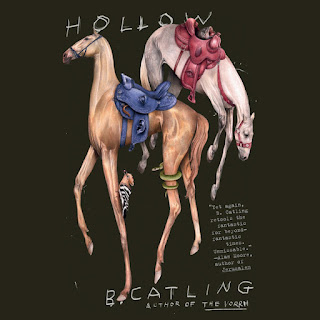
Brian Catling's HOLLOW (Narr Jonathan Keeble)

I keenly regret our loss last year of Brian Catling, primarily a visual artist and sculptor -- he even contributed a monument to the displays at the Tower of London -- he also turned his hand to writing the kind of deeply strange, even expressionist, weird fiction that I like best in all the world. His Vorrh Trilogy, especially in audio form as narrated by Allan Corduner, is very likely my favorite series of the 21st century so far. He didn't write a whole lot more, though. I should just be grateful that he wrote at all; he might have been perfectly content to keep on making grotesque cyclops masks to model for photographs and called it good. At least he wrote one of his cyclops into print.

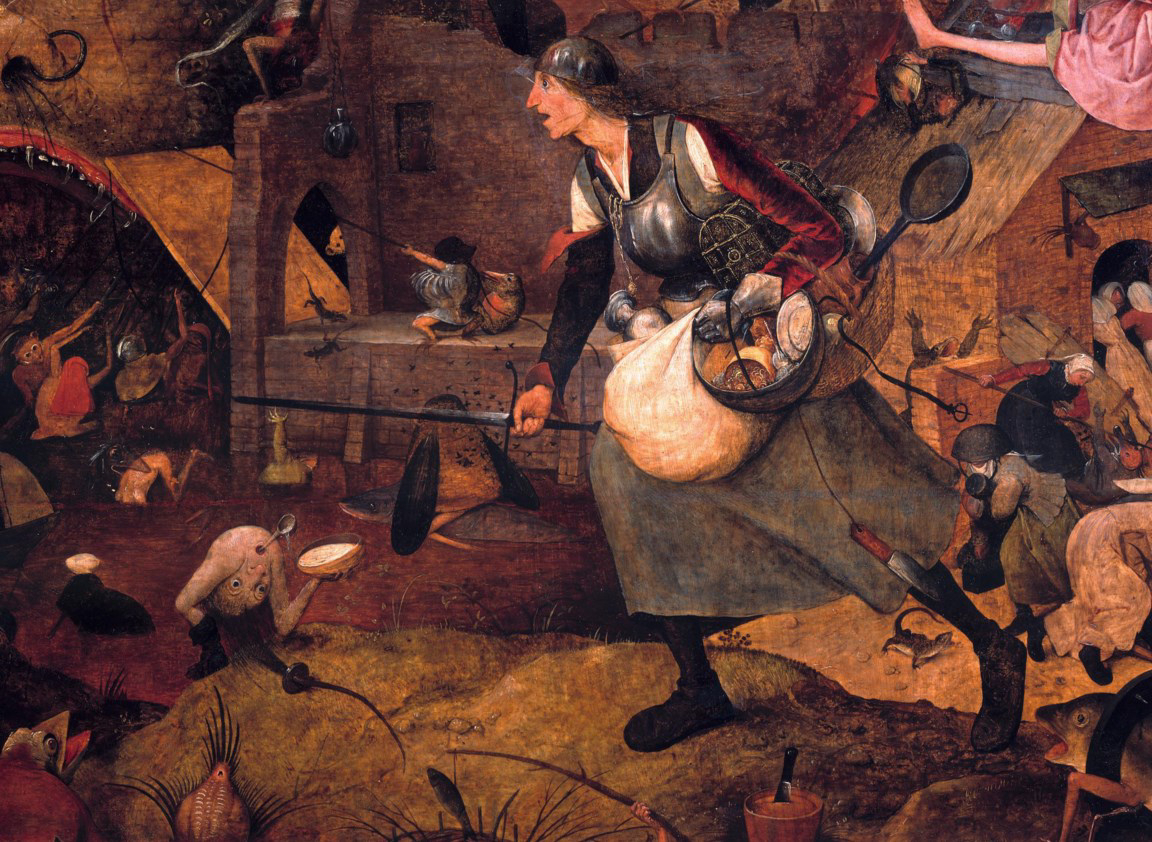
In his stand-alone novel Hollow his background in the visual arts is one again very much on display, but this time instead of an impression of Eden in Africa, he's chosen to invent a story for which the paintings of Pieter Breugel the Elder and Hieronymus Bosch might serve as illustrations - or, say, he's written back stories for the beings that populate those images. 

It's even cooler than it sounds. Which is mighty good, incidentally; narrator Jonathan Keeber is very much in the vein of Allan Corduner, or Simon Vance or John Lee, but doesn't quite hit their very high mark, mainly due to his tendency to make too many of the novel's inhuman or demihuman characters, and one monk with a sligt speech impediment, sound like Gollum with a bunch of juicy sweet fish in his mouth. I had to listen to those bits of dialogue multiple times to parse out what was being said, which is troublesome indeed when one such character is the very oracle whose utterings feel very much like the key to the story. Mercifully, there is not a lot of this in the book, and Keeber's reading of it is otherwise exceptional.

But so, what's Hollow all about then?

The action this time is set in Europe and concerns a motley D&D gang of murder hobos on a mission to deliver an Oracle to a weird monastery that may have been built on the ruins of the Tower of Babel.* Said Oracle is small and greyish in color, with atrophied limbs and unsettling aspect -- and, as the murder hobos discover to their cost, has an unsettling talent for ventriloquism, used to disturbing and deadly effect on a few occasions during their journey.

I could not help but imagine this Oracle and the one it's to replace as something like good old Dalek Caan from Doctor Who, also a weird and atrophied thing with weird prophetic powers and a creepy voice. Your mileage may vary.

Anyway, while the murder hobos escort this Oracle, two brothers from the monastery that is their destination embark on a journey of their own, to find out the source of some weird creatures that have been turning up in their neighborhood.

Interwoven with the tales of these journeys are some bizarre and creepy goings-on at the monastery, and also the account of how one of my favorite characters in western painting, Dulle Griet, aka Mad Meg, evolves from a humble and much-abused wife and mother, living in the village that supports the weird monastery, into the avenging proto-feminist virago that Bruegel immortalized as leading a band of women to attack Hell. In Catling's account of this evolution, she has a best friend who gets burned as a witch, a dumb failson, and a worthless and abusive husband, so it is with relied that we watch as she befriends all of the strange creatures who share the Bruegel canvas with her,  further endearing her to me. I loved Mad Meg long before I read this book, but this book made me love her even more.

As for the Oracle, as I said, it is an ill-defined creature (possibly related to the Erstwhile of the Vorrh?) whose natural habitat is a tightly enclosed place. The first of its kind (for there are more than one) that we meet has been walled up in the monastery, where a small community of monks devotedly study its weird and gnomic emanations until, under suspicious circumstances, it disappears and dies. Or does it?  At any rate, another is sent for, hence the escort mission, but meanwhile the original may be haunting the place, sort of? Anyway, weird things start happening but they don't seem quite as weird as they are against the backdrop of this monastery, which contains a walled-off battlefield of some five square miles in which the zombie-ish dead and the tormented living engage in perpetual warfare against one another.

Meg, on the other hand, has mostly mundane problems to deal with, until suddenly she, too, encounters the "Woebegot" aka "Filthlings" - bizarre little creatures with human and animal characteristics turning up all over the place and annoying those they don't just outright frighten. They are, of course, figures from Bruegel and Bosch, and when they start talking to Meg in their confused polyglot way it is impossible not to imagine them as Monty Python-esque animations. Eventually they become, as I said, something like friends to Meg and become along with her my favorite figures in the story, at times intensely comic (such as the account of how three of them came to be named Bleagh, Garrett and Eueuw, whom Meg accidentally "summons" when an unrelated incident causes her to make these noises!), at others uncanny and disturbing. What do they even want? What can they even do?

We're mostly supposed to care about the escort mission, though,  and it is also bizarrely entertaining as the mercenaries are picked off one by one (one of them is killed off right at the beginning of the first chapter by the party's leader for reasons that seem arbitrary and disproportionate for a long time until they're sort of explained) and encounter strange things like a menacing but ultimately helpful giant in their travels with their strange dependant. Whom they must feed every night. By taking turns confessing their worst sins into a bag of bones. So that their confessions enrich the marrow. Which is then fed by spoonfuls, like so much baby food, to the Oracle.

I love Brian Catling.

So much.

The mechanism by which the murder hobos must feed the Oracle gives us a chance to get to know them at a satisfying and deep level as they dredge up their most horrific personal anecdotes, like one man who was used by a bunch of nuns as angel bait and later winds up eating said angel (he can't compare it to chicken nuggets though, since those are hundreds of years in the future).

All of these narrative threads come together in the end just in time for Fat Tuesday, celebrated in proper batshit fashion in Meg's village, in bizarre and bloody fashion, with some highly entertaining violence, some grotesque comeuppance, and the entry of at least one character into perhaps the worst kind of eternity that doesn't actually involve devils and pitchforks and lakes of fire. The ending chapters especially reward close attention, as characters keep appearing from weird perspectives as their storylines intersect and the Woebegots finally fulfill what I guess is their purpose? But maybe it's just a side benefit of fulfilling their true purpose?

I'm going to have to read this one again sometime soon. What hardship!

*Which, that tower sure has been turning up in a lot of my reading lately. 

Monday, April 10, 2023

Kathleen McLaughlin's BLOOD MONEY: THE STORY OF LIFE, DEATH AND PROFIT INSIDE AMERICA'S BLOOD INDUSTRY

"We've built an entire segment of global medicine upon the certainty that a certain number of Americans simply can't live on a regular income alone." - Kathleen McLaughlin in Blood Money

I've had just enough good fortune in my life to have been the kind of person who could hear a phrase like "plasma economy" and think it was some of that charming combination of actual scientific terminology and gobbledygook that we call "technobabble" or more specifically "Treknobabble" - in which the meaning of "plasma" concerns a superheated state of matter used to make things go pew-pew-pew on a starship. Had I gone to a public university instead of the groovy private college that gave me a huge scholarship because it wanted more geographic diversity in its student body, I might have found out about the exchange of human plasma -- as in that straw colored fluid that separates out from red and white blood cells when blood goes through a centrifuge -- for money a lot sooner than I did. And, to be honest, coming from a vastly different socioeconomic background from my classmates at my swanky private college as I did, I might have been tempted into that industry back then too. Concert tickets, beer money, spontaneous train rides into The City to go shopping or clubbing or to the opera -- the cost of these things meant nothing to most of my peers but I had to think long and hard before saying yes to opportunities. Had my college been located in a less privileged area, where a plasma "donation" center might actually be located, well, I might have said yes a lot more often than I did, and never mind that I might have been too fatigued to properly enjoy it.

I've donated buckets of whole blood over the years, hitting the one gallon club too long ago to remember, and I was a regular platelet donor, too, once a random test of my donated whole blood revealed that I had never been exposed to a common virus that is very dangerous to premature babies and cancer patients, meaning my platelets were safe to give such patients in a way that most other people's weren't. I kept on donating platelets until I had to go on a medication that meant I couldn't donate anymore and felt horrible about it. But, only dimly aware via, of all things, a college guide by Lisa "Preppy Handbook" Birnbach that some folks out in the world sold their plasma for beer money, I never thought of selling my plasma.*

Like I said, I was fortunate. And really dumb with a credit card, but it could have been worse. But anyway, I only learned what the true, real-world meaning of the "plasma economy" was this year, when Kathleen McLaughlin made the political podcast rounds promoting her latest book.

As I learned when I read Blood Money: The Story of Life, Death and Profit Inside America's Blood Industry, the plasma economy was only really becoming a thing over in China while I was learning Chinese at my private college in the late 80s and early 90s. China built plasma donation centers all over its poorest regions like the province of Henan, and persuaded its poorest citizens that it was safe and altruistic and patriotic and slightly profitable to roll up a sleeve and let an already-big-but-not-yet-quite-global industry treat them like lodes of metal in a gold mine (plasma gets described as "liquid gold" a lot in this book). Only it wasn't quite as safe as advertised; cutting corners to meet demand and save costs led to unsanitary practices like reusing needles and tubing or not sterilizing phoresis machines... just in time for the HIV/AIDS crisis (which China ignored about as assiduously as the U.S.A. did for as long as possible/until some heroic women whom McLaughlin profiles called out the problem and were exiled for their pains) to kill or permanently impair countless citizens for (shortened) life and ruin China's blood supply for years and years to come.

Fortunately for the global trade in human plasma, which is made into a whole host of long-known and newly-developed pharmaceutical products that are pretty much all insanely expensive by the time they're administered to patients whose mobility, functionality, even lives depend on them, the same ghoul who retarded the U.S.A.'s response -- even acknowledgement -- of the HIV/AIDS crisis had also so accelerated our country's descent into gross economic inequality that conditions were perfect to start up a bigger, better, badder version of the plasma economy right here.

The trick, the industry had learned by the time a building boom of plasma centers started in earnest here, was not to rely on the seriously destitute/homeless, who among other things are less likely to be healthy enough to provide the staggering volumes of body parts the industry needs to satisfy global demand for the stuff (because only a tiny handful of countries allow this trade). But the people who are just a paycheck or a family crisis away from being that undesirably desperate can and have been incentivized not only into selling their plasma on the regular but also selling it as often as they possibly can, by paying them enough to supplement the kind of shitty jobs that in addition to not paying a living wage also tend not to allow workers to hit that magic 40 hours a week that would  qualify them to receive shitty health insurance and helpless 401k exposure to the stock market they offer instead of pensions -- but not paying plasma sellers enough for the supplementary income they get to actually help them beyond a tank of gas or sack of groceries or Christmas gifts for the kids.

And speaking of how most countries have prohibited this trade, you won't believe where another huge pool of donors comes from. Hint: that flow stopped abruptly when COVID-19 closed our land borders for a while, and still hasn't really recovered since a follow-up debacle in which Homeland Security suddenly decided that crossing into the U.S. to sell body parts counted as labor and violated the terms under which most plasma sellers were permitted to come in for a day. 

And speaking of COVID-19, I couldn't stop wondering as I read: given that the people whose veins are tapped the most to meet the global demand for plasma are the same people who were hardest hit and mostly likely to have died from the virus before they even had the chance for cynical and manipulative blowhards to persuade them not to get the vaccine, to the tune of some 800,000+ souls lost forever, how many plasma sellers did we lose to COVID-19? And did their habits of selling their valuable plasma for pittances twice a week increase their susceptibility to dying of COVID-19 if they caught it? We might never know, because even before the pandemic, nobody seemed interested in studying the long-term effects on plasma sellers of the practice. There's too much money at stake for gigantic multinational corporations and too little concern for the human motherlode they mine, very few of whose members are treating Senators or Supreme Court Justices to lavish yachting vacations if you know what I mean.

Adding to the inherent (and aggravating) interest of her subject is McLaughlin's own connection to the plasma economy: she suffers from a rare autoimmune condition that leaves her dependent on regular infusions of an insanely expensive medication made from human plasma. Several times a year, the combined plasma of dozens, if not hundreds or maybe even thousands (it's kind of hard to know because the industry isn't exactly bragging about this in prime time) of people is slowly infused into her body over the course of five boring hours at a high but fluctuating cost to her medical insurance provider and to McLaughlin herself. A journalist with a history of covering things like what HIV/AIDS did to China (and herself living in China on and off over many years), it was surely inevitable that she would come to write a book like this, and from a compelling personal perspective. 

It also gave her a conversational inroads with the many plasma sellers she interviewed in places like Rexberg, ID, Flint, MI and El Paso, TX that few journalists could match. Her combination of gratitude and ever increasing discomfort with the whole subject color every line. 

And, as we demand more and more from nosy journalists who call attention to problems we've been happy to go on ignoring, McLaughlin has given considerable thought to what we might, as a civilization and as a nation, do to make this system less exploitative and safer. Compensate plasma sellers fairly and on a consistent basis. Do basic research on how frequent extraction of this fundamental body part affects the short- and long-term health of the extractees. And, of course, restore the social safety net so people don't get trapped in this system in the first place. 

Blood Money is a captivating and infuriating read, despite its tendency to repeat points and even whole sentences - like pretty much every other major non-fiction book in this age of publishing consolidation, this text could have used a bit more attention from an editor or two, but of course that would cut into the bottom line and, who knows, the poor overworked editor now having to do the equivalent of five people's jobs might also have been a little weak and exhausted from a lunch hour passed in a crappy recliner with a fat needle stuck in the crook of her arm, sucking out her blood and forcing an anticoagulant into her vein. 

I learned a lot and was made to think a lot about a system I've only been dimly aware of, out of what seems more and more like plain old luck. I might yet find myself in the position of the people McLaughlin interviewed, though given my own personal constellation of obnoxious health issues, if our society ever reaches the point where it's depending on the plasma of people like me, we're pretty much screwed all the way.

Here's hoping...

*There have been times when I was in desperate enough financial straits to have done it, but such times have only ever come upon me when I lived and worked (on a salary basis for pay that I learned years later would have qualified me for food stamps and Medicaid even though I had the words "executive" and "director" in my job title) in regions too isolated and remote to participate in the plasma economy; any money I'd have been paid would have just burned up in the gas tank of my shitty car driving some 300+ miles round trip to be tapped.

Sunday, April 9, 2023

Becky Chambers' A PSALM FOR THE WILD-BUILT

Ok, this is probably a sad thing to admit, a commentary on the books I've chosen over the years, as much as it is on the quality of the book at hand, but I don't think I've been as charmed by a novel since I first discovered Nathan Lowell's Solar Clipper series or the work of Walter Moers. Becky Chambers' first Robot and Monk book, A Psalm for the Wild-Built, is a delightful portrait of the kind of future I want and with its dual main characters and the gently hopeful plot they enact, an endlessly engaging read. 
It's just so short, though!

Leave 'em wanting more, the adage goes. And I do want more!

There's something almost cruel, though, in the experience of reading books like this; they show us how perfectly reasonable is the near-utopia they depict, show us all the nice things we could have if enough of us would just do a little bit of work towards trying to make our  world less shitty for more people, but every interruption or sound on the street or twinge in our bodies reminds us of all of the ridiculous and ridiculously powerful forces are pulling in the opposite direction, trying to make the world more shitty for more people all because their imaginary sky daddy or philosophy-that's-more-important-than-actual-people or just shitty personalities (or all three, in the case of who I now insist we have to stop calling The Former Guy and instead refer to as The Indicted Guy. Plus, the abbreviation, TIG rhymes with a word that also describes him) insist that change for the better is Bad and will lead to Oppression of the Minority that has been Oppressing all the Other Minorities for Centuries. Which would apparently be Unjust in a way that all the other oppression has not been?

Anyway. Psalm for the Wild-Built shows us a terraformed (or possibly already life-supporting?) moon orbiting a gas giant, originally settled by human beings who brought advanced robot technology with them when they came but whose robots achieved self awareness -- and the humans who settled this moon were humane humans who understood it was wrong to enslave thinking and feeling beings even if they're ones we created, and gave the robots their liberty. The robots then withdrew completely from human society and went off into the wilderness to explore and witness and enjoy without harming. Meanwhile the humans the robots left behind adapted their culture into a solarpunk utopia, but it's not just the energy and technology they developed and continue to employ that are utopian, but they've developed an easy-going polytheistic religion that doesn't proscribe or prescribe but just functions as a way of understanding the experience of being alive and appreciating the world and each other.

Our point of view character, a non-binary human named Dex, has served in a monastic order within this religion (purely by choice; no economic or social pressures affected their choice, either!) in the capacity of a novice but has, as our story opens, chosen to become only the most delightful religious vocation that has been thought of in the history of ever, a Tea Monk. Whose vocation is to travel the moon by means of a heavy-duty bicycle and camper-trailer combo, stopping at each human settlement and setting up a shrine, not at which to pay or offer sacrifice or take instruction, but at which to set down in a pretty setting among a few choice nice things that have some devotional significance but aren't especially valuable -- they're there to be nice things, not to inspire awe or envy -- and have a cup of tea, provided by the Tea Monk, after he/she/they have greeted you, determined your general physical/emotional state, and decided what blend of botanicals to infuse into a brew that will taste good to you and help you feel better. Once served with a nice cup of tea, you can then relax and enjoy it in silence, make idle chitchat, or pour your heart out to the Tea Monk as you see fit.

A good Tea Monk -- and Dex grows to become one of the best if not the best -- travels on a nearly completely self-sufficient basis thanks to the wonder of modern water filtration/food preservation/hygiene/life-support/comfort technology embodied in the trailer/bicycle rig, but is often offered a nice hot meal or a soak in a devotee's big bathtub or local hot springs or a roll in the hay, etc as thanks for how well he/she/they apply their vocation. Dex has enjoyed this life for a long time, but feels that something is missing and develops a yen to travel off the beaten path a while, into the untouched wilderness that exists off the actual beaten paths between settlements Dex has traveled these years.

Within a patch of actually wild nature, Dex encounters a being no one has in centuries -- a robot! And we learn that the robots, too, have developed a very easy-going and appreciative culture of their own. For instance, their naming convention has drifted far from the alpha-numeric designations of their forebears who wandered out of the Factories so long ago; now when a new robot comes to awareness, it takes its name from the first thing it observes. So this robot is named Splendid Speckled Mosscap, Mosscap for short, after the mushroom that it first saw the day it came to be. And boy, is Mosscap a wonderful character!

Mosscap has a unique mission for which it volunteered; to renew contact with humanity and find out "what humanity needs." Dex persuades Mosscap that it will need to consult someone besides Dex to answer this question; Mosscap in turn persuades Dex to let it accompany them on its travels, to help Dex along and keep them safe. And thus is formed a beautiful and delightfully weird friendship despite a certain degree of mutual unintelligibility.
You're an animal, Sibling Dex. And animals have no purpose. Nothing has a purpose. The world simply is. If you want to do things that are meaningful to others, fine! Good! So do it!... You keep asking why your work is not enough, and I don't know how to answer that, because it is enough to exist in the world and marvel at it. You don't need to justify that, or earn it. You are allowed to just live.

Mosscap's wisdom is the wisdom that built both the robots' and the humans' societies, only most individuals don't immediately seem to recognize it. Will Dex come truly to understand and embrace this, or will they continue to frustratedly wander the moon seeking this thing called "a purpose"? Or will Dex get eaten by a bear before Mosscap can rescue them?

I'm pretty freaking glad the sequel is already available. I just have to wait for a few dozen library patrons who requested it first to finish it. Meanwhile, it's just wonderful to know that books like this are (still) a thing, and I'll be checking out Becky Chambers' other series... as soon as I get my turn on those, too. The fact that in Wyoming, which to judge by our voting records is mostly full of the kind of people who claim not to want the kind of world that Solarpunk/Hopepunk exists to imagine, so many people are waiting to get a hit of what Chambers is slinging is as comforting as the books themselves.

Ahh!

Now, wait'll you get a load of the non-fiction I've been reading that this was a break from. 

Saturday, April 8, 2023

Guido Morselli's DISSIPATIO H.G.: The Vanishing (Tr Fredericka Randall)

In the room I visited at the Mayr there was the usual supply of tranquilizers on the night table. I pocketed them. Not because I suffer from insomnia; I had another idea. I feel I have a duty to symbolically resow (yes, resow) the species, following Deucalion. He used stones that grew into human beings. With those meprobamate pills, I hope to propagate a calmer, less quarrelsome breed (compared to the extinct). I thought I might plant them on the Bellevue tennis courts where I watched the Davis Cup’s European zone matches. They ought to produce handsome people, like tennis champions, and like them, inclined toward fair play.
Guido Morselli's last and posthumously published novel, Dissipatio H.G.: The Vanishing is not your typical post-apocalyptic romp. We have no fights over resources, attacks by rival gangs, deadly games of hide-and-seek with the forces that destroyed human civilization. In Dissipatio H.G. (the "H.G." in the title refers, essentially, to the entire Homo genus in scientific nomenclature), the enemy has only ever been internal. Indeed, the story starts with a suicide attempt.

On the eve of his 40th birthday, an unnamed narrator I'm going to call Solo because I'm sick of writing "unnamed narrator" and permutations thereof, resolves to end his life by jumping into a cold underground Alpine lake to drown, but can't quite bring himself to do so and falls asleep on the shore. On the following morning, he wakes, a bit disgusted with himself, and heads back for his home in a tiny Alpine town, only to find that not only is nobody home at his house, but also anywhere in his neighborhood, his town, the neighboring city of Chrysopolis where he works at a newspaper, possibly the entire world, as he eventually and methodically determines by checking out the international airport to which flights no longer arrive and from which none depart. There aren't even the piles of clothing some Christian fundamentalists maintain will be the only traces of the righteous who will be Raptured up just before the End of the World.

But the world as a whole seems to be doing quite all right, except for the livestock, pets and houseplants languishing in otherwise empty human dwellings.

Solo being both a solipcist and a misanthrope -- the kind of guy who refers to Christmas cards as "the annual extortion of greetings" -- he feels fine, building a mocking memorial to the human race out of some abandoned cars and mannequins in downtown Chrysopolis, catching and milking the odd newly wild goat, raiding the well-stocked pantry and refrigerators of a grand hotel* but occasionally smashing a shop window to steal some fruit. "Anarchy and monarchy coexist, now and in me," Solo observes -- or maybe gloats? But he's not quite the gloating kind. "No one possesses me; I possess all."

Solo's last human interaction appears to have been when he passed by an old church's ossuary on his way to his not-suicide. He translated a sign painted over its gate for a tourist: "They were as you and you will be as they are." An interesting parting scene for Solo and the humanity he finds reprehensible for its polluting ways, its materialism, its dullness.

When he returns to the ossuary later, he finds that the human skulls it used to contain have all disappeared as well, which lead this reader to start wondering about cemeteries and columbariums and whatnot but Solo has no fucks to give on this topic so I was left wondering. I got used to it.

It's not through any will to learn, any efforts at playing detective, that Solo starts forming a notion of what occurred while he was up at the lake not ending it all. He just sort of notices things. No cars are clogging the streets or highways to indicate any effort at escape, for instance, and even the beds in the houses he explores still look almost like they're being slept in; the covers are disturbed but not pulled back as they would be by someone getting out of bed. People just disappeared, "vaporized" as Solo calls it, and that was that. 

He finds a journal entry though, penned by a cook in the hotel at almost exactly the stroke of midnight on the night of the disappearance, that suggests that at least some people knew this event was coming and were kind of looking forward to it. Solo being something of a (former) public intellectual type, he's more interested in musing about Freud and the death instinct and other matters philosophical than in the phenomenon the cook's note reveals, though, and soon he's back to his own personal pursuit: observing nature as it starts encroaching in and reclaiming the territory humanity thought was ours, starting with the mold in the cheese in the hotel restaurant and moving on to animals and birds starting to nest in abandoned houses in the city he has always hated. 

Mercifully this novel is quite short. I say mercifully not because the experience of reading it is in any way any more unpleasant than any other post-apocalyptic yarn, nor because Solo is a particularly unpleasant character, but more because it is, in its way, even bleaker than what most of us consider the bleakest entry in the genre, good old Cormac McCarthy's good old The Road.

I have one more book to finish from Radtezky March, though that month is over, and then I think I'm going to go back to free-range reading. The geographic theme was interesting for a while but I've gotten quite a few ARCs and whatnot that I want to get to that won't fit any such. It was a fun idea but I'll not run it into the ground, for all that I already had an Anatolian April half-planned. The Turkish novel I most want to read hasn't even been published in English yet, after all!

*The electricity and phones remain on for the whole story, as many theorists even back then -- the novel was written in 1973, not long before, incidentally, Morselli himself succeeded where Solo failed -- had posited it might, for a while.


Saturday, April 1, 2023

Miha Mazzini's THE COLLECTOR OF NAMES (Tr Maja Visenjak-Limon)

After what I saw in the cellar I often thought about God. For some time, that was all I thought about. This is how it is, I think. The only time we’re in contact with him is when we sleep. And dreams are our defences, our earthiness, trying to lead us away from Him. If we fight them and break through them we come into contact with Him. That’s what we call a nightmare. The more horrible the nightmare, the closer to Him we are. And that’s why in our everyday life it doesn’t matter whether you believe in God or not: but when your life starts becoming a nightmare that belief is the only thing that can save you. There are no decisions when you’re in contact with God. There’s no free will. And that’s what makes the nightmare so horrible. Things happen to you. Horror is the prayer of our time.
What could be more idyllic than a few months' stay on a relatively unpopulated and undiscovered Mediterranean island in the summer between your school years and the start of your adult life? Plenty if you're a teenaged character in Miha Mazzini's cosmic chiller, The Collector of Names, which explores the experiences of a passel of teen boys who've been given the keys to a newly-acquired but still pretty much abandoned villa on one end of the island, and a girl who's come to have her first taste of independence while staying with her great uncle on the other end, where a quaint village braces for the influx of tourists that are about to start pouring in now that a campsite has been established in the island's interior and word has gotten out about it.

Ana's great uncle, Aco, grew up on the island and was the first to encounter its weird and terrifying secret, which manifested in his childhood only as a weird green glow coming from the cellar of the villa when it was newly built and the home of a diplomat's subcontinental Indian widow. Aco took a dare to go check it out as part of his initiation into a gang of older boys who were themselves too afraid of, in particular, the hue of green that shined out of the basement window. He emerged from his encounter with his hair turned completely white, but we don't get to find out what he saw until much later. 

Cut to decades later when Ana has come to visit, and four teenaged boys re-open the villa with the weird secret in its cellar: Max, the son of the villa's new owner and a self-imagined lady-killer and the first to strike up a conversation with Ana on the ferry to the island; strong and fit Sano; less assured farm kid Alfonz; and poor, skinny, clumsy Raf, who is really only along because Max felt he owed Raf a good time after copying off his schoolwork for years and years. They've come for a little while to get good and drunk, having brought rucksacks full of homemade schnapps and cleaned out the entire beer and brandy stock of the village's only store-cum-bar, but since the villa has no refrigerator and the ocean tides on the nearby beach are too strong to use seawater as a cooler, the boys decide to use the spooky cellar to keep their drinks cold -- only to discover a weird crate full of a plastic-like substance that is warm to the touch, and a bunch of tiny stalagtites of what turn out to be some kind of amber, each one containing the letters spelling out somebody's name. All kinds of names, from the commonplace to the exotic and foreign. And there are a LOT.

By the time one of the boys has a direct encounter with the... entity in the cellar, it's too late. 
Some truly gruesome scenes ensue, and some truly touching ones as well. The monster from the cellar affects everyone differently with its simple tactics, but as its victims meet or approach their ends, their unique emotional wounds are reopened as we experience their madness from the inside. The Collector of Names could have just been an entertaining gore-fest, but Mazzini isn't interested in writing a literary slasher film; he wants us to feel what everybody's feeling rather than just pointing and laughing at their deaths.

Livening things up still further is Aco's childhood gang, all of whom grew up to serve in the same military unit, with Aco emerging as the leader with the moral authority he gained when his hair went prematurely white. They have maintained a certain military discipline together over the years, for all that it looks like, to the teenagers arriving on the island, they just sit together on a bench every day and codge (that's what a codger does, right? Codges? Anyway, these guys codge). In other words, under Aco's direction, they've been planning for the day when whatever is in that cellar emerges. Were their preparations effective? Only one way to find out, friends. It's a tight, short read. Go and get it!