Sunday, April 20, 2025

D.G. Compton's THE CONTINUOUS KATHERINE MORTENHOE, aka THE UNSLEEPING EYE

If there was one thing she hated, it was people who thought and talked of morning but their health.
We are reminded of this fact about the heroine of D.G. Compton's The Continuous Katherine Mortenhoe (originally published in the U.K. as The Unsleeping Eye, which I think is a better title for reasons I'll get to in a bit) many, many times as circumstances slowly and inexorably force her to become just such a person as she considers herself to hate. Plagued by vague symptoms for a few years -- while living in a world that has conquered illness and injury to such an extent that old age is the only thing that kills most people -- Katherine learns in the very first chapter that she, aged a mere 44 years, is that great rarity, someone who will die young. In four weeks, in fact. 

But The Continuous Katherine Mortenhoe (I really do prefer the other title, but this is how it's more generally known, especially since NYRB published the edition that I read, with the above cover and an insightful-as-always introduction by Weird Fiction Connoisseur Jeff Vandermeer) is not merely about a dying woman and how she chooses to spend the time she has left. That would be a fine read on its own, but it's probably not something I would choose, even with the added angle that this novel has, that Katherine is, in our modern parlance, a generator of A.I. Slop -- she cranks out romance novels to order at terrific speed by entering numerically coded prompts into a computer, which then spits out the text. The result is then published under several different pen names based on sub-genre rubrics, market trends and existing fan base expectations. Cough.*

This novel was originally published in 1974.

But no, it is neither our heroine's terminal status nor her so-of-the-moment-it-hurts profession that drew me in to this work. For in addition to experiencing her sudden and unexpected twilight with a loving and compassionate husband, Harry, by her side, Katherine Mortinhoe is, basically, The Truman Show. Except instead of living in a giant domed TV studio populated with actors in on the secret, Katherine's intimate agonies and kinder moments are being documented by a single camera. Well, two cameras. 

Implanted in the eyes of a journalist who is stalking her and her husband.

Without their consent. 

Yeah.

Beautiful Katherine Mortenhoe and her beautiful husband make a beautiful couple doing beautiful things in a beautiful world, while she prepares beautifully to die. It's also beautiful..

The story of a dying woman navigating her last days in a society unused to death being anything but a dramatic accident that kills too soon for medical intervention (as we get to see, a bit graphically, at one point) or what discreetly awaits the end of a long life, that would be a fine novel to read, but that really isn't this novel. And this is why the original title, The Unsleeping Eye, is better. Because this book is as much about Roddie, the "Man with the TV Eyes" as it is about Katherine, and it is also, to a lesser degree, about the hungry attention of that "pain-starved public," though not as much so as I'd expected. 

See, since Roddie just had the cameras implanted in his head (it's left ambiguous whether they have fully replaced his eyes as cybernetic prostheses or have just been grafted onto and into them) his body and the "TV Eyes" are still integrating, and for the time being he cannot spend any time with them closed, nor in darkness. He literally is the unsleeping eye. "Weren't the latest sleep deprivation drugs amazing?"

But Katherine, too, has unsleeping eyes of a kind, except when her condition makes her lose consciousness for a while. But, very aware that she's only been given a month to live, she's very, very conscious of time passing and lying in bed at home is both a waste and, due to her society's sense of entitlement to her as a spectacle, not really an option. Other unsleeping eyes want to witness.

I was expecting a lot more from this perspective, that of the television audience, but apart from the way a few people react on meeting Katherine, either with her husband or with Roddie, in person is pretty much the sum of what we get. We are just meant to understand that the public is always watching, always waiting, tapping their feet impatiently and glancing at the clock, eager for their daily dose of vicarious misery. No, D.G. Compton did not anticipate the demise of appointment television. But we all know how I feel about evaluating science fiction based on the accuracy of its predictions, don't we?
The thing is, beauty isn't in the eye of the beholder. Neither is compassion, or love, or even common human decency. They're not of the eye, but of the Mind behind the eye. I had seen, my mind had seen, Katherine Mortenhoe with love. Had seen beauty. But my eyes had simply seen Katherine Mortinhoe. Had seen Katherine Mortinhoe. period.
Well, of course Roddie develops a certain affection for his subject, which she almost seems to return -- platonically, platonically; she is married and Roddie is still very emotionally, if not domestically, involved with his ex-wife and their child. But friendship, respect, appreciation and, yes, compassion. His TV eyes are still what is actually seeing Katherine, but it's his mind, still very much his own no matter into how much hock he has gone to his employees for his body, who is observing her. And starting to feel a certain kind of a way about what he is in the process, simply by being around her, of doing to her.

Two other really fascinating aspects of this terrific little novel are worth touching on here. One is the seriousness with which personal privacy is taken in its world; upon realizing just how much her experience is in danger of becoming public property, Katherine goes to the authorities and gets a "three day personal grief" certification, which takes the form of a badge she can wear and a sticker she can put on the threshold of her apartment. Universally, this badge and sticker are respected by members of the public and the press, even as the latter scheme to get around the letter of the law behind the emblems. But for the three days its in effect, Katherine and her husband can invoke "PG" and everybody back off, even the most intrepid of paparazzi. To read about this in our own year 2025, in which we cheerfully and thoughtlessly violate our own privacy dozens, if not hundreds of times a day, for no reward but clout and maybe a hint of fellow feeling, is quite an experience. One might almost envy Katherine and her co-nationals.

The other notable thing is the disease which is curtailing Katherine's life. It's given a fancy syndrome name I can't recall any longer (or look up because it was a library book for which others were waiting), but what it boils down to is a severe and fast-acting neuro-degenerative condition caused by the overwhelming input of too much information by too many means into a simple human brain that evolved to work with good old Dunbar's Number of people and information sources and experiences and means of communication. As a person whose entire career has been spent manipulating information with computers to a degree unusual for her society, she's one of only a handful of people who have ever manifested with the full-blown syndrome, making her a profound medical curiosity as well as a social one. Suddenly, her situation doesn't seem so enviable, does it?

Or as improbable? Except, of course, we still live in a world where health care is only sometimes successful in staving off death, unfairly rationed, etc., etc.

But so, a question: would it be a worthwhile trade off to have people wandering around with TV Eyes who can record and broadcast our every move and utterance to the world without our knowledge or consent, in exchange for universal healthcare and longevity for most?

Oops, I see what I did there. Ha.

*Because this novel was written back when the basic assumption about our culture was that we would always have standards for our art, even our machine-assisted art, she spends more time editing and proofreading the computer's output than she does on the prompts. Ah, me...

Wednesday, April 16, 2025

Solvej Balle's ON THE CALCULATION OF VOLUME, VOLUME ONE (Tr by Barbara Haveland, Narr by Elizabeth Liang)

I have discovered something uncanny. Or at least, it is not something that I have discovered, because I already knew it, but I have discovered that it is uncanny. It's a problem that I cannot solve. There are ghosts and monsters. Thomas is the ghost, and I am the monster.

Back when I could still play video games on a console with a controller, despite the fact that my hands and arms worked perfectly well, even brilliantly (I had a triple digit typing speed with a very low error rate, a skill with which I have earned a better living than any other, to my eventual downfall), I really sucked at them. A great failure at combos, a great button masher in combat, a great repeat wanderer of labyrinthine game maps, and a greater misser of clues was I. Which meant I spent a lot of time playing scenes over and over again so as not to die, so as to pick up the object I'd missed last time that I can't progress without, so as to finally finish the fucking driving level.*

And now someone has captured exactly that experience in a prose novel. Which, quite unexpectedly, does not suck nearly as much as starting all over again for the hundredth, two hundredth, who knows how many hundredth time at the beginning of a level does. Though it tries.

I first learned about the internationally acclaimed On the Calculation of Volume, Volume One, from my dear old booksnobbing pal SJ, she of the dodisharkicorn, who was all but jumping up and down and screaming at me to read this the second she finished it. There are not many people I allow to to this to me, by the way, but when Sarajean says something is good, I add it to the TBR, and when she goes bananas like Eric Cartman at Casa Bonita about something, I prioritize it. And when that thing then goes on to make not only the long but the short list for the International Booker Prize, I know I've got to hurry up and get it before every single Booktuber I follow wrings it dry for content. Even if I have a strong feeling that I've all but read it already as it is. Which, ha ha ha...

But so, why am I talking about repeating video game levels in a post about a critically lauded novel? Because it's a novel of repetition, of course; it's everybody's favorite repetition story, Groundhog Day, or, if you're a real nerd, the Stargate SG-1 episode "Window of Opportunity."

Our heroine, whose name I've already forgotten but can't be arsed to look up and anyway it was a library book with a long waiting list, runs a very specialized antiquarian book dealership with her husband, Thomas, out of their home, and either makes enough money from this to live very comfortably in rural France, or one or both of them brought their own money. I strongly suspect the latter because she mentions that her husband inherited their cozy cottage and has never lived anywhere else. So already this is a super relatable protagonist here and, spoiler alert, I don't much care for her because she's also very boring. But anyway...

As what passes for events start unfolding, she is on a business trip to Paris and has had a pleasantly successful visit, finding several books that fit her very specific rubric and reconnecting with an old friend who runs a beautiful Parisian antiques shop with his brand shiny new girlfriend with whom we at first are led to think there might be some conflict but no, everything is lovely and they have a perfect evening with the exception of a small mishap that leaves our heroine with a slightly burned hand that will become a touchstone through what follows. Touchburn, I guess?

The next morning, she discovers that she is living the exact same day over again. She is not herself compelled to repeat the previous day's actions but everything else around her happens exactly as it did the day before. She spends a few days in Paris trying to test out just how faithfully the rest of the world is repeating itself before deciding to head home and see if her husband can help her figure all this out.

The next chunk of the novel finds her growing increasingly frustrated with her situation and her husband, who never flat out disbelieves her or treats her like she's crazy (again, no conflict is allowed), and does try to help her, but has to have everything explained to him every single day, when he wakes up (mostly) pleasantly surprised to find her home a day early. And she starts to understand that not only is he not going to be much help, but that they are drifting farther and farther apart even as they share meals and make plans and have sex; from her perspective, time is moving forward and she is keeping track of how many times she has repeated this same date (November 18) and sometime during the night he forgets everything they've said and done. From his, it's just another day with his nice wife in his nice life and tomorrow will be another (that she might never see?) one. If this persists for a long enough time, the reader realizes, though she never verbalizes this, she will age while he will not, she will change and he'll stay the same. 

Tara. Her name is Tara. Yes.

Much is made in reviews of this series, which will eventually comprise seven volumes, of how sad and tragic this is, and Solvej Balle her translator, Barbara Haveland, and the almost farcically even keeled narrator, Elizabeth Liang, convey this simply and beautifully, even as our heroine retreats physically from her coexistence with this "ghost" of her husband, moving herself into their guest room and, having long ago memorized her husband's path through his day well enough to predict it, minute by minute, avoiding him altogether while she tallies up hundreds of days and performs half-hearted little experiments to determine the parameters of her imprisonment in time. And comes to think of herself as the monster, secretly sharing her husband's house and consuming its resources.

What keeps this narrative even remotely interesting is the aforementioned parameters of this time loop. The burn on her hand heals a little bit more each day until it's a faint scar; even though it happened in Paris, where she no longer is, from contact with a heater she only touched on the very first November 18th but never even went near on any of the subsequent subjective days. The books she bought in Paris had disappeared when she awakened on Day Two, forcing her to return to the shops where she bought them, but then on Day Three and onward they (mostly) persisted in her possession. But a gift that she bought in Paris and gave to her husband is gone the next day, from her perspective, and, of course, never existed, from his.

Most importantly for her long-term existence, any food she consumes is removed from the universe forever; anything she, for instance, buys from a shop and then eats, will no longer be for sale in that shop on subsequent days, even though in every other way said shop will be identical and the people in it behaving identically unless interacting directly with her. And anything she eats from the pantry or fridge at the cottage will also disappear. Sooner or later there will be nothing left in her village and she will have to go further afield.

So it's really just the mystery of what's going on and how she's going to figure this out that provides any story at all. I mean, eventually she's going to encounter at least a small level of privation in the next six books once she's eaten herself out of her location, but otherwise...? As averse as Balle has been to introducing any drama apart from our heroine's admittedly touching, weary sadness, I can't count on that, though 

One thing that did enchant and intrigue me, though, was an allusion to Adolfo Bioy Casares' uncanny and haunting novella, The Invention of Morel: not only is her friend in Paris surnamed Morel, but there is in the back room of his store a hint of a mysterious device that has the potential to be the key to Tara's entire plight. We only get a tantalizing glimpse of this possibility in this first volume. It is this and only this that truly draws my curiosity toward its sequels.

For otherwise, I have to ask myself, am I up to spending six more novels with this boring, privileged character, who only sort of seems to love her husband (seriously, the way she describes their relationship, even when they're boning, is a snooze) and never gets excited about anything and never even shows any emotion but sadness-about-being-parted-from-Thomas? I'm really not sure. I mean, she's not gonna be golfing into a wormhole anyone soon, iykwim. Still, I might give Volume Two of The Calculation of Volume a chance sometime, because I am still intrigued by the overall situation.

But then again, I could just let the Internet or SJ spoil this for me and move on to all the other shinies still on my TBR. A new set of Internet friends and fellow lovers of what the wags are calling "high brodernism" have convinced me that it's time to read Miss Macintosh, My Darling, which I peeked at and was immediately captivated in a way I wasn't with this, so, you know. 

At least On the Calculation of Volume, Volume One, was short.

*Seriously, had they really been a thing back then, I could have had the worst Let's Play channel on all of YouTube. They'd have maybe paid me not to play!

Tuesday, April 8, 2025

Adam Levin's THE INSTRUCTIONS

The rest of the crowd booed. Not so much at Maholtz as the implications of the anticlimax he and I had just provided them. To see an oppressor felled without a hint of violent struggle can’t help but tarnish the shine on your victim badge. To see Maholtz made to cower so easily had to make those who would have otherwise cheered wonder how they, for so long, could have cowered so readily before him. They were booing themselves.
If Michael Pemulis, the very best character in Infinite Jest who is neither in drag nor in a wheelchair, were about five years younger and a student at a Chicago area day school instead of a Boston area tennis academy, he would be Gurion ben-Judah Macabee, the criminally, the messianically precocious hero of Adam Levin's big honking fiction chonk, The Instructions. Except instead of a tennis racket, our boy is packing a weapon of his own devising called a penny gun, and a pocketful of tiny metal wing nuts.


And a brain, an insight into humanity, and an advanced understanding of ethics that would shame any of the Incandenza family, would probably shame a Dostoevsky character. 

I am a middle aged Wyoming woman, neither a 21st century middle schooler, nor a child of the suburbs, nor even a little bit Jewish* so I'm about as under-equipped a reader for this novel as one could ask for, but I read it with admiration and delight anyway.

I was as charmed by its depictions of actually healthy and loving family dynamics as fascinated by its eternal school day themes of intra- and inter-clique politics, petty and serious rebellion, unjustly wielded authority, unbearable boredom, grandiose plans for the future, philosophical speculations both juvenile and profound, concerns earthly and spiritual and, of course, young love. 

But what young love it is: 

Above all, June and I were in love. I wanted reassurance because she’d gotten winked at, but it wasn’t her fault that she’d gotten winked at. It was Berman’s fault. He shouldn’t have winked. He shouldn’t have gotten me wanting reassurance. Especially because there could be no reassurance. That’s what was chomsky. To think that a hand-squeeze would reassure was chomsky. Had June squeezed my hand, I wouldn’t feel reassured; I’d only wonder why she thought I wanted reassurance. I’d worry that she thought I wanted reassurance because Berman’s wink was, in fact, worth worrying about. = If June had squeezed my hand, I’d want more reassurance. And I saw it was good that she hadn’t squeezed my hand. Which isn’t to say I stopped wanting reassurance, but that all at once I saw what needed doing, not to me or for me, but by me: I had to tell Berman not to wink at my girlfriend. Had he not been an Israelite, I’d’ve thought of that sooner, gone straight to confrontation. Instead of burning sweaty seconds lamely sorting useless feelings, I’d have risen to my feet and said, Don’t you fucken wink at her.
A big thinker as well as an over-thinker is Gurion ben-Judah Maccabee, who is already infamous when he first shows up for classes in a new middle school, where his prior record of fights and rebellion lands him immediately in the school's special disciplinary unit called The Cage, in which every student is confined to an individual carrel and is closely monitored by a beady-eyed Australian disciplinarian with a name, Botha, that I associate with South African apartheid (I'm sure not accidentally am I so reminded). He doesn't teach, doesn't do anything but watch the students like a hawk and enforce the Cage's infinitely long list of behavioral standards while other teachers nervously present lessons to around 30 fifth through seventh graders, which Gurion is, I think, the only fifth grader by age but, as compensation for his immediate entry to The Cage, the school also agreed to honor his prior promotion to seventh grade on account of his intellect. 

Classic, this. 

But so, Gurion is very, very concerned about justice (and his father is a renowned civil rights attorney), about studying the Torah and about promoting the welfare of his co-religionists to whom he refers as Israelites rather than as being Jewish students. One of his many acts prior to his advent at his current school was to invent a punk little weapon constructed from the top of a plastic soda bottle and a rubber band, and to write out minutely detailed instructions on its construction and use, as well as to design a strict ritual for how this knowledge is to be taught and disseminated., starting with: Only to Israelites. His goal is to arm every Israelite boy in Greater Chicago and beyond with a weapon easily broken down into disposable trash, but capable of launching a small projectile (he uses a penny and calls it, thus, the Pennygun, but we encounter a sort of co-inventor who came up with the same device independently but uses it to fire fountain pen nibs and thus calls it the Pengun). This weapon has achieved a mythic status among devotees of The Instructions as evident from this YouTube clip explaining it.

Gurion also has a loftier project going on than merely helping young Jewish boys to defend themselves from antisemites and school bullies, however; he has been drafting for some time a work he fully expects will one day be regarded as scripture. And many of his former schoolmates, forbidden though they are by their parents from associating with him ever again, consider him a wise leader and teacher, even to calling him Rabbi, and agree that his writings will indeed become scripture. Two of whom, we learn, have even served as translators, necessary because Gurion chose to write about half of the original in Hebrew.

So is this book a very long marriage of The Books of Jacob and Heathers? Certainly more so than it is a descendant of Infinite Jest, for all that I invoked that book at the start of this post. Gurion does feel a bit like Pemulus, but differs vastly from that yachtsman-capped mischief-maker in that, for starters, the closest he ever comes to mind-altering substances is a cigarette or two he is deftly manipulated into sharing with the school's Golden Boy as Golden Boy seeks to co-opt Gurion's growing authority as an outcast leader. Which Gurion only figures out later, but don't you worry. Everybody gets their due in this massive work. Justice is served, like revenge, a bit cold... Or maybe not so cold?

For, on top of everything else, we find that author Adam Levin can write the best kind of action scenes, in which every shot, punch, kick, launch and thwack is clearly delineated, precisely described, but the pace is never allowed to lag. I say this as someone who often skips long flight scenes because I find them boring. But I mean...

By my side, on his knees again, Desormie gripped my face by the jaw and started squeezing. I bonked him with the megaphone. He squeezed unfazed. I got the bell to his ear and flipped on the siren. He threw himself backwards and I started getting up, but my hurt wrist kept folding beneath my weight and Desormie returned and he kicked me in the stomach.
The above is even better if you know who Desormie is. Neener.

And this, from a special sub-plot we can call the Revenge of the Band Kids, in which Levin shows us the weapon in everything:

Their brass scarred from teeth and their padcups askew, the bandkids were blitzing in squads of fours and fives, walking through the mini-riots, mowing down anyone. Cymbalists alternated neckchops with headclaps. Flautists pulled their flutes apart for double-fisted piking. Tubas and euphoniums remained strapped to players who held them under-arm to ram with like jousters. Splinters poked from fractures in oboes used for skullshots. The buttons jammed forever on trumpets gone knuckleduster.
Which is to say that, at heart, The Instructions is a war story at least in as much as the famous Pillow Fort vs Blanket Fort episode of Community was. Well, except instead of blankets and pillows we have actual blows exchanged and projectile pennies, wing nuts and pen nibs fired by Gurion's small army, the Side of Damage (and their junior auxiliaries, Big Ending and The Five, which, get ready for those five scene-stealing Best Buddies**) at their foes, the Arrangement. What, you thought that cover art was symbolic? This is middle school.

But so, my readers may well ask, is this a tale that really needs so many hundreds of pages to tell? Oh, yes. But are they really so satisfying, those pages? Also yes.

And I haven't even gotten around to all of the terrific character drama, the terrific characters, like Gurion's brand shiny new girlfriend, the fierce and fiery and newly-converting-for-his-sake June Watermark. And his best friend Benji Nakamook. And the one they call Brooklyn, as newly arrived as Gurion with even more dramatic a back story, with whom Gurion bonds immediately and who challenges him in ways Gurion usually only experiences with adults. If it weren't for the buddies of The Five, Brooklyn would be my favorite character in the book. 

And there are so many more. By the novel's climatic combat scene, the reader knows most of the Side very well, has watched a few of them fall in love (mutually!) and others learn for the first time that they have power. Usually for the better. Usually.

And yes, like so many books I'm reading now, this one seems to be more important to the present moment than to the one in which it was written, for all that it is a tale that could only take place then (2007), could only feature characters born just before 9/11 and raised doing active shooter drills in school. More than ever I am convinced that the Zoomers, largely the children of my own Generation X, are fundamentally different beings from those of us who remember not having to take off their shoes in public in order to board a plane and when phones were fastened to walls and History supposedly had an End, in whichever way you choose to define that word. Theirs is a fundamentally different world and they are prepared to live in an even stranger one. 

Too, lots of us have been promulgating the "gonna tell my grandkids" meme for years. What if they were to believe us? Because they don't really care? Because they have real problems, but have also at least solved the problem of what to do with all of those pennies lying around everywhere. It's a better idea than CoinStar or whatever. 

We damage we.

All great books command re-reading, but you can’t ever read the same book twice. Knowing, as you do, from the second reading forward, that A will lead to B, to Y to Z, your post-first readings are far more concerned with what exactly happens between those events, far more concerned with those parts you scanned (or even skipped) the first go-round in your rush to discover what would happen next.
Yeah, that's pretty much Gurion, and by extension, Adam Levin, equating their own book with the other great ones. But here's the thing: it is their equal. And I'm already looking forward to reading it again. I underappreciated some of these kids the first time. Including, possibly, Gurion himself!

Damn.

*My nickname at Bard among my soon-to-be dining companions for four years of mealtime shenanigans was "Blond and Blue" as in "Uh oh, Blond and Blue is giving me shit" -- at least until one way discovered that my name rhymes with a famous Dinah Shore ditty that serves as the theme song to, coincidentally, the movie "Heathers" thus guaranteeing me four years of hearing my name sung out loudly and not very tunefully before every meal I ate in Kline Commons. I was a member of an all-gentile cast of the Purim play one year, though...

**I've quoted too much from the climax, but I have to add just one snippet of The Five in action:

The Five were fine too; didn’t need coverage either. Bored with Shlomo, who no longer convulsed, and glimpsing Eliyahu between heads and shoulders, they gamboled toward the south wall, the better to see, a capering troop that undermined its native cuteness shooting mystified kids in the eyes at close range, stepping on crotches and faces on purpose, vociferating multiple Yiddish vulgarities.
These are little guys, maybe ten years old (like Gurion himself, actually, which is part of why, maybe, he takes them seriously where others would pat them on the heads and imagine them in propeller beanies), who have already had enough of bullying but quickly learned that if they can count on each other, they count. And since one of their number got pasted in the halls earlier in the week, they have their own little vendetta against the aforementioned Shlomo, who forfeited his Israelite status when he picked on the shrimp in order to commit a hate crime by proxy. And I mean, one of them even gets to rescue a cheerleader from a groper, with masterful fifth-grade aplomb. Egads, these kids are the greatest!

Tuesday, April 1, 2025

Support My Public Library, Won't You?

Now is a pretty rough time for libraries. The current administration, busy attacking everything good about civil society, has not neglected to try to undermine our country's public library system. But libraries aren't going down without a fight if we give them our support. 
I'm a retired lady living on a tiny pension that leaves next to nothing in the way of a book buying budget. This means that if you've ever appreciated a post of mine over the last five years, chances are very, very good that I got the material from the Natrona County Public Library in Casper, WY.
I've never asked you for anything unless you count my two little books I have links to on this page. But if you've ever wanted to give me a little thank you, may I suggest a cute tee shirt or tote from them? I just got the Checked Out one. 
BTW, the sculpture in the photo above is of Prometheus. He's a celebrated local landmark here in Casper, as you'll see on some of the designs. 
I'll post a selfie in my shirt when I get it.
Thank you!

Sunday, March 30, 2025

Phillip Freedenberg's and Jeff Walton's AMERICA AND THE CULT OF THE CACTUS BOOTS: A DIAGNOSTIC

I have a very special category on my reading tracker app which I call "On Dead Tree Despite the Pain," which, if I have actually finished a book, actually says more about my regard for said book than, say, whether I've managed to write about it here at Kate of Mind. I was not only interested enough in the book to start it despite the pain I knew it would cause me (long time readers of this here blog know that physical "on dead tree" books are extremely uncomfortable for me to read and trade paperbacks are the worst of all), which I only undertake if there's no other option, but also so engaged by said book that I actually suffered its physical effects just to completely experience it at first hand. 

I'm undertaking a modified "read what you own" type challenge*, and have acquired over the last many years a pretty significant stack of books that I really really really want to read but are either only available on dead tree or are unreasonably priced in digital or audio editions (charging more for an ebook than for a new copy in hardcover or paperback will never be ok), so you're going to see quite a few of these in the next few months.

America and the Cult of the Cactus Boots: A Diagnostic is a relatively recent acquisition for me, but the very idea of this book and the buzz around it in my very favorite weirdo literary corners of the internet meant that of all the physical books that I'm ready with which to torture myself, this was the one that most elicited cries of "hurt me, daddy" from my imaginal lips. 

I mean, look at it, for a start. And this is just the front cover, mind.

America and the Cult of the Cactus Boots: A Diagnostic is going to be a very difficult book to talk about because very difficult to do justice to, but it's a book that simply must be discussed at enthusiastic, bewildered, what-the-fuck, best medicine on paper lengths. 

Especially in year one of The Re-Trumpening Muskification, aka the Enshittification of the country about which this novel chiefly concerns itself. 

We learn from the jacket copy that it was written in the last year of our first overtly felonious POTUS' first term, while we all anxiously hoped and waited and worked to get the felon the hell out of there and as we ultimately succeeded (more or less), but the time it now feels like America and the Cult of the Cactus Boots is most needed for is right now.

At least until something even worse happens. 


And look; while this is ultimately a therapeutic and a hopeful read, the fact that this book exists in any form also makes me a little nervous, because the current regime could take some mighty terrible ideas from its pages, if they can persuade anybody with enough smarts and soul to understand it to explain it to them. Like the Total Information Control Initiative, which not only seeks to completely eliminate the written word from humanity's present and future (and even its past inasmuchas once the written word is successfully eliminated, so is most of our collective memory), but has a truly diabolical means of doing so that tells Ray Bradbury's Firemen to not so much hold its beer as go on permanent furlough the better to cross the entire supercontinent of the Americas on foot to fetch a whole new kind of beverage the likes of which do not exist as yet. By which I mean the whole enterprise of destroying books and printing presses and whatnot is not nearly the priority our reading lives have led us to prepare for. Instead, the TICI promulgates a high tech electro-psychotropic screen that the user straps on right over the face, a device so entertaining and so pleasurable to use that nobody (or almost nobody) really needs to be forced to prefer it to reading or possibly even speaking. Supplied free of charge, it is, of course, also subject to constant tinkering and updates to ratchet up its addictive properties and its ability to spy on and later replace the contents of the users' very minds.

I mean, Fuuuuuuuuuuuuuuuuuuuuuuck. Neurolink, everyone?

Never mind that, kind of like Roko's Basilisk, there's not actually any guarantee that such a thing is even possible given stuff like resource availability and the universe's tendency toward entropy and sheer individual human cussedness and the actual feasibility of getting everybody to always react to the same thing in the same way in a world where, for example, people can have paradoxical reactions to medications and some people are actually repelled by sex and some people are genetically disposed to perceive cilantro as tasting like soap ...

Which, of course, is how, within the world of AatCotCB, at least on its Most Pathetic Level of Reality, there are still some dissidents here and there who cling to their books and underground newspapers and shampoo bottles to read on the toilet, including the novel's dual heroes, Phillip Freedenberg and Jeff Walton, who yes, happen to be the metafictional avatars of the author and visualizer/illustrator of this book. On the Most Pathetic Level of this book's Reality, they are employed at a Buffalo, NY print/lithography shop and have, as the story begins, just recently completed a large order of high quality protest signs that demand we all MAKE AMERICA READ AGAIN and seem destined to reap some terrible consequences at the hands of U.S. President RALPH's new Total Information Control Initiative, rumored even now to be approaching their building. 

While this and related tasks had been ongoing, the pair have been eagerly awaiting the arrival from faraway Slovenia (yes, this is more corona/samizdattery) of a novel by Rick Harsch entitled The Manifold Destiny of Eddie Vegas** an actual book in our own world which, at the time of AatCotCB's writing, could only be acquired by emailing the author, one Rick Harsch, sending him the price and shipping costs via an Internet payment service, and then sitting back and waiting for the author (who is also corona-samizdat's publisher, warehouse manager and shipping clerk) to send the book from Izola, Slovenia to your own dear personal mailing address.

While they waited, they were inspired to begin writing and illustrating AatCotCB, which Harsch had already expressed willingness to publish, both in our real world and in the novel's MPLoR.
But so, even as the pair have begun to conceive of this work, it is already bursting into this work and into their world, sometimes in relatively tame ways like their sudden discovery in the attic of their shop a cool antique radio by which they can occasionally receive "Messages from the Great Beyond," more mundanely regarded as weird bursts of very targeted shortwave radio transmissions from none other than the author of the book they're waiting for and who has already agreed to publish AatCotCB, Harsch, who seems eeriely omniscient about their predicament and eager to warn them not only of the imminent approach of the Total Information Control Initiative but also of the presence, just outside their office door, of a full camera crew preparing to shoot the opening scenes of the film adaptation of AatCotCB.

And then the book starts getting weird. 

Like descriptions of competitive clothes ironing as extreme sport weird. Like a giant, near-infinite information processing network constructed on and between the brains of a vast herd of cattle (unknown whether dairy or beef cattle) living in a vast underground facility in the Midwest weird. Like one of the character's two hands disappearing from his body and much later being found, the hands, living independently and working as a park ranger in Alaska weird. Just a pair of youngish male human hands giving you directions and cleaning the latrines and telling you not to pet the grizzly bears. Ho hum.

And there are illustrations. Glorious, glorious illustrations from the demented genius mind and hand of Jeff Walton, who combines the painstaking, detailed realism of a scientific illustrator with his deep insights into the imagination of his longtime friend, author Phillip Freedenberg and a powerful sense of psychedelic whimsy to create the kind of works that belong, in poster form, on every college kid's dorm room wall and many of which would make utterly amazing tattoos if you could find an artist who could do them justice without taking psychic damage. 

And hey, you ergodic literature fans, you freaks pining for a new House of Leaves-style bibliographic experience, AatCotCB has you covered. See, Phillip and Jeff and sometimes a cute little homunculus of Rick Harsch wind up traveling through the "word tunnels" of AatCotCB, The Manifold Destiny of Eddie Vegas, and an unfinished novel Freedenberg started writing some 20 years ago, and the reader must really on subtle textual clues to determine in which book's lines through which they are currently moving or, occasionally, being chased. And one form of attack they occasionally experience takes the form of a "word fever" in which Phillip begins spouting lines and lines and sometimes pages and pages of surreal... I almost want to call it word salad but it's kind of... word salad that hasn't been tossed yet? So it's got defined layers and just enough hints of connection and is still formed into grammatical units that function like sentences and sometimes even seem to be carrying actual meaning but then seem to collapse into incoherence again and start to feel skippable, but Freedenberg has an uncanny sense for how much patience his readers are bringing to the exercise of reading his word fever symptoms and drops in a few lines that actually communicate something right there to keep one going. 

Or at least it seemed that way to me.

Oh, and there are constant other textual tricks that tempt the reader to page back, sometimes hundreds is pages, to reinterpret a scene, image or illustration, which will be great fun for some and really annoying to others. I thought it was fun, mostly. 

But none of this I've said so far adequately conveys the truly tonic effect of this work. It's not just a celebration of creativity but a cry out for it as one of the only things that can save is from "gestures at everything" and the despair to which the everything counts on us succumbing. The whole reason this book exists is to join up its readers in a Unified Field of free thinking, weirdness for its own sake, and the will to create something new, even if it sucks. Maybe especially if it sucks? These seem like very warm-hearted and forgiving guys, the kind of guys who would work extra hard to find something to praise, some way to encourage the creator of, even the most pedestrian work of fiction/drawing/bit of music/piece of fiber art/whatever as long as it was sincerely offered.

The world needs much more of these guys, and much more from them. But, as we got hung up on saying to each other during my very first personal experiment with psychedelics, "You can do it, too. It's not a show!"

Bring it, my darlings. And yes, that includes you, Phill, Jeff, Rick... Actually, Rick is good. I mean, he's even published a cookbook recently.

*I'm making exceptions for things I've previously requested from my public library that, all but at random from my perspective, suddenly come available, and also for a bunch of books I've been longing to read for years that are available via Kobo+ and are thus suddenly within my budget. But otherwise, it's a stack of trade paperbacks sitting in my reading room and the contents of the ebook reader that shall no longer be named. And believe me, there are years and years worth of TBR on there. The story bundles alone are staggering.

**Which is next on my list of books I'll be reading on dead tree despite the pain, so stay tuned. It will be my first Rick Harsch book. I hope it's as delightful as he is.

Monday, March 17, 2025

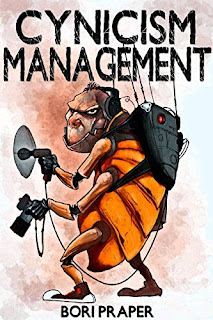
Bori Praper's CYNICISM MANAGEMENT: A ROCK'N'ROLL FABLE

"For a while there I wondered whether Jesus Christ is a gerontophile..."
"Excuse me?"...
"Well you see Fidel, it's simple really... Nuns are supposed to be virgin spouses of Christ. They mostly spend their days in convents, untouched, so I assume they're waiting to finally join their husband and, I imagine, to consummate their marriage. Most of these devoted young women turn into withered hags by the time they manage to kick the bucket, you know, especially since they're not supposed to speed up the whole process much in any entertaining way anyway - I don't believe many of them take a lot of drugs or drink themselves to death very young, or die of cholesterol overdose... Anyway, once they finally get to shag the lord, the majority of them are, well, mature, even elderly, or bloody ancient, if we're completely honest. So you see since this suspicious arrangement had to be organized by our lord, and if he himself has decided this is how he wants it.."
More novels, whether or not they are chiefly concerned with the farings of a newly-formed progressive rock bands in a suburb of Ljubljana, Slovenia, should come with their own soundtrack album. Perhaps there are more than I know of, but until I stumbled across Cynicism Management: A Rock'N'Roll Fable while perusing the offerings at corona/samizdat (my new favorite indie press*), I only knew of one in all the world.** But now I know of two, or rather, three, because I see that the sequel to this madness has a soundtrack album of its own.***

This, of course, delights me. It would even if the album was not to my taste, or if it were but the novel was not. But in fact, I'm pretty delighted by both .

Cynicism Management is the name of a fictional-yet-also actual band comprised of a motley international crew of ridiculously talented but as yet not-very-successful musicians with high standards for themselves and each other, a taste for rather baroque time signatures and somewhat outmoded instrumentation (an early and only slightly heated discussion among the members concerns the practicality of acquiring and incorporating a Hammond organ, for instance) but a punk/metal sensibility and somewhat revolutionary politics. 

These are the friends I've always dreamed of having and I began to miss them mere moments after putting the book down: Finnegan Frotz, an "extraordinarily pale" Black Scotsman, the lyricist and main ideas man; Amalia, Scots vocalist, hostess, his on-again off-again lover; her brother Randy, bass player and weed connoisseur; Bogomr, a Ukrainian performance artist/exotic dancer/musician who has been raised to believe he is an actual vampire; Eric, an Australian heavy metal guitarist with an unhealthy fixation on his perpetually receding hairline; and Fidel, an Italian revolutionary by day,  kickass prog drummer by night. I mean, come on!

But wait, there's more. Like a group of six women who have all turned up in a certain basement in London where they are employed to monitor feeds from various spy cameras installed in various toilets in various airport bathrooms around the world. And whose employer, the amusingly named Omnipile Industries, a multinational conglomerate so large and far-reaching that its in-house intelligence service has usurped the function of most governments' services, has suddenly sent them all to the Ljubljana suburb to observe the activities of one of Cynicism Management's members. He has a unique tattoo in his nether region that seems to offer the only clue anybody has found to the kidnapping of the children of Omnipile's CEO. Could be a coincidence, but nobody seems to think so.

By the way, the solution to the whole tattoo thing may be the single geekiest solution to any mystery that I have ever encountered in life or in fiction.

Incidentally, about midway through the novel the group of women acquires a thoroughly disrespectful but awesome nickname that I think I'd have enjoyed being called as a younger woman, myself: they are the Bitch Scouts. We never learn their actual names, by the way. They get unique and sometimes humorous personal designations (though one is simply referred to as Another One) but never names. But we don't miss them.

And of course this suburb of Ljubljana is populated by a host of fantastic tavern keepers, would-be-porn soundtrack composers, drunken firemen, pensioners, peasants, lunatics, picturesque trollops and a mayor on the make who can't stop spinning cockamamie economic development schemes that are probably doomed to fail, either entertainingly or depressingly, or both.

So, the resulting tale feels an awful lot like Laszlo Krasnohorkhai and Virginie Despentes decided to collaborate on... a thriller of sorts? Except kind of funny. Sometimes very funny.

The novel starts out a bit scatological -- the way the Bitch Scouts learn about the tattoo that kicks off this whole story is on the gross side but also on the paranoia-inducing -- and makes fun of alcoholism quite a lot (Superman Nap!), and commits many other sins against propriety in all the ways one would expect a so-called "Rock'N'Roll Fable" to commit, but never quite delivers up what we expect, except for equal parts of big, amazed laughs and thrown devil horns. And it's full of weird conversations like the one I quoted at the beginning of this post.

The result is the most sheer fun I've had in reading a novel/listening to an album than I have had in a long, long time. There is a sequel, Pendulum Pet, which I have already acquired on the strength of this one and you'd better believe you'll be hearing about it soon right here at Kate of Mind.

In the meantime, I've got a new album to put on obnoxious heavy rotation, chez moi. My housemates don't like I nearly as much as I do, but even they have to admit that a few of the songs are genuine bangers.

*Note, I originally tried to buy Cynicism Management from corona/samizdat and yes, you do have to wait for them to ship your copies to you from Slovenia but it's totally worth the wait and the shipping charge because they have some cool, cool stuff and publisher Rick Harsch is an excellent human (who is also a writer and you'd better believe you'll hear more about him here soon) BUT he was fresh out of paper copies of this so I had to look elsewhere to get its words into my eyeholes. Fortunately, ebook editions of it also exist and hey, if, like me, you've recently abandoned the Big River for less fashy climes, both Cynicism Management and its sequel, Pendulum Pet are not only available via Kobo but are part of its Kobo Plus subscription, so you can read them that way if you don't want to wait for corona-samizdat to get some more paper copies printed. But I still call dibs on a paper copy if one turns up, Mr. Harsch!

**That one, in case you're interested, is Eating Eight by Lars Paul Linden, a cyberpunk-ish romp about a book -- or actually a comic book script-and-cassette tape combo referred to as a "book-dope-book" that gets you high when you read it. The soundtrack really did come on cassette, featuring music from Linden's band, Penis Fly Trap. It was my honor and joy to receive review copies of these back in the day when I was an occasional scribbler in an underground music and politics 'zine, The Pit Report. Back in the 1990s when I lived in Boston. But rest assured, dear readers, I wasn't cool then, either. But I knew some cool people and got to do some cool things like get high on book-dope-books.

***Here's a link to the main soundtrack album, Tit Augmented over at the least shitty music streaming service I've found, but note: there is additional music featured in scenes from the book that isn't on this album because it's not by the band, but by another musician who is also a character in the novel, Ray Kosmick, who does some very cool electronic music that he (the character at least) intends for porn soundtracks but which I find are great listens just on their own. By the way, here is my very favorite track from Tit Augmented, just because:


Monday, March 10, 2025

Alexis Wright's PRAISEWORTHY

Yes, he felt he was the total winner about that, his identity war, and he was truly beating Aboriginal Sovereignty hands down by fetching up his so-called ninja powers for eliminating the endless threats going bang, bang, gangbusters, from preventing his dreams from coming true. It was always a total war, and the boy pushed ahead like he had jumped from the ditches, and was already flying Qantas like a piece of war machinery that was destroying the mediocre killer drama, and the whole sick and sorry trail of far-reaching consequences that were coming to a head, to prevent him from enduring the final moments of being in his ancestral world, before he would not be long gone forever from the scene.

I was expecting a lot of things from Alexis Wright's most recent offering, Praiseworthy, which absolutely deserves every bit of the hype it's gotten but is also a very difficult read in many ways, which I'll get to. I was not, however, expecting Praiseworthy to be the best depiction I've ever encountered of what our hyper-mediated and tech-accelerated and over-connected 21st century media environment is doing to the inner lives of the young children growing up steeped in it. After all, this is a novel about an Aboriginal community in the northwest of Australia, focused on a family that lives in a house they built themselves out of whatever scrap metal and other discarded materials they presumably found in the course of doing their bit to make their town, Praiseworthy, into an award-winningly Tidy Community. 

Not exactly Neuromancer, in other words. But as that novel's author famously observed, the future is here, it just hasn't been evenly distributed yet -- only he made that observation back in the 1980s. It's now, alas and alack, the 2020s, and some of it (arguably the worst of it) finally has been distributed relatively evenly. To wit, a chubby little eight-year-old resident of Praiseworthy is running around with a government-issued iPhone, iPad and Apple watch (which he has to sneak into other people's houses to charge because his parents won't even spring for electricity because "our people survived for thousands of years" without it) and he is thus every bit a part of what has become of the internet as the Tide Pod Eaters and the Booktok Influencers Who Only Read Dialogue and the diehard adherents to QAnon.
If anyone in the town of Praiseworthy was desperately trying to get his hands on horse paste during the early days of COVID-19, it was our boy Tommyhawk Steel, is what I'm saying.

Oh, Tommyhawk, a not-quite villain of his novel. Tommyhawk, his virtual nose pressed to the virtual glass to watch the 21st century passing him by as he is stuck in a podunk town full of native hicks who have resisted assimilation into White Australia, has as warped a perspective on life as a little kid could possibly have. Someday, he is certain, a wonderful blond white lady, the Minister for Aboriginal Affairs, is going to arrive at the head of the Australian military to rescue Tommyhawk from Praiseworthy and its villainous, backward and 100% pedophilic population (the Australian government/media complex of the 2020s, with the willing help of Praiseworthy's mayor, is pumping out constant messaging that Aboriginal parents are uniformly incompetent bumpkins who don't really love their children and it's just a matter of time before every child they have access to gets molested, and Tommyhawk, whose media consumption (and, to a degree, his formal education ) is not being monitored by anybody who cares about him, Believes It All) and take him away to live with her in Canberra, in the glorious Parliament House, where he will be safe and loved and respected and recognized for his inherent Greatness.

Of course, Tommyhawk is wrong about everything, but the people around him, including his family, are all occupied with other matters and too busy to even notice (well, his father kind of noticed, dubbing Tommyhawk a fascist on the day the kid was born...) what a head full of wrong he's got, let alone make the effort to correct him, even about the fact that they actually do care about him.

Tommyhawk is, you see, only one of four very eccentric and passionate members of the Steel family, all of whom are very, very involved in their own shit (well, mostly donkey shit, but we'll get to that), mostly stemming from their circumstances as Aboriginal citizens of 21st century Australia.

For starters, the Steel family's house is built on a piece of land they have claimed as their share via Australia's Native Title system. Which would be pretty straightforward except the chunk of land in question happens to be Praiseworthy's long-established high tech cemetery. A cemetery equipped with live streaming cameras and other equipment so faraway relatives of the deceased can not only watch over the graves of their loved ones via the Internet but can also broadcast themselves to the cemetery and, e.g. sing to their departed ancestors at any hour of the day or night. And they do. And they can also send comments on the appearance and general condition of the grounds. And they do.

I don't participate in anything like Nextdoor but I feel like this system in Praiseworthy's cemetery is very much like a Nextdoor for a diaspora and the very thought of it gives me hives.

But it gets better. By which I mean worse. Because Tommyhawk's parents haven't just settled down to live, themselves, in the cemetery. They've also turned it into a giant sanctuary for feral donkeys. I told you we'd get to the donkeys. There's a psychedelic-looking donkey right there on the American edition's book cover. Why is there a psychedelic-looking donkey on the cover of Alexis Wright's novel, Praiseworthy?

Meet Tommyhawk's father, who goes by many names but most officially (I think) is known as Cause Man Steel. And his Cause is nothing less than the survival, nay, the thriving, of his people through the coming climate Jackpot (William Gibson again, yes), which he plans to manage from Praiseworthy by establishing a global transportation and shipping powerhouse completely independent of fossil fuels or manufactured machinery, i.e., 100% donkey powered.

Of course I'm thinking of the Underpants Gnomes. I wouldn't be at all surprised to learn that Alexis Wright was thinking of the Underpants Gnomes. The United States' stupid pop culture has eaten the entire planet. 

But so, Cause Man Steel's plan to save the world and become, in the process, its first Aboriginal Billionaire, is: Phase One: Collect Donkeys. Phase Two: ... Phase Three: Profit (and save the world).

Except this is not in any way presented for laughs. Cause Man Steel is in absolute earnest and lives a life of anguished seeking, prompted by dreams sent by his land and his ancestors, to enact this plan and pursue its central and most crucial aim: find the God Donkey, a donkey of corporeal perfection so great that its fur is not just silvery grey, like the hundreds or even thousands of donkeys he has liberated from "neglectful" owners or just lassoed out in the desert (Australia's feral donkey problem puts the southern U.S.'s feral hog problem to shame) and brought home to Praiseworthy's cemetery, one by one, in his decrepit and sandblasted Ford Falcon, but the exact hue and shininess of platinum.


You're probably already piecing this together. Tommyhawk's daddy is on a perpetual quest for the perfect donkey instead of being there to parent his son, and keeps using the barely running family car to bring failed God Donkey candidates home and turning them loose in the Internet-enabled cemetery and its environs (I mean, you don't expect feral donkeys to respect property boundaries, do you? Of course they're on the loose all over Praiseworthy, eating all the plants and pooping everywhere and kicking up clouds of dust which aren't even the only airborne hazards of life in Praiseworthy, as I'll get to.). And I mentioned that people all over the world can witness and comment on this, right? To whom are the commenters' helpful comments directed? 

Meet Tommyhawk's mother, Dance, wife of Cause Man Steel, who is sick to death of all her neighbors, actual and virtual, bitching at her about the donkeys. Her life would be nothing but being a receptacle for donkey bitching if she hadn't long ago checked out, mentally and emotionally, and cultivated a Nabokov-level obsession with moths and butterflies, an obsession that seems mutual because she is never presented in Praiseworthy without an absolute lepidopteran cloud orbiting her person. Occasionally, she notices her sons.

Oh, and she is convinced she is biracial: everybody tells her that, based on her appearance, she has at least one ancestor who was Chinese. So any issue of Native Title or anything touching on the eternally fraught question of Who Counts as Indigenous is extra complicated where she and her children are concerned. Which she doesn't think about much until circumstances in the novel force her to think about it all a whole lot.

Yes, sons, plural, because she and Cause Man also have a 17-year old, who rejoices in the name that is absolutely reflective of his father's priorities, but feels almost like it exists solely to provide the second two-thirds of the novel with a bitterly funny running joke, Aboriginal Sovereignty Steel. Ab.Sov to his friends and girlfriend, from whom he has recently been separated because she is a few years younger than he is, and by some reckonings, this makes poor Ab.Sov a pedophile. So, you know, Tommyhawk's big brother doesn't have much time for him either.

All of this is to say that, Tommyhawk Steel is a very, very unpleasant Eric Cartman of a kid, but, even more than Cartman, one who makes sense as a product of his environment and  is a tragically funny (until he's not) little asshole of a character, who is but one of the novel's two main antagonists. 

I feel like I've given away too much already so I'm not going to talk much about the other, the albino mayor of Praiseworthy, who is very much on board with the effort to force his people to Assimilate and in general get with the global economic exploitation program and seems to be spending most of his time trying and failing to put a stop to Operation Donkey God and maybe just put Cause Man in jail or something.

Nor have I much discussed the big problem literally hanging over the heads of every adult, child and donkey living in Praiseworthy, a mysterious and persistent atmospheric haze that yes, per the great Brian Wood*, is strongly reminiscent of Don DeLillio's Airborne Toxic Event except in that it's been there for years and is actually visible. The haze is introduced right at the novel's beginning as the likely ultimate source of the community's woes but its menace and effect are quickly overshadowed by those of the town's two most powerful internal enemies, Mayor Ice Pick (yes, that is his name) and Tommyhawk Steel.

The voluntary searchers who had never before wished to be elsewhere in their lives except being on country now felt their time immemorial beings jeopardized, by knowing this kind of little fascist was not dreaming ancient homeland dreams, and this made them feel as though their sanity was being stolen, and that they too had been placed in some jeopardy departure lounge of a busy international terminal, the subnormal monstrosity of unnaturalness that they had never before managed to imagine in their holy-place mind, and all this foreign mind transporting stuff happened just by watching the way the kid was prancing around like a caged animal in their aired zone airstrip cut through stripped land, where even they, who had never been to a city, were now impatiently pacing while channeling anyone for the sake of just saying hello, and checking for non-existent incoming and outgoing flights bundled in the blue sky, and expecting a call from somebody calling the scenario glistening in a sunray and oh! My god, it was not even the mother, Mother, or the White Mother calling.

The above is how this novel depicts a scene in its last third or so, in which an even more agitated and impatient Tommyhawk is pacing back and forth alongside Praiseworthy's makeshift airstrip, jabbering into his iPhone, while most of the rest of the town has been mobilized to search for Tommyhawk's missing older brother. And, given said brother's highly idiosyncratic name, Aboriginal Sovereignty, it's a big question, sentence by sentence, whether what's being discussed in phrases like "their missing Aboriginal Sovereignty" is the person or the concept. And is the mother being discussed currently Tommyhawk's actual mother, Dance Steel, or is it the faceless bureaucrat in charge of Aboriginal affairs for the Australian government? Etc.

All of this is to say that Alexis Wright does some wild things with English prose even allowing for the presence of Australian slang terms and the very, very broad and flexible range of meanings Aboriginal communities on Australia impart to seemingly ordinary and straightforward words like "country."

Wright's style also very effectively mimics a much older form of storytelling than a maximalist (did I mention that Praiseworthy is over 700 pages long? Well, it is) 21st century novel: a bedtime or campfire story, told in chunks over many nights, each time handing off the narrative duties to a new Oracle (which is often more than one being) and circling back to remind listeners/readers of where we last left all the characters physically, emotionally and spiritually before nudging the plot along a bit with something new. Furthermore, the narrative itself seems to be built around the idea that all of its reader/listeners witnessed the original events and are as much being reminded as told about them, so a lot of what we might call plot elements either happen offscreen or don't seem to actually happen at all. And sometimes the facts seem to differ, sometimes substantially; we are, after all, getting multiple perspectives on events. For example, suddenly the volunteer force looking for Ab.Sov has swollen from a handful of fishermen to a crowd of maybe thousands? But we aren't told when this happened or how. It's just suddenly so. You learn to roll with it. Or you don't. But it's better if you do. 

This has caused some readers to fuss that Praiseworthy is too long and bloated with all of that repetition and if all you ever read is tightly plotted genre fiction, you'll probably think so, too, unless you go into this with consciously different expectations. This isn't a soap opera or an action-packed adventure, not a social novel, nor, precisely, a character study. It's very much its own thing. And I'm not sure right now what to call that thing, but I like it.

*Chad Post and Brian Wood devoted an entire season of the consistently great Two Month Review podcast to Praiseworthy. Go listen to hear these insights and much more!