Showing posts with label Andrei Tarkovsky. Show all posts

Wednesday, October 18, 2017

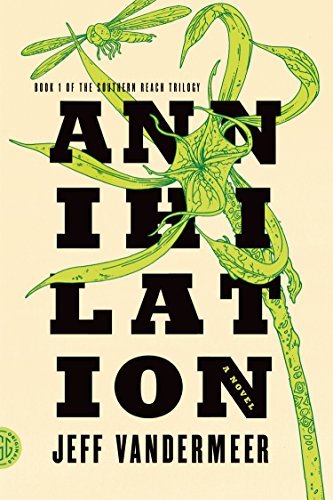
Jeff Vandermeer's Southern Reach Trilogy

It's proven impossible for me to regard the Southern Reach trilogy (Annihilation, Authority and Acceptance) as anything but an inversion of the Strugatsky Brothers' Roadside Picnic and, by extension, Andrei Tarkovsky's Stalker.

Both story worlds feature a section of territory that has been mysteriously alienated from the rest of the planet, reverting to an appearance of pristine nature while also becoming a place where the laws of that nature as we know them do not necessarily apply. As I detailed in a prior post, in Strugatsky's, the area seems to have been created by careless accident and its interaction with the rest of the world is based mostly on people sneaking into it and retrieving objects with strange properties, some useful, some harmful, and some unfathomable, for scientific research or for profit. Paramilitary authorities exist that seek to curtail this trade in Alien Crap but aren't terribly successful. A scientific bureaucracy exists to try to unravel the area's mysteries and origin (the Roadside Picnic metaphor being only one of many theories about the place), but it's mostly just reverse-engineering Alien Crap or otherwise trying to find practical human applications for it.

As I dove into Annihilation, I was quick to conclude that the Southern Reach, which is a scientific bureaucracy with strong ties to both the military and intelligence services, was basically the Strugatsky's Institute and that I would be getting it's side of the story to counter-balance the Strugatsky focus on ordinary schmoes trying to make a living off the Zone.

But then I realized there are important differences. The Zone in Vandermeer seems to have an intent, for one. Something or someone deliberately caused it. And while much human effort is made keeping the riffraff out of it, the Zone does a pretty good job of it all by itself. There is only one way in, though there might be many ways out. And while people sneak into Strugatsky land and bring stuff out, the Vandermeer Zone sends stuff out on its own accord, for its own mysterious reasons, by its own unknowable ways. A lot of the time the stuff it sends out is people, or seems to be. As in sometimes members of the official expeditions come back, but not through the entrance, and they're physically, medically and psychologically altered.  Maybe it's not really them. Maybe it's copies of them, sent back to perform particular functions, with the expedition members' identities as camouflage.

What the Zone intends is never really made clear, nor are many theories put forward by the Southern Reach, for all its thrity-some years of study. But to read these books as whodunnits or whydunnits seems to me a mistake; these are works of speculative phenomenology, more interested in the people trying to figure it all out and what their efforts do to their lives, than in the Truth.

Each of the three books concerns itself with different people, though there is considerable overlap. A biologist we only come to know as Ghost Bird (her husband's nickname for her) tells us first-hand (sort of) of her adventures on what turns out to be the very last Expedition into the Zone, in the company of a Psychologist whom we learn in the next book is actually the Director of the Southern Reach. They find a "tunnel" that Ghost Bird insists on thinking of as a "tower" that has simply been sunken into the ground. The Anomaly is its official term in Southern Reach-speak, and its inhabited by, among other things, a long and discursive, vaguely sermon-esque stream of consciousness written on the walls in letters picked out by living masses of plant and fungal material, material which periodically dusts visitors in a pollen that is more than pollen, and begins to colonize those visitors and transform them for the Zone's purposes. There is also a Creature, but it's so central to the trilogy and yet so unfathomable that I can't even find words to talk about it right now.

Then there's, apparently, nobody's favorite of the trilogy, Authority, which concerns itself with the guy chosen to take over as Director of the Southern Reach after the last Director disappeared on the expedition in Annihilation. Trained from childhood to think of himself as, and to ask others to call him, Control, this new Director has his work cut out for him. Nobody's cleaned up after the last Director, physically (her office is a cluttered mess full of weird stuff) or bureaucratically (her assistant director is none too pleased to find someone else got the job she thought would naturally fall to her), and then there's his own weird background to contend with, as he's a third generation public servant in that special cloak-and-dagger way, but it's his mother who was the apogee; he's just some schlub who gets by on being her son. Authority largely concerns itself with bureaucratic struggles as Control tries to find out what really happened to his predecessor, what his job is really supposed to be, and what the Southern Reach, long in decline, underfunded and raided periodically for talent, is actually for. A lot of people found this book unbearable, but I wound up liking it quite a bit. Even more than Annihilation, it felt like one of those maddening early computer games like Myst, long on mystery but, in my experience, short on solution (I sucked at Myst and have never finished it, yo). The Biologist, or something strongly resembling her, makes an appearance, as a subject Control must question endlessly but fruitlessly for explanations as to how she survived, how she got out of the Zone, and why she was found just sort of aimlessly hanging out in a nearby vacant lot. She becomes his obsession, even as he comes to realize that she's actually just some kind of copy of the person who went with the last expedition (partially in pursuit of her own answers about what happened to her husband, who "returned" from a previous expedition as an imperfect copy of himself that died of cancer, just like all the other returnees from his group).

The final novel, Acceptance, divides its narrative into three pieces, in three different time frames. Control and, eventually, the Biologist, in the overall narrative's "present" meet up in the aftermath of the last novel's climax, which involved, among other things, the Zone overflowing its previous boundaries behind the triumphant striding return of a copy of the Director who has become larger than life in more ways than one, and decide to follow a weird pathway back into the Zone the Biologist literally coughs up into the ocean and see what they can discover there, now that the Zone might well be everywhere.

In other narratives, the Director's own story, including her childhood in the exact region that became the Zone and later career with the Southern Reach (under an assumed identity because we're all pretty sure they wouldn't let an actual native of the Zone head up Zone studies because who knows how those people have been affected), unfolds in the middle-past, and a figurant from the first novel, the Lighthouse Keeper, becomes a proper character as his story unfolds in the more distant past. And yes, the Director knew the Keeper when she was a little girl and he was a man in his late middle-age. He went on to become the Creature in the Anomaly, once the Zone became the Zone; she was removed from the area by external circumstances just days before it happened, and always wondered what happened to her friend the Keeper.

We meet the Biologist again, the original one, unmistakeable but irrevocably altered (and freaky), and we get some answers, but not all of them, about what's been going on with this place all these years. I'm still making up my mind about whether or not I'm satisfied with it all, but I did read the trilogy straight through, non-stop, and that says something about its quality. I'll probably return to it again after I've seen the first movie. Stay tuned.

Thursday, November 14, 2013

Arkady & Boris Strugatsky's ROADSIDE PICNIC with remarks on Andrei Tarkovsky's STALKER

I recently and for the first time* saw Andrei Tarkovsky's glorious lo-fi sci-fi (before that was much of a thing) adaptation of Arkady and Boris Strugatsky's Roadside Picnic, Stalker, and loved it so much I watched it four times before I could bring myself to send it back to Netflix.** And it turns out that I love the source material just as much, which doesn't always happen with books-adapted-to-films. But then again, this is Tarkovsky doing the adapting.

The film is a stripped down version of the book, its trio of main characters deeply abstracted and Tarkovskified from the cast of Roadside Picnic, partly due to the constraints under which the director was working -- hence the low-fi part of the sci-fi, i.e. nothing near the special effects budget that would be required to render all of the alien artifacts and gadgetry the novel's characters encounter -- and partly because Tarkovsky, as always, had his own things going on. Like creating breathtaking underwater Cornell boxes while contemplating the bitter hilarity of our mortal existence:


But what's this all about, you're probably asking?

Roadside Picnic and its adaptation concern the aftermath of an alien stopover on Earth by beings so incomprehensibly different and presumably advanced that they might not even have realized (or cared) that this planet was inhabited by at least one species that presumes itself sentient. Like careless travelers stopping for a picnic lunch, the aliens left behind a fair amount of crap, to which we humans are drawn as ants are to the wrappers and napkins and food scraps human picnickers might leave.

But what crap it is, glorious and dangerous and mysterious and powerful and did I mention dangerous? As are the Zones themselves that were visited and contain the Alien Crap (a list of which can be perused over at Wikipedia but ware spoilers!), in which the laws of physics, life and death, etc. are profoundly different from those prevailing in the good old ordinary universe as we know it and may also change from time to time.

So of course humanity is studying it (carefully) at very high levels and of course at lower levels there is a black market in Alien Crap and in unauthorized trips to the Zones to acquire more Alien Crap and also to exploit some of its properties like the Golden Sphere (which in Tarkovsky's film is changed into a Room), which grants wishes! Hence the existence of folk like our main character (and the title character of the film), Red, who is a Stalker -- a guide into and smuggler out of the Zones, who starts off his career as an unskilled research assistant, takes up a line in Stalking to make a little beer money, and then, when he gets his girlfriend pregnant, realizes he's got to keep breaking the law to keep his new family in groceries.

So even though the novel has a lot more gee-whiz sci fi elements than the film did, it's still a bottom-up view of a world transformed by an alien visit; Red is a working stiff, not an eminent scientist or astronaut, something which critics have made much of when writing about this book over the years; this book, of course, predates the "high tech/low life" scenarios to which cyberpunk and its spawn have long accustomed us. But just as we never get tired of working stiff stories in other genres, there's still plenty of room for working stiff sci-fi, especially when it's this good.

Roadside Picnic manages to be a slightly farcical (in that dry, dark and Russian way) quest narrative, a meditation on how small and insignificant we very probably are in the universe, a family drama and a cautionary tale. With Alien Crap.

In other words, it's completely wonderful.

But what really keeps it intriguing is the novel-world's central mystery: is there an overall, coherent, logical system behind all the Alien Crap and how it works, as in did the Brothers Strugatsky plan it all out and develop it as a complete puzzle for us to solve -- one with a solution -- or is it just a whole bunch of weird phenomena that they thought would be cool and just brainstormed one night over, say, some mushroom tea a la Babylen and Andrei in the fantastic Generation P (an adaptation of some more amazing Russian science fiction, my beloved Victor Pelevin's Homo Zapiens, and which film contains more than a few visual and narrative homages to Stalker. It's fly agaric all the way down, yo.)? Which might mean it's still weirdly meaningful, but not in a systematic way that one can tease out with mere reason... an exercise all the Alien Crap and Zone Traps which Roadside Picnic offers pretty much irresistibly invites the reader to try.

The film, of course, has other things with which to bake one's noodle, big philosophical and religious questions without which a Tarkovsky film would not be a Tarkovsky film, as well as long, slow, meditative and dreamlike scenes like this travel sequence:
:


This sequence should be required viewing for anyone who thinks he or she could pull some lo-fi sci fi cinema. It's just three guys sitting on a railroad car watching the scenery go by, but Eduard Artemiev's perfect musical accompaniment (which I played on a loop for a while during my reading of Roadside Picnic) and the transition from gritty industrial sepia-toned film stock to full color film*** and a lush green landscape**** makes Tarkovsky's Zone feel just as strange as the Strugatsky's but in a completely different way.

 Wonderful as Stalker is, though, now that I've read the novel from which the film is abstracted, I kind of wish Tarkovsky used more of the source material, not so much the Alien Crap as  the novel's social dimensions: the novel takes us inside the Institute which studies the Alien Crap and has a lot to say about the difficulties being encountered in figuring out how it works, why it works, what some of it might be for; it also spends some time with what must surely be the organization behind the Professor's mad scheme in the film, with those who oppose the exploitation of the Zones and regard them and their products as EVIL. Too, a movement within the Institute charged with policing and shutting down the Stalkers introduces a huge friendship and betrayal plot/theme that adds layers of intrigue to the novel (but also, sadly, winds up not being resolved within its text). But all that would require a different filmmaker altogether to develop. Richard Linklater, say.

It's hard, too, to read this book now without perceiving a lot of Soviet themes and thinking, spotting allegories about the dangers of Western-style materialism, for instance, as well as a certain environmental/pollution-themed cautionary tale. Careless aliens made whole swathes of our planet uninhabitable and hostile. Careless people have the same effect on other species' habitats. Species have evolved that are entirely dependent on our artificial impacts; in Roadside Picnic, we are in danger of adapting irrevocably to the impact of the Visit. Which, for all the novel's cast knows, might just be the whole point!

Oh, so much to think about, when we think about The Other...

*This to my shame, because I do consider myself a fan of Tarkovsky. But I'm a fan of a lot of things, and it takes time to get to them all!

**And no, this was not just so I could keep looking at Anatoliy Solonytsin. No, really!

***This is probably due to another one of the famous Soviet austerity/resource choking constraints that left directors like Tarkovsky having to work with little bits of lots of different kinds of film rather than a deliberate choice to do some Wizard of Oz-ish gimmicky contrast, I'm pretty sure. But that's Tarkovsky, making lemonade. But, you know, the lemonade might transform your digestive tract and eventually your whole body into more lemonade if you drink it.

****And the whole theme of a gorgeous natural landscape transformed into something still beautiful but deadly as hell strongly prefigures/predicts what would become of the environs of Chernobyl as you can observe in Michelle Boganin's 2011 Stalker-esque tour of Terre Outragee.