Showing posts with label historical fantasy. Show all posts

Saturday, April 15, 2023

Andrus Kivirähk's THE MAN WHO SPOKE SNAKISH (Tr Christopher Moseley, Narr Aaron Landon)

I first learned about Andrus Kivirähk via the film adaptation of his novel November, which introduced the world to perhaps the greatest folk horror monster ever, the kratt, a wholly unique monster that starts out life as a pile of junk before animating it via a few drops of blood dedicated to, of course, the devil. Once animated, a kratt will help you with your farm chores and whatnot, but you have to keep it busy or else it will turn on you. In the movie, and so I presume, the novel, one kidnaps a calf and flies it through the air forming with it cinema's very first cowlicopter! Plus, there are werewolves! 

Alas, as of this writing, that novel of his does not appear to have been translated into English yet. But the film is occasionally streaming and was popular enough here that your local public library might have it on DVD, as mine did. So until the book is rendered in English (or you learn Estonian) this will have to do. But wait!

Another of Kivirähk's novels, The Man Who Spoke Snakish is so beloved in the author's home country of Estonia that it has been adapted into a board game there, and has been translated into many languages including English! And it's even available as an audio book, decently performed by new-to-me narrator Aaron Landon, who has a voice in the higher range that isn't the most delightful to hear in straight up narration but Landon did a wonderful job on the many characters' voices, many of whom aren't even human so I'm still pleased with and gladly recommend the audio edition.

Set in medieval Estonia right around the time that land is becoming Christian and adapting its culture along the lines of the rest of Europe, The Man Who Spoke Snakish is chiefly a novel of culture clashes. Our title character and narrator, Leemet, has been raised among a handful of hunter-gatherer forest people, where he fed on a diet of  roast venison, wolf's milk and owl's eggs and listened to stories of his mother and the bear that was her lover (prefiguring Leemet's sister Salma's own relationship with and eventual marriage to another bear) until accidentally killing Leemet's father the day daddy caught them in flagrante. The bear, Leemet learns, was a gentle soul and so regretted killing Leemet's father that it castrated itself and vowed never to see Leemet's mother again. 

And we're off!

We quickly learn that Leemet's people are unusual for much more interesting reasons than their diet or habit of, err, bear-loving; some are still staunchly clinging to a very strict and proscribing paganism centered around "sprites," which beings demand a lot of sacrifices at all times and have very short tempers; others have focused on maintaining a fascinating and useful tradition: the language called "Snakish." A reasonably fluent speaker of the language can, of course, befriend snakes, as Leemet quickly does, acquiring a charismatic and practically-minded adder named Ints for a best friend, but what most of Leemet's people seem to use it for nowadays is to command animals. They summon deer to lie down and allow themselves to be mercifully and humanely killed for meat and hides; they keep herds of wolves in barns like cows and tell them when to sleep and when to meekly allow themselves to be milked and when to allow humans to ride them like horses for their sylvan wars, though those wars are nearly as much a thing of the past as is the Frog of the North, a giant flying amphibian who protects the forest people but who can only be summoned by a large number of fluent Snakish speakers calling it down in unison. Nearly, but not completely; we do get a bit of wolf-riding in The Man Who Spoke Snakish, but it's only one swift element in one of the novel's most exciting and action-packed and anguished scenes.

Meanwhile, "progress" has happened to most of the rest of Estonia. Most of the region's people live in villages, have converted to Christianity (though maybe not as sincerely as the colonizing knights and monks might wish; most of them treat it more like a matter of fashion than of faith), and speak German. And they are very, very keen on proselytizing to the forest people and trying to shame them into moving out of the forest and into the villages, giving up their weird diets and freewheeling ways for lives sowing, tending and harvesting grain, making it into bread, and eating that instead of owl's eggs and wolves' milk. And of course, obeying the foreign monks and soldiers ("Iron Men" as the locals call them) who have subjugated everybody else.

While Leemet is still a boy learning his first Snakish words, he meets a village girl named Magdelena and through her comes into contact with her father, Johannes, the village elder, who barely lets the Lemeet and the boy he was exploring with get a word in edgewise before he's commanding them to go tell their parents that they must move into the village and be christened with new, biblical names and give up their culture altogether, really. Cowed, Leemet kind of agrees but doesn't wind up actually obeying; he'd much rather hang out with his uncle, the greatest still-living speaker of Snakish, who sees in Leemet perhaps the last person who will carry his people's traditions into the future -- even though, because Leemet's father once fell under the sway of village life and wanted to eat bread, Leemet was actually born in the village, and is thus shunned as a village person by about half of the dwindling population of the forest.

He soon comes to have more unusual companions, befriending a pair of local "primates" -- possibly some last remnants of the Neanderthals or Homo Erectus? -- who treasure other animals, especially lice, which they have carefully bred until they have one as big as a child. It loves to go for walks and to go swimming in a nearby lake, becoming a new source of friction among the forest people. 

The giant louse also loves Leemet's childhood tagalong, Hia, a plain and meek little girl whose parents are the most ardent remaining devotees of the sprite cult and force her to behave at all times as a paragon of forest virtue, toiling to exhaustion every day to butcher all the meat needed to feed the hundreds of wolves her family keeps in a gigantic barn, and being force-fed wolf milk even though she can't digest it. The scenes between this giant louse and Hia are some of the most charming in a book that is long on charm -- but also on violence. 

The violence in this book is mostly at least indirectly Leemet's fault; his fascination with the villagers brings his world into more direct conflict with theirs as he discovers to his horror that all the former forest people now living there have not only forgotten Snakish but regard snakes as servants of Satan and mostly refuse to believe that Leemet himself is not a werewolf preying on their pitiful flock of sheep. 

Leemet spends most of the story trapped between orthodoxies and struggling to be left in non-observant peace. The villagers (save one) harangue him to give up his wicked "pagan" ways while the hard core forest people maintain he'll never be good enough for them, either, no, not even when he emerges as the last living human who can speak Snakish. And just when he thinks he's found a way to settle down in happiness with a sweet wife and his snake friends, both orthodoxies attack, demonstrating that his choices will never be respected. 

How Leemet reacts to being doubly hemmed in and to gradually losing everything he cares about may shock some readers, who find themselves rooting for a pair (a long-lost ancestor shows up late in the book and quickly starts stealing every scene he's in!) of violent anti-zealots bent on avenging their losses on the whole rest of the world. It's a strange feeling to be cheering on a gory rampage with a high body count, but Kivirähk has fashioned his tale and portrayed his hero well; by the time the rampage begins we understand completely the feelings behind every blow struck, quixotic though they all are. 

If nothing else, we come away with one important lesson: don't fuck around with Estonians. You never know who might have a pair of venomous fangs concealed in their smile, ready to bite anyone who corners them. Have some respect. 

Tuesday, April 11, 2023

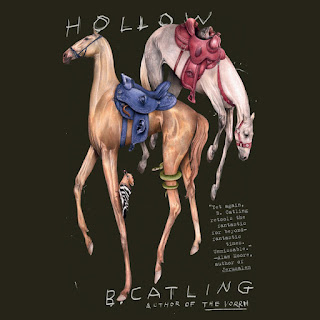
Brian Catling's HOLLOW (Narr Jonathan Keeble)

I keenly regret our loss last year of Brian Catling, primarily a visual artist and sculptor -- he even contributed a monument to the displays at the Tower of London -- he also turned his hand to writing the kind of deeply strange, even expressionist, weird fiction that I like best in all the world. His Vorrh Trilogy, especially in audio form as narrated by Allan Corduner, is very likely my favorite series of the 21st century so far. He didn't write a whole lot more, though. I should just be grateful that he wrote at all; he might have been perfectly content to keep on making grotesque cyclops masks to model for photographs and called it good. At least he wrote one of his cyclops into print.

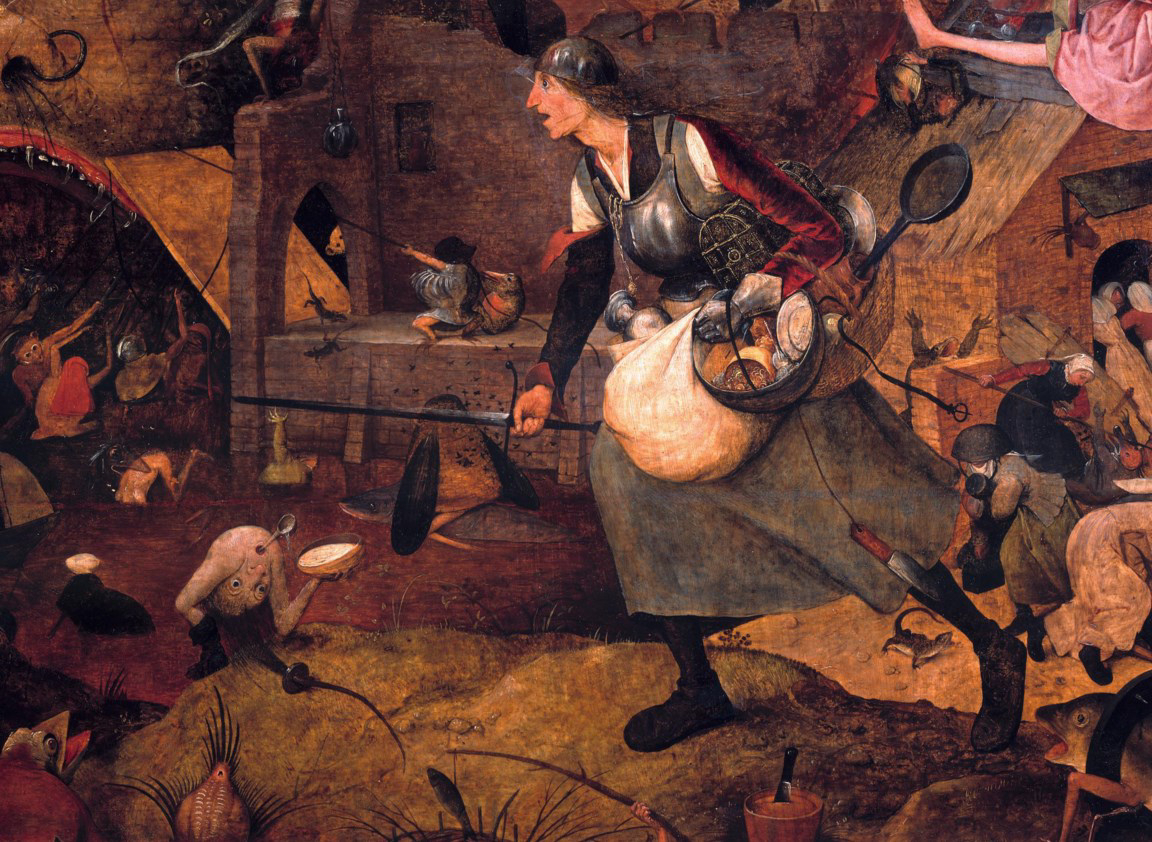
In his stand-alone novel Hollow his background in the visual arts is one again very much on display, but this time instead of an impression of Eden in Africa, he's chosen to invent a story for which the paintings of Pieter Breugel the Elder and Hieronymus Bosch might serve as illustrations - or, say, he's written back stories for the beings that populate those images. 

It's even cooler than it sounds. Which is mighty good, incidentally; narrator Jonathan Keeber is very much in the vein of Allan Corduner, or Simon Vance or John Lee, but doesn't quite hit their very high mark, mainly due to his tendency to make too many of the novel's inhuman or demihuman characters, and one monk with a sligt speech impediment, sound like Gollum with a bunch of juicy sweet fish in his mouth. I had to listen to those bits of dialogue multiple times to parse out what was being said, which is troublesome indeed when one such character is the very oracle whose utterings feel very much like the key to the story. Mercifully, there is not a lot of this in the book, and Keeber's reading of it is otherwise exceptional.

But so, what's Hollow all about then?

The action this time is set in Europe and concerns a motley D&D gang of murder hobos on a mission to deliver an Oracle to a weird monastery that may have been built on the ruins of the Tower of Babel.* Said Oracle is small and greyish in color, with atrophied limbs and unsettling aspect -- and, as the murder hobos discover to their cost, has an unsettling talent for ventriloquism, used to disturbing and deadly effect on a few occasions during their journey.

I could not help but imagine this Oracle and the one it's to replace as something like good old Dalek Caan from Doctor Who, also a weird and atrophied thing with weird prophetic powers and a creepy voice. Your mileage may vary.

Anyway, while the murder hobos escort this Oracle, two brothers from the monastery that is their destination embark on a journey of their own, to find out the source of some weird creatures that have been turning up in their neighborhood.

Interwoven with the tales of these journeys are some bizarre and creepy goings-on at the monastery, and also the account of how one of my favorite characters in western painting, Dulle Griet, aka Mad Meg, evolves from a humble and much-abused wife and mother, living in the village that supports the weird monastery, into the avenging proto-feminist virago that Bruegel immortalized as leading a band of women to attack Hell. In Catling's account of this evolution, she has a best friend who gets burned as a witch, a dumb failson, and a worthless and abusive husband, so it is with relied that we watch as she befriends all of the strange creatures who share the Bruegel canvas with her,  further endearing her to me. I loved Mad Meg long before I read this book, but this book made me love her even more.

As for the Oracle, as I said, it is an ill-defined creature (possibly related to the Erstwhile of the Vorrh?) whose natural habitat is a tightly enclosed place. The first of its kind (for there are more than one) that we meet has been walled up in the monastery, where a small community of monks devotedly study its weird and gnomic emanations until, under suspicious circumstances, it disappears and dies. Or does it?  At any rate, another is sent for, hence the escort mission, but meanwhile the original may be haunting the place, sort of? Anyway, weird things start happening but they don't seem quite as weird as they are against the backdrop of this monastery, which contains a walled-off battlefield of some five square miles in which the zombie-ish dead and the tormented living engage in perpetual warfare against one another.

Meg, on the other hand, has mostly mundane problems to deal with, until suddenly she, too, encounters the "Woebegot" aka "Filthlings" - bizarre little creatures with human and animal characteristics turning up all over the place and annoying those they don't just outright frighten. They are, of course, figures from Bruegel and Bosch, and when they start talking to Meg in their confused polyglot way it is impossible not to imagine them as Monty Python-esque animations. Eventually they become, as I said, something like friends to Meg and become along with her my favorite figures in the story, at times intensely comic (such as the account of how three of them came to be named Bleagh, Garrett and Eueuw, whom Meg accidentally "summons" when an unrelated incident causes her to make these noises!), at others uncanny and disturbing. What do they even want? What can they even do?

We're mostly supposed to care about the escort mission, though,  and it is also bizarrely entertaining as the mercenaries are picked off one by one (one of them is killed off right at the beginning of the first chapter by the party's leader for reasons that seem arbitrary and disproportionate for a long time until they're sort of explained) and encounter strange things like a menacing but ultimately helpful giant in their travels with their strange dependant. Whom they must feed every night. By taking turns confessing their worst sins into a bag of bones. So that their confessions enrich the marrow. Which is then fed by spoonfuls, like so much baby food, to the Oracle.

I love Brian Catling.

So much.

The mechanism by which the murder hobos must feed the Oracle gives us a chance to get to know them at a satisfying and deep level as they dredge up their most horrific personal anecdotes, like one man who was used by a bunch of nuns as angel bait and later winds up eating said angel (he can't compare it to chicken nuggets though, since those are hundreds of years in the future).

All of these narrative threads come together in the end just in time for Fat Tuesday, celebrated in proper batshit fashion in Meg's village, in bizarre and bloody fashion, with some highly entertaining violence, some grotesque comeuppance, and the entry of at least one character into perhaps the worst kind of eternity that doesn't actually involve devils and pitchforks and lakes of fire. The ending chapters especially reward close attention, as characters keep appearing from weird perspectives as their storylines intersect and the Woebegots finally fulfill what I guess is their purpose? But maybe it's just a side benefit of fulfilling their true purpose?

I'm going to have to read this one again sometime soon. What hardship!

*Which, that tower sure has been turning up in a lot of my reading lately. 

Tuesday, January 24, 2023

David Liss' THE PECULIARITIES

That he should be considered beneath the dignity of this working man’s beast-child is a bit of a blow. Yes, he is becoming a plant, but he comes from an excellent family, and he doesn’t think the outside world would consider him so bad a prospect.
In the Weird alternate Victorian London of The Peculiarities, Whitechapel and Bethnal Green have become infamous not only for the crimes of Jack the Ripper, but also of The Blind Headsman, Mister Fancy Pants, the Rabbit Hunter and the Fool with a Hook. Also, women occasionally give birth to litters of rabbit kits instead of human babies, the famous London Fog has tendrils that can actually grasp and manipulate objects and people, and there are some people walking the streets concealing under their sober London clothes the green shoots and leaves sprouting from their bodies. 

Welcome to David "The Coffee Trader" Liss' foray into weird fiction. He's as good at the weird as we've always known him to be at straight historical fiction. His forays into comic books have served him well.

"The Peculiarities" is this world's name for a generalized invasion of weirdness that is for-sure happening in London and rumored also to be going on in other world cities like Paris and New York. There's all the weird stuff I mentioned above plus phenomena like people turning lycanthrope, by which is meant nothing so expected as your ordinary everyday werewolf who turns from human to wolf at the full moon, but a human who grows fur and a snout and pronounced canines and pointy ears for good. One thinks of, say, Dog-Faced Joe from Tim Powers inimitable The Anubis Gates. But wait, there's more. Other folks become various kinds of sex maniac and a junior clerk might suddenly try to, say, rape their hated boss in broad daylight right in front of all of the other clerks, and would have succeeded if a few of those subordinates hadn't decided that proper subordinates don't just stand there and watch while their hated boss gets bummed by the lowliest clerk in the office, they peel that lowly clerk off the boss and shove him into a closet like a bunch of god damned heroes, and then meekly go back to work copying out correspondence, checking columns of figures and sorting documents for filing. As it were.

Amid all this madness lives our hero, Thomas Thresher, younger son of a banking magnate, who has always expected that he is to act like a typical younger son of a rich and important man and piss away a respectable but not alarming amount of Daddy's money on cards and whores and booze-ups and pointless Continental tours with other younger sons, only to learn upon Daddy's death that he doesn't get to do any of that any more but is expected to Work for a Living at the Family Business, at which he must start on the lowest rung, as a junior clerk. Which means he is there for the aforementioned near-rape of his detestable boss, Mr. Philpot, by the only guy in the office who was ever decent to Thomas. Oops.

And before you can say "let's all go to a ritual," Thomas is haring off after a mystery, for in his toils at the bank he has noticed that his family's firm has been busily buying up the tiny, inconsequential (to the bank, if not to the individuals) debts of a lot of little people, and won't let any of them pay it back. Thresher's Bank prefers to have something to hold over these people, for reasons that are not at all apparent. The anomaly bothers Thomas, but he doesn't actually do anything about it until he recognizes a name on one of the letters he's meant to file away: the mathematically inclined childhood best friend who, despite actually having been rather a good influence on Thomas, was mysteriously forced out of their school when they were 12. Thomas suspected at that time that this expulsion was at the Threshers' behest, to put an end to the friendship, but never did anything about it until he is reminded of it all these years later. 

And before you can say "let's all draw a pentagram just over there, maybe" he has a crush on his old friend's widow, is visiting wolf-women in unsavory neighborhoods, and is planning to crash an open house of one Hermetic Order of the Golden Dawn, there to consult no less a person than Samuel McGregor Mathers (having already met William Butler Yeats in his initial inquiry about his bank's holdings in petty debts). And also, Aleister Crowley! 

But more interesting than all of this is one of Thomas' companions in mystery-solving, one Esther Feldstein, whose father is in league with Thomas' brother to such an extent that the two have decided that Thomas and Esther should get married! For the good of the bank, Big Brother says. And Esther's father is rich, if nouveaux so, but not so much so that Esther is a catch. For one thing, as her name might suggest, the Feldsteins are Jewish, and this is still the 19th century. So why are these two moderately powerful (if outsizedly so in Thomas' and Esther's individual lives) people trying to pair these two off, their own inclinations be damned? 

But Esther's status as Thomas' hand-picked-for-him bride is not what makes her interesting: she is smart, observant, committed to social justice (it is she, for instance, who notices that the Peculiarities mostly affect poor families, that poor women are much more likely to give birth to rabbits, etc), sure of herself and ready to take action on what she cares about. She is, really, everything that Thomas is not and has never been, and is thus obviously a much better match for him than his friend's widow, but even more so -- she would have made a much better heroine for this book!

But it's Thomas we have to deal with, Thomas' point of view that we get to share as he does mathematical/magical battle with unseen forces, faces down the Elegants (ghostly/vampire-ish creatures that reminded me of nothing so much as the Gentlemen from the famous Buffy the Vampire Slayer episode, "Hush") and puts his crack junior clerking skills and thwarted mathematical talents to the best possible uses to foil his brother's nefarious plot that does indeed link the family bank to the Peculiarities. He's not such a bad sort, is Thomas. He's just very much outshone by Esther. So it goes.

I would have missed this book completely if it wasn't for Lavie Tidhar's devotion to plugging book bundles for charity (whether they feature his own work or not), so to him, my thanks. David Liss is never one to snooze on. It would be a terrible shame never to have found this. Which, there's kind of room for a sequel? I would read many more volumes of stuff set in this world, whether the hero be Thomas, Esther, Ruby (a wolf-girl who helps them quite a bit) or even some brand new characters. Like the aforementioned Tim Powers, Liss has created a truly original and intriguing magical system and thus a world with room for many more cool adventures. Crossing my fingers for more of this!

Tuesday, December 13, 2022

R.F. Kuang's BABEL: Or, The Necessity of Violence: An Arcane History of the Oxford Translators' Revolution

R.F. Kuang has been on my radar for a while but it was this year that she published a book that I absolutely knew I was going to have to read right away, not just put on the never-ending TBR list. I mean, it's about language translation, foreign language study, and colonialism. And Mandarin! The only way it could have been more in my wheelhouse would be if Babel, Or the Necessity of Violence: An Arcane History of the Oxford Translator's Revolution somehow also managed to concern insects, amirite?

The novel starts off an early chapter with a neat little quotation from none other than C.S. Lewis, long before the first time reader realizes the quotation is probably meant ironically, as something to be subverted, rather than reverently, as something to be illustrated and upheld:
"But this shall never be: to us remains
One city that has nothing of the beast, 
That was not built for gross, material gains, 
Sharp, wolfish power or empire's glutted feast."
Lewis was celebrating his university, Oxford, but we can never be sure how sincerely he meant these lines. He never struck me as an especially naive man, but nor did he seem a great satirist. At any rate, in our world the notion of a university as a place above and apart from commerce and politics is a belief more useful as a rhetorical device than a realistic description, and in the world of Babel it's cause for bitter laughter before our young hero has finished the first day of his studies there. 

In this alternate universe, it has been discovered in the late Renaissance/Early Enlightenment period that silver has certain magical properties that can be harnessed by engraving it with pairs of words from different languages that mean approximately the same thing but not precisely; it's the tension between the differences that powers the forces employed to use silver bars as talismans that can alter the world. Fir example, a bar engraved with the English word "meticulous" and its Latin forerunner (etymology matters!) "metus" (meaning "fear or dread") has the effect of producing "a chilling anxiety whenever the user erred in their work" -- or as a character complains when they're lent it to use in preparing for exams "It doesn't tell you where you went wrong... It just makes you want to vomit for no reason you can discern."

Once a bar has been so engraved, it must be activated by a person fluent in both of the languages employed, making speakers of foreign languages* into human resources of great importance, to be highly prized -- so much so that some members of the upper crust of this universe's British Empire have resorted to breeding them like livestock. Such are the origins of our hero, a half-English, half-Chinese boy who takes the English name of Robin Swift since he's not allowed to use the surname of his biological father, a professor of translation at Oxford University, who has allowed Robin to grow up for a few years with his mother under the guidance of a hired British nanny but who then callously allows Robin's mother to die of cholera when Robin is old enough -- about eight years old -- to be useful, fluent enough to think and dream in his native Mandarin Chinese but also in the English he grew up speaking with his nanny.

Soon Robin is whisked away to England to continue his education with private tutors, living in his father's posh London home but rarely interacting with the man, until it's time for Robin to matriculate at University College, Oxford, in 1830, when its mighty silver-working facility, Babel, is at its mightiest. Someday Robin will be one of the rare and valued few who can make new magical silver bars to continue enriching the British Empire, which sits at the center of endless flows of raw silver and thus of all other forms of the world's wealth.

Silver is also accelerating the pace of industrial development relative to our own world; the magic of silver bars is automating processes that required human input well into our 20th century. Here the Luddites were but an early wave or violent protest and crushing poverty experienced by Britain's artisans and skilled laborers back while Victoria was still just a pretty little princess being spoiled by the Sailor King.

Robin quickly comes to sympathize with his fellow colonials (his class at Babel consists of a young Muslim man from India, a young Haitian woman, and a token native Brit who is still marginalized at Oxford because she's a woman) and with the plight of the newly unemployed, and gets drawn into a secret society that relies on marginalized students like him to pilfer silver and engraving materials from the fortress of Babel for use undermining the Empire. That society, called Hermes, has an even closer claim on his loyalty than might first seem apparent, though: before there was a Robin, there was a Griffith, who was taken from his own Chinese mother too early to develop true fluency in his native language and thus proved a disappointment to their father. D'oh!

Much of the tension of the novel's first third or so, then, arises from Robin's keen awareness of his situation as both a valuable resource to the Empire but also a complete dependent on it: a slave, though a well-treated one who is being allowed to do what he loves most.

Inevitably, our hero finds his way back to his birth city of Canton just in time to find himself interpreting a confrontation between a British businessman and General Lin Zexu over Britain's arrogant insistence on continuing to import opium into China despite the Emperor's increasingly strict edicts against the stuff. Meaning Robin is there for the first salvo of the first Opium War. And to see his last excuses for pretending not to see the problems attendant on his enjoyable situation, the price paid by others for his privileges and comforts, go up in smoke. Well, something has to incite the titular translators' revolution, doesn't it?

This takes place in the final third of the book amidst broken fellowships and surprise alliances as everybody discovers the real powers of solidarity and class consciousness -- and of unintended consequences. Suddenly every chicken the British has ever wronged comes home to roost in its new Tower of Babel. And they might have brought a bomb or two...

The result of all of these odd juxtapositions and weird story beats is an exciting and deeply affecting novel that I'm going to remember for a long time and will probably want to read more than a few times. Phew!

*Especially speakers of non-European languages, because speakers of these have been in contact with English and vice-versa for too long and loan words and other cross-pollinations like false cognates and folk etymologies drain too much of the necessary tension out of those word pairings,  meaning that bars engraved with an English and a French or Italian or German word are weak sauce by the time our story begins. 

Friday, May 6, 2022

Indra Das' THE DEVOURERS (Narr by Shishur Kurup & Meera Simhan)

After spending what felt like months entangled in some very long 18th-century styled doorstop fiction, it's pretty refreshing to return to what mostly feels like a straight-up monster story, though there's a lot more going on in Indra Das' The Devourers than that, of course. 

The subject/object of the story has a dramatically weird entrance as a stranger approaches a lonely college professor, one of our twin narrators, Alok, with an arresting declaration -- "I am half-werewolf" -- and says he wants to tell the professor a story. His compelling announcement and first teaser serving of that story have an uncanny and hypnotic impact on Alok that seem more like the powers of a vampire than a werewolf, but as we soon learn, this Stranger sort of started self-identifying as werewolf for complex cultural reasons that started off when he saw,  in his third century of life, An American Werewolf in London. So, uh, buckle up, this is a strange'un.

The novel's overall premise takes more from  Interview with the Vampire, than from any werewolf story I've heard as The Stranger's tale unfolds over several intense encounters with Alok, but it goes Anne Rice one better. Or several - what if Louis were not merely one of Lestat's metaphorical children but his actual biological child by a human mother? And what if most of the story concerned that human mother's epic quest across the length and breadth of Mughal-era India to find her rapist (because of course he was) and give him a good talking-to? And that her traveling companion was one of the werewolf/rapist's ex-packmate, who is pursuing the rapist not out of a quest for justice or to help the newly-pregnant victim, but basically to berate the rapist for having sex with a human, and a female human at that, eww gross, that would be like if a human had sex with a chicken or something because humans are prey. I mean, it's already way more interesting than the pseudo-gothic whining of Anne Rice's sexy but self-pitying characters, right?
The story unfolds in two narratives, one told by Alok, chiefly in the form of intervals in which he tries and fails to make any headway in his relationship with the Stranger who has appointed Alok to transcribe and type a manuscript about the Stranger's shapeshifter people. As with the other narrative, of Cyrah, the Mughal rape victim, there is some sexual tension in Alok's scenes with the Stranger but that's really not the point of the story, any more than it is when we travel with Cyrah and her rapist's friend Gévaudon. Both stories are more concerned with the ineffability of the predators who have made humans their prey, while looking just like them, holding out as a tantalizing mystery, rather than a lore-established certainty, that these shapeshifters were once full humans and that the same transformations they've undergone can happen to Alok or Cyrah as well.

Or, perhaps, the Beasts can regain the humanity that they only think they've lost?

Of course, the Stranger could just be pulling Alok's leg and extorting free editorial services from him, a possibility which is also carefully kept in play as the two intertwined stories unfold.

As often works brilliantly with dual first-person narratives, the audio book edition's producers chose to use different narrators for the two stories, with Shishur Kurup giving Alok exactly the kind of precise diction and haltingly thoughtful speech we'd expect of a lonely college professor who maybe should be questioning his sexuality a little more carefully than he has been, while Meera Simhan gives Cyrah a forcefulness and, yes, bitchiness, that a character like hers would need to survive in a world that is already plenty hostile to a lone, uneducated Muslim woman who has had to turn to sex work in order to survive and has barely done so even before crossing the paths of three slavering monsters who would ordinarily just think of her as a midnight snack. If they are what they think they are. But even if they aren't, Cyrah would have been doomed without that strident willfulness Simhan gives to her every syllable. As her rapist, who claims to be Fenrir from the Norse pantheon just to make sure this story is weird enough, observes, his and Gévaudon's kind are to mere humans as human men are to human women: predators.
Yeah, it's a bit simplistic, but this is the 1650s in India. I mean, an early bit of Cyrah's account describes a partially completed Taj Mahal surrounded in scaffolding. 

Monday, July 30, 2018

B. Catling's THE ERSTWHILE

Where the first book in B. Catling's Vorrh series, The Vorrh, was a scattershot of interesting ideas, weird characters and language games, its sequel, The Erstwhile, is a bit more conventionally readable, while losing none of the prior's strangeness. All in all its a much more enjoyable read, but I'd kind of expected that.

I only took up the first book after reading a few tantalizing reviews of the second, which focused on the title character class. The Erstwhile are basically remnant angels, those who had failed to defend the Tree of Knowledge from Adam (Eve is never mentioned in this derivation from the book of Genesis) and were cast aside and forgotten after that little mishap. In the thousands (millions? Catling takes no stance on how old the Earth might be) of years since then, these angels have gone to ground -- literally in some cases -- and devolved into weirdly malformed monster shapes with moss and plant life growing on various bits even before they became completely quiescent.

Or so it seems until some of them start interacting with humans again, usually when they are accidentally discovered in and around The Vorrh by European colonists looking for resources to exploit there. When a few of these beings are dug up and shipped back to Germany, they come under scrutiny and care and start to seem human-like. And when one emerges mysteriously from the mud on the banks of the Thames in the 18th century and becomes the freaky muse of one William Blake (yes that William Blake, whose image of Nebuchadnezzar graces the cover of this novel and in this story is understood actually to be a portrait from life of one of the Erstwhile), and then spends a century so drifting among human society in London, that one becomes so human that he takes on the name of Nicholas Parsons and becomes a sort of trustee at Bedlam.

Meanwhile back in the Vorrh and the colony city of Essenwald, all of the characters who survived the previous novel are trying to live out their lives after those weird events, with varying degrees of success. Ghertrude Tulp is mysteriously pregnant but not sure by whom -- Ishmael? Some random guy on the same carnival night that Ishmael slept with Cyrena Lohr and by so doing cured her blindness? Ishmael and Cyrena are living together in her sumptuous house and getting tired of having sex with each other. And the city is in steep economic and social decline since the Limboia, the "mindless" slave labor force that kept the timber industry going in the last novel, have up and disappeared. Others have tried to take up the work, but unlike the Limboia, they can't handle the weird powers the forest exerts on puny human minds -- namely all but erasing them.

Soon Ishmael, the only man anyone knows who has traveled through the Vorrh without losing his memories and mind, is drafted into leading an expedition to go find the Limboia and it's all a bit like Werner Herzog's Herz aus Glas.

Already you can see that this novel has a lot more of a conventional focus and structure to it. The expedition provides one of its main narrative threads, twined with another in which a new character, Dr. Hector Schumann, is called upon to take up the mysteries posed by the Erstwhile brought to Europe. A third story, of a lonely old woman who rescues a mysterious baby from the abandoned home of The Vorrh's white savior figure and his black shaman mistress/wife, is woven in less well for all that there are structural parallels between it and the Schumann story in their final thirds. And the fate of Ghertrude's baby is, I guess part of all of this, too, but not really?

For this book is a textbook case of Middle Chapter Trouble. For all that it's a much more enjoyable read than its predecessor, it's even more frustrating, in that exactly none of the questions or problems it or the prior book poses gets resolved at all, leaving a lot for the final book, The Cloven, which just came out, to answer. But, to be honest, I have zero hope that anything will actually get resolved, because Catling isn't here to try for narrative coherence. He's all about the language.

And some of this is downright beautiful:
The stillness of the water became a secondary feature to the movement of the snow. It fell straight down into its own reflection on the mirrored Thames, the depths of the reflection rising up to meet it. Each flake fell from a black sky and fluttered up from the river's black bed to meet its twin and become one before disappearing.
I mean, god damn!

A lot of the time, though, Catling threatens to become downright annoying, especially when he gets precious with malapropisms -- which I have to assume is what he's doing because otherwise 1) He's kind of a doofus and 2) The editorial staff at Random Penguin all need remedial courses. I'm assuming its deliberate because I'd rather that were true. But there sure is a lot of "finally crafted jewelry" and whatnot in here.

But so maybe it's just sunk cost fallacy working and maybe it's still just good enough to make me want more -- I really can't decide -- but I'm looking forward to The Cloven. But I've got a lot of library books to get through before I go looking for it, because right now I'm Vorrhed out.

Thursday, July 19, 2018

B. Catling's THE VORRH

Two covers for the first volume of B. Catling's trilogy seem to appear with equal frequency when a curious would-be reader starts poking around, the one at the left and the one I have reproduced further down. Both of them are maddeningly deceptive about what kind of book The Vorrh really is, for it is neither as coldly abstract as the black and white cover*, nor as lushly imaginative as the more colorful one.

Some have compared The Vorrh to the work of Mervyn Peake, whose famous Gormenghast trilogy I have started once or twice but not had the will to finish even while appreciating its uniqueness at least enough to see why this comparison is somewhat apt: Gormenghast, a "fantasy of manners" is both engaging and off-putting in its seeming plotlessness and the artificiality of its characters; The Vorrh is, perhaps, a fantasy of projections, slightly more plot-driven but also off-putting because it gives up its secrets so very, very reluctantly. And the artificiality of its characters, about which more in a bit.

The Vorrh of the title is an imaginary African forest, originally imagined by French surrealist Raymond Roussel for his Impressions of Africa, an outlandish romp through a wholly imagined version of the continent. Roussel becomes a character of sorts in Catling's book, a sketch of his story bookending the rest of the action, mostly just to remind us of how earlier generations with no actual experience of Africa romanticized it, but also to add another layer of weirdness to what is already a pretty weird tale.

For this book, The Vorrh is evoked rather than shown as an African forest of supernatural dread that just might conceal the original Garden of Eden at its heart -- and has a completely transplanted European town, moved stone by stone from one continent to another -- on its edges, thriving on an extractive economy based on timber from the forest (yes, children, this story is in part an answer to the question no one else has ever asked -- what if we started logging operations in Eden?) harvested by conveniently docile native slaves (their docility supernaturally compelled by the presence of... A pretty nasty thing I'm not going to spoil for you here though it's a perfect example of Catling's amazing ability to conjure up the truly grotesque) who are the only people who can come and go from the forest without losing their minds or memories (because they kind of don't have those to begin with? Maybe? At least according to the White Men who manage them? But maybe for reals? Maybe?). The Vorrh is also inhabited by creatures straight out of John Mandeville's fables of the kingdom of Prester John (for those non-Prester John fans out there, similar beings are visually depicted in Rene Laloux's crazy time travel cartoon Gandahar/Light Years) and by beings known as The Erstwhile, who are probably degenerated angels (?) and a sad, silent, grotesque and grey-skinned figure whose toenails have turned to horns or maybe hooves but whose human hands (the first human hands, we are told) look kind of normal and who might be Adam, as in Adam from the book of Genesis (?) Not even Roussel could come up with this stuff, is what I'm saying, but here he is, sharing some pages with them. Sort of.

Nor is Roussel the only historical figure to appear here, as a more fully developed narrative serving as a sort of mini-biography of photographic pioneer Edward Muybridge (with added steampunkish/fantastical elements and a fun interlude when he did some work for Sarah Winchester of Mystery House fame) is interwoven with accounts of Catling's own characters, which include Ishmael, a stunted cyclops of a boy raised by small bakelite robots until a pushy teenaged busybody, Gheertrude Tulp, invades the basement of the mysterious mansion given over to his care, accidentally destroys one of the robots and decides to finish raising him herself; Williams/Oneofthewilliams/The Bowman, Great War veteran and borderline white savior figure who resolves to explore the Vorrh after his shaman-lover dies and commands him to turn her into a sentient bow and two white arrows, which he fires ahead of himself to sort of (?) maybe (?) show him the way deeper into the forest(?); Cyrena, a blind woman who has her sight restored after spending a carnal carnival night with Ishmael, and many more, including a Scotsman who sort of accidentally finds out the secret of manipulating the local "hive-minded" tribesmen, another guy Tsungali,** who might be a member of that tribe but maybe it's a different tribe (the ambiguity is deliberate, as far as I can tell) who joins a host of other weird figures who have chosen to try to prevent The Bowman from crossing the Vorrh even if it means killing him, and...

Do you see?

So I can't even tell for sure if I liked The Vorrh, as such. It's overflowing with weird and neat ideas, and full of passages of stunning imagery (Catling is also an accomplished poet). None of the characters are remotely sympathetic*** but none of them are boring... And always there is the mystery. A sequel, The Erstwhile, is next on my to-be-read file, and a third book in the trilogy, The Cloven, is due out later this year. I'm tentatively on board for the rest of the set. We'll see how I feel after The Erstwhile. Which, judging from the title is going to be a bit more focused on the degenerated angels? Maybe?

Whatever. As long as the prose is still good.

*And I cannot account at all for the choice of such obvious eclipse imagery on this cover, either.

**Tsungali, who has spent most of his life as a colonial soldier and who carries a semi-sentient rifle, is my favorite character, chiefly for one scene quite early in The Vorrh, in which he visits England to serve as a living exhibit for his masters, and chances upon a display of artifacts in the British Museum that are not only the work of his own "True People" but are in fact things that his grandfather made and used, as his grandfather's ghost tells him. This is by far the most deeply felt and moving scene in the entire book, and so seems a bit out of place among the violence and willful misunderstanding and surrealism, but it made Tsungali stand out as, for me, the heart of the book.

***To be frank, all of them are awful, except Tsungali and MAYBE Ishmael, and even he is awfully creepy, even if we can understand why he's creepy. But this book is full of violence, rape, exploitation, manipulation, more violence, grotesquerie, class snobbery, yet more violence, and did I mention violence? I mean, the book starts with a guy dismembering his dead lover to make her spine into a weapon, so... yeah. Not a book to take up if you're looking for depictions of healthy relationships, honest conversations or demonstrations of the power of love and human kindness. While it's plenty critical of colonialism, it still lavishes a lot of loving detail on the mindsets that made colonialism possible and yes, this includes the female characters (which in addition only barely pass the Bechdel Test).