Showing posts with label fantasy fiction. Show all posts

Sunday, May 4, 2025

Jared Pechaček's THE WEST PASSAGE (Narr by Steve West)

Ok, bear with me here. Things are gonna get weird. I know, I know, when are they not? But this is in the upper reaches of the kind of weird that I really, really like and often find it very difficult to adequately describe. This risks me accidentally talking you out of giving this book a try, which is one of the reasons I didn't blog about this book when I first read it back in December*. And I'd almost rather just leave you stumbling around and maybe happening upon it by chance than accidentally talk you out of trying it. 

But this is a really weird, really cool, really unusual book. Even by my standards. 

So.
The West Passage, Jared "By the Bywater" Pechaček's debut novel, is kind of the answer to "what if we could return to the great castle of Gormenghast centuries after Titus Groan rode off to become Mervyn Peake, and the Bright Carvings and everything else were left to rot, and no new Master of Rituals had been appointed, and so everybody had just sort of half-assedly continued some half-remembered versions of all the ceremonies and customs... but those customs actually all turned out to have, like, existentially important functions. Like keeping terrible, deadly eldritch beings in check? And making the seasons happen? Which, the castle is so big that different parts of it experience different seasons?"**

Can you imagine that?

Ok. Now imagine that instead of the Earls and Countesses of Groan there were... bizarrely shaped, multiply-eyed, terribly powerful, inscrutable, gigantic eldritch "ladies" in charge of it all, but they seem to have mostly gone mad or lost interest in doing whatever it is they do when they're not conferring arcane and possibly pointless forms of authority and/or literally changing the minds of whatever puny, hapless humans happen to blunder into their presences?
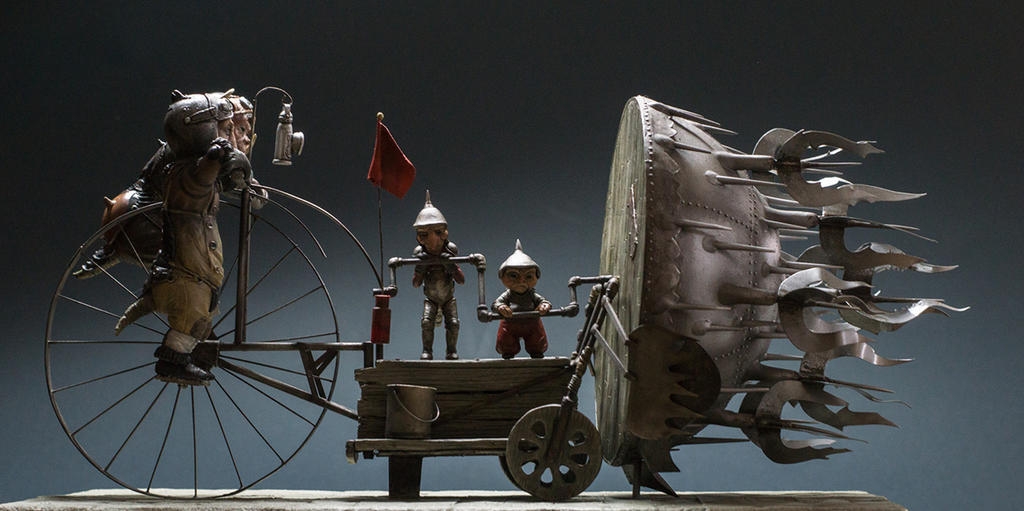
Oh, and here and there are bits of really odd technology and whatnot still in use, baroque and Rube Goldbergian and not necessarily being put to their originally intended uses. They kind of remind me of some of the contraptions of, say, the goblins in Jim Henson's Labyrinth


So that's the setting. How about the story?

It's a bit simpler. A bit.

We meet two apprentices from the Grey Tower (the only tower that's no longer under the direct control of a Lady). Kew was the apprentice to the tower's late Guardian, who trained him pretty well in Protecting (against what? Nobody seems sure anymore) but died without passing on the title and whatnot that would give him the authority to take over for her. There is only one way for him to get what he needs to do the job now, and that's to go find a Lady. And give her a cryptic message from his late boss: something or other is waking up. And it sounds like that might be bad?

Maybe?  

Our other apprentice-about-to-rise, Pell serves with the Grey Women (not Ladies, human women) who perform the rites and duties associated with death and birth. Pell helped with the services for Kew's mistress, witnessed one error, committed some others herself, and is now pretty sure that it's her fault that winter has come way too early to the Gray Tower and she must travel to other parts of the Castle to find out how to put it right. Is she correct in this?***

Maybe?

The West Passage, then, is kind of a double quest narrative, though one in which neither of our plucky young heroes really have any idea about the nature of their world, their rulers, or what they're supposed to be doing. Kind of like everybody else.

And the quests? Might not really be the point anyway. 

The atmosphere in which all of this takes place is deliciously strange and borders on the nonsensical, Lewis Carrol as interpreted by Jeff Noon via Mark Lawrence. It's not exactly hostile but it's not not hostile. Everybody remembers different bits of lore differently (delightfully, the old lore is referred to as coming from "story times," and the really, really old lore from "song times"), and many are desperately, jealously clinging to different bizarre privileges that may or may not be actually important to the overall survival of this world. 

What I'm still not adequately conveying here, though, is the sheer mad inventiveness of it all. For instance, at one point, thinking that a bee is merely something somewhat like what you and I would also call a bee, Kew, sure that he's done for, gasps to it "Tell them I tried," just to say some last words to something, if not someone. Only moments later, the bee turns out to have treated those words as a message, and to have delivered them to someone "with the face of a trout." Which Kew is not at all surprised by, and I don't think it's just because it's more surprising that someone is there at all than that it has a fishy head. And before we know it, Trout Mask Replica (not his real name, but come on) is asking Kew, who is still surrounded by hungry jackals, if he has seen any lizards about. "You'd know a lizard if you saw one. Big suckers. Teeth like boats."

There are tons of weird little one-offs like this, sending the message to us that this world really really isn't ours, that pretty much all the nouns should be in scare quotes, or at least the animate nouns should be, and that the more you pay attention to what's going on, the less certain you should be that you understand what's going on. I'm not going to accuse Pechaček of deliberately misleading his readers, but I'm not going to absolve him of this, either.

Let's just say that never has a book seemed more dissimilar  from my first to my second reading - and it was only a few months between them. I need a lot longer than that to forget things. But I was definitely watching the wrong pair of hands the first time around. 

So of course I'm thinking about Gene Wolfe, here. And you know I don't mention him lightly. And also of Jeff Vandermeer, of whose Area X this world could be a descendant, the Palace a thousandth mutant iteration of the Lighthouse, the Ladies and other creatures the descendants of Ghost Bird and her dolphin-husband.

But, of course, maybe it's always been this way, here. Beehives have always been things you can saddle up and ride out to someone's rescue. Fancy cakes were always made and decorated, not to be served and eaten, but to be tipped immediately out onto a midden heap almost as high as the Castle is tall. Butterflies have always been part of funeral rites in which they suck the corpse dry.

Adding to the fun is the book's habit of breaking up the narrative with odd passages that, say, invite us to consider what mistakes a character has already made in the course of a quest. It's again hard not to think of Labyrinth, which adds a lighthearted bit of whimsy here and there to leaven the heavy duty strangeness. 

If she'd gone that way, she'd be headed straight to that castle. 

And yes, sometimes, just sometimes, things hit that level of cute.

Believe it or not, all of this insanity comes to a very satisfying conclusion, one of the best I've encountered in recent years of reading weird fiction and Weird Fiction. While I would gladly spend much, much more time exploring this Palace and the world in which it exists, there aren't any cliffhangers, plot holes or loose ends leaving me clamoring for a sequel. Sometimes it's okay to write a stand-alone.

But I'm sure hoping Pechaček's got something else in the hopper that'll be ready to show us soon. I really get the feeling that, as many other reviewers have commented,  including my boys over at Death//Sentence, Pechaček is only getting warmed up.

This is cause to celebrate. And maybe to create an elaborate cake for... reasons.

 *Which, I mean, it was December, but also, caveat listener: narrator Steve West has a very deep and rich voice, distractingly so. He's like Jot Davies on a diet of virgin's blood and truffled chocolates. 

**As in when it's summer in one wing, it's fall in the next one over. Probably. But it's not quite as big as that suggests. Though it does take a few days' walking to get from one wing to another, so, still pretty big.

***Oh, by the way, both of these questing characters get new names in the course of the story, and one of them switches gender. Because this world is just like that, yo.

Monday, August 5, 2024

Tim Powers' MY BROTHER'S KEEPER

Anglican Church," he muttered. "You nearly never go to church anyway -- your church is the moors, your priest is your dog, your God is -- I don't know what. The wind.
Anybody who's been reading this blog for more than ten minutes knows how much I freaking love Tim Powers. He was the first author I ever put on the Automatic Buy list, long before I realized I even had such a thing.

But because he was the first and was, for a long time, the only, I still collect him in hardcover. Which is a format which I read with increasing difficulty as the years go by.

So while I was running around screaming like a little kid on Christmas Eve waiting for Powers' latest, My Brother's Keeper, to come out, had pre-ordered it the moment that was possible, I'm only now, almost a year later, finished reading it.

I beg you, do not take that as any kind of commentary on its quality, anymore than you should take its dirt-common title or its cover blurb from, of all people, Orson Scott Card.*

Because My Brother's Keeper is Tim Powers' tensest and creepiest read since he invented his own micro-genre of literary historical weird fiction (which lesser mortals have failed to duplicate. Cough. Seth Grahame-Smith. Cough) with The Stress of Her Regard, to which he returns here, not with a sequel like the serviceable but not exceptional Hide Me Among the Graves, but a true spiritual successor, pitting the Brönte sisters, their hapless brother and their Yorkshire parson father against a family of sort-of werewolves. I say "sort of" because these are werewolves in the way that the lamiae of Stress/Hide Me are vampires. This is still Tim Powers, an OG chaos magician of literature, the kind of guy who says "what if these classic monsters but both cooler and more sorrowful?"

And yes, of course there is a very Heathcliff-esque character striding the moors with Emily Brönte and her gigantic bull mastiff, Keeper (who is one of the best dog characters I've encountered in recent years and within recent years I read Jeffrey Ford's Well-Built City trilogy. Keeper ranks up there with Wood!), but he is not an inspiration for Heathcliff; the Emily of My Brother's Keeper already has a completed manuscript of Wuthering Heights in her writing case, has indeed been tempted by her brother, Branwell, to meet the wonderfully sinister and perfectly named villain, Mrs. Flensing, by suggestions that Mrs. Flensing has publishing connections in London. 

No, Powers just lets Alcuin Curzon, the "one-eyed Catholic" whom Emily and Keeper rescue one day, serve as a sort of unremarked-upon slant-rhyme to Heathcliff, the better to enlarge the imaginative power of she whom Emily Dickinson named "Gigantic Emily Brönte" by his presence, instead of diminishing her by creating a lame figure for her creation to be based on.

I like it.

Honestly, I haven't been this excited by a Tim Powers novel since the very first time I read Last Call. Do not snooze on this one, or I'll let Mrs. Flensing get you.

*Just, remember that we liked Card once, and he wrote some good books before he started milking his IP dry.

Saturday, July 15, 2023

Mark Lawrence's THE BOOK THAT WOULDN'T BURN

It's always the books you don't have that call to you, you know that. Not the ones already on your shelf. They can wait.
A new trilogy from Mark Lawrence is an inherently wonderful prospect, but one set in a giant, labyrinthine library that not only fills an entire hollowed-out mountain but whose inside is probably bigger than the outside and allows people who explore it enough to engage in a limited form of time travel? Aww, Mr. Lawrence, you wrote a(nother) book just for little old me? You shouldn't have. But I'm glad you did.
 
The Book that Wouldn't Burn is kind of set in the same world as Lawrence's Broken Empire pair-of-trilogies-and-some-sidequels*, but absolutely does not require any knowledge of those other books to enjoy. There are simply a few Easter eggs to tell us that the Library and its people exist somewhere in that world's timeline, plus the name of the city at the base of the Library's Mountain is Crath, as in Jorg of Ancrath. It might prove, in the projected next two books, to have more and more definite ties to the Broken Empire, but it needn't; they'd just be grace notes for Lawrence's fans, of whom I am one.

We explore this tiny-yet infinite world with one Livira, whom we meet as a little girl who shares a precarious existence with a kin-unit of maybe 40 people in a settlement out in The Dust, living on a meager bean crop carefully tended with water from a single well. We figure out quickly that Livira, nicknamed for a tenacious desert weed, is another avatar of the girl Lawrence likes best to write: smarter than her society expects or wants her to be, fierce, inquisitive and bluntly practical. Her perilous existence out in the Dust where she regularly gets into scraps with boys much bigger than she and fetches water from a well her settlement keeps having to deepen to continue its usefulness (and their survival) would be a fascinating study on its own, a Fremen tale without a sietch, like the original settlers on Arrakis, but Lawrence has different designs for little Livira.

For a start, humans are not/no longer the only sentient species on this broken earth, as we quickly learn when a vicious band of Sabbers (the word just means "enemy" in the common language of Livira's people) attack and destroy and round up all the human children they can find, whether to eat or sell as slaves, they're not telling, but no sooner has Livira discovered that at least one of them can sort of speak her language and has started annoying that individual with endless questions, than the Sabber train gets derailed by a loosely organized military or paramilitary band from Crath City, locus of the famous Library, to which it has always been Livira's secret wish to immigrate someday. 
Be careful what you wish for, etc.

Livira quickly learns that, while the Sabbers are regarded by Crath City's inhabitants and their King (who has everybody convinced he's descended from the original builder of the library and no, it is not possible to encounter mention of him and not wonder if he's an ancestor or descendant of Jorg of the first Broken Empire series) as barely more than animals -- it is Known that they interbreed with dogs, for example -- "Dusters" like Livira and her friends are considered hardly any more human; her kind are fit only to work and live in the city's sewers.

But of course Livira is not going to settle for being perceived or treated like that, and by the time she actually enters the city, she has already convinced one of her new captors, a man named Malar who quickly became my favorite character, that she might be worth a bit more to him if given a chance. Eager to be rid of this tiny pain in the ass, Malar steers her into the notice of a mysterious man named Yute. Yute sees her potential even more clearly, and picks her for a point-making stunt in the "Allocation" process that assigns young Crathians to their future roles in the adult world. When she then bulls her way into making an even bigger Point than Yute probably intended, she ends up as his latest protégé and a trainee inside the Library.

Interwoven with Livira's story is that of Evar, a young man who is trapped and has grown up, Piranesi-style, with four other children deep inside the Library itself, which is, of course, completely uninhabited and falling to ruin, but a Chamber within it has been semi-repurposed for human survival with a central pool and book-soil in which a small crop of foodstuffs can be grown. Evar and his siblings all emerged as young children from a mysterious Library device called The Mechanism, about which more in a bit, into which each had disappeared at various points in the distant past, not having aged despite having been missing for perhaps centuries. Alll, except for Evar, have come out of the ordeal with a preternaturally acute and useful skill set that amounts to superhuman expertise. One is a master psychologist, one the greatest assassin since the word was coined, another has most of the history of the world crammed into his head, and the group's only girl is a one-woman army, with a headful of tactics, strategy and weapons-lore that matches her homicidal hatred of the Sabbers. Evar, though, just has a hole in his memory and a vague notion that he spent his Mechanism-time with a beloved Woman whom he knew, even as a little kid, was his Destiny.

Evar and his "siblings" have been raised by strange and powerful android-like functionaries of the Library that reminded me of nothing so much as the bakelite robots who raise Ishmael the Cyclops Boy in B. Catling's Vorrh Trilogy, the Assistant and the Soldier. We learn much more about these two mysterious guardians as the novel unfolds, but that way lies way too much spoileration, even for this blog.

The Mechanism from which Evar emerged is a fascinating bit of kit, even for an infinite Borgesian Library: a person who enters it with a book winds up experiencing that book in a very direct and lifelike way that alters that person's character and experience of the world forever. This is how Evar's siblings all acquired their superpowers originally: they wen't into the Mechanism with authoritative non-fiction books under various circumstances (the one female in Evar's world, for instance, whose name is Clovis, was hidden in the Mechanism as a small girl with a Big Book of War Stuff right after watching Sabbers slaughter her entire family and kin-group and yes, Clovis is very much more like Lawrence's typical tough little girl and serves here perhaps to show us what Livira would have been like without the Library), and as part of their continuing education when the five of them came out of the Mechanism together, Evar's siblings have all continued to use the Mechanism to broaden and deepen their abilities. Evar, though, avoids the Mechanism, emotionally haunted by his lack of real memories of his experiences within it. The big difference we know of between Evar's and his siblings' Mechanism backgrounds is that Evar went into the mechanism with a novel.

Considerable space in the plot is devoted to the wanderings of Livira and of Evar through the fascinating mysteries of the Library**, which eventually bring them together, but once they're very tenuously together, Lawrence explodes both of their worlds in fascinating and (for me at least) surprising fashion. It is telegraphed early on that little Livira will eventually grow into Evar's mysterious dream woman, but none of that prepares us for how this develops; I thought I had anticipated the nature of the obstacles to their relationship but I was delightfully wrong! And the actual antagonistic forces pack even more of an emotional wallop than I'd been bracing for. 

There is also some of Lawrence's best prose-craft to date, as when Evar, freshly parted from Livira by cruel fate, contemplates how much she means to him:
...he could do nothing but love, need and want her. Whatever she looked like and whatever crimes her people had wrought, she was Livira, coiled around his heart, woven through his veins. He would find her again... at least there would be an honest parting between them, not one forced by sudden circumstance. And having lived his life within the confines of a library Evar knew that endings were important.
I haven't yet read everything that Lawrence has published -- for reasons beyond me, for instance, my local public library has yet to purchase either of the sequels to The Girl and the Stars -- but this feels like somewhat new territory for Lawrence's fierce skinny weed-girl heroine, whose relationships with other characters usually revolves around friendship and sisterhood rather than romantic love. He writes the latter as well as the former, all while also crafting my favorite kind of novel hands down: one that begs to be read again immediately from the beginning after a revelation near the end invites me to completely change my understanding of key story elements.

I really, really hope that Mark Lawrence and his crew at Random Penguin don't dilly dally too much in letting me back into the Library, is what I'm saying. I haven't been this tortured by the immediate unavailability of a book's sequels in a long, long time and I'm not sure what I'm going to do with myself while I'm waiting, besides, of course, read The Book that Wouldn't Burn again.

*Or at least it takes place in a world that can access the Broken Empire World via its Lewisian Wood Between the Worlds-esque "Exchange." And yes, Livira and Evar have some very Digory and Polly moments together there, but, as Livira eventually comes to discover, in whatever iteration of the old stories she is thinking, she herself contains both the Witch and the Princess, because Mark Lawrence is serious about his fantasy.

**The biggest of which are what it's really for and if it is a net good for the world or not. We come to learn that civilizations have destroyed themselves utterly in possibly planet-killing ways, over and over again, always with the help of the knowledge they recover once somebody discovers the Library. We just never seem to overcome the warlike side of our nature that leads us to harness knowledge for its destructive killing power, and this entire novel serves very strongly as an indictment of the alas, still very common, perspective that knowledge isn't any good unless it's practical, that culture and the humanities are useless and the people who want to study them are frivolous drains on society's resources, but Lawrence doesn't err on the side of "no, the humanities are More Important," just keeps firmly pointing out that knowledge without philosophy is dangerous as fuck.

Monday, May 8, 2023

Marina & Sergey Dyachenko's ASSASSIN OF REALITY (Tr Julia Metov Hersey, Narr Jessica Bell)

There is a kind of deeply pessimistic magical thinking that occurs to some people when they find themselves on the verge of falling in love (or, really, already having so fallen but not ready to admit it). We say to ourselves something like, oh no now God or the universe or fate or my enemies have another hostage for my good behavior. They know they can't actually hurt me directly because I'm hopeless already, but they can hurt this person that I might love, and hurt me that way. 

Marina & Sergey Dyachenko's Vita Nostra books are all about exploring what this means when it's literally true. Last novel, the hostages were heroine Sasha Samokhina's mother and Mum's new husband and baby. If Sasha didn't study hard at the weird school she'd been coerced into attending, terrible things would happen to her family. Examples were made when she tried to test this, even as she (was told that she) gave up her humanity in order to become something entirely else; her studies were preparing her to wield incredible power, and so there had to be incredible consequences if she showed signs of misusing it.

At the first novel's end, when she took the all important third year Placement Exam at the Torpa Institute of Special Technologies, Sasha, already acknowledged as the school's finest current student and poised to become a uniquely powerful Imperative Verb in the Great Speech, manifested as something even more alarming and unexpected than that. An Imperative Verb could profoundly influence other Parts of Speech (as she learned when she understood that her then-boyfriend, a Subjunctive Verb, would never really have freedom or free will while they were together), but the Password she turned out actually to be is more powerful yet. Too powerful. There must be consequences.

This second novel, Assassin of Reality, starts off with an imposition of some of those consequences, conducted in such a way as to free her original hostages for her good behavior from their roles, and introduce a new one: an attractive airline pilot, Jaroslav, who grew up in the town of Torpa and flies a regular route in and out of its municipal airport. They are immediately and ferociously attracted to one another, but it all feels rather forced and Sasha senses the hand of her terrifying advisor, Farit Kozhennikov in it all. 

It is, of course, only one of her problems. 

As she begins her fourth year at the Torpa Institute of Special Technologies, Sasha is, oddly, warmly welcomed back by her classmates, even those who previously resented her, but regarded with outright hostility by their most important teacher: their frighteningly altered former gym teacher. This teacher, Dima, whom everyone had been led to regard as a gentle himbo, is in fact every bit as scary as Farit -- maybe even more so, as he shifts between his himbo and his steely-eyed bastard personas moment to moment and without warning. And he teaches the most difficult and dangerous class yet, in which students must examine and manipulate diagrams that can manipulate them back, for the worse. 

It is Dima who declares Sasha an "Assassin of Reality" but won't explain why, and flatly refuses to teach her. Another instructor at the school with whom she has a better relationship tries to help her make up for this severe handicap, but with limited results -- and strangely joins her advisor Farit in encouraging her to let a love affair with Jaroslav happen! She needs, they tell her, a way to recharge herself, get away from it all, and, most importantly, a source of fear to balance out the spells of omnipotence that have led Sasha to believe, in her grander moments, that she can fix everything that's wrong with the world, even the fact that people have to die.

Speaking of dying, Farit has shown up with a new way of using Jaroslav to compel Sasha's good behavior, a way that doesn't harm a hair on Jaroslav's head, and is even crueler than casually reminding her that any airplane can crash. And it's as subtle as when the Tenth Doctor asks Harriet Jones' aide-de-camp if Harriet maybe looks "a bit tired." And as devastating.

Some readers have complained that Assassin of Reality isn't as interesting as Vita Nostra, which was, after all, intended as a stand-alone, but I think it's every bit as interesting, just differently so. Vita Nostra was first and foremost a coming-of-age, structured by Sasha's progress through her first three years at Torpa; Assassin of Reality, while still taking place almost entirely at the school, has far murkier territory to explore: adulthood, with its new responsibilities, burdens, freedoms and fears. Sasha hasn't graduated yet but the Placement Exam she didn't really pass so much as obviate at the end of Vita Nostra was still very much a rite of passage (which not everybody survived), and her life after it is very, very different.

Part of this is because we finally find out what happens to Torpa students after they pass the Placement Exam; first- and second-year students are simply told that third years move on to study "elsewhere" after Placement, but it turns out it's really "elsewhen" -- they are transported as a group 15 years into the future, effectively cutting them off completely from their families and former lives in general (with the exception of poor Kostya, Sasha's first friend at the school, who has the dubious honor of being the son of their terrifying advisor, Farit)! That this kind of means that maybe Jaroslav was just a kid when Sasha endured her first three years at Torpa is never really explored but it's hard not to think about anyway.

Moreover, this book masterfully draws out a thread of ambiguity, if possibility that has been there in this story all along. Except for Sasha's winged flights over Torpa and her deeply weird experiences of profoundly altered perspective, we haven't seen much that is overtly magical or supernatural. Even the supposed time travel could really just have been accomplished by updating the decor of the Institute and adding some newer technology.* 

There is always the possibility that Farit has simply manipulated Sasha and her classmates, threatened them, confused them, spirited them away from their loved ones, shut them in with a bunch of equally vulnerable young people and made them work to exhaustion and beyond at stuff that makes no sense. They get little sleep, are forbidden most outlets for normal youthful energy, and become convinced that their teachers and Farit have godlike power over them. What does that all sound like?

It sounds kind of like a cult, to me. Sasha wouldn't be the first young woman to become convinced, through a series of events and circumstances and, yes, abuse,  engineered to be as bizarre as possible, that she's had a few supernatural experiences. Possibly with the help of psychedelics in the tea everybody is always sipping?

"It's too much to just give up, isn't it?" Sasha was dizzy, as if Farit's voice was alcohol of the highest proof, or a warm poison flooding her ears. 

And just when Jaroslav seems poised to become a source of actual strength for Sasha, when he and his father seem about to become a new family to which she might gladly belong (she even starts to consider having a child), Farit, with just the barest suggestion, turns her against her new love. And it never occurs to her that Farit might have simply lied to her. By the time he poisons her love with a few words, she is convinced of only two possibilities: that Jaroslav and his father have been lying all along, or that while they might have been real and honest and sincere before, Farit has such power over time and reality that he has reached back in the history of their lives to make his whispered slanders into the truth. But the simplest and most likely possibility is not the correct one in this mixed up world of Sasha's. 

This is, of course, the least interesting way to understand what's been going on in these books and I don't necessarily espouse it. I do, however, admire the skill and care that went into constructing the world of these novels, such that the mundane interpretation is even possible. I plan to go back and read these first two books again before I tackle the third, Migrant which, I'm told, has already been translated by Ms. Hersey, but does not yet seem to have a publication date in English. I have, however, been working very hard on my Russian vocabulary, and an ebook of the original Russian edition was very inexpensive so maybe... maybe I'll jump the gun. 

Of course, I said that about the third of Rodrigo Fresán's Tres Partes, which was published in English before I was even halfway through the Spanish edition, so pfft. I will note, though, that my Russian is way better than my Spanish. 

Either way, I'm excited for Volume Three, even though this second book had a very satisfactory ending on its own. 

*Just because they were using physical books, pencils, paper and blackboards in Vita nostra didn't necessarily mean that plasma touchscreens, smart phones and computers didn't exist, after all, just that the school didn't provide them. This could be for reasons of budget, aesthetics or the behind-the-times requirements of pedagogy.

Wednesday, April 26, 2023

Marina & Sergey Dyachenko's VITA NOSTRA (Tr Julia Meitov Hersey, Narr Jessica Ball)

Book review sites, jacket copy and other official and unofficial arms of what passes for book promotion these days all seem to regard the remarkable Marina & Sergey Dyachenko's Vita Nostra as "dark academia" but the inestimable Popqueenie (to whom I owe a million more thanks for recommending this book to me) and I agree that where this book and its sequels really belong is in a category we've created, Beyond Yacht Rock-style, as The Magic of Language. To wit, it has more in common with books like Pontypool Changes Everything, The Flame Alphabet and Embassytown than it does with such wizarding school classics as the TERFing Classist Lady's books and Lev Grossman's The Magicians. Most of all, it is of a kind with R.F. Kuang's Babel, which overlaps these two made-up sub-genres in much the same way.

The school in Vita Nostra, the Torpa Institute of Special Technologies -- is a lot more rigorous than most literary magic schools, and I don't just say this because they use actual Latin on matriculation day. The curriculum is much more conceptual, bizzare, nearly incomprehensible, because in the Dyachenkos' magical system, the students first must undergo a lot of weird training designed to fundamentally alter, first their neurological makeups and, later, their very nature as physical beings on this earth, before they can ever even dream of exercising any abilities that defy or alter the laws of physics and other norms we consider as constituting realilty. Indeed; Vita Nostra feels to be fundamentally concerned with what the effect of supernatural-ish abilities would be on a human's nervous system than with depicting any jolly accidents with turning each other into critters or misfiring with a magic wand.

Our point of view character is a young woman, Sasha Samokhina, who catches the notice of a Torpa recruiter while on vacation with her mother. As Sasha's long-divorced Mum meets a wonderful new man and cautiously begins a relationship at a seaside resort, Sasha is stalked by an unsettling man in dark glasses and dark clothing that might at first seem like a Man in Black type but turns out to be much stranger and scarier; without ever spelling anything out or giving any overt demonstration of his power or how it works, he asserts a sudden and uncontestable power over Sasha. Within moments of his finally addressing her, she just knows that if she doesn't obey him, he has the power to destroy everything she loves or could love. Her Mum and Mum's new boyfriend, Valentin, are suddenly hostages to Sasha's good behavior.

Through a series of bizarre commands and requirements that begin with her being trapped in a time loop reliving the same single day of her vacation endlessly until she finally agrees to a bizarre sort of exercise program, and follow Sasha through her final year of high school, this man, Farit Kozhennikov, steers her right clear of her intended future -- a philology degree from her local university, which she will attend while continuing to live at home with her Mum, and someday a job as a professor -- and into enrollment at the mysterious Torpa Institute, where the professors are strange and the curriculum even stranger; their first year at school is largely spent poring over paragraph after paragraph of complete gibberish, which they must memorize and recite without ever being told what it's all for.

Of course what it is for is to begin transforming them from mere humans into, and here's where the Magic of Language stuff comes in -- parts of what is known as The Great Speech. And while most of the transformations are internal and not readily visible, some wild talents like Sasha's manifest early and unpredictably in the form of unstable metamorphoses that in some cases -- Sasha's and one of her stranger professors -- include the development of wings. Wings that actually let them fly about above the rooftops of Torpa late at night. 

Indeed, were it not for the fact that Vita Nostra -- the title coming from the Gaudeamus sung on the students' first day at the school -- contains no references to religion or spirituality beyond this title at all, I'd almost suspect that the school exists actually to turn humans into something very like angels, and yes of course once again I thought of my patron saint Jacopo Belbo (actually Umberto Eco, of course)'s quip that "God created the world by speaking; he didn't send a telegram" as Sasha's teachers carefully allow her only little drabs here and there of useful information about why she's at this school and being put through these courses of gibberish reading and, later, strenuous application of a peculiar form of mental geometry exercises.

Meanwhile, this is still at least in part a coming of age/school days novel, which means that yes, there is a soupçon of teen romance. The first fellow student Sasha meets upon arriving in the out-of-the-way town of Torpa, Kostya, becomes a bit more than her first friend, and she has another short but fairly intense relationship with a younger student in her second year at the school. These never overwhelm the overall plot or flavor of the story, though; they are all but inevitable experiences in a young person's life but they are very much not the point, which might frustrate readers who come into this expecting more dark academia but suited me just fine.

What I've found most remarkable about this book is how little anything gets spelled out for us but how perfectly we feel we understand what's at stake and what the consequences might be for Sasha if she fails, making the closing scenes of Vita Nostra a marvel of tension and anguish for all that what is actually going on is just the handing out of exam papers for the third year Placement Exam toward which they've all been working, the midway point of a Torpa education beyond which an impenetrable wall of mystery stands between first, second and third-year students and the final two years before graduate school.

Vita Nostra doesn't quite end on a cliffhanger as such, but does end on a note of possibility and ambiguity as Sasha experiences an even weirder Placement Exam than we've been led to expect. Having been given a general idea of the kind of part of the Great Speech she is going to manifest as and then Reverberate, she and we think maybe we know what's coming next, but boy do we not. So it was a good thing that a sequel, Assassin of Reality, has already been a) translated and b) released on audio; Jessica Ball's crisply British delivery was both enjoyable enough and unobtrusive enough for me to wish to continue this series on audio -- and I had a credit waiting to use to get that one, which I'm already devouring. And, well, there is a third book out in the world and it's already been translated, per Julia Meitov Hersey, but I don't know when it's going to be available and I'm getting pretty good at reading Russian and the Russian language ebook edition was just three bucks and so...

Saturday, April 15, 2023

Andrus Kivirähk's THE MAN WHO SPOKE SNAKISH (Tr Christopher Moseley, Narr Aaron Landon)

I first learned about Andrus Kivirähk via the film adaptation of his novel November, which introduced the world to perhaps the greatest folk horror monster ever, the kratt, a wholly unique monster that starts out life as a pile of junk before animating it via a few drops of blood dedicated to, of course, the devil. Once animated, a kratt will help you with your farm chores and whatnot, but you have to keep it busy or else it will turn on you. In the movie, and so I presume, the novel, one kidnaps a calf and flies it through the air forming with it cinema's very first cowlicopter! Plus, there are werewolves! 

Alas, as of this writing, that novel of his does not appear to have been translated into English yet. But the film is occasionally streaming and was popular enough here that your local public library might have it on DVD, as mine did. So until the book is rendered in English (or you learn Estonian) this will have to do. But wait!

Another of Kivirähk's novels, The Man Who Spoke Snakish is so beloved in the author's home country of Estonia that it has been adapted into a board game there, and has been translated into many languages including English! And it's even available as an audio book, decently performed by new-to-me narrator Aaron Landon, who has a voice in the higher range that isn't the most delightful to hear in straight up narration but Landon did a wonderful job on the many characters' voices, many of whom aren't even human so I'm still pleased with and gladly recommend the audio edition.

Set in medieval Estonia right around the time that land is becoming Christian and adapting its culture along the lines of the rest of Europe, The Man Who Spoke Snakish is chiefly a novel of culture clashes. Our title character and narrator, Leemet, has been raised among a handful of hunter-gatherer forest people, where he fed on a diet of  roast venison, wolf's milk and owl's eggs and listened to stories of his mother and the bear that was her lover (prefiguring Leemet's sister Salma's own relationship with and eventual marriage to another bear) until accidentally killing Leemet's father the day daddy caught them in flagrante. The bear, Leemet learns, was a gentle soul and so regretted killing Leemet's father that it castrated itself and vowed never to see Leemet's mother again. 

And we're off!

We quickly learn that Leemet's people are unusual for much more interesting reasons than their diet or habit of, err, bear-loving; some are still staunchly clinging to a very strict and proscribing paganism centered around "sprites," which beings demand a lot of sacrifices at all times and have very short tempers; others have focused on maintaining a fascinating and useful tradition: the language called "Snakish." A reasonably fluent speaker of the language can, of course, befriend snakes, as Leemet quickly does, acquiring a charismatic and practically-minded adder named Ints for a best friend, but what most of Leemet's people seem to use it for nowadays is to command animals. They summon deer to lie down and allow themselves to be mercifully and humanely killed for meat and hides; they keep herds of wolves in barns like cows and tell them when to sleep and when to meekly allow themselves to be milked and when to allow humans to ride them like horses for their sylvan wars, though those wars are nearly as much a thing of the past as is the Frog of the North, a giant flying amphibian who protects the forest people but who can only be summoned by a large number of fluent Snakish speakers calling it down in unison. Nearly, but not completely; we do get a bit of wolf-riding in The Man Who Spoke Snakish, but it's only one swift element in one of the novel's most exciting and action-packed and anguished scenes.

Meanwhile, "progress" has happened to most of the rest of Estonia. Most of the region's people live in villages, have converted to Christianity (though maybe not as sincerely as the colonizing knights and monks might wish; most of them treat it more like a matter of fashion than of faith), and speak German. And they are very, very keen on proselytizing to the forest people and trying to shame them into moving out of the forest and into the villages, giving up their weird diets and freewheeling ways for lives sowing, tending and harvesting grain, making it into bread, and eating that instead of owl's eggs and wolves' milk. And of course, obeying the foreign monks and soldiers ("Iron Men" as the locals call them) who have subjugated everybody else.

While Leemet is still a boy learning his first Snakish words, he meets a village girl named Magdelena and through her comes into contact with her father, Johannes, the village elder, who barely lets the Lemeet and the boy he was exploring with get a word in edgewise before he's commanding them to go tell their parents that they must move into the village and be christened with new, biblical names and give up their culture altogether, really. Cowed, Leemet kind of agrees but doesn't wind up actually obeying; he'd much rather hang out with his uncle, the greatest still-living speaker of Snakish, who sees in Leemet perhaps the last person who will carry his people's traditions into the future -- even though, because Leemet's father once fell under the sway of village life and wanted to eat bread, Leemet was actually born in the village, and is thus shunned as a village person by about half of the dwindling population of the forest.

He soon comes to have more unusual companions, befriending a pair of local "primates" -- possibly some last remnants of the Neanderthals or Homo Erectus? -- who treasure other animals, especially lice, which they have carefully bred until they have one as big as a child. It loves to go for walks and to go swimming in a nearby lake, becoming a new source of friction among the forest people. 

The giant louse also loves Leemet's childhood tagalong, Hia, a plain and meek little girl whose parents are the most ardent remaining devotees of the sprite cult and force her to behave at all times as a paragon of forest virtue, toiling to exhaustion every day to butcher all the meat needed to feed the hundreds of wolves her family keeps in a gigantic barn, and being force-fed wolf milk even though she can't digest it. The scenes between this giant louse and Hia are some of the most charming in a book that is long on charm -- but also on violence. 

The violence in this book is mostly at least indirectly Leemet's fault; his fascination with the villagers brings his world into more direct conflict with theirs as he discovers to his horror that all the former forest people now living there have not only forgotten Snakish but regard snakes as servants of Satan and mostly refuse to believe that Leemet himself is not a werewolf preying on their pitiful flock of sheep. 

Leemet spends most of the story trapped between orthodoxies and struggling to be left in non-observant peace. The villagers (save one) harangue him to give up his wicked "pagan" ways while the hard core forest people maintain he'll never be good enough for them, either, no, not even when he emerges as the last living human who can speak Snakish. And just when he thinks he's found a way to settle down in happiness with a sweet wife and his snake friends, both orthodoxies attack, demonstrating that his choices will never be respected. 

How Leemet reacts to being doubly hemmed in and to gradually losing everything he cares about may shock some readers, who find themselves rooting for a pair (a long-lost ancestor shows up late in the book and quickly starts stealing every scene he's in!) of violent anti-zealots bent on avenging their losses on the whole rest of the world. It's a strange feeling to be cheering on a gory rampage with a high body count, but Kivirähk has fashioned his tale and portrayed his hero well; by the time the rampage begins we understand completely the feelings behind every blow struck, quixotic though they all are. 

If nothing else, we come away with one important lesson: don't fuck around with Estonians. You never know who might have a pair of venomous fangs concealed in their smile, ready to bite anyone who corners them. Have some respect. 

Tuesday, February 28, 2023

Alice Brière-Haquet's PHAILANA (Tr Emma Ramadan)

What if the Mothman (of prophecy fame) were a little girl named Manon, lost in Jack the Ripper's London? Being relentlessly pursued by a would-be mad scientist and protected by a weird old lady and a pack of Very Good Dogs?

I mean, shut up and take my money, amirite?

In Alice Brière-Haquet's Phalaina (Greek for "moth") the Goodest of the Good Dogs, Giulio, even becomes a point of view character, as he is an agent of the secret Mothman People (I know it's basically the Secret Commonwealth aka Faerie, but they hang out with moths, have very moth-like habits and glowing red eyes; they are the Mothman People) via his friendship, not only with Molly, the woman who becomes Manon's human protector after Manon escapes from a convent, but with a strange and gangly man with weird abilities who is seeking to reunite Manon with her people. Her people who live in a special harmony with nature and can communicate telepathically with each other and with all animals. Manon can't yet because she's still a larva, basically.

Giulio doesn't entirely steal the show, but he does emerge as Phalaina's most dynamic and dependable hero even when he's not the point of view character, so I think perhaps this novel should actually have been named for him, but then someone would have to explain the cover art (though I like how, in the American edition, the upper wings of the moth depicted look almost like dog's heads in profile and the lower wings, combined with the tree's trunk and a hollow at its base, form yet another dog's face! I wonder if that was intentional? The cover artist for the English language publisher, Levine Querido, is not listed on the copyright or title page, dammit!). 

Ah, but the Mothman People are not her only people; Manon had a human father, a famous and wealthy professor, Dr. Humphrey, who corresponded with Charles Darwin and started an important scientific foundation before dying in a mysterious carriage crash out in the boonies, which some sinister types know Manon was in but survived...

Among the sinister types are the hilariously Cruella DeVil-ish Harriet Humphrey, the dead professor's sister and sole heir -- unless proof surfaces that he had a child, say -- and her icky boyfriend, John, who was the Secretary of the good doctor's foundation and is helping Miss Humphrey to locate Manon, but maybe not in service to Miss Humphreys' or Manon's interests!

The resulting tale is a chase narrative reminiscent of, say, The Quincunx (but written for a middle grade audience) tinged with all of the coolest cryptid stories, Charles Paliser meets Coast to Coast AM minus the mRNA vaccine hysteria.

Translator Emma Ramadan kept this book's intended audience very much in mind and kept the prose clear and direct, though for some reason decided that the very modern (I think?) "heave" was a good usage to convey nausea and vomiting in a historical fantasy set in the 19th century, which usage tripped me up every time. I doubt the intended readership will even notice that, though; they'll just be having a good time while absorbing the book's very timely message about living in harmony with, versus dominating, nature. What a different world we might have now if that message had gained more traction back then. 

I hear Alice Brière-Haquet has written a few other books. Perhaps the next time I'm in the mood for some weird fantasy from the French, I'll grab one and spend some time with her again. She is delightful!

Tuesday, April 19, 2022

Alan Moore's JERUSALEM (Narr by Simon Vance)

"That's what art's for; it rescues everything from time."

An early chapter in Jerusalem, Alan "Swamp Thing" Moore's enormous contribution to prose fiction, depicts a black man, born a slave in the United States but freed by the Emancipation Proclamation as a teenager, whose wanderings have landed him in and around Northampton, England in the early 20th century. Henry, sometimes called "Black Charlie" by the locals, first surfaces briefly in a prior chapter as a figure that chapter's point of view character (who is actually named Charles but goes by "Oatsey," a nickname derived from Cockney rhyming slang and who turns out to be someone famous you're going to have to read the book to find out about) encounters at two interesting moments in that character's life. When the next chapter proved to be focused on Henry/Black Charlie, I felt a rare delight in that the author had recognized that a figurant in one story was interesting enough to deserve his own chapter. As I've observed here before, I have a habit of getting more interested in background or side characters than I am in the protagonists, and I'm usually left frustrated. But not here!

And not only does Henry get a fascinating back story and a fulfilling afterlife in "the Upstairs"*, but his chapter is the most moving one yet encountered as one settles in to this enormous work of over 1200 pages (just over 60 hours!). Henry, who travels the countryside on a sturdy bicycle with ropes for tires, drawing a cart as he goes about his rounds, with wooden blocks attached to his feet for braking (because this is from before bicycles had brakes) learns near the beginning of his day that his favorite hymn, "Amazing Grace" was written by a pastor at a church in Olney, which is not far from where Henry hangs his hat and dotes on his family. On a whim, Henry takes time out from his ordinary rounds to visit the church and bask in the wonder that a white guy in England wrote a song that Henry has always felt best reflected the Black experience in America. Upon arriving, he is disappointed to learn that the pastor, John Newton, is not buried by the church in Olney, but, as readers who already know about John Newton, or even can just guess there's going to be some irony here, can foresee, this isn't going to be Henry's worst disappointment of the day. Go read about John Newton at that link, if you don't already know.

We are spared a scene where the kindly churchwarden who admits Henry to the building and shows him Newton's portrait reluctantly shatters Henry's illusions about the author of "Amazing Grace"; when we pick up with him again he is pedaling home and having to stop every mile or so to wipe the tears from his eyes.

Of course, I had to wipe my own. Alan Moore, what are you even doing to me, man? I was ready for some crazy magick (I'm a huge fan of, for instance, Promethea) or some gratuitously gross Lovecraftiana (seen Neonomicon? Jacen Burrows was the illustrator, if that gives you any clue on that score), or another round of "let's dump out the whole box of action figures and make them fight evil together (Hello, League of Extraordinary Gentlemenor some intensely esoteric and deep pop culture local to Moore's hometown of Northampton (Dodgem Logic, anyone), but not to get my heart torn right out of my body and squeezed dry before I'm even sure what this enormous doorstop of a novel is really going to turn out to be!

Which is kind of a hybrid between one of Edward Rutherford's better efforts and B. Catling's Vorrh Trilogy (even to including quite a significant role for one William Blake in its back story)**, except tossed into a kaleidoscope, there to be manipulated with manic energy at varying speeds by its author-operator. Ah, there at last is the Alan Moore I expect.

Interestingly, the reader's experience of Henry's "Amazing Grace" experience makes a useful lens through which to look at one of Jerusalem's larger themes; for as much as it is geographically concerned with Northampton and the region within it known as "the Boroughs", it is, in terms of character, somewhat focused on a peculiar family, first known as the Vernals and later the Warrens when a woman of the family in the early 20th century marries a man named Tom Warren and it's their descendants we subsequently meet and observe, who have been marked out by an ancestor's possibly fated encounter with an angel (and these angels are just as weird as Catling's Erstwhile while also partaking of, at least metaphorically, the internet's obsession with the weirdness of "biblically accurate" angels) in the 19th century. A strain of supernatural power that presents as a distressing mental illness appears in many of them, but what it amounts to is that they have come to perceive time very, very differently. They see all of it at once. So, for example, when John "Snowy" Vernal's first daughter is born, he can't handle the birth because he already knows how her whole life will go, what tragedies she will face, and how she will die in 80-some years: all alone and not even noticed for a few days. I'd probably jump up on a nearby roof instead of watching the delivery, too, Snowy.

So our experience of wincing in anticipation for Henry's loss of innocence regarding the author of "Amazing Grace" (presuming the reader already knows the realities of John Newton's life, which I think is pretty commonly known now? But I live in a bubble of internet where it is and maybe you don't? Anyway, pretend you did because it's dead easy to educate yourself) mirrors that of Snowy and others of his family, earthbound kwisatz haderachs without the benefit of sworn fedaykin or interstellar travel.

The Vernal-Warrens, often in sibling pairs, continue this weird existence well into the 21st century, in which their unique birthright as sort of supernatural watchmen of "the corners" makes them an integral part of a great universe-defining Event set for 2006, for which the first half or so of the book, including a whopping 11 chapters of a toddler's near-death experience, is just table setting and elaborate foreshadowing and even so when the Event finally comes, the reader is by no means ready for what's coming.

A lot of this book is written from a sort of multidimensional, godlike perspective we've seen Moore play with in, for instance, Watchmen, whose Dr. Manhattan character narrates his experience in an omniscient "everything that happens is happening at once" style, finally perfected for Jerusalem because the characters in Jerusalem afflicted with this power still care. They care deeply, whether they are angel-Builders who know that what they're asking of the Vernals will be hard for them or fathers who know that their granddaughters are doomed to die young even as they watch the baby's mother being born. 

This continues even into the novel's ostensible main character (and Moore's self-insert figure), the irascible, seemingly sociopathic artist Alma Warren - whose younger brother, Mick, was the toddler who spends eleven chapters choking on a cough drop while his spirit is lead on a bewildering and revelatory tour of time and space by a gang of deceased fellow Northamptonians who have chosen to spend their afterlives as street urchins calling themselves the Dead Dead gang*** -- is passionate about the welfare of what's left of the denizens of her beloved Boroughs, where England has been stashing its unwanted working class and its unwanted weirdos for some 800 years, and mad as hell at how the forces of globalization and gentrification (given form in the Upstairs as a giant torus-shaped chimney, sucking in and burning up the very substance of the world from a spot near a pub) have torn the community apart and especially what this means for its older citizens who have known no other life and are suddenly uprooted and moved into unfamiliar apartment blocks full of strangers. This is her hobby horse and the great subject of her coming art exhibit in 2006, which is ostensibly the Event towards which everything else in the novel is leading us, except...

Except about halfway through one figures out that the most important person in this novel is one whom we've barely met, who doesn't even get a name unless you're paying very close attention/going back to re-read or re-listen to sections (her name is Marla). She's just a poor, drug-addled sex worker whom we see sort of in the background of other scenes in 2006 and for most of the novel she's just a bit of local color, until we realize [SPOILER ALERT DUH] that she is the same person whom Mick briefly met during his tour of the Upstairs, a woman who had a terrible past but turned it around and wound up doing an incredible amount of good by developing a questionnaire that helped a future-from-our-perspective UK government humanely and sensibly handle a flood of climate refugees and all around prevent the country from becoming, say, what we see in Alfonso Quarron's searing Children of Men.**** She's so important that Asmodeus himself tried to manipulate a young and ghostly Mick (newly arrived in the Upstairs) into promising to help Asmodeus kill her someday, but instead, with the help and inspiration of the Dead Dead Gang, he helps rescue her from a client-turned-rapist who has decided to murder her (this act of heroism also involves ghosts from other time periods and living relatives of Mick and Alma but it all starts with the Dead Deads).

But up until her escape from gruesome death, she has been the only person we've met who hasn't gotten the Henry treatment. Do you think maybe Alan Moore has a point in all of this? Maybe something about always be kind and stand up when you can because you never know how important what you've done might turn out to be for future generations, maybe? What a silly, comic book writer thing to spend 1200+ pages to tell us. Silly, silly Mr. Moore.

Anyway, like we always love to joke about Gene Wolfe, patron saint of big complicated books you have to read many times to understand, I just read Alan Moore's Jerusalem and all got was the sinking feeling I'm going to have to read it again. Because I almost got too distracted by the epic flights of fancy (we haven't even talked about Snowy Vernal's afterlife, journeying to the very end of time and space itself with his beautiful baby granddaughter on his shoulders!) to notice this, and at first I actually found the ending of Jerusalem a bit of a let-down. But it's not. Because what seems like the ending -- Alma's exhibition and its moderately satisfying but decidedly not epic denouement -- isn't the point at all.

Magicians are tricky.

Anyway, wow.

*Which is sort of Heaven-like but a lot more interesting than most afterlives, incorporating as it does a lot of elements of the kind of space-and-time-bending geometry that marks the last act of Christopher Nolan's Interstellar but still manages to serve as a stage for a lot of good old fashioned character drama and a rollicking good post-mortem adventure story. Because Alan Moore

**Others have insisted this is a sort of James Joyce homage/pastiche, and there are certainly elements of that, but for me the Rutherford/Catling elements are far too prominent in comparison to the Joyce ones, for all that there are whole chapters of Joycean near-gibberish - which, cheers to Simon Vance for rendering so perfectly comprehensible that his narration has half- convinced me to try Finnegan's Wake after all. 

***And if you're thinking those eleven chapters are my favorite part of Jerusalem, gold star to you. Mick's adventures with the Dead Dead Gang are so delightful even the denizens of the Upstairs are fans, because one of the kids, Drowned Marjorie, managed to write and publish a complete account of them in the afterlife, but hasn't yet as these adventures take place, except the kids keep running into beings that are huge fans of theirs and do them favors as a result, because time is way more than wibbly-wobbly and if Alan Moore is ever allowed near Doctor Who it'll pretty much collapse all of existence. 

****A movie that came out in 2006, which is the year in which Alma's Exhibition and the Rape of Marla/Kaff take place and this cannot be a coincidence; if there's any writer living who pays razory attention to pop culture, it's the Wizard of Northampton.

Friday, December 31, 2021

Kij Johnson's AT THE MOUTH OF THE RIVER OF BEES

"Where does it begin?" she says at last. "Where does it end?"

He is slow answering and she knows he is as trapped in its weird beauty as she. "No one knows," he says: "Or no one says. My dad used to tell me tales, but I don't know that he knew, either. Maybe there's a spring of bees somewhere, and it sinks underground somewhere else. Maybe the bees gather, do this thing, and then go home. There's no ocean of bees anyway." 

No guesses as to what attracted me to Kij Johnson's fantastic short story collection At the Mouth of the River of Bees. My proclivities are well known to you all by now. But I mean, come on, just look at this cover. And yes, I think this bee's mouthparts look kind of weevil-y, but bees come in lots and lots of varieties and mutations and variations and I mean, she's just cute, right?

Johnson first won my devotion with her extraordinary Lovecraftian novella The Dream Quest of Vellitt Boe, which took inspiration from Lovecraft's The Dream-Quest of Unknown Kadath, a piece HPL neither revised from its early draft nor got published in his lifetime, but which might just be my favorite thing he ever wrote and yes of course at least part of it is because Chad Fifer sold me on the space-faring kitty cats. For her take on this crazypants universe, Johnson gave me a childless spinster just like me as a tour guide, and I'm forever grateful for the resulting adventure.

So my expectations for this story collection were quite high going in, and I'm delighted to say they were more than met! For one thing, Johnson shows mastery in pretty much every sub-genre of speculative fiction here, meaning there is guaranteed something for every reader here. For another, she is that kind of writer best for short stories, a master at quickly sketched world-building that still feels complete even in just a few lines, the better to get on with the storytelling. Not everbody can do that, but Kij Johnson sure can.

I'm not going to discuss every story in the collection, though every one of them has something astonishing or thought-provoking or just plan cool to offer and only one of them is one I'd skip if there's a next time I read this collection because yuck (but yuck, too, can be a testimony to a writer's powers!).

But let's talk about themes for a moment. One is loss; many of these stories are explicitly about losing something, someone, or a whole lifestyle, and how to cope with it (not always gracefully) or, in one notable case, postpone it for a while. Another is animals, anthropomorphized or not. Another is Asia; several of these stories have explicitly Japanese or generally Asian-inspired settings and bear that extra burden of "writing the other" but bear it very well indeed.

Best among the animal stories (though not quite of the Asian) is the delightful "The Cat Who Walked a Thousand Miles" and no, no evocation of that song is necessary, thank you. Our little heroine, Small Cat, does not fall down at anybody's door, for a start. Raised in an abandoned city house and garden in Japan by a large family of feral cats who've developed their own take on fudoki, to which she hopes to add someday, Small Cat sees the downfall of this feline paradise and decides to live out a story from her ancestral fudoki about The Cat From the North, in reverse; instead of coming from the north, she will go north, eventually going as far north as a cat can go without crossing an ocean. Her adventures along the way are by turns exciting, heartbreaking, charming and adorable.

Of the Asian themed ones, "The Empress Jingu Fishes" is a standout. The titular empress is a shaman, blessed/cursed by the gods with complete and perfect foresight. She knows when she gets married that her husband would not live long, so she loved him as well and as fiercely as she could. She knows that he will die while their kingdom is at war with a neighboring one (though not the one the gods had commanded them, through her, to attack) and before their son could even be born. She knows that their son will be a great emperor in his time and will eventually be elevated to godhood. She knows all of this while she sits by a spring and fashions a line, hook and some bait to try to catch a trout that she doesn't need purely to feel at least a tiny illusion of having a bit of free will; she is powerless against the forces that took her husband and will take her son and wants to kill something, but this is her sole opportunity to do so. It's an exquisite tale.

Other stories are closer to our own experience, or seem that way at first. For instance, "Names for Water" seems like a mundane slow burn about a student looking for excuses to skip or even drop her math class and change her major, but turns out to have galaxy-spanning impact and implications by the time its few pages are off the paper and in the reader's head. For all we know, little things like this are happening every time our cell phones ring. But probably not. Kij Johnson is much better at writing realities than the hacks in charge of the one I live in are.

She's also good at 17th century naturalist pastische, as it turns out. "MyWife Reincarnated as a Solitaire - Exposition on the Flaws in My Wife's Character - The Nature of the Bird - The Possible Causes - Her Final Disposition." is just that, both a biting satire on the pompous and patriarchal style of narration fashionable at the time and a delightful poke in the eye of the kind of patriarch who wrote that way, as it tells the story of how his much disliked wife apparently reincarnated as an extinct flightless bird, as the title gives away, but has gotten a last laugh on him right under his nose the whole time. Henry Fielding would applaud. And possibly bite his thumb at Kij Johnson, sir. As such.

Then there's the title story, "At the Mouth of the River of Bees" in which a young woman and her ailing German shepherd find themselves on a road trip like no other, compelled to follow the course of an annual migrating bee swarm so large and long that it blocks major highways for days on its northward course. What she finds at the end of the journey is terribly bittersweet and doesn't have a whole lot to do with bees, but like in my favorite Paul Valery poem, the bee isn't really the point; it's a "tiny gold alarm" there to sting us into taking necessary action. For some reason, I pictured this as a major motion picture starring Dakota Johnson. Your milage may vary.

A final favorite I'll mention, and the story that occupies the biggest chunk of the volume, is the extensively imagined and constructed "The Man Who Bridged the Mist" which takes us either to a fantasy world or a science fiction one -- it doesn't really matter which -- in which a society at roughly the medieval level of technological development must contend with a unique geographical feature if its to extend the benefits of civilization to its outskirts and other side. Not only is there a vast river of water dividing the Empire, but over top of it is another, more dangerous and weirder, river of "mist", but it's not like any mist we've ever encountered. It flows along the course of the water but it's denser than water, dense enough to row boats across but corrosive AF and prone to strange disturbances and, oh yes, home to monsters the locals call Fish but are unlike any fish you or I are thinking about. For a start, the Big Ones could destroy whole towns if disturbed enough to surface. Our fish out of water coming to this mist-river is an architect there to build a vast suspension bridge across it, the first of its kind. The majority of the story concerns this effort of his and of those he hires to help him, including two members of a family whose hereditary duty has been to ferry people and cargo across this river, who won't be needed if this giant construction project is successful. This story I'd especially recommend to people who like reading about logistics and mundane projects like building. I promise you it's not boring for those who aren't into that sort of thing; just that those who are, will especially like this one.

There are also stories about marauding tribes in another fantasy-or-sci-fi setting (and how I love that Johnson is comfortable letting these settings of hers be either, just fine with the ambiguity), a bureaucrat who is being groomed for minor godhood but doesn't want to leave his mistress, a family of foxes who beguile a young husband into madness in order to survive, and an exceptionally brutal Galactic empire and how its tactics for keeping everybody unified actually affect populations at its edges. Like I said, there's not a bad story in the bunch, though if graphic and weird sex isn't your cup of tea, maybe skip "Spar", the slightest of these stories in any case.

All in all, this was the perfect collection with which to wind down my reading year, cementing Kij Johnson as a writer to watch and filling a lot of little moments in between tasks in exactly the way I most want a collection of short fiction to do. The buzz was warranted.

Saturday, November 20, 2021

Caitlin Starling's THE DEATH OF JANE LAWRENCE

you tried to live a small life, jane shoringfield lawrence. you tried to have no regrets. you tried to control everything. and now you are here, filled with guilt. how many have died because of your actions? because you married a man who did not want to marry, because you made him care enough to lie to you, because you forced him to confront those lies?

That's a pretty intense bit of dialogue-or-monologue whatever the story it's in, but coming from the mouth of a unique monster in the middle of a gothic novel that seems at first like it's going to be so by-the-books a gothic novel that it needs to have a woman with great hair running away from a building on the cover, it's more intense still, and that's what The Death of Jane Lawrence is from the get-go: intense. 

The novel at first seems like a gothic take on my beloved Middlemarch, and in many ways it is as I'll discuss a bit below, but we quickly learn that it's actually set in another world, in which the Great Britain analogue fought a terrible war on its own soil against a Russia analogue, and many ordinary civilians who took on the job of helping the injured and the trapped when cities were attacked or fell, were killed by chemical weapons. So this argues for it being a post World War I story, but there are no internal combustion engines or electricity; indeed, only the poshest of houses has gas lighting, so the feel is of the 19th more than the 20th century. Also, a kind of magic actually works, maybe. We'll get to that.

Jane Lawrence is our heroine's married name, though she starts off the novel as a PTSD-riddled ward of her late parents' friends, newly adult and faced with a tight situation. Her guardians are moving back to the city where her parents died horribly in the war, which she doesn't want to do, but the income she has from her parents isn't quite enough to live on by herself, so she needs to find a way to supplement that somehow. She is a self-taught accountant of considerable skill, but the alternate England in which she lives isn't quite ready to countenance a single young lady supporting herself that way, yada yada, point is, girl needs to get herself married. But see that bit where she's a self-taught accountant? There's a bit more to it all than that; Jane doesn't really do people, she does numbers. Brilliantly and often, and often to the point of not noticing that she's been doing numbers for ten hours without a break and oh, somebody's been trying to talk to her for the last twenty minutes oops.

Enter Augustine, not exactly the Tertius Lydgate to her Rosamund Vincy, but he is a well-educated and idealistic doctor who could have had a brilliant career elsewhere but is practicing in their quaint little town and living in his family's seriously dilapidated estate, so he is very Lydgate-ish if Jane is no Rosamund*. Lydgate-ishly, too, Augustine is known to be less than a brilliant businessman for all that he's a great surgeon, and so seems perfect for Jane, who doesn't want a husband so much as she wants an employer who can't fire her. Augustine has no wish to get married, but she quickly out-logics him and shows him he's better off with than without her, and quickly the two quickly reach a very businesslike arrangement with some odd conditions: Jane is to live in town in living quarters above Augustine's office, while he goes home every night to the aforementioned estate. She's not to ask why, nor to explore, maybe she'll get to have a peek at the place once in a while someday but never at night, etc. In other words, Augustine Has Secrets.

Circumstances, of course, force them out of their perfectly planned arrangements almost immediately, starting with the fact that oops, they're attracted to each other, rather ferociously. And then, oops, a mix-up on their wedding day teams up with an epic thunderstorm to trap them both overnight on Augustine's dilapidated estate full of secrets, some of which Jane has personal encounters with. Oops, oops, oops!

Chief among these secrets are terrifying reflections in darkened windows and dusty mirrors (dilapidated is actually a kind word to describe the state of Augustine's stately home; it's a barely habitable dump) of a young woman with blood red eyes and terrifying aspect. But Augustine's aspect is not merely that of a man who lives in a haunted house, as Jane quickly discovers; as I said, in this world, it's possible that a kind of magic exists, though it's a far cry from the mediums-and-Ouija-boards the ghostly apparition sets us up to expect; this world's magic owes more to that of Diane Duane's Young Wizards series than to any ordinary fantasy novel. Which means that, yes, Jane's got "a mind for magic" more than most of the other practitioners we encounter in this story, which might all be fine and good except it's via this maybe-magic that the monsters I quoted at the beginning of this entry have found their way into Augustine's house and Jane's life.

The last third of the book is chiefly taken up with Jane's reluctant embrace of her abilities (for very good reasons) and the various emotional, moral and physical costs of her doing so, and this novel does not pull any punches in describing them. She nearly starves, has to confront every fear she's ever felt in vividly rendered detail, and has to do some pretty gross things. This is not a story for sissies, though the 19th century medicine angle should have scared them off already.

But if, say, Sarah Chorn is not cranking out her tear-jerking gutbusters fast enough for you, I'd say you could add some Caitlin Starling to your TBR pile to fill in the gaps between Sarah's books. And if Sarah is new to you and Caitlin is not, well, you know what to do. Go make with the clicky.

Just have some kleenex handy.

*For one thing, she gets roped into helping with a dramatic and bloody emergency case on her very first day at his office, which is only the second day of their acquaintance!

Monday, July 30, 2018

B. Catling's THE ERSTWHILE

Where the first book in B. Catling's Vorrh series, The Vorrh, was a scattershot of interesting ideas, weird characters and language games, its sequel, The Erstwhile, is a bit more conventionally readable, while losing none of the prior's strangeness. All in all its a much more enjoyable read, but I'd kind of expected that.

I only took up the first book after reading a few tantalizing reviews of the second, which focused on the title character class. The Erstwhile are basically remnant angels, those who had failed to defend the Tree of Knowledge from Adam (Eve is never mentioned in this derivation from the book of Genesis) and were cast aside and forgotten after that little mishap. In the thousands (millions? Catling takes no stance on how old the Earth might be) of years since then, these angels have gone to ground -- literally in some cases -- and devolved into weirdly malformed monster shapes with moss and plant life growing on various bits even before they became completely quiescent.

Or so it seems until some of them start interacting with humans again, usually when they are accidentally discovered in and around The Vorrh by European colonists looking for resources to exploit there. When a few of these beings are dug up and shipped back to Germany, they come under scrutiny and care and start to seem human-like. And when one emerges mysteriously from the mud on the banks of the Thames in the 18th century and becomes the freaky muse of one William Blake (yes that William Blake, whose image of Nebuchadnezzar graces the cover of this novel and in this story is understood actually to be a portrait from life of one of the Erstwhile), and then spends a century so drifting among human society in London, that one becomes so human that he takes on the name of Nicholas Parsons and becomes a sort of trustee at Bedlam.

Meanwhile back in the Vorrh and the colony city of Essenwald, all of the characters who survived the previous novel are trying to live out their lives after those weird events, with varying degrees of success. Ghertrude Tulp is mysteriously pregnant but not sure by whom -- Ishmael? Some random guy on the same carnival night that Ishmael slept with Cyrena Lohr and by so doing cured her blindness? Ishmael and Cyrena are living together in her sumptuous house and getting tired of having sex with each other. And the city is in steep economic and social decline since the Limboia, the "mindless" slave labor force that kept the timber industry going in the last novel, have up and disappeared. Others have tried to take up the work, but unlike the Limboia, they can't handle the weird powers the forest exerts on puny human minds -- namely all but erasing them.

Soon Ishmael, the only man anyone knows who has traveled through the Vorrh without losing his memories and mind, is drafted into leading an expedition to go find the Limboia and it's all a bit like Werner Herzog's Herz aus Glas.

Already you can see that this novel has a lot more of a conventional focus and structure to it. The expedition provides one of its main narrative threads, twined with another in which a new character, Dr. Hector Schumann, is called upon to take up the mysteries posed by the Erstwhile brought to Europe. A third story, of a lonely old woman who rescues a mysterious baby from the abandoned home of The Vorrh's white savior figure and his black shaman mistress/wife, is woven in less well for all that there are structural parallels between it and the Schumann story in their final thirds. And the fate of Ghertrude's baby is, I guess part of all of this, too, but not really?

For this book is a textbook case of Middle Chapter Trouble. For all that it's a much more enjoyable read than its predecessor, it's even more frustrating, in that exactly none of the questions or problems it or the prior book poses gets resolved at all, leaving a lot for the final book, The Cloven, which just came out, to answer. But, to be honest, I have zero hope that anything will actually get resolved, because Catling isn't here to try for narrative coherence. He's all about the language.

And some of this is downright beautiful:
The stillness of the water became a secondary feature to the movement of the snow. It fell straight down into its own reflection on the mirrored Thames, the depths of the reflection rising up to meet it. Each flake fell from a black sky and fluttered up from the river's black bed to meet its twin and become one before disappearing.
I mean, god damn!

A lot of the time, though, Catling threatens to become downright annoying, especially when he gets precious with malapropisms -- which I have to assume is what he's doing because otherwise 1) He's kind of a doofus and 2) The editorial staff at Random Penguin all need remedial courses. I'm assuming its deliberate because I'd rather that were true. But there sure is a lot of "finally crafted jewelry" and whatnot in here.

But so maybe it's just sunk cost fallacy working and maybe it's still just good enough to make me want more -- I really can't decide -- but I'm looking forward to The Cloven. But I've got a lot of library books to get through before I go looking for it, because right now I'm Vorrhed out.