Showing posts with label space opera. Show all posts

Sunday, June 7, 2026

Ursula Whitcher's NORTH CONTINENT RIBBON

Sometimes there's a better way to show me the society, the world an author is imagining than via a single piece of narrative fiction. If you've created a truly richly developed culture that really differs from ours, it can be more effective, by which I mean both more efficiently communicative and more interesting for me as a reader, to show me facets, via vignettes or mini-biographies or, most gracefully, short stories about different characters occupying different roles in that society. And the stories need not necessarily overlap or interact, nor do they have to depict earth-shattering crises or huge personality conflicts or major civilizational turning points, either. An older example of this is Lucius Sheperd's story cycle surrounding the vast corpse of The Dragon Griaule; but I've found an even better one here.

Ursula Whitcher's phenomenal story suite, North Continent Ribbon, where, as the cover explains to us, "every contract is a ribbon, and every ribbon is a secret," depicts one of those imagined worlds that would feel like a fantasy setting if the tales within were read out of order; several of them involve no science fictional wizardry or even much-beyond-medieval era technology. Were it not for its opening matter, which declares that it comes from a larger work named Cross-Planetary Investment: A Practical Vraselian's Galactic Opportunity Handbook and informs us that the planet on which most of these stories take place is an important source for "faster-than-light vehicular components sourced from a high-orbit E-type singularity," the society on the North Continent of Nakharat would be all but indistinguishable from one of the weaving planets in Andreas Eschbach's The Carpet Makers, for instance.

But amidst its tales of ribbon-crossed lovers and sundered families and somewhat shady business dealings, we get hints that there's a lot more going on than just trade and agriculture and the many different ways love can come and go in human lives. There's the question, for instance, of how those aforementioned vehicular components, once assembled into faster-than-light vehicles that navigate through what this culture refers to as the deep*, are sourced. And what they even are. Which, it might seem as one pages through this slim little volume, are questions that might not get answered? At least not explicitly?

At least, not if you're not well versed in the kinds of science fiction and fantasy that I love best, where what's going on between the characters is not the whole of what's going on in the book, might even be a distraction from that, actually. See also Gene Wolfe and M. John Harrison and Frank Herbert and Alastair Reynolds.**

But even if you're not willing to plumb the weird and somewhat distressing secrets of this world, Whitcher still has plenty of rewards for your attention in store; these stories feature deftly drawn characters facing dilemmas that are delicately fantastic yet still mundane enough to be believable, from clandestine business machinations by rival corporations vying for profit, to local political scandals, to estrangement between children and parents, to inappropriate workplace love affairs, to secret labor union conspiracies, to the threat of imminent invasion by military forces that might just be coming to restore peace and safety, but might also come to impose new tyrannies over old -- all amidst some stunningly good line-for-line science fiction writing, like this in an earlier story, "The Fifteenth Saint":
The new text began with a litany: an electron's internal spin, the electron dancing around a nucleus, the shiver of atoms within a rock, all the way up to the slow rotation of the galaxy's arms and the slide of entire galaxies. Twisted behind and within and around all of these things was the deep, that other space where starships cut between stars. At every shift in scale, the book said, we experience a loss. But at every shift in scale there is the deep, thus at every shift in scale we find eternity; at every shift in scale there is the beloved, who has always been the beloved.
The text under discussion in the above, by the way, is a sort of samizdat that is buried in a book that has found its way into the hands of one of a district's hard-working political officials, who is starting to suspect that some of his co-equals in power and responsibility not only aren't holding up their ends -- he has just had to spend a whole day solving what should be a trivial problem for somebody else's constituent, only to be stymied repeatedly by layers of bureaucracy that he didn't even know had been imposed because things have been so compartmentalized -- but might actually be corrupt! But the culture of Nakharat is far too subtle for a samizdat to just come out and say things like that; far better to do so indirectly, poetically and above all memorably.

But also, and this is what makes Nakharat feel truly fantastic to a 21st century reader in most of the English-speaking world, the situation that official just had to deal with is really more of an exception than the rule, because Nakharat has a fundamentally different conception of how a civilized society runs. Among other things, the military forces on this world do not exist primarily to fight wars or extend or exercise the domination of a particular polity. No. As two characters in a later story, "Ten Percent for Luck," discuss as one explains to another why she's chosen the career path she has:
"But why the military?" Because it sounded like Inkar hadn't just taken a Contract with Otter Company. Her parents might have had actual shares. People with that sort of income didn't join up, not usually, not even with a paid commission.
"Because I wanted to build something."...
"Don't Companies build things?"
"For themselves. So they can take tolls. The army, we protect everyone. It doesn't matter who you are."

And I haven't even gotten into the lovely grace-notes present throughout these stories, like the whole ribbon thing. Almost everyone on the planet wears their hair in braids decorated with colorful ribbons that show their various personal and professional affiliations. Look at a person's hair and you can see where they went to school, to what professional societies they belong, if they are married and/or have children, if they're a high official in a Company or a public servant or a member of the military or a sex worker -- but only if you are on close enough terms with them to see them without their turban. Every contract is a ribbon, and every ribbon is a secret. And yes, there are some people who have no braids, no ribbons at all, and who flaunt this with loose, flowing hair not wrapped up in a turban. Those are very special people indeed, and yes, we meet one, kind of. But that person is maybe not as unencumbered as his hair suggests, hmm?

All in just 154 pages. My goodness!

Lots of people have had a good chuckle at the fact that North Continent Ribbon was short-listed for the 2025 Ursula K. LeGuin Prize for Fiction, and that the author is also named Ursula, as though the fix is in. But her own prose above and Your Humble Blogger are here to assure you that Whitcher deserved the honor, actually. And she's just revving up; this is her first book. And whether she chooses to continue writing, publishing and collecting Nakharat stories, or tries her hand at something else entirely, I'm here for it. Though I reckon I'll have to be patient, as she is a working mathematician, too.

I'm gonna choose to believe that she's taking her poet's ribbon at least as seriously as her math one, though. Because I definitely want to see more of her stuff. I'll put one in my hair, too, if need be. I've been growing it out again. And hey, it's grey now, so whatever color she chooses, it won't clash! Lemme know, Ms. Whitcher!

*Which I think is basically what most science fiction calls hyperspace or wormhole space or folded space. Use your favorite hand-waving term for how we cross the stupefying vastness of space without wasting human lifetimes in generation ships here. "The deep" seems just fine. I like, too, that it's treated as nothing special, so that it doesn't even get capitalized.

**What? You didn't know that the secret of the Revelation Space universe's Conjoiner Drives is explicitly revealed within that series? Tell me you haven't read Reynolds' short stories without telling me you haven't read his short stories. My goodness!

Friday, May 8, 2026

Ernest Hogan's CORTEZ ON JUPITER

I don't know about you guys, but if we have to have a Palmer Eldritch figure in our damnable future, I would much rather it be a Latinx visual artist than Elon Musk. Can we live in Ernest Hogan's World instead of Philip K. Dick's? Just as a treat?

Think before you answer. 
Allow me to elaborate. 

It's going to be very hard not to drift into the incredible bilingual slangy brilliance that is every word out of the mouth, pen or spray can of Pablo Cortez, the hero of Ernest Hogan's early cyberpunk should-be classic, Cortez on Jupiter, because I've been trying to improve my Spanish lately by reading the Oz books translated into that language, and the weirdness of that experience easily bleeds over into the demented delight of this tale of a graffiti artist in space!

Pablo is more than "just" a graffiti artist though; once he gets into space by a circuitous route involving the overworked criminal justice system and the jaded art world of a near-future greater Los Angeles, our man only goes and invents an entirely new art form! One that takes his already highly developed color sense and love of movement for its own sake and adds the novelty of zero gravity to what he does and to what the paint does -- and how it makes his "canvas" a truly three-dimensional sphere of influence, as it were, muchachitos.

"Working in freefall," he tells a news camera invading his studio at the center of a space station, "Has added a new dimension to my work."

If you can't tell, I kind of like this book. 
 
I had to feel -- and create -- ways of flinging paint and moving in freefall. It was like magic, flying and dancing with colorful matching creatures: the protomorphic beastery of a new mythology. This was a second ritual for outer space. I was a shaman for the new frontier. (Italics mine)
While Pablo makes his zero-gravity splatter paintings* in defiance of the arts foundation board who paid his way up the gravity well (they liked his sketched ideas for what amounted to ascemic writing, the beginnings of an imaginary alien alphabet that i can't help but imagining the Beltalowdas of the Expanse series using for secret communications sprayed in plain sight someday -- but aren't too keen on what he's chosen to do instead), another artist works on a "viral graffiti robot bomb" and other less probable contraptions, the kind of work that might someday inspire a new generation of industrial designers working on machines our species hasn't imagined a need for yet; another of the artists is a floating bombshell of a woman who occasionally remembers to sculpt something between press interviews and photo shoots and three-day drug binges because artists gotta artist.

The sculptor tries having a fling with Pablo to keep the paparazzi excited -- if they get bored, her career could sink her back down to the Mudball after all -- but Pablo is in the Zone, work-wise and anyway, doesn't do drugs. When he was a little boy in East L.A., his parents got a little too deeply absorbed in a neo-Aztec subculture** and got addicted to a new-old drug called ATL and overdosed, leaving little Pablito to discover their bodies. All part of the legend, but he stays true to it and doesn't even really drink alcohol. 

All of this by itself would make for a unique and intriguing novel (as far as my reading has gone, we won't really see much attention paid to the idea of art in zero-gravity until the very early 21st century, when Alastair Reynolds will consider the possibilities of vast and intricate glassblown confections that would only be possible in space stations), and there's more than enough character drama with these artists and patrons to have kept me happy,  but Hogan had more on his mind.  This isn't "just" about what if we sent a graffiti artist into low earth orbit to make art on a space station. For one thing, this is a future in which humanity has started spreading through the solar system -- and encountered another life form right in our backyard. The planet Jupiter, a vast gas giant that could contain 1300 Earths in its volume, and that doesn't have what we could regard as a solid surface except deep in its core where it's subjected to pressures that make the floors of Earth's oceans feel both easy and peasy, has something weird living in its famous Great Red Spot! But so far, we have utterly failed to make contact with it. Or have we.

Before you can say "volatile and mercurial artist beefs with his patrons," Pablo has manipulated (or been manipulated into; opinions differ, and this story is told from many divergent points of view) his way onto the weird team of volunteers who have agreed to be lowered via special modules into that giant atmospheric storm to try to talk to the beings known to us as the Sirens. Pablo won't be the first; several others have failed and come back as mind-wiped vegetables. He isn't the most qualified; the OG "Sirenaut" was a seasoned spacer with a system-wide reputation, after all. Until he came back with zero control over his bodily functions and whatnot...

No, what Pablo is, is the strangest, the most stubborn and the most egotistical of the candidates. So when he shows up in Jupiter's orbit, the scientific reasearch/entertainment conglomerate*** in charge is ready to launch him on the mission immediately! But first he has to meet the love of his life, telepath and fellow Sirenaut Willa Aboid, whose fate is weirdly bound up with his even though they're not very successful as a typical couple and their romance does not satisfy the audience back home. Once again, Hogan has much more interesting things in mind for this pairing, things that are impossible to discuss without spoiling the fun of discovering what all the weird little hints and foreshadowings sprinkled through the novel actually mean. And while Cortez on Jupiter largely does exist as a self-spoiling text, there's no point in robbing you of the fun of what discovery there still is. Though if I haven't convinced you to check this one out as yet, maybe you deserve it.

Hmm.

Anyway, I'm delighted to see that Hogan, who is a practicing visual artist as well as a Gonzo science fiction writer, is still at it after all of these years, even to having just recently published a short story collection that I'm going to rush to get just as soon as my current embargo (I'm trying to read down a huge accumulation of the evidence that when it comes to buying new books, I have no self-control at all, even if I'm down to my last head of lettuce in the fridge. You may not see my tsundoku room. The fact that I have a tsundoku room is bad enough) conditions are met, aka I have read at least 100 of the print, ebook and audio books that I already own. But then, yeah, Guerilla Mural of a Siren's Song will be mine. Oh yes, it will be mine.

*And yes, of course I'm thinking of that OK Go video. 

**Anticipating Hogan's next novel, the psychedelic cyberpunk splendor that is High Aztech.

***Why yes, Ernest Hogan anticipated reality TV just like D.G. Compton did

Saturday, July 5, 2025

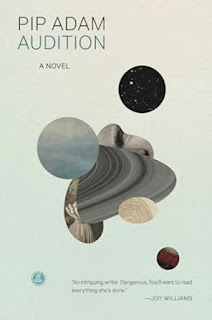
Pip Adam's AUDITION

I am thinking very hard for a moment but trying not to go quiet like we did the last time we tried to think very hard.
One of the sillier, yet rather profound, bits of The Hitchhikers Guide to the Galaxy concerns the Belcerebons of the planet Kakrafoon. Formerly a highly civilized and quiet race, their perceived smugness about their civilization annoyed the rest of the galaxy into afflicting them with the dread social disease of telepathy. Once so punished, in order not to broadcast their every stray thought to the rest of the world, Belcerebons had to keep up a constant stream of chatter, at the expense of all other activity. Their planet thus became a very noisy and inane place.

I mention this because a similar fate, though not under similar circumstances, has seemingly befallen the crew/passengers aboard the star ship Audition, a craft powered by sound. And while any sound would originally have done, these crew members soon have to resort solely to talking because, well, they're not on the Audition because of their superior skills or merits, but because they are afflicted by a freakish and continuous growth. This growth, which has resulted in our characters all having been about three times normal human size in every dimension at the time of the ship's departure from Earth, has left them, as Pip Adam's touching, inventive and at times weirdly theatrical novel, Audition, begins, confined to the three largest spaces on board ship, into which they now barely fit so they can't move anymore, can't make the sounds of footsteps or opening and closing doors or rustling fabric; the only sound they can make is by talking, calling out to one another by way of a continuous babble of conversation, which at first is just status reports on how their legs are losing circulation and maybe gonna die and fall off or how the big skylight on the basketball court where one is trapped is now just a keyhole relative to the size of their still-growing eye. When that runs out, they start trying to piece together how they got there, but are quickly thwarted by a big problem: they don't seem to remember anything from their pasts except that they had been launched into space because they were too big to stay on Earth.
They were the unwanted. That was clear to them, perhaps it had been from the start. They took up too much room.
Then we start to get a little more information about the crew members - Alba, Stanley and Drew - from the perspective of one of their earthside trainers in an extended flashback. The Giants, as they came to be called, have been herded to a big sports stadium in Europe to be trained for their special mission: they are to be sent in giant spaceships to explore and maybe colonize other parts of the galaxy. A joke is made that this will make room for 540 regular sized humans, as many jokes are made at the Giants' expense, for as they have grown, so have the distances that their nerve impulses must travel. Like the dinosaurs to which these poor people are often compared, they seem slow and stupid to the rest of us, and dangerous, and greedy for resources, and did I mention dangerous? People who are different are always dangerous, you guys. Even if they can't accidentally step on you and squash you like a grape.

But so before these Giants get launched into space, they must be "trained" -- really, conditioned, brainwashed even -- to follow patterns of behavior and belief set by the normal-sized humans (though, the Giants always tell us, they hate being called that), and to forget as much as possible their lives before the stadium they've been taught to call the "Classroom." Presumably this is so they don't develop resentments over how they were treated prior to the "launch 'em into space" solution was adopted, but also in general to make them more biddable. Thus all their prior habits of speech in the book's introduction begin to make sense as programmed responses. They've really done a beautiful job with the ship, you guys. The Classroom was beautiful, too. The teachers were so kind. The food was so delicious.

And so they all find themselves in space, unable to recall anything about their previous lives as ordinary human beings, compulsively responding to lights and sounds like trained monkeys and unable to hold on to the simplest thoughts once a behavioral trigger is activated. It's horrible to behold, even just in print, a real tragedy that seems inescapable even before they come up with a seemingly doomed idea: 
We thought if we broke the ship, we'd remember,' Drew says. 'That we'd get it back. Ourselves before the classrooms.' The ship settles again, suddenly, and the sound levels out. 'And we were wrong,' Alba says.
It's pretty much the most tragic observation I've seen made in speculative fiction, and remember, I've read stuff like The Sheep Look Up multiple times. But...

About 2/3 of the way through this gently strange and obscurely distressing book, Audition morphs into a kind of first contact story, and once if the best, in terms of conveying the truly alien, that I've encountered that was not written by Peter Watts. Because what our trio encounters at first adjusts them/itself into something in accord with Alba's and Stanley's and Drew's senses and understanding, accommodating them so beautifully they think they're maybe in Heaven, but then starts pulling them along to meet the new universe and awareness halfway in a very subtle and convincing manner:
Stanley and Drew are beside her and they’re under the tree where they spent the first night. It is changed. Some kind of autumn has come over it. Its branches reach the ground now and it’s a different colour. The sky around it has also turned. Everything is shifting from the pastels into much more saturated colours. The brightening has been happening, Alba now realises, gradually the whole time they’ve been there. But now it’s at a point where it affects everything. The whole world sings in the bath of the colour field that comes from the sky but the tree has definitely changed colour, it isn’t an effect of the sky. The three newcomers who aren’t that new anymore shade their eyes from the brightness but T.J., A.J. and R.J. look at them with open eyes, waiting for them to sit down. The locals are stiffer in their movements and possibly taller. They sit in a more anchored way than the first day they sat together. They are taking up a different space. Alba looks at Stanley and then at Drew and none of them have changed in the same way. No physical change has come over them at all. They are the same as when they first arrived. Which surprises her because her insides feel completely rearranged.

I can't say much more about this aspect of the novel without giving too much away, so I'll just take a moment to marvel at how it transforms the entire rest of the story, including some pretty distressing material that comes up once our trio manages to break their conditioning and remember how they knew each other before the Classroom, before they even became Giants. Audition isn't here to coddle us and our delicate little feelings (though it's not here to brutalize us, either), you guys.

What it is here for, is to ask us to ask ourselves how certain we are that the world has to be the way it is now, that people have to have the relationships that they have, that what we know now about the universe is all that we can know, and that we are right about what we think we do know. That's all a pretty big job for a novelist, but judging from this book, my first read from both author Pip Adams (and from her fascinatingly off-beat U.S. publisher, Coffee House Press, which, more from them very soon!), Pip Adam is up for the job.

I think I'm going to need to read this one again sometime soon.

Tuesday, May 16, 2023

Edward Ashton's ANTIMATTER BLUES (Narr John Pirhalla & Katharine Chin)

Somehow I didn't know that a sequel to Mickey7 was in the works, let alone already published. Thank goodness for Mastodon, where I landed early in the Twitter diaspora and where frank curiosity about what everybody else is reading is possibly the most common conversation I have there, or I still wouldn't know that Edward Ashton'sp Antimatter Blues existed!

I hadn't planned to read the audio edition, though. But for some reason, that's the version my public library bought despite owning only the ebook version of Mickey7, so, since beggars can't be choosers and I'm a beggar since retirement, audio it was this time. 

Except now I have a new audio narration pet peeve: when a (first person) narrator aims for callow and casual but the only note he really achieves is every sentence that isn't another character's dialog ends in what I can only describe as a verbal shrug. Like when a parent tries to warn a kid not to come crying to them if they ignore the warning and suffer mild to moderate consequences? Except it's every single sentence, and usually nobody could have predicted the consequences of a thing so nobody could have warned about a thing and the consequences are usually way beyond mild to moderate -- often they are severe to near-fatal, i.e. the kind after which it is never appropriate to say anything remotely like "I told you so" especially since usually no, in fact, you didn't. It makes the narrator character, Mickey, who is already not the most sympathetic or reliable of these, sound like he is constantly abdicating responsibility for every single thing that happens. This could be excused as an audio narrating choice when it's a thing for which responsibility might be assigned, like having lied to your partner or lost an important resource or, you know, actually did tell you so, but this tone is even used when describing perfectly mundane things like crossing a room or biting into a protein bar. Over eight or so hours of a really great story, this goes from being annoying and occasionally misleading to my finally wanting to send narrator John Pirhalla* back to high school speech class. And flunk him on principle the first time so he has to take it twice. 

As for Pirhalla's co-narrator, who's really more of a guest voice but that's not really officially a thing, Katherine Chin, she is fine. I can't say more than that, though, because of a weird choice the producers made to have Pirhalla voice everybody's dialogue, including the female characters', including Mickey's beloved, Nasha, who is actually so important she's basically a co-protagonist... in the bog-standard "raise your pitch above your normal speaking level, add lots more vaguely "feminine" breathiness and give most of your lines a flirty tone" style that way too many male narrators use for female or enby characters. Why do they have Chin at all, then? Only to play Nasha when her dialogue comes over the radio. Um, whut.

Anyway, the book is good enough to make up for all of that. I'm a big fan of the book. I recommend it to everybody who likes science fiction. But I'll urge anybody who decides to read to to do so in digital format or in good old fashioned print.*

Well, except for one kind of neat thing about the audio versus other formats: in the book, we come to know a non-human character called Speaker, who not only learned human language wholly from years of eavesdropping on radio conversations between Mickey and his best friend, Berto, but has also exactly duplicated Berto's voice and speech patterns; if they heard but couldn't see the one speaking, nobody could ever tell Speaker and Berto apart until it became a matter of each character's unique perspective or experiences being communicated, i.e., the voice said something that only Speaker or Berto could or would say. Berto is a daredevil pilot who talks like Buzz Lightyear. Speaker is a constructed representative of a vast hive mind and its body, like all of its kind, is a vaguely insectoid/trilobite-ish form. So imagine a Buzz Lightyear and a giant pill bug who also talks like Buzz Lightyear on a desperate mission together. It's amusing in audio book format in a way print could never match. If that sounds like fun to you and you think I'm being overly sensitive (I mean, I've coached high school speech teams to state championships a few times so I've made a lot of kids pay attention to details like this, so yes, I am more sensitive than most when it comes to vocal narrative) to the Verbal Shrug issue, hey, sample it and see. 

Anyway...

Our story picks up two years after Mickey Barnes, seventh of his name, resigned his job as the "Expendable" for humanity's beachhead colony on an icy frost clod of a planet called Nefilheim. A mission's Expendable is a person with no particular skill set of the kind that would ordinarily merit a spot on a mission but is simply willing to do all the dangerous/fatal tasks that need doing on that mission. If an Expendable dies in the line of duty, a new clone of that person is quickly grown in a vat and imprinted with the previous clone's memories and personality from up to the moment the prior clone last submitted to Upload. The memories might thus include the prior's experience of dying from, say, being the first to try eating vegetation or meat from a new planet, or being attacked by a new creature, or exposure to radiation while making emergency repairs to the kind of thing that emits radiation.

Mickey 7 explored the consequences of an Expendable actually surviving a supposed death but only making it back home after he, presumed dead by the rest of the crew, had already been replaced by his clone. In the process, Mickey discovered that an alien monster (that happens to be what everyone thinks killed him) is actually sentient. And in his dealings with the monster species that I don't want to get too specific about, one important thing that I can't help spoiling happens: he left a very powerful antimatter bomb in their possession. Or at least told his commanding officer that he did.

As Antimatter Blues gets going, Mickey's colony finds itself sorely in need of getting that bomb back, not to use as a weapon or to blow anything up, but to drain of its antimatter for fuel to keep the colony going through a projected planetary winter that could very well render the whole colony extinct. And we find out /are reminded what Mickey really did with the bomb, which becomes a McGuffin in a vastly entertaining plot that involves renewing relations with the alien Creepers, whose vast underground labyrinth of a habitat is very near the humans' dome, meeting another population of Creepers who are even weirder and scarier than humanity's neighbors, and getting inextricably and irrevocably involved in inter-population politics as they race to recover humanity's only hope for survival. In the process we get to know Berto and Nasha a lot better than we did last novel. Nasha especially gets a chance to become a more important character in her own right, starting with a pretty grim and close look at what it has been like for her to watch her boyfriend die of various hazards seven times. Amusingly, she gets referred to as "The Nasha" by the Creepers, whose perspective on her, remember, has been formed by supposedly private conversations between her boyfriend Mickey and her fellow pilot, Berto, both of whom affect an exaggerated fear of/respect for Nasha at all times. In other words, the Creepers think that Nasha is pretty much the biggest badass ever, and she comes pretty close to proving them right.

Mickey, also, gets to show a bit more general heroism as he is all but shoved into command of the mission, since it's his fault the antimatter is out of human control. He makes a hell of an ambassador to an alien race, but his unique experiences as a former Expendable give him an equally unique perspective on what it means to be an individual, a concept he has great difficulty explaining to the two flavors of hive mind with which he has to negotiate.

But of course it's the Creeper called Speaker who steals the show this time around, weirdly charismatic, stern, occasionally baffled by us weirdo humans and very, very committed to his Nest's survival. It's the Speaker's presence in this second book that really makes it an even better read than its predecessor and makes me hope for a few more Mickey7 novels to come. Mickey and the Creepers. I mean, come on!

*Who sounds enough like Casey Kasem that I was constantly waiting to hear this. And so I hereby renew my plea for blooper reels at the end of audio books. They would be the most fun. And if there are still more than a handful of home-producers out there, I absolutely want to hear the takes spoiled/enhanced by your pets (*cough* especially Paul E. Cooley *cough*). Come on. You know it would enhance the whole audio book experience and thus allow your special friends to contribute a tiny bit more to your (hahahahaha) livelihood (hohohohoho).

**I have a terrible, terrible time with paperbacks, especially trade paperbacks, because I can't physically handle or manipulate these for more than about 15 minutes per day without searing physical pain and inability to get pretty much anything else done that day. I have a category on most social reading sites I call "On Dead Tree Despite The Pain" into which I put books that I found worth that annoyance and discomfort to read and finish. Guys, I would have read Antimatter Blues in a mass market paperback if I had to. In fact, I seriously considered DNFing the audio book (no sunk cost except a tiny bit of my tax dollars) and waiting for a cheap used paperback to wash up at Alibris or my local used bookstore. But I really got into the story so I forged on through. 

Tuesday, March 28, 2023

Kontakt: An Antholgy of Croatian SF (Ed Darko Macan & Tatjana Jambrišak; various translators)

I love a good speculative fiction anthology, especially one with a theme. Kontakt: An Anthology of Croatian SF wouldn't seem to have much of a unifying theme beyond the nationality of its authors, but  while it's a hodgepodge of sub-genres and styles, some interesting similarities emerge that make it hang together brilliantly. 

Originally printed as a sort of souvenir for the 2012 European Science Fiction Convention, which was held in Zagreb, Croatia that year, it's a great showcase of a single nation's best and brightest established and up and coming writers of speculative fiction -- only a handful of whom I had heard of before grabbing this book!

From weird alternate universe godpunk-cum-Christian eschatology (Katarina Brbora's "Avaleon and the Black Feather") to Kafka-esque military sci-fi (Darko Macan's "The Corridor") to accounts of the practical impact of mind-bending metaphysics that would do Sigizmund Krzhizhanovsky proud (Goran Konvični's "Time Enough, and Space"), pretty much everything that speculative fiction lovers look for in an anthology. Unlike many that are more concerned with adhering to the conventions and restrictions of English language speculative fiction publishing, several of these stories express national and regional concerns that might alienate less careful or curious readers. A few minutes of research, or at least clicking on unfamiliar words or proper names in the ebook edition, will greatly enrich the experience of reading Kontakt. 

Nowhere is this more clear than in the aforementioned tale of Brbora's, "Avaleon and the Black Feather," which the anthology's editors describe as "a breezy treatment of that trinity of heavy topics: religion, patriotism and cheap jewelry," in which a young man of Italian heritage but Croatian birth, Santino, becomes low-end jewelry store clerk Tamara's new roommate and quickly establishes himself as even stranger than he already seemed. For one thing, he has a good-sized collection of Croatian editions of books that have not yet been published in Croatia. And his Bible turns out to have content that differs somewhat substantially from the one we and Tamara are familiar with. The famous Well to Hell hoax gets discussed as Tamara discovers that in Santino's Bible, "Sataniel" isn't the obnoxious boaster and tempter we know but is in fact the supreme authority on Earth, which he rules ruthlessly from a mighty fortress near the North Pole! Before we can say "portal fantasy" Tamara has followed Santino into an alternate universe where the city of Zagreb still looks a lot like her city of Zagreb but is in much better shape and is located near the Black Sea, where an ikavian dialect is the official language and the ugly blue stone in Tamara's janky ring (which her weird boss makes her wear around for marketing purposes) actually has vitally important supernatural properties. The story is plenty engaging as translated (by the author herself, as is generally the case in this anthology. Monolingual education is not a Slavic value!) but I suspect it resonates much more with Croatian readers. 

Kontakt also contains some first rate body horror. In Danilo Brozović's "Fingers" the protagonist discovers a unique affliction waiting in his DNA like a time bomb - but too late to do anything about it. At first he has a glimmer of hope when he learns that his father had the same grotesque problem at his age but doesn't now... until he realizes that his father, who has succumbed to dementia, might not remember how he got over their condition. Brozovć is more interested in letting us contemplate what life would be like suffering from such a condition than in explaining it, though, and the story takes off in an unexpected direction, leaving us with even more questions but still satisfied as the story ends. 

Less satisfying because perverse and icky if you are, as I am, on the prudish side, is the vividly imagined "De Cadenza" (Danjiel Bogdanović) in which a crew of bon vivants in space begin their list of perversions with using living human beings as furniture, with and upon which to have imaginatively perverse zero-gravity sex, and then develop even greater manias for acts the Marquis de Sade would balk at recording because they don't have any philosophy with which to dress up their indulgences. Eventually the story dispatches with them satisfyingly, though. But still, pass the brain bleach.

For my money, the most enjoyable of the lot is Tatjana Jambrišak's exciting and ultimately hopeful tale of a group marriage of space explorers who suddenly find themselves having to plan to re-start human society on a distant and newly discovered planet. "Give Me the Shuttle Key" is maybe the most conventional story in Kontakt but that doesn't make it dull or ordinary. The characters and their imperfectly fitting agendas are engaging enough and their situation compelling enough for me to long for a much longer work exploring their relationships and how they rise to meet their fates as maybe, but hopefully not solely, the founders of humanity's second chance.

Another standout, Aleksandar Žiljak's haunting "The Dead" plays off cultural memories of Nazi concentration camps* as it sees what might well be the site of one put to use for a new purpose: the economic exploitation of zombies, the cheapest and, if you have a willing bokor on the payroll, most easily managed labor force there is. The story has a whole camp full of them toiling day in, day out, assembling cell phones under the watchful eyes of Kevlar-clad overseers, armed to the teeth and well practiced at head-shots. Double tap to, uh, select. Good science fiction should afflict the comfortable; I was more uncomfortable reading this story (on my electronic device of choice) than I was any of the other stories except maybe "De Cadenza" (because I really am more than a little prudish). Your results may vary.

One way or the other, not a single story in Kontakt left me unmoved, and most drove me to look up their authors to see if anything else they've done is available to me. Many of the writers gathered here are associated with a Croatian speculative fiction magazine called Ubiq (hooray!) and I find myself wondering how hard it would be for language nerdish little me to just subscribe and bull on through with a dictionary (once I've figured out what dictionary to buy; the intricacies of language in this part of the world are beyond what I'm accustomed to)? But meanwhile, I know the gang at Apex have already discovered and shared Alexandr Žiljak, and that Dark Horse and Marvel gave Darko Macan a whole lot of work in the 90s that I haven't read yet, so maybe I'll start there. Regardless, next time you're hankering after some spec fic that's a little stranger than you've been getting lately, look to Croatia! Because wow! They are quite familiar with our stuff, but they're not by any means just producing more of the same. 

*One of which, Jasenovac, was located in Croatia back when it was part of occupied Yugoslavia. 

Tuesday, January 10, 2023

Christopher Ruocchio's ASHES OF MAN (Narr by Samuel Roukin)

I love a lot of things about Samuel Roukin's narration of the Sun Eater series, Christopher Ruocchio's gigantic space opera spanning five novels in the main line and an ever-growing library of side-quels, but what I've liked best is something I've barely mentioned in my posts about these books: his performance as Tor Gibson, series hero Hadrian Marlowe's childhood tutor and, by a remarkable set of circumstances that reunite them a good century after Gibson abetted Hadrian's first escape, friend. Roukin gives this character, who is supposed to be as stoic and emotionless as a Kohlinar- trained Vulcan, an incredible warmth and tenderness that he seems to have saved for this character alone -- without Gibson ever seeming to drop that controlled facade of unflappable calm and unassailable logic. It's quite a feat, and it's why sometimes you take do want an actor for a narrator. 

But so, of course this latest novel in the main line, Ashes of Man, begins at Gibson's grave. Sigh.

"Heroes do break, you know," Hadrian warns us early in the book, just as he has so many times before. Hadrian is one of the most fallible heroes I've encountered in recent genre fiction -- not a bumbler or a fool, but gloriously imperfect and limited despite the superhuman advantages plain old heredity, genetic engineering, corrective surgery/surgical augmentation, and a mysterious godlike entity from the future have given him. He's a well-educated generalist who uses his time wisely but he is still just one guy with one brain and one set of experiences in which to draw -- except when he's not, but even when he is juggling space and time to find that one tiny and astronomically unlikely inflection point that lets him survive the unsurvivable, he still just this guy, you know?

Mostly. 

This latest installment of his sage shows us still more of the amazing universe in which he exists, which is full of all of the coolest bits we love in space opera/ planetary romance; in the first third of this novel a city* straight out of James Blish's classic Cities in Flight descends on a planet Hadrian happens to be on while attending to his cousin, the Sollan Emperor, and the Emperor's vast peripatetic court. The city doesn't come with a population itching to get to work like Blish's "Okie" cities do, but it's still a whole damned city slowly descending onto the ground, meant to replace wholesale one that the Cielcin destroyed decades ago when it laid waste to this planet. It's an incredible thing to have happen, even in these books -- but of course to most of the Sollan Empire's jaded courtiers is just another excuse for a party and some more intrigue. They're barely even all that interested in the legendary Half-Mortal, Lord Hadrian, or his frenemy Bissander Lin, the only guy besides Hadrian to have fought and killed a giant Cielcin cyborg super-soldier!

More incredibly, speaking of Lin, who hasn't appeared for a couple of novels now, good to see you again even though you're still not my favorite, one thing I've really noticed in this last novel is how brilliantly Ruocchio manages character. Not characteristics, not characterization, but characters; several times now he's slipped a new one into the crew several novels before that person really becomes important, or even gets much dialogue, so that when they do come to the fore, when their innate talents are called for
or they're called upon to do something "out of character (usually transcending their limitations)" they don't feel new or like they're replacing someone that got killed off or left behind, just finally getting to shine a little in Hadrian's attention, because never forget that while Hadrian has greater claim to honesty than a Severian, say, it's still his subjective view of the story we're getting. So in this novel, Lorian, to name my favorite example of this and the character who prompted these musings (as I noticed that Roukin's voice for him is, well, he doesn't sound much like Warwick Davies or Peter Dinklage, though those are my fan-casting picks), is now fully part of Hadrian's inner circle of planners and doers as he, Valka, Lin and a whole Legion** (replacing the lost lamented Red Company) prepare on direct Imperial order to try to take the fight, not merely to the Cielcin but to the Cielcin's terrifying eldritch gods, which are not abstractions requiring belief to even exist like humanity's gods, but are part of that reality that doesn't go away when you quit believing. They might have an actual physical presence, even a location. And the Empire might have clues that might lead to that location's discovery. Clues they've had since the very first Sollan Emperor, William Windsor the First (the current Emperor is William XXVII but remember the ruling class enjoys ridiculous longevity so the time since William I is much, much, much longer than what we could call a generation. And of course the Emperor hasn't always been a William. Or, necessarily, in possession of a willy, as such), nuked Earth to radioactive slag to save Humanity from the Mericanii and first made contact with the mysterious entity/entities Hadrian knows as The Quiet.

Two other near-figurants from the prior novels come to the fore in Ashes of Man to become proper characters, too, with even more impact on the overall plot than Lorian gets to have, but that's because they are more important people in the books' universe: Olorin, who originally gave Hadrian his light saber high matter sword, and Emperor William the XXVII, but they don't have near the claim on my affections that Lorian does (though how much of my love for Lorian is really displaced affection for Miles Vorkosigan is anybody's guess. There's a reason Peter Dinklage is my fan-casting choice for the role of Lorian if a screen adaptation ever comes to be. And speaking of which, ahem. Make with the clicky and weigh in on that!). William even gets to be a little bit of a hero, though he causes as many problems as he solves as he, Hadrian, Olorin and Valka (and the Emperor's staff and military command) struggle to coordinate the evacuation, not only of the live inhabitants of a world under attack by the Cielcin, but also millions of colonists in cryosleep that have been stored there for seeding future human worlds -- and would thus be the universe's greatest meat locker for the ever-hungry, carnivorous Cielcin hordes.

In the process, inevitable tragedies occur, both for some of the tiny handful of beloved ongoing characters who have survived the prior novels and for some new friends, as is inevitable in any decent series concerned primarily with war. We're used to grieving with Hadrian by now, but by novel's end he feels like he's been dragged back to the beginning and taken us with him, without even the faint hope that, say, a pal frozen in carbonite out there somewhere can lend us. I'm still all in on this series and am already looking forward to my habitual "I've got to refresh my memory of all the prior books by reading them again" before the next one comes out which is... when? This time I don't even have a title to watch for, to mark as "To-Read" on StoryGraph or pre-order. HELP!!!!!

But for now, excuse me. I've used up this box of tissues and need to find some more. *Sob*

*And when I say "city" I don't mean some cute little portable mini-city like London in the film adaptation of Philip Reeve's Mortal Engines, I mean a big freaking city. The Sollan Empire only makes things to one scale, and it is stupefied. I mean, Hadrian routinely travels light years of distance aboard ships he casually mentions are over 50 miles long! You think it's a long walk down to the chemist's but that's just peanuts compared to...
**Who, by the way, is led by a fellow goes by the name of Sharpe.

Friday, November 18, 2022

Alastair Reynolds' EVERSION

One of my favorite of Alastair Reynolds shorter works is a fiendishly gruesome little puzzler of a novella called Diamond Dogs. Set in his Revelation Space universe, it tells the story of a small party of mathematically inclined geniuses, two of whom are childhood friends who grew up at the highest strata of their society setting puzzles and traps for one another of greater difficulty than can even be imagined by us Earthbound, non-augmented humans of our own century. As adults, one's family makes an intriguing discovery on "the ragged edge of human space" where only one other human party has ever explored, only to die one by one of an unguessed-at number of various baroque and visceral "punishments" when they failed to solve a series of alien puzzles of increasing bizarre complexity. It's a compelling and memorable read, but not for its subtly drawn or complex or relatable characters. Those are found elsewhere in Reynolds' oeuvre (see especially his Poseidon's Children trilogy). But I always wondered what it would be like if Reynolds had held back the intense plot of Diamond Dogs for a longer work with more developed characters. 

Now I know. 

"The geometry..." he murmured. "The geometry! I think I can see it! Each quarter section is homeomorphic to a triangle!" He stared back to us, wide-eyed and uncomprehending of our own inability to visualize what was plain to him. "Can't you see it? It's beautiful! And hideous! It's... not right!"

Eversion, the master's latest, shows us not only what Diamond Dogs would be with better characters and actual stakes, but also takes another go at the intriguing ideas Reynolds explored in Terminal World, in which different levels of a city-state exist at different levels of technological development, those levels determined by the "resolution" at each level, i.e. how fine the grain of the very stuff of each level can get and what levels of precision it will allow. Except, again, the emotional and existential stakes turn out to be much higher in Eversion, for all that it, too, has a mathematical puzzle at its heart.

A ship called, just like the one that carried Dracula to England, the Demeter, has been engaged by a boorish Russian oligarch/magnate to follow up on a magnificent discovery at the edge of the known world. The magnate, Topolosky (wink), spared no expense on equipment but values secrecy over quality when it comes to the mode of transportation and the crew who will get him, his burly assistant Ramos, and his pet mathematics prodigy, Dupin, to where the mystery awaits. Meaning the captain and crew are competent but not spectacularly so, but, Topolosky thinks, are less likely to ask awkward questions or make unreasonable demands for things like advance warning of hazards to life and limb, etc. This is a nice and meaty beast of a plotline right here, but this is Alastair Reynolds hitting new heights of narrative brilliance, so of course there is a lot more going on.

For starters, Topolosky isn't our point of view character; the ship's medical man, Silas Coade, is. It's Silas' first voyage and he is a terrible lubber as it turns out, so he spends most of his time cooped up in his digs until he is called upon to save Ramos' life after a terrible accident, after which time he forms a friendship with the man as the Demeter nears its mysterious destination and various tall tales and outright lies on the part of Topolosky can no longer be denied. It's the Age of Sail and they're way north of Spitsbergen and approaching a cove and a hidden lagoon where a bizarre structure they call the Edifice awaits them. No, wait, it's the Age of Steam and they're tramping along the coast of Patagonia looking for a fissure that will admit them to the interior of a vast glacier concealing a mysterious Edifice. No, wait, they're aboard a state-of-the-art airship approaching the hole at the bottom of Antarctica that will admit them to the interior of the Hollow Earth where a mysterious Edifice clings to the ice and rock above the Void. No, wait, they're plying interstellar space on a ship that would make Flash Gordon or Buck Rogers proud and approaching a... oh, no, wait, they're on a spaceship, but it's just moving within our solar system, following up on an earlier effort to explore what's under the ice on the Jovian moon of Europa...

Each iteration of the story unfolds gracefully and reveals a little bit more of the true nature of the Demeter and its mission. Silas is an aspiring novelist in addition to being a doctor, and he's keeping the crew entertained with his futuristic imaginings of what a more advanced version of their mission might be like -- or are they retro ones? Along the way, the crew's lone female member, the lovely Ada Cossile, keeps nagging at him to do better, to try harder, to get it right, damn it, hinting that their situation is way more dire than it seems.

Each iteration also comes to concern itself with a deeply deranged and near-insolvable mathematical conundrum; the Edifice is not of any known human manufacture and seems to have deformed itself -- to have turned itself partly inside-out or everted, toward an unknown but probably sinister end. And Topolosky's great wish is to explore it first, claim credit for discovering its secrets and, of course, to profit from any applications might result from the study of the Edifice -- even if it costs a life or two.

The final layer of the mystery is as beautiful as it is heartbreaking, and every tear it jerks is earned in a way that only the more recent of Reynolds' work has accomplished (I'm thinking from Poseidon's Children through the great Revenger novels, of course), because these are fully imagined people whose dilemmas and danger have real emotional heft -- but none of Reynolds' trademark awe-inspiring and cosmic scale is sacrificed in the process. He really does just get better and better, you guys! I can't wait to see what he's got for us next, and he remains my number one buy-on-sight science fiction author. Tremendous stuff!

Wednesday, October 26, 2022

Christopher Ruocchio's KINGDOMS OF DEATH (Narr by Samuel Roukin)

We've come a long way with Sir Lord Hadrian Half-Mortal Demon in White Marlowe since he was a young sprat who wanted to be a Scholiast just like his dear old tutor and ran away from home when his father decided to make him a torturer-priest instead. 

 Along the way with Hadrian through Christopher Ruocchio's massive Sun Eater series, we've explored anarchic gatherings of extreme cyborg self-experimenters; battled and defeated two great princes of humanity's archenemy, the Cielcin; met an effectively immortal Saturn who prolongs his life by taking over his children's bodies and keeps a pet/slave artificial intelligence from the dawn of recorded time that renews itself with human body parts and human brains; learned mind-blowing secrets about the galaxy's history from before humans took to the stars; survived court politics that make those of Byzantium seem tame and dull; died at least once and resurrected' gained superpowers of incredible utility that are almost impossible to use when they're most needed; made friends that would die or kill for him; become the idol of at least one cult... and now, as we catch up with him in this fourth novel of the main sequence of the series, Kingdoms of Death, he's being pressed into service as a diplomat. His mission: to persuade the Lothrian Commonwealth to join forces with the Sollan Empire and its allies to defeat the Cielcin once and for all, before the Cielcin can defeat humanity and turn us all into livestock, both the kind that labors and the kind that gets eaten.

Buckle up. 

This fourth volume in the main series is both its most exciting and its most tedious. Some of Ruocchio's finest action set-pieces, including a truly heroic chase-cum-last stand, are paired with long chapters of crushing boredom and sameness that do almost too good a job of depicting life as a prisoner with no hope. Oh, and trigger warnings for torture, I guess, but, being the under-medicated chronic pain patient that I am, I found that most of our hero's agonizing experiences sounded pretty much like getting out of bed and trying to get dressed every day (at least until they started peeling his long muscles like fruit), so, your mileage may vary, etc.

As usual, there are two halves to this narrative, with the first bringing Hadrian and his enterage to a whole new-to-us society that is half Yvgeny Zamyatin and half Ascia (there's even an emphasis on Groups of Seventeen). The Lothrian Commonwealth is a totalitarian horror so complete that people don't even have names, live in cells in vast hive-like buildings under opaque domes (their planet not exactly being naturally hospitable to life, or much to look at) that function also as Faraday cages, the better to keep its population from ever organizing against the regime. And the very language of the Lothrians is downright Ascian, consisting only of aphorisms from its Black Book of doctrine and containing no personal pronouns at all.

Hadrian has been given yet another impossible task by his cousin, the Emperor, who still claims to be shielding Hadrian from the many forces at court who wish him ill, but whom Hadrian and his people still suspect is really trying to shield his power from Hadrian. What better way to get him out of the way for half a century or so than tell him to go convince this bizarre and depressing society to give military aid to humanity's existential struggle, preferably without completely upsetting the social order there, hmm?

The second half sees Hadrian alone and friendless and utterly in the power of the Cielcin Prince of Princes, Syriani Dorayica, who accords Hadrian a disorienting level of respect even to regarding Hadrian as the true "King of the Vermin" and insisting Hadrian participate in rituals meant only for the Cielcin elite -- while also mutilating, imprisoning and torturing Hadrian for, in the grand tradition of torturers through the ages, information that the Cielcin already has. And the Prince of Princes has even worse in store for Hadrian, for Hadrian's entire Red Company of 90,000 human souls has also fallen into Cielcin power.

And Christopher Ruocchio is definitely of the GRRM school of callous beloved character deaths. And told ol' George to hold his beer. Which means I'm a bit angry with him at the moment, but I can't say I didn't know this was coming. Hadrian's being in Doctor Who Jeopardy and being Palatine, with a life span far exceeding pretty much everybody else's, guaranteed that this was coming. But still, I bite my thumb at you, Ruocchio!

Now I have to wait like the rest of the plebs for the next volume, Ashes of Man, to come out in December. I could scratch my Sun Eating itch with some sidequels and novellas, but I dislike spending audible credits on such short reads and I insist on finishing these with Samuel Roukin's voice in my ear, so those will have to wait for the next sale-or-stupid-windfall, I think. Meanwhile, I have a library full of other stuff I've not listened to or read yet, but December sure can hurry the hell up. I'm ready to watch Hadrian eat the damned sun already.

Though that might be another novel yet?

Sunday, October 9, 2022

Christopher Ruocchio's DEMON IN WHITE, Narr by Samuel Roukin

Two new characters introduced in the great sweep of the third novel in the main sequence of Christopher Ruocchio's Sun Eater series, Demon in White, give us an even greater idea of the enormous scope the author has imagined in imagining this universe. Both also quickly rose to prominence in my estimation, contending against protagonist-narrator Hadrian Marlowe and his beloved Dr. Valka Ondare* for the title of My Favorite Character so far. And one of them even survived the novel!

The first I want to discuss is Lorian Aristedes, a junior officer whose tremendous organizational talents and gift for strategy have been languishing unnoticed in a minor post in the Sollan Empire's legions for a long time because he is something the Empire abhors: a child of a member of the Palantine and some other caste. This isn't mere class snobbery, though; because Palantines, with their physical perfection, greater height and incredibly long life-spans, are as much the product of post-conception tinkering as of selective breeding to preserve the advantages originally bestowed by genetic engineering centuries ago; decanted as much as born, grown in vats to order. Hadrian himself is one such, and has several times had to face up to how this really makes him little different from the variously augmented (cybernetic, surgical and genetic) Extrasolarians he met in Howling Dark. Lorian had one such parent, but the other was not, meaning he's a sport, and all sorts of weird recessive traits that have lurked unexpressed in the Palantine genomes, removed by careful post-conception pruning in sanctioned children, have manifested in this man's body. He is short, has malproportioned limbs (much is made of how he needs what amount to ring splints to use his "too-long" fingers), is functionally almost an albino. He is, in other words, a living exhibit of how perfect the Palantines really aren't, and has had to struggle mightily all of his life to justify his very existence.

Miraculously, Lorian Aristedes does not exhibit much of a chip on his shoulder once Hadrian finds him and sweeps him into his orbit and gives him rank and responsibility in Hadrian's increasingly infamous Red Company. Most of the time he is quietly competent and matter-of-factly rescues his fellows' fat from the fire; occasionally he concocts brilliant strategies that combine with Hadrian's ever-expanding all-but-supernatural abilities (we'll get into that in a bit) to deliver successes that can only be described as miracles by the time word of them reaches the rest of the Sollan Empire, and never mind that it's going to be Hadrian, Valka, and the rest of their weirdly glamorous band of former gladiators, military misfits and exotic "homunculi" who both spread and share in Hadrian's growing legend.

My other favorite new guy is Udax, a member of one of those alien races humanity has conquered/colonized as we expanded into the galaxy to occupy billions of worlds. Unique (I think?) among these races so far, though, Udax's people presumably fought back, else how would the Sollan Empire come to recognize their martial prowess enough to be willing to incorporate units of them into its Legions? When Hadrian first meets Udax and his fellow colonial auxiliaries, the Not-Amarantin are finishing their training and are about to form the Empire's first non-human unit. Hadrian and his friends are fascinated to watch these raptor-like people at work, for yes, they have feathers and talons and huge wings that work; the Sollan Empire is about to gain a unit that combines infantry and air force! Or, as I kept thinking of them, Flying Sepoys. 

But, the Not-Amarantin are very, very touchy about being gaped at like carnival freaks or zoo animals and don't take too kindly to the Red Company's frank interest and Things Get Ugly, revealing, d'oh, yet another plot on Hadrian's life. Udax had been paid by, probably, a Chantry agent to pick a fight and try to kill Marlowe and as much of his entourage as possible! Their little mutiny is quickly put down and its hotheaded young ringleaders rounded up for disciplinary action straight out of the John Company's brutal past, but Hadrian decides that if he can talk Udax around, Udax might be worth sparing. This, of course, happens, and Udax and his fellow sepoys become a very important addition to the Red Company just in time for their next mission for "Earth and Emperor": to join the Imperial Fleet to help ward off a massive Cielcin attack threatening a strategically important system through which a great deal of commerce and military assets must frequently travel.

A good century or so has passed since the events of Howling Dark, and just as Hadrian and his friends have kept busy -- before the Not-Amarantin join the Red Company they have been on the Empire's library planet exploring Restricted Archives of Forbidden Knowledge up to and including meeting yet another leftover Artificial Intelligence left-over from the "Mericanii" whose machines enslaved almost all of humanity back when we just had the one planet and Hadrian's having another visionary encounter with the Ancient Aliens he calls "The Quiet" -- so have the Cielcin. Among other things, they've been trading with the Extrasolarians, whose scientists have happily accepted the challenge of building giant Cielcin cyborgs with extra limbs and Admantine exoskeletons and armor (Adamant being the only material that swords like Hadrian's light saber High Matter sword can't cut, and traditionally only used for space ship hulls). We learn that in events between Howling Dark and Demon in White, the Red Company encountered some early prototypes of these monsters and defeated them, and a second encounter with a better version of one opens Demon in White by way of showing us how much more badass the Red Company has gotten since Hadrian killed his first Cielcin prince and got his nickname of Half-Mortal, but they haven't seen anything yet!

The serious high drama and action of Demon in White takes place on the target system's planet, where the Red Company has been assigned to defend its chief city and its millions of inhabitants from the Cielcin provisioning runs that are sure to take place while the giant spaceships in orbit duke it out (remember: Cielcins eat humans with relish and poor table manners). Lorian and Udax both demonstrate their worthiness of my love, and Valka, who was literally fridged through a lot of the fighting in Howling Dark and hasn't stopped berating Hadrian for it, not only gets to fight but gets to prove her point that he would have taken a lot fewer losses if he'd let her fight last time; coming as she does from a culture with no taboos against implanting computer enhancements in human bodies, she has a head full of powerful circuitry that lets her hack the terrifying flying borers the Cielcin launch in combat to chew through enemy forces, armor and all. Which, good thing, because not only have the Cielcin cyborgs gotten even better since last they tangled with the Red Company, but also a whole lot bigger. Like 30 meters tall, with extra arms and implanted howitzer-type artillery and metal claws that let them do things like scale tall buildings, King Kong-style.

Fortunately, Hadrian has some new tricks up his sleeve as well, for "The Quiet", not content with outright resurrecting him in Howling Dark have now expanded Hadrian's very senses. He can now, when he concentrates properly, see all of the possible outcomes of an incident, choose the optimum and make it reality, all in a split second, allowing him to perform some feats that look impossible but are really just astronomically improbable, and are only really possible for someone with Hadrian's Palantine self-assurance and talent for melodrama. And yes, this marks him out as an even greater threat to the Chantry and to the Emperor (who wears the "whiter than white" color called Argent and could be taken for the Demon in White of the title, except ahh, Hadrian, whose close familial relationship as a cousin of the Emperor is also entitled to wear that color, is the one who gets the actual sobriquet) and his court (never get more popular than the boss), but he'll have to deal with that later! Because right now, his duty is ACKSHUN!!!!

What I'm saying is, these battle scenes kick all kinds of ass, once again enhanced by audio book narrator Samuel Roukin's bone-chilling rendition of the king hell cyborg's impossibly deep and hollow voice as it taunts Hadrian, and later that of the big bad Cielcin overlord who has been uniting the clans and introducing things like strategy and tactics to their formerly atomized and half-random attacks on human assets. I mean, the Cielcin overlord sounds a lot like Kharn Sagara, but Roukin's only one guy, you know? 

Meanwhile, in the big Sun Eater plot, more becomes clear to Hadrian and to us, through the same set of mind-bending revelations that have led to his new superpowers. The Quiet turn out to be even stranger and more unsettling than Hadrian had previously thought, and while he's previously proceeded on the assumption that what he calls The Quiet and the Cielcin call The Watchers are the same Ancient and Powerful Beings, much has thrown his assumptions into doubt. Ruocchio, through his ancient narrative persona of Old Man Hadrian who is recounting his centuries and centuries of life and warfare, does a magnificent job of balancing this overarching plot with the episodic natures of the individual novels, guaranteeing that I'm going to be very antsy after I finish Kingdoms of Death and have to wait for December and the new installment, Ashes of Man.

Space opera, guys. It sure is space opera.

*Once again, I hit that flaw that comes with enjoying these books as audio productions; I have to cast around the internet for other reviews or summaries in order to see how things are correctly spelled. I haven't found a proper spelling for Valka's last name, or for the bird-race to which Udax belongs, which is why I call them Not-Amarantin, referring to Alastair Reynolds similarly bird-like alien race from his Revelation Space universe. If pressed I would say the species name in Sun Eater is something like "Ektani"?

Monday, September 19, 2022

Christopher Ruocchio's HOWLING DARK (Narr by Samuel Roukin)

I could already tell, less than halfway through the second volume of Christopher Ruocchio's Sun Eater series, that it's going to be one I'll enjoy returning to, even if it doesn't have a conclusion as satisfying as I currently believe it will. I still watch the first three seasons of Battlestar Galactica, the first four of Babylon 5  (and hope ardently that we get to see its reboot/revival), after all. 

As always, here there be dragons, by which I mean spoilers, except maybe I actually mean dragons, hmmm? Of a kind? Waving lots of pale and grasping human hands in the dark?

Howling Dark launches the story of Lord Hadrian Marlowe, renegade interstellar aristocrat, some 50 years into the future from where we left off in Empire of Silence. He's also a long way from the planet where he washed up after escaping his unwanted destiny as a cleric-cum-torturer for the repressive Chantry, the Sollan Empire's state religion. At the end of Empire Hadrian made contact with a small party of Cielcin, members of an alien race with which humanity has been at war for hundreds and hundreds of years. The Chantry and other local powers assumed these Cielcin had come as a vanguard to an invasion force, but Hadrian, the only person on the whole planet who had ever learned any of the Cielcin's language, discovered that they were actually there on a religious pilgrimage, to visit some intriguing ruins left by a long lost ancient civilization that long predated human or Cielcin exploration or conquest. And in so coming to understand that much, Hadrian saw a possibility to try for Peace. There's a being of some kind out in the dark who has a way to actually make contact with a leader of a major clan of the Cielcin (who are so predatory and warlike that they will prey and war on one another as soon as humanity) -- but that entity dwells on a mysterious and possibly only legendary planet!

And so Hadrian has embarked on a unique mission to try to find this entity, The Undying, on that planet, Vorgossos. With him are many of his friends from his gladiator days and one or two from his unpleasant time as a courtier on the backwater planet he's left behind - and a whole lot of new people, most of them military or mercenaries, representing not only the Sollan Empire but a few other human polities as well.

And here we're experiencing a few elements of the 21st century's revival of Doctor Who, and not just because we know that the Hadrian telling us his story is a Hadrian centuries old who has the guilt of genocide on his conscience; we also have elements specifically of Stephen Moffat's controversial habit of introducing new-to-us characters who have established long and deep relationships with our hero off-screen. For one thing, Hadrian has a lover, Jenan, who was originally part of a kind of pirate crew Hadrian's mission fleet tangled with, defeated and absorbed some time over the 50 years since Empire. And while Hadrian is nominally the Lord Commandant of the mission, it's really a career military officer, Bassander Lin, who is calling the shots. Their relationship is mostly cooperative and cordial, until Plot Things Start Happening!

But so, I found a sense of breathlessly having to catch up as Howling Dark opened, very similar to how I felt when I managed to read Malka Older's Centenal Cycle in the wrong order. I suspect that this will someday be an unusual experience, though; the Sun Eater series already has a few side-quels and it wouldn't surprise me a bit if a future novel or novella might be devoted to the early years of Hadrian's ragtag fleet. I would opine, though, that such would really not be necessary (but then, I'm also on Team Never Show Us Jim the Fish). The Sun Eater saga is wonderfully enriched by strong character relationships, but it's got a big looming plot question ahead, as the series' entire point is explaining to us how Hadrian Marlowe became the Sun Eater. How he unseated a tyrannical captain and recruited his crew isn't very important to the arc and these are all very long books already. 

I will say this, though: Ruocchio is way better than Moffat at this trick. I mean, Moffat just dropped the Paternoster Gang on us out of the blue and we never even really got to know much about how they met or why they were so fiercely loyal to the Doctor. Moffat just counted on the characters being too awesome for this to annoy us and just kept jingling the keys. Ruocchio made the new characters awesome and explained where they came from and why. And he did it well enough to make some early scenes of irrevocable parting between them feel earned and honestly affecting. Very affecting. No, you're the one who's crying.

Several unsavory encounters and gripping fight scenes and followings of clues later, Marlowe and his friends have found the legendary Vorgossos (orbiting a brown dwarf star!) and come under the jaundiced eye of its unnaturally immortal ruler, The Undying, whose name is Kharn Segara* (a figure of myth from the founding era of the Sollan Empire) and suddenly we're in yet another literary territory, once which I absolutely did not see coming even though our narrator is surnamed Marlowe! For the interlude on the lost planet whereat Hadrian seeks a contact through which to begin peace negotiations is straight outta Heart of Darkness, my friends, with Kharn Segara a 15,000-year-old Kurtz ruling a mad kingdom at the ass end of known space, and yes, my friends, it gets that dark. Actually, more so, because this heart of darkness is also a demented cyberpunk hell-hole where Kharn employs unspeakable means to prolong his own and his exclusive clients' lives and to satisfy the perversions common to bored playboys everywhere and I was bracing myself for this to get truly icky but Ruocchio is a tasteful writer as well as a talented one.

Unlike in Conrad's most famous tale, though, here Kurtz is only a first or warm-up boss; there is so much worse to come, even in his own realm, than Kharn Sagara, you guys!

Anyway, while we're in Kurtz Kharn's realm, we also get to watch Hadrian's relationship with a character I didn't mention last time, the enigmatic Valka, develop in a lot of interesting directions. Last novel, Valka seemed poised to be a love interest, if one whose levels of education and culture were dizzyingly above Hadrian's and then there's also the fact that she's from a civilization that doesn't share the Sollan Empire's maniacal Butlerian Jihad-esque distrust/hatred of computers and artificial intelligence. In many ways, Valka is straight out of a cyberpunk novel, with a headful of neural augmentations that make her that vital character in every Shadowrun game, the technomancer/hacker, but imagine that character who is also Indiana Jones because she is a xeno-archaeologist in the Dan Sylveste mode (though she wisely mostly stays out of politics). Or a (mostly) law-abiding River Song? Anyway, Valka rocks, and Marlowe knows he is nowhere near worthy of her but wants to try to be, even though he regards her with just enough superstitious dread to basically think of her as a witch -- and hey, she almost got burned as one near the end of Empire of Silence. She still hasn't forgiven him for fighting a duel to save her when she was well on her way to saving herself, of course. Anyway, they spend a lot of time alone in various flavors of guest quarters on Kharn's dark, weird planet trying to figure out the many mysteries of what Kharn is up to, how/if they're going to get what they want out of him, and what his intentions toward the Cielcin prisoner, called Tanaran, that he has stripped them of in the guise of entertaining their petition. Oops!

In an attempt to regain control of Tanaran and of their immobilized spaceship, Hadrian and Valka go exploring and Ruocchio explores a terrifying conjunction of ideas: what if the Vatic Fountain (Gene Wolfe) were a terrifying monster out of the deep past, and what if the Pattern Jugglers (Alastair Reynolds) gave swimmers the ability to See Through Time? Meaning Hadrian gets not one but two cryptic glimpses into his future in this novel, though the first was only really a preview of the second, into his metamorphosis from renegade nobleman/mercenary to figure of superstitious awe and dread? In a terrifying encounter made all the more intense by narrator Roukin's choices in how to voice a weird collective inhumanity waiting in the dark at the end of a cyborg-guarded labyrinth?

Yeah...

While all of this has been going on, the Sollan Empire has not been sitting idle, of course; nor have the Cielcin. We learn late in Howling Dark that the number of star systems the Empire has lost to Cielcin incursion has come to exceed 900, with billions and billions of human beings dead (and eaten!) (most of them) or brutally enslaved and mutilated (in a manner chillingly reminiscent of the fate of Father Sandoz in Mary Doria Russell's The Sparrow, which, yikes).

And of course the conflict between the Empire and the Cielcin follows Hadrian to Kharn Segara's creepy dark planet, first according to Hadrian's design, because he can't start peace talks with the Cielcin without eventually meeting some Cielcin who aren't his prisoners, and then very much not according to Hadrian's design, and this is where Ruocchio goes bigger than big. And also displays a talent for manipulating reader emotions that I almost resent because of the devastating use he made of it here, leading us from baroque horror to tense diplomatic drama to huge boffo combat scenes to almost unbearable character drama (Hey, Hadrian has been warning us from the start that he has often been accused of having a taste and talent for melodrama!).

I suppose the game of spot-the-reference (and hey, we haven't even gotten to what amounts to Hadrian's possessing a light saber, which Ruocchio has managed to make even cooler than the Star Wars version by concocting a plausible-sounding pseudoscientific explanation for how the weapon works and, more importantly, what its limitations are) that I've played here makes it sound like the author has just cherry picked his favorite bits from other novels, is just a kid playing with a mismatched set of action figures and telling his babysitter the story as she indulgently smiles or blatantly ignores his babbling, but that's the least deserved criticism that could be leveled on these books. Ruocchio, who's had a pretty good career as a genre fiction editor, has impeccable taste in science fiction bits and bobs and wields them all with tremendous skill, maturity, intelligence and passion. Even the bits that seem to have no business appearing together are made to feel organically joined and earnestly communicated through Hadrian Marlowe's insightful, frank, erudite and compelling narrative voice. Hadrian is as complicated and well-rounded as a Dorothy Dunnet hero, enacting a Gene Wolfe plot (and occasionally using Wolfean vocabulary**)
through a Mary Doria Russell moral and Alastair Reynolds physical universe. I have, as the kids used to say, no choice but to stan.

Seriously, friends, don't sleep on these. Hadrian's story is already epic AF (and we've gotten the barest taste of how epic it's going to get by the revelation in this novel of why he bears the sobriquet of "Hadrian Half-Mortal) and it's only going to get more so. A fifth volume in the main narrative is coming out in December. There's plenty of time yet to catch up on the series in time to plunge into that with me and Ruocchio's other, too few by my lights, fans. Yeah, they're big fat books but they never get dull and never stop provoking thoughts and ideas and feelings and, well, what the hell do we read novels for if not to have those?

As for me, I've already started listening to Demon in White. And Ruocchio has already made me cry at least once.

*Whose name I was mentally spelling as "Khan" because narrator Samuel Roukin -- still absolutely perfectly cast as our protagonist-narrator, and if these books ever get adapted for the screen I hope it's soon so Roukin is still young enough to play Hadrian -- is very, very British.

**My favorite of Ruocchio's pseudo-Wolfean terms so far is "Xenobite," which Hadrian uses to refer to aliens the way Severian uses "Cacogens", though "Xenobite" is a more accessible and evocative word, employing the "xeno-" prefix to denote otherness while rhyming with "cenobite," which is more than just a name for the monstrous powers of Hellraiser fame. It also denotes monasticism, and those to whom Hadrian generally refers with the word are the Cielcin, whose social structure is fanatically hierarchical and to be a Cielcin's subordinate is by definition to be its (and that is the pronoun; the Cielcin are an asexual race) slave. Interesting, no?