Showing posts with label theater. Show all posts

Wednesday, December 4, 2024

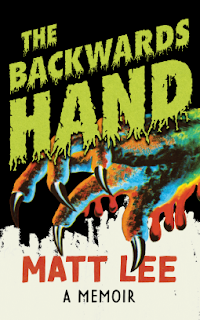
Matt Lee's THE BACKWARDS HAND: A MEMOIR

My E-ARC copy of Matt Lee's The Backwards Hand: A Memoir has, presumably as an anti-piracy measure, undergone a blanket text edit in which all "fi" and "ff" letter combinations have been replaced with two taps of the spacebar. So, for example, "film" has become " lm" and "effect", "e  ect" through the whole book. It's jarring at first, but shortly my brain adjusted to it and just took it in stride. 

The possibility has occurred to me, of course, that this is not just a factor in my copy from Netgalley but an intentional gimmick in the text as a whole, to make a point about neuroplasticity or human adaptability or something, but probably not. Lee isn't interested otherwise in being either subtle or gimmicky; he is here to tell you, very plainly and without sparing anyone's fee-fees, what his life with a very unusual congenital difference has been like.

Lee was born with bilateral radioulnar synostosis; the two bones in his forearms, which actually rotate and cross over when an unaffected human rotates their hands front to back, are fused together in the crooks of his arms. Surgically un-fusing them, at least back when this was offered to him, would unavoidably damage a cluster of nerves located right where the bones are fused, leaving him with constant pain (something I know all about and wouldn't wish on Elon Fucking Musk, for all that he wants to put chips in the brains of people like Matt Lee and myself and maybe all of us because of reasons) and a still-deeply limited range of motion that wouldn't even approach "normal." Not exactly a win-win proposition.

There are notes of existential terror in this text, much of which is devoted to famous disabled people and other "freaks" from history and how they were depicted in art and treated by their families and, most importantly, by the authorities. Lee spends a lot of text, for instance, to the Nazis' euthanasia program, which targeted the mentally and physically disabled; eugenics is never far from the discussion when societies discuss policy toward us. This fear has only grown with the results of the recent U.S. election, of course, but that development was still in the future when this book went to press. 

Lee's own story is far less bleak, however. He has married and has a child who does not share his disability, has had an acting career and has developed a clear and concise prose style and a dedication to thorough research that should serve him well moving forward in life -- and, as he takes care to emphasize in The Backwards Hand, he doesn't owe all of the setbacks he has encountered on the way to this state to his disability. Some of it is attributable to his own immaturity, infidelity, or general assholery. Disabled people are neither monsters nor saints; it just took him a while to realize that his disability did not automatically make him a monster. 

But man, this book has made it a little harder to go into 2025 with anything like a sanguine attitude. But, like that was going to happen anyway, amirite?

Who knows, maybe we'll end up in the same camp and I'll get to tell him in person that I appreciated this book and told all my friends to read it. Except I'm housebound because nobody will take basic precautions against diseases that could kill us, so instead of actual friends, I'm telling whoever still reads this blog. Read this!

Wednesday, June 26, 2013

Ned Beauman's THE TELEPORTATION ACCIDENT

No book that I actually finished has ever made me want more to take a shower after the last page (no, not even one by Chuck Wendig. I KNOW!) more than Ned Beauman's debut novel, Boxer, Beetle. It was therefore with a trepidation only partly assuaged by my knowledge that my best reading pal SJ loved this one that I began The Teleportation Accident.

The cover helped.

Misleading as it is as to its contents.

What's inside is often unspeakably foul, vaguely misogynist (at one point early on the phrase "non-mercenary vulva" is used to describe a theoretical female who might be kind enough to sleep with our protagonist) and reads a lot like one might imagine a (wildly unlikely) collaboration between Robert Silverberg and Douglas Adams would, if it were set in pre WWII Berlin, Paris and Los Angeles (with a little -- a very little --  and the wrong bits of -- Henry Miller thrown in). I was craving a shower before I'd even finished one chapter. But...

But...

Well, I did not mention Douglas Adams lightly, except instead of gentle absurdist/parodic humor, the humor one is slapped in the face with every few lines is nasty and sordid and really pretty repugnant, but funny nonetheless. Funny enough to make even the most umbrage-taking feminist keep on reading, even if she winds up hating herself for it. As in chock full of lines like "the moon over Berlin shone bright as a bare bulb in a toilet cubicle." Ha ha ha and eww.

As for what it's about, well, it's sort of a companion piece to Boxer, Beetle in that it, too, is largely concerned with Germany in the 1930s, but where many characters in that book are obsessed in various ways with the Nazis, those in The Teleportation Accident, even though unlike the Boxer, Beetles they are from Berlin, are pretty much oblivious to them. Egon Loeser and his friends are more concerned about parties and pussy and scoring some decent cocaine -- or a corkscrew -- no, an actual corkscrew, jeeze -- than about world or local affairs. Politics is for people who can't handle art.* "History happened while you were hungover," the tagline says. And for these people it's so true that it's only when Loeser chases his ill-chosen anima projection, one Adele Hitler**, to Los Angeles (via Paris) that he gets even an inkling of what is happening to the Jews in his home city and country, and this only in that people he meets in LA assume he's a refugee like everybody else -- and assume he knows why they might think this.

So this book could almost be an exploration of how people could remain carefully, willfully ignorant of one of history's greatest crimes right up until it was too late for them to do anything about it. So described, this book becomes somewhat admirable (I'd posit it's this quality that got it listed for the Man Booker prize). But that makes it no less tough to take. But I suppose I'm supposed to admire that as well.

The book does, though, get a few bonus points for playing a bit with an amusing conceit -- that H.P. Lovecraft's fiction wasn't really fiction but just sort of veiled/fictionalized references to staggeringly difficult concepts in particle physics and dimensions and whatnot -- but like so many of the neat ideas tossed around in here, it doesn't get the attention it deserves. It's kind of like Randy from A Christmas Story opening his presents. Wow, oh neat, wow, yeah, and RIIIIIIIP into the next package. Except the Lovecraft stuff is not the toy zeppelin we see the kid asleep and cradling at the end. The Lovecraft stuff is the socks.

And speaking of the end, or rather, the four ends, the words "Scooby Doo Ending" kept coming to mind. And even though the very last bit where [REDACTED] turns out to be [REDACTED] in [REDACTED] is pretty cool and amusing, that last of the four epilogues is really the most interesting bit of the book. So interesting, in fact, that I wound up wishing I'd gotten to read that book instead of this one.

Ah, me.

*Of course, in no small part that proved to be quite true, as Adolph Hitler was famously a failed artist.

**No relation to Adolph, we learn in very casual passing.