Tuesday, December 23, 2025

Jazmina Barrera's THE QUEEN OF SWORDS (Tr Christina Mac Sweeney)

The Queen of Swords, Jazmina Barrera's fascinating and unusual study of Mexican literary icon Elena Garro, might get shelved among the literary biographies in the rare and special kind of bookstore that will even bother to stock such a thing, as a rule, but The Queen of Swords is about as much a biography as Orson Welles' incredible F for Fake is a documentary. Which is to say both "kind of" and "not at all.*"

Furthermore, in arguing for the "kind of" side I would have to invoke the parallel or tandem biography, like Charlotte Gordon's Romantic Outlaws, which simultaneously studies Mary Wollstonecraft and her daughter Mary Shelley, while also giving considerable time to each Mary's equally-if-not-more famous husbands. Elena Garro's daughter is nowhere near as big a presence in QoS as Elena herself, but the child's father, Elena's famous husband Octavio Paz, takes up the space that Helenita doesn't, while Barrera's surprisingly entertaining experiences of researching and writing the book also shares the space, kind of the way some of Orson Welles' hijinks round out F for Fake. 

Moreover, both projects are complete delights, marred only by their (by modern standards) brevity -- though by saying they're "marred" implies that this is a flaw when it only really highlights the fact that they left me wanting much, much more.**

But there's no equivalent, in QoS, to the famous Chartes sequence in FfF. Barrera's work is much too intimate and personal to yield a big meditation on art and history and architecture. And Garro's life was a lot more harrowing than Welles'; several times she and her daughter were fleeing entire countries ahead of assassins, possibly vindictive ex-lovers, political authorities and penury. And Barrera has only the medium of text to convey all of this. But what text she has!

What we conserve of the dead is, above all, images and words: in that they are similar to books. We might even make the mistake of confusing the two, but no life fits in a single book. It would need several trunks, whole libraries, university and press archives to hold the vast, elusive life of Elena Garro, and what I write here doesn't aspire to that. It doesn't pretend to have the last word on anything or anybody. This isn't a biography, it's scarcely a notebook. It is a collection of stories, ideas, facts, and cats.
Garro was a woman who deeply loved the idea, if not the fact, of divinatory arts like the I Ching and the Tarot -- hence the incredible cover Two Lines Press generated for the English language edition of QoS, which takes the same iconic photo of Garro that graces the original and abstracts it into a version of a card of the Minor Arcana. Amusingly, the text itself is divided into very short chapters, some only a sentence or two long, each with a pithy title that could almost be the name of one of the Major Arcana, like "THE CRIME OF FANTASY" or "PERFUME," such that I had a working theory while reading the book that there was one chapter for each card in the Tarot. Alas, when I actually sat down to count the chapter-ettes, I got far more than the expected 78. It was still a fun theory, and while I have zero evidence that this idea was ever part of Barrera's plan for QoS, I respect that if it was, such a gimmick was not allowed to govern the presentation. Barrera's short, specific chapters (which, further arguing against the idea that this is in any way a biography, are not remotely chronological; they are firmly grouped by ideas according to a scheme that I couldn't really parse out but didn't really try because the text is far more interesting than the structure), which quote liberally from Garro's own works and those of her contemporaries, also present the reader with a pleasing run of meta-knowledge in the form of marginalia clearly identifying the precise source for its quotations, a technique I find that I much prefer to footnotes or endnotes and one that I wouldn't mind seeing catch on with other writers who are bridging the gulf between the scholarly work of formal criticism and the popular biographical one.
I've dreamed of Elena Garro a number of times and almost all those dreams have left me with brief, inconclusive pictures: a blurred image of Elena standing up, wearing a coffeee-colored, tailored suit; Elena Garro and Bioy Casares laughing at something awful, with Octavio Paz looking worried. I once dreamed that Elena entered a worm spiral of time and space that carried her from Los Angeles to San Francisco. Another night, I dreamed that Elena and Helenita were Lorelai and Rory from the television series Gilmore Girls.
Elena Garro is a brand new discovery for me. I had of course heard of her husband, who won the 1990 Nobel Prize for literature, but, to be honest, Latin American, and especially Mexican, literature is still a bit of a blind spot for me. I have read more fiction translated from various dialects of Arabic than I have from Spanish, more from the Austrian Hapsburg empire than from Spain's. Ernest Hogan, Alejandro Morales, Rudy Ch. Garcia, Silvia Moreno-Garcia (does she count since she's actually a Canadian citizen?)... so I've read some weird fiction from Mexico, sure, but not any literary or mainstream stuff... and then I find that Elena Garro is at least as responsible as more familiar-to-me creators like Gabriel Garcia Marquez for the development of Magical Realism, especially in its stricter definition in which the source for the magical is Indigenous folk legend and belief***. But so anyway, I came into QoS as cold as cold could be, and leave it now determined to make up for lost time with Elena Garro. How fortunate, therefore, that my brand shiny new subscription/membership to the Center for the Art of Translation and Two Lines Press brought me, not only QoS, but also The Week of Colors, a collection of Garro's short fiction originally published in 1964 and newly translated into English by Megan McDowell. It's like these people want to make it easy for me to fall in love, or something.

I will probably never love Garro as much as Jazmina Barrera does, though. As she shares in the course of the book, QoS started out as an essay for a journal, but as Barrera, whose own great-grandparents were friends of Garro and Paz, got access to loads of archival material and re-read Garro's works for the umpteenth time, her love became all consuming until the project swallowed up all of her time and effort and became this wonderful book. I'm grateful for this love and for the fact that it is still possible, at least for a very few of us, for people with a passion to pursue it fully and come out with something this terrific to show for it. Let's hear it for adventurous editors, curious scholars, and prolific playwrights/poets/novelists. This world would sure suck without them.

*And if I had to compare it to anything besides FfF, it would have to be to something like Michel Houellebecq's "literary mash note" H.P. Lovecraft: Against the World, Against Life, though QoS has an entirely different tone.

**And just as FfF led me down multiple rabbit holes of wrong and crazy awesome about Elmyr de Heury and Clifford Irving and Howard Hughes, well, let's just say that I'm already falling past the levitating rocking chairs and apothecary shelves and bookcases on my way down to exploring Elena Garro's (and friends') literary wonderland, starting with a newly released translation of Garro's The Week of Colors published in tandem with QoS, just to make sure I did so.

***And in these pages I learned that one of the many reasons why authority figures of various kinds did not appreciate the treasure they had in Elena Garro was her consistent and lifelong support of Indigenous rights (and, of course, her very vocal and active support of revolutionaries in general), entitling Garro to even more of my admiration than her literary output already demands.

Friday, December 19, 2025

William T. Vollmann's YOU BRIGHT AND RISEN ANGELS

Oh, ants, my sisters, good old honeydew-seekers! From close up you are sticky and shiny and gristly; and your nymphs have parasitic red mites stuck to them. You are too intent upon your chewing and gathering to listen to me, but I tell you that despite my warm feelings I really do not like you, and I cannot feel sorry for you in any way because there are too many of you and you are not cute at all. You eat too much of my forests; you are a rebellious tribe, and I will destroy you; I will poison your nests with sweet-smelling traps.
Man, I've known of the existence of this book for decades. I had a vague idea of what it's about and that it was probably going to be something I would love, but I never came across it in a bookstore, back when it was new and a physical store selling physical books, or a public library, was the only way to get them, so I never picked it up for my personal collection or checked it out. Later on, online booksellers became a thing and I went bananas, just like everybody else did, but by then a lot of newer books were on my radar, and then e-books happened and then...

But really? I couldn't tell you why it took me so long to get around to You Bright and Risen Angels, apart from its still never turning up in any bookstores I've managed to hit when I've a bit to spend. And there not being an ebook or audio edition. And there being millions and millions of other books vying for my attention. 

Sigh.

But so, better late than never. And also, thank goodness for my having a few dozen high brodernist friends, many of whom are obsessed with Billy TV and his oeuvre, who selected his Europe Central as a book club read (which I loved and consider one of the best books I read this year, but I'm not ready to write about it yet and think I'm gonna read it again before I do)* and I was jolted into remembering that back in the 90s when I was temping my way around the Greater Boston area (so many bookstores! But I never saw this in any of them. And anyway, Infinite Jest happened, etc.) I was kind of always on the lookout for this big chunk of literary speculative fiction about insects and revolution and hey, online booksellers still exist, and not all of them are avatars of pure evil...

So, anyway, You Bright and Risen Angels is finally in my life. And, as I often but don't always say, it feels like it was written just for me. Well, except for all the gun stuff. There's a fair amount of gun stuff. Which isn't really for me, but I'll put up with it if an author makes it worth my doing so. 

Billy TV sure did! Though he also kind of tricked me in some pretty inventive ways, like providing a rather untrustworthy, though vividly descriptive, table of contents. As such.

This book was written by a traitor to his class. It is dedicated to bigots everywhere. Ladies and gentlemen of the black shirts, I call upon you to unite, to strike with claws and kitchen pokers, to burn the grub-worms of equality’s brood with sulfur and oil, to huddle together whispering about the silverfish in your basements, to make decrees in your great solemn rotten assemblies concerning what is proper, for you have nothing to lose but your last feeble principles.
I'm coming to dislike the phrase "late-stage capitalism" almost as much as I do all the Underpants Gnome-ish fantasizing about the neo-Nuremberg Trials that are surely just around the corner for the current crop of bigoted,  authoritarian oppressors who have come to power in so much of the world. Both memes presuppose that these regimes so obviously carry the seeds of their own destruction that it's just a waiting game for the rest of us; we don't really have to do anything. We certainly don't have to get nasty or violent. We just have to keep the popcorn ready for when the imaginary good guys who are going to swoop in and save us show up and clean house, like they did in World War II. Except somehow, we all seem to think that we're gonna get to skip the war part this time? Or at least that somebody else is going to do the arduous stuff? But on what basis do we think that?

Anyway, YBARA is an elaborate, baroque and challenging allegory of what it's most likely really going to feel like when everybody's finally had enough of the manipulations and empty promises of our current socio-economic systems that keep everyone too scared or hopeless or indoctrinated to be be willing to even imagine a slightly better world anymore. Couched as a giant revenge plot of bugs against bug zappers. 

But that sounds a bit dry and no-fun, doesn't it? But see, those are two things this book ain't, especially if you like weird shit like giant, freakishly long-lived anthropomorphic insects who have teamed up with their more conventionally sized and life-spanned brethren to fight back against human domination and destruction; like sentient agglomerations of electricity that, for their part, seek to preserve the status quo except with themselves in charge instead of stupid humans; like a handful of sinister, immortal oligarchs who both embody the status quo and believe the aforementioned agglomerations of sentient electricity are actually their willing servants and weapons; like a tiny cadre of passionate revolutionaries who were already ready to take matters into their own hands and fight, despite their paltry numbers, and then accept surprise offers of tactical, strategic and actual support from the very gnats that ordinarily would be tormenting them in swarms in their secret lair above the Arctic Circle!

Oh and there's also another oligarch, shadowy, sinister and remote, manipulating affairs from his base of operations on Mars? And a secret race of plant-people who can dramatically alter their own biochemistry to incorporate some industrial products and by-products to give themselves really weird superpowers like remote viewing via developing photographic film at a touch? I mean, you can't say Billy TV is unimaginative. 

All of this is related to us, by the way, by an unreliable narrator who seems to at least *believe* he is the last human survivor of the resulting conflict, who in his loneliness has programmed an elaborate computer simulation** depicting "resurrected" versions of all of the important actors in the scenario (helpfully listed for us with notes on their interrelationships and alignments in a Dramatis Personae at the beginning of the book right before its wild and rather fanciful table of contents). As he boots up his system for the latest iteration of the game, he addresses the personality constructs inhabiting it as his "Bright and Risen Angels" with a melancholy air. But is he really a lone survivor wistfully reliving the actual past of the narrative, or just a frustrated Infocom employee? Heh.

And it is because of this that YBARA often gets categorized as proto-cyberpunk. As this is really barely just a frame narrative, though, I think so promoting it is a mistake. You're not going to see any console cowboys, expensive razorgirls, or Rastafarian satellite-dwellers here,  but nor are you going to get the funky, vaguely creepy pseudo-biopunk of, say, Bruce Sterling's more interesting offerings, or the intensely insect-focused action of "antasy" works like Clark Thomas Carlton's output to date,  which I must confess to having vaguely hoped for back in the early days of my knowing this book exists.

I am by no means disappointed by what I got, for all that it does not even contain what the second half of the table of contents suggests that it will. Because what it's actually in these pages is fascinating in its own right, with its alternate history of the industrialization of the United States, its vision of cryptoterrestrials (again, rather before even most fringe communities were even really talking about certain phenomena in those terms) and its depiction of how rebels are made, not born. This is that rarity of rarities, a genuinely unique book, and one I'm profoundly glad to have finally gotten to read.

Interestingly enough, I seem to have stumbled into what feels awfully like a spiritual sequel to YBARA. Stay tuned right here to find out what it is. 

By the way, I think there's going to be a lot more Billy TV content on this blog in the new year, but don't worry: I'm pretty sure this one is still going to prove to be unique, because this guy's restless intelligence and creativity have legendarily led him never to write the same, or even the similar, book twice. Dayum!

*Yes, I'm in a book club now, at long last, halfway through my sixth decade on this warming, dessicating planet. 

**Recall that this book was first published in 1987, when most high schools in the U.S. boasted, at most, a few Apple IIes awkwardly situated in the library for a handful of nerds to play typing games on. Oregon Trail was still in the unimaginable future for most of us who weren't in the industry or attending a handful of schools adjacent to it. But guess who was working in the industry as a programmer back then? Billy TV!

Wednesday, December 10, 2025

Rick Moody's THE FOUR FINGERS OF DEATH

What happens when a writer with exceedingly literary pretentions wrangles a contract to novelize a B-movie of the kind most of us nowadays can only imagine watching with the silhouettes of a nebbishy guy and two iconic robots bopping around in the lower right corner of the screen?

Has anyone ever asked this question before?

Well, Rick Moody did. And the results are bananas.

The Four Fingers of Death, for much of its considerable length, directly answers this question by serving us a smorgasbord of pulpy goodness ranging from a crewed mission to Mars (conceived as the last grasp at relevance for a NASA and a United States on the brink of destitution, third world-caliber exploitation by actual world powers, and a concomitant brain drain that has brought us into the world of Mike Judge's Idiocracy but without that film's unfortunate eugenics arguments) to a suddenly self-aware chimpanzee whose pages-long speeches display a surfeit of internet-gleaned erudition*, to an amputated human arm infected with alien bacteria that's mindlessly crawling around Arizona committing murder and a few sex crimes while spreading its disease. Helpful servant Thing, of Addams Family fame, this ain't. 

Oddly, the narrative doesn't really play this for laughs, though it acknowledges on nearly every page that its every premise is ridiculous. I mentioned that the fictional writer of this madness, whose own career forms a frame narrative for his novelization of The Four Fingers of Death (a 1960s Technicolor remake, we learn, of an older black and white schlock-classic, The Crawling Hand), has serious literary pretensions; our man Montese Crandall, previously only known for flash fiction so brief that he only ever actually published single sentences, explores in depth and with sensitivity the inner lives of the astronauts on their journey to and through their tragic, pathetic and farcical experiences as the first humans on Mars, the dawning sentience of the experimental chimpanzee, Morton (alas, unable to perform a Caesar and uplift other apes with whom to be strong together), and the plights of the many earthbound humans, at many strata of society, whose lives are affected by the titular hand and its disease. 

While also treating us to some over-the-top gross and bawdy sex scenes, very much the funniest I've ever read.

Meanwhile, Moody pulls a kind of The Corrida at San Feliu of a trick, considering and expressing considerable emotion upon different aspects of a common problem -- most prominently, how gifted but emotionally stunted men deal with the loss, to death or desertion, of their wives -- through different narrative layers. In the frame narrative, Crandall is watching his wife slowly waste away and die of chronic disease; in the astronaut layer, Major Jed Richards is kind of in denial of the fact that his long separation from his wife started long before he blasted off for Mars and he's probably not getting her back if he makes it back to earth; and in the chaotic Crawling Hand account, a scientist whose wife died some time ago is keeping her body in cryonic suspension while he experiments on lab animals using cells from her body as he works on a cure for what killed her -- and hasn't leveled with his teenaged son about any of it. The son, meanwhile, often looks poised to repeat his father's emotional mistakes, except he has a girlfriend who is way more healthy and dedicated to making their relationship work than any of the wives in the novel. Seriously, if you don't come out of this with a deep love for Vienna Roberts, I am starting to doubt your commitment to Sparkle Motion.

That this book doesn't collapse under the weight of all of these premises is a source of wonder to me, even weeks after having compulsively read its over 700 pages almost without stopping (after a false start with the audio book, which is so poorly done in so many ways that I didn't even make it halfway through before my spleen erupted and sprayed bile all over a bunch of my Discord buddies, who I think were ready to beg me to switch to any other format when I did just that). Even if I hadn't been deeply emotionally invested in all of these characters and strapped in for all of their plots and subplots, I would have hung in just to see how the hell Moody was going to bring all of this madness to a close, even before I realized he was going to do so in the middle of a howling mad latter day Burning Man analog. But damn me if he didn't stick the landing. And earn a perfect 11 from all of the judges except for that one who actually is just really afraid of apes.

Utterly batshit. And brilliant. 

*Obviously this book was written back in the days when web searches were still useful and AI slop not even imagined by the likes of your Corys Doctorow or your Williams Gibson. Ever the peril of science fiction is this race against actual culture towards dystopiae.

Tuesday, December 9, 2025

Mathias Énard's THE ANNUAL BANQUET OF THE GRAVEDIGGERS GUILD (Tr Frank Wynne)

I never realized, before plunging into the fray of Mathias Énard's The Annual Banquet of the Gravediggers Guild, that a work of fiction could have terroir. This is not the kind of sentence I ever imagined myself writing, or taking such pleasure in having written, but it's the best way to describe this novel, at least insofar as I understand the concept I'm evoking here. 

The Annual Banquet of the Gravediggers Guild, hereinafter referred to by your lazy blogger as TABotGG, teems with the kind of rural characters that a reader might will be terribly romanticized -- but stubbornly refuse to be, who persist in their Rabelaisian crudity (the works of François Rabelais, and of François Villon, echo throughout this text even before the title scene begins quoting these guys outright) and gossiping ways as our main point of view character struggles to document their way of life for his anthropology dissertation, all while realizing that he doesn't really even understand his own. 

David Mazon, late of the academic world of Paris, has done field work before, but this time he's really got to dig into his subject and get his hands dirty (beyond his futile battle with the weird red worms infesting the bathroom of the hut he's renting from a local farming couple). But of course, like most academic fish-out-of-water types, he's realizing that his course of study and lack of experience outside of studenthood hasn't even prepared him to research well. He spends most of his time playing with the farm cats who adopt him, and playing Tetris, at least at first.

So,  TABotGG could easily fall into cliché and bore us to tears as yet another supposed sophisticate finally learns about real life from colorful locals -- but it never does. We get a certain amount of arrogant bumbling on David's part, and of deserved comeuppance, but Énard is much more interested in pulling us deep into the soil and its produce here, avoiding also the tiredness of bewailing how every particle of dirt in Europe has passed through innumerable human bodies over the centuries, Europe is a bone heap, etc: Énard is here, instead, to celebrate this. And, in the process, to hint rather gently at the responsibilities of stewardship these facts impose on the agricultural communities who have made all of this possible. But only gently. No preachy environmental polemics here!

Instead, as we follow David through his rounds of interviews and tours and trying of his hand at the odd farm chore -- and David turns out himself to have quite a bit of character, as we see early in his story when a winter storm knocks out power to the village and he resorts to stealing candles from a church for the benefit of a near stranger who is stranger than he knows (we'll get to Arnaud -- oh, Arnaud! -- in a moment) -- we are invited to feel the course of waters through the soil and the decomposition of bodies, and the nutrient cycle, but, again, without being lectured about it. 
Meanwhile, we get to know lots and lots of characters, and not just in their current incarnations; we're a bit in Eastern philosophical territory here, as, upon a character's ordinary or dramatic or untimely or actually pretty funny death, we follow his or her soul, unstuck in time but very much confined to this geography, through karmic cycles of lives as people and animals of other eras in the region. For instance, David's wormy nemeses have human stories, too.

This is best explored through the character of Arnaud, whom we first come to know as the poor, neurodivergent young man whom the locals think is fun to get drunk and make him do his one seeming party trick of being able to rattle off a historical precis of everything of significance that ever happened on a particular date. We learn later in the book that there's much more to this seeming fixation and... look, I would read a whole book just about Arnaud. Arnaud is the best. But this is a book about a banquet, according to the title, right? A banquet held by the people who start up the process of converting the meat puppets we walk around in for a few decades, back into soil.

And these guys know how to party.
"...as was his wont, he filled the glass to the ringing brim until the surface of the wine was slightly convex, which he checked, stealthily approaching the glass with the wiles of a Sioux warrior, chin resting on the tablecloth, as though the precious liquid must be caught unawares before it should flee: once again Martial Pouvreau managed to ambush the wine’s meniscus; with pursed lips and an inhuman slurping noise, he drank off a good two centimeters of Chinon in a single draft before lifting his glass by the foot, with airy insouciance."
Oh, the banquet scene, the novel's capstone and center and longest (and most exhausting) chapter by far. I initially complained a bit about it to a few of my book-nerdiest friends, who all agreed that it's a bit much and a major tonal shift that can feel out of place. It is, however, the title scene, in which a hundred or so funerary professionals from all around the greater area of western France (or it might be the nation, excluding those from the cities?) come together for three days to discuss business a little and eat and drink a lot. Traditionally, these three days are a time when no one dies so that the gravediggers and cemetery caretakers and embalmers and hearse drivers and whatnot can let their hair down, and boy do they ever. We are treated to careful and meticulous details about everything they eat and drink, to their shop talk as they guzzle, and to their over-the-top feats of public speaking in which they quote and paraphrase France's earthiest literary figures.
“Of a sudden, darkness fell upon the battlefield below. 
“‘Gendarme, an eclipse! The darkest shadow has surprised our armies!’ 
“‘Not so, Commander, ’tis the giant’s schlong that blots out Phoebus! His tumescent pork sword is big as a billboard!'"

Which brings me to translator Frank Wynne, one of the greatest to ever do it, and who had his work cut out for him in rendering many versions of spoken and written French, prose and poetry, into something like their equivalents in English; as he shares in a terrific translator's note at the end, for instance, he  cleverly resorted to rendering one character's outré and vaguely archaic dialect... as Scots. 

It totally works, by the way. In a scene in which a judge is struggling to understand her testimony in court, even with the help of a local "interpreter."

But so, this isn't, like, Doc Martin  (for all that I could see Martin and many of the other residents of Port Wenn at work and play here) but a French novel by the same guy who sent Michaelangelo on an imaginary sojourn in the Ottoman Empire; trigger warnings galore, here. There are bawdy and sometimes gross jokes. There is a very vivid description of rape and its aftermath. There is cruelty and negligence and lots of talk of creepy crawlies and rotting corpses and inept gunplay and cheerfully lusty sex. But there's also a nice love story or two and many depictions of healthy marriages and friendships and fellowship and good food and well-turned earth. 

Basically, TABofGG is a hefty French novel about hobbits. It's a book I didn't even know I needed, but find that I most certainly did. From now on, whenever I contemplate the Shire, I shall not imagine them with those rich English countryside accents, but robust and fruity French ones, starring Gerard Depardieu as Bilbo Baggins and Romain Duris as Frodo. Your mileage may vary. But I think you'll have more fun if you do. Give it a try, non?

Saturday, November 8, 2025

Andreas Eschbach's THE CARPET MAKERS (Tr by Doryl Jensen)

Andreas Eschbach has not been on my radar before now, but I'm determined to make up for all the time I've missed knowing his work, for if The Carpet Makers, his mid-90s pseudo-medieval space opera stunner that seems only to have finally gotten translated into English because of Orson Scott Card,* is anything to go by, I'm going to need to read everything of his I possibly can, and may even have finally to try learning German so I don't have to wait around for translators. Yeah, it's that good.

The pseudo-medieval element turns out, of course, to be a bit of a red herring, for while the story starts in a very low-tech, materially impoverished and superstitious society, we soon learn that it is but one of many planets, star systems, even galaxies that, along with the rest of known space/humanity, exists under the rule and on the sufferance of a far-away Galactic Empire. Which empire is ruled by an absolute monarch everyone worships as a god, believes to be immortal and omnipotent, and demands a very peculiar form of tribute from the planet where our story starts: carpets that are elaborately and intricately hand-knotted from human hair.

Creating these carpets is the sole driver of economic activity on this planet, which has a very rudimentary government and civil society and trading network, all in service of bringing thousands of these exquisite handicrafts to the planet's Port City every year for transport off-world to, they have always understood, decorate the Emperor's palace. Which must be very, very large and very, very fancy to even have room for all of the carpets they have been sending over tens of thousands of years.

A special class of artisans makes these carpets, which are about the size of a nice area rug, very, very slowly and very, very precisely. The culture of these artisans is one of generational obligation and strict hereditary status and privilege, in which a carpet maker, upon reaching manhood, is presented with a money chest meant to support him and his entire family over his entire life, the proceeds from the sale of his father's sole produce, one single, perfect carpet, created over the father's entire lifetime, knotted from the hair of the elder carpet maker's wives and daughters. Each carpet maker can only have a single son which he raises to adulthood, but unlimited daughters. If additional boys are born to any of the carpet maker's wives, the carpet maker must kill the infants (we get rather a shocking incidence of this to kick off the book). His daughters provide what raw material his wives don't, wives being chosen chiefly for the quality and natural color of their hair; ideally each carpet maker has at least one black-haired, one brown-haired, one red-haired and one blonde wife.

The son of the carpet maker, who will become a carpet maker himself, thus begins his career benefiting from a debt to his father that he can never repay; his father has worked his entire lifetime to make and sell a single carpet, for which he will be paid enough to keep his son and daughters-in-law in housing and food and chattels for the new carpet maker's entire career, until the son in turn finishes and sells a carpet, the proceeds of which will support the next generation of his line.

Once a year, a vast caravan completes an even vaster circuit of a large swathe of the planet, collecting that year's supply of newly-completed carpets and bringing them to the Port City, to be taken away by increasingly decrepit starships piloted and crewed by conscripted citizens of the planet, who have learned to fly by rote and have no idea how to repair or maintain the ships beyond the basics of flying them. Their cargo is thousands of carpets, whisked away once a year.

The entire rest of the planet works to provide basic material support for the carpet makers' families and the "shipsmen" who crew the creaky old transport vessels. The only form of culture we learn of is a weird and fascinating musical tradition of playing something referred to as a "triflute" -- a musical instrument that comprises three wind instruments twisted into one and deftly manipulated by the talented player, who is the only form of actually skilled class that exists apart from the carpet makers'. I found this sub-culture more interesting than the carpet makers' (of course I did) and a sub-plot involving a child prodigy at the triflute being conscripted to become a shipsman instead of continuing to develop his talent greatly enriches the novel but is not allowed to develop as the parallel story it should have been, ultimately kind of going nowhere except to create a red herring in the main plot, which I'll get to in a moment.

But so, the DNA of this novel is pretty evident and distinguished: the craft-as-sacrifice and service element of the Bright Carvings of the first Gormenghast novel, spliced in with a Galactic Empire that owes more to, say, God Emperor of Dune than to the Foundation series, but with a greater sense of mystery than either of these settings have to offer. What is being done with all of these carpets when they reach their destination? How did this weird tradition start, and why does it continue? What kind of weirdo demands millions and millions of carpets made out of human hair as tribute from a distant, conquered world?

Unlike a lot of the books I tend to gravitate toward, The Carpet Makers does answer all of these questions; we do get to observe bits of the greater empire, which has undergone considerable upheaval in the time it has taken one man back on Carpet Planet (we never do get an actual name for this planet) to perform his life's work. There has at least been a rebellion, and the Emperor has been proven to be less immortal than everybody thought, for all that he has provably lived and reigned for over a hundred thousand years. The Rebellion that took him out is struggling to assemble a government that is not just another absolute monarchy, but faces the threat of a new emperor arising in the person of the hero who murdered the old one and enjoys considerable prestige and adoration among the populace of the imperial planet and the worlds close to the former empire's center.

And there's one other thing: there's not a carpet in sight, for all that the palace is more than big enough to accommodate quite a lot of them.

And no one at the empire's core has ever heard of the Carpet Planet or its produce, until a scouting expedition stumbles upon it and a disobedient member of the crew decides to land on it and look around and maybe spread the word that the empire is no more. Which is, of course, heresy on that planet. Uh oh.

Another sub-sub-plot (this is a big picture novel rather than a character study; I couldn't tell you the name of a single person in it. We just get sketched-in stories, told briskly in individual chapters and then never visited again) involves the empire's staggeringly huge and complex archives, which have been re-organized so many times over millions of years (the emperor that was recently offed was the tenth of this empire, and it's implied that most of his predecessors were also functionally immortal) that almost nobody knows how far back in time the records go, let alone what's in them all. A laughably small team has been assigned by the new government to find out what they can about a number of questions, including why this weirdo Carpet Planet claims it's been sending carpets to decorate the palace for millennia -- and why, although this weird planet's inhabitants are absolutely certain that they are the only such planet, exploratory teams out in the far reaches of space have discovered that the whole galaxy (one of many ruled by this empire) which contains the Carpet Planet also contains tens of thousands of other Carpet Planets with identical cultures and missions!

All of these wild ideas and intricate plots are rendered by translator Doryl Jensen into some pretty exquisite prose, with an emphasis on describing scenes of dreary beauty and not a little pathos:
The narrow street was still sleeping. A light early-morning fog hung suspended between the squat gables and was mixed with cold smoke from hearths in which the fires had gone out in the night. When the first Sundays flicked across the roof ridges of the crooked little houses, everything seemed bathed in an inappropriately dreamy and delicately misty light. Like little piles of dirt, beggars lay in some dark corners, sleeping on the bare ground, ragged blankets twisted up over their heads.
As I said, we do get a solution to the mysteries posed, which is, by the way, devastating. It doesn't quite demand a complete re-read of the prior text, but it will change the way you've been thinking about the carpet makers, their world, the empire they serve, and the myriad ways giving any one guy absolute power is a very bad idea.

And so I find myself in the position of owing a debt of gratitude to, of all people, Orson Scott Card, who used his clout to get this amazing novel translated into English and published by Tor. I'm still pretty annoyed with the man, but there you go. We are complicated creatures.

And now, I'm off to hunt down some more of Eschbach's work.

Monday, September 29, 2025

Laszlo Krasznahorkai's BARON WENCKHEIM'S HOMECOMING (Tr Ottilie Muzet)

One of the funniest, saddest and most stupid character deaths since the middle interlude in Stephen King's The Stand, and -- for a different character! -- an equally ridiculous funeral scenes in a caliber with a Juzo Itami film are only two of the absolute delights on offer to a certain kind of reader in Laszlo Krasznahorkai's Baron Wenckheim's Homecoming

I, needless to say, am that kind of reader. 

But first, Krasznahorkai makes his reader earn those delights, for this novel also contains some of the longest and most complicated compounds sentences that do not contain "the fact that" that I've yet seen. I read the ebook edition, so I couldn't actually count physical pages, but let's just say that the novel's very first sentence fills a number of them that's well into the double digits. Ottilie Muzet earned some delight, too, rendering such constructions into readable English prose.

Everybody has to work when Laszlo has something to say. But we already knew that. 

Nobody has to work as hard, though, as Krasznahorkai's characters, though maybe it's not a question of "work" so much as "endurance;" the title character, whom we quickly come to understand is not only elderly and aristocratic in that genteely poverty-stricken post-WWII way, but is also intensely neurodivergent. So of course, Krasznahorkai had to go and design the best (by which I mean worst) possible way to torment the old Baron that any literary sadist could devise. And he makes us share that torment, too, by making us understand precisely what the Baron's issues and tics are, making sure we always have them very much in mind, foreshadowing the torture in store for our poor protagonist, and then slowly unfolding his exquisite Rube Goldberg plot against the Baron's sensitivities over fully half the novel. 

The effect is not unlike watching the tied-up maiden squirm on the railroad tracks, intercut with scenes of the incoming train coming, starting from hundreds of miles away. -- but instead of a train it's more like a Katamari.

But I'm focusing too much on the title character, and there are so many other unfortunates whose fates are affected by decisions made by - and even more by decisions made about - this old aristocrat who is returning to the hometown he hasn't seen since his family high-tailed it out of Hungary sometime during or after the War. Chief among these is a famous professor whose own bad and weird chickens come home to roost and leave him hiding,as the novel begins, in a shack he built himself out of trash in an unsightly and overgrown vacant lot on the outskirts of the Baron's hometown* not long before The Homecoming. His cantakerousness, runaway philosophizing, inscrutable motives and surprising proficiency with firearms quickly bring him into conflict with a local Biker Gang as well as with local authorities, which, get ready for those. Each authority figure gets time in the spotlight, mostly to display the qualities that lead an anonymous commentator to pen a screed for publication in a local paper, the better to call out every excreble facet of the supposed Hungarian national character and leave them all pondering their commitment to Free Speech something something Epstein Files something something. 

Krasznahorkai even takes the time to poke a little fun at his very own writing style late in the novel, as the editorial staff of the local opposition newspaper contemplates the above-mentioned screed:
"- the gratuitous use of all these innumerable "wherases" and "wherebys," - I think we should just wipe these or like fleas in a pigsty"**

And we cannot forget the poor old lady who gets dragged unwilling into the spotlight when the gossip traveling ahead of the Baron's train reveals her as the Baron's long-lost first love, the whole reason he's made the journey from the land of his exile (and later disgrace), exotic Argentina, to this provincial Hungarian city. Marika, aka Marietta, barely remembers the Baron as an abnormally tall and thin youth who crushed on her from afar and once accidentally scared her into thinking he'd committed suicide. She doesn't even seem to have thought of him much when her relationships with a series of handsome but abusive jocks has left her alone and sad with a dead-end job and only one true friend in her old age. But now, suddenly, the whole city wants to know everything about her and has planned a whole romantic new chapter for her life as Mrs. Wenckheim, munificently helping the Baron to lavish his imagined millions on worthy civic projects and business ventures and deserving individuals, ever after. And if a few of them have already decided to start lobbying her for future gain, what's the harm?

But so, if The Melancholy of Resistance was a tr agedy, Baron Wenckheim's Homecoming is somewhere between a black comedy and a farce, but with real feeling for the people and places in which it is acting out. I was already a Krasznahorkai devotee, but now more than ever. 

 *Which, Easter eggs in the text suggest, is the same town depicted in The Melancholy of Resistance, and, for extra fun, it's impossible, if one has also read Chasing Homer as I so recently did, not to wonder as Baron Wenckheim's Homecoming unfolds, if maybe the Professor isn't going to end up being the fugitive in that novella!

**It is so hard to pull quotes from prose like this. One either gets a very short and pithy little clause pulled out of a sentence or a giant block of text full of ellipses lest one overwhelm the screen with a sentence longer than other books' entire chapters!

Tuesday, September 9, 2025

Vladimir Sorokin's BLUE LARD (Tr by Max Lawton

About midway through Vladimir Sorokin's infamous, absurd and obscene Blue Lard, a very au courant couple in an alternate (very alternate) mid 20th century Moscow go out on a very chic date that winds up forming a tableau of the most perfect encapsulation of the state of world culture in the 1990s I've encountered in a long time, maybe ever. It might seem ordinary at first: they attend a performance of Tchaikovsky's Eugene Onegin at the Bolshoi Ballet. But this ain't the stately, ornate palace of the arts you're no-doubt imagining right now. I mean, well, it is, but it's also so much more:

The hall of the Bolshoi Theater constitutes the primary sump of the Moscow sewage system.  Those who are superficially familiar with fecal culture suppose the contents of a sewer system to be a thick, impenetrable mass of excrement. This is not even remotely the case. Excrement makes up only twenty percent of its contents. The rest is liquid. Though this liquid is murky, it is still possible to survey the entire hall with strong enough lighting -- from the floor spread with carpets to the ceiling with its famous chandelier.

To attend a performance at this Bolshoi requires donning a kind of diving suit, and the lobby of the famous theater now functions as an airlock, from which the contents of the auditorium are pumped in and out to facilitate entry to the performances. The rest is pretty much a typical theater-going experience, just murkier. Oh, and you have to attach a special apparatus to your diving helmet to make it compatible with the drinks service in order to enjoy your champagne uncontaminated by #1 and #2 and whatnot. As is ever the concern when ordering comestibles in public, no?

By the way, sorry if any of the above grossed you out too much. But if it did, you might as well stop reading this post, and cross Blue Lard off your TBR, because the vast variety of offensive material packed into this novel, of which the Bolshoi sewer lagoon is by no means the most offensive, means it probably isn't for you. 

Except, well, you'd be missing out on a lot. Even a pretty decent and straightforward plot (well, except for some wibbly wobbly timey wimey bits) mixed in with outrageous scenes, nearly impenetrable slangs (including a lot in a sort of Russian/Chinese pidgin that only dorks like translator Max Lawton and Your Humble Blogger* likely really enjoy; there's a glossary in the back of the NYRB edition**) and off-kilter parodies of the works of most of Russian literature's greatest heroes that, to a 21st century reader, are gonna feel like the output of a Large Language Model force fed on Pushkin and Akhmatova, Tolstoy and Dostoevsky, Platonov and Chekhov, but are somehow both worse and better than that for reasons I'll get into later. 


Later in the book, after a hilariously explicit yet oddly tender sex scene that you've probably already heard about if you've heard anything about this book, the lovers have a bit of a literary discussion for their exhausted and happy pillow talk:

"I've forgotten what a book even is."
"That's forgivable for the leader."
"Are there interesting writers?"
"There are.  But not interesting books."
"In what sense?"
"You see... something is happening with Russian literature. But I still haven't quite understood what."
"Is it rotting?"
"Probably."
"Well, we're all rotting. As soon as a man stops growing, he starts rotting."
"A book isn't a man."
"Do you mean to say that books don't rot?"

Blue Lard is the first book that I've encountered that i truly feel could only have been written in the 1990s, a decade in which public intellectuals were making nonsense declarations about "The end of history" and predicting stagnation and stasis as all we had to look forward to now that the great Cold War had been "won" by the West. At the time I thought this attitude only prevailed in the West -- the former Soviet Union was still living through some mighty interesting times*** -- but here in this book that first saw print in 1999 we have the above arresting image of the flower of Russian arts and culture reduced to its very dregs, passed through a million digestive systems and still being circulated and presented as all there was on offer. And that's just for a start.

Egads, I love this weirdo, Sorokin.

But so,  what does all this have to do with lard, of any color? 

I'm not going to go too deep into the color stuff. Sean over at SFUltra handled all that just fine and I'd just be rehashing him. Suffice it to say that this particular term for the color blue in Russia has come to take on connotations not unlike our old use of "lavender." But what's the Lard?

Buckle up. 

So, for about the first third or so of the book, told by the way, in epistolary form by a technician to his absent lover in the kind of prose that might remind the reader of James Joyce's love letters to his wife, Nora, if James Joyce had been a Russian science fiction writer, concerns a bizarre project. For the good of Mother Russia, hilariously mis-grown  clones of great Russian literary figures of the past are set to work producing new texts, not for the sake of generating those texts (which are shared in full in these letters), but in order to collect the weird and unspecifically powerful residue that these clones produce as a byproduct of their literary efforts, a blue substance very like bacon fat that the clones secrete when writing.

So basically, Blue Lard is misbegotten creativity (the only kind Sorokin foresaw his culture producing as the millennium ended****) made tangible and collected to use as fuel for grander projects. Our correspondent and his coworkers all believe that it will serve as fuel to power a nuclear reactor on the Moon. Russian greatness of the future must consume Russian greatness from the past in order to achieve Russian greatness in the present. Or something. How all of that is supposed to work is beside the point -- very much so, as at no point do we even come close to seeing this reactor, or the Moon at all. What does become of the Blue Lard is so much weirder than that. So much. As Lawton says in his "extraduction" at the end of the book, Blue Lard isn't meant to be understood so much as borne witness to.

Except, and I know this is the very height of hubris to even pretend to say, I feel like I did, in fact, understand that to which I bore witness, here. Just not on a conscious level. Or a rational one. But Vladimir Sorokin and Max Lawton put something in my brain by means of black excrescences on white paper, and that something will live in there forever, inflating the view my inner eye has of my brain, like Tetsuo's body in the last act of Akira, eternally. If you've already read this book, you know exactly what I'm referring to here. Heh.

But so anyway, this whatever that Sorokin and Lawton put into my brain, can I even explain it? In a blog post? You see here that I have tried. But I feel like I've failed, even as most people feel like they have failed to understand Blue Lard. But maybe it's not a matter of understanding, or of bearing witness, but of making the mighty effort to invent a new art form, a new kind of expression, with which we can convey our individual and idiosyncratic experiences of reading Blue Lard. I'm game. How about you?

Rips, ni ma de.

*Recall that Mandarin and Russian are the two languages that I've made the most effort to sort-of learn except my squirrel brain is even worse about hopping from language to language than it is from book to book.

**But you don't really need it. Context clues are usually enough to get the gyst, and I think constantly flipping to the glossary page would just slow you down/annoy you into DNFing long before the real fun of Blue Lard even begins.

***My perspective on this is still, I freely admit, colored by my old Beaudacious Bard College classmate's big ugly book about his experiences in Russia in the 90s.

****I think he's been proven wrong on this score, I'm happy to say. Not only has Sorokin himself continued to publish some fascinating work almost as fucked up as Blue Lard, but so have the Dyachenkos, Tatyana Tolstaya, Eugene Vodolazkin, Victor Pelevin, Dmitry Glukhovsky and Lyudmila Ulitskaya, to name a few whose work I myself have read. Perhaps not all of this will be regarded as immortal work for the ages, but some of it likely will, and none of it is rotted or boring or terribly conventional. I've certainly enjoyed it quite a lot, anyway, some of it, like Vodolazkin's Laurus, I've read more than once and even decided to try reading in the original because I've liked it so much. To say nothing of Belorussian, Ukrainian and other Former Soviet states whose native writers are getting the kind of international attention that used only to be possible for either very orthodox or wildly transgressive Russian nationals 

Wednesday, August 6, 2025

Laszlo Krasznahorkai's CHASING HOMER (Tr John Batki)

...when you stand there paralyzed and stinking, doused with gasoline, and see the flame of that lighter getting closer and closer, and when you still just managed to feel yourself being slightly lifted by the propulsive force of the explosion, only to have your small body spatter into tiny fragments before it's consumed, go ahead and try querying then about such things as: what is life.

What if the most melancholy writer out of Hungary suddenly decided to write his version of Run, Lola Run, but, instead of giving it a driving techno soundtrack, turned to an avant garde jazz composer for a bunch of creepily compelling tracks to accompany each chapter of the resulting novella? And disdained to give us any back story as to explain why his protagonist is a desperate fugitive? And what if he also turned to an illustrator of intense and compelling abstract-expressionist imagery to further enhance the work? You'd wind up with an exquisite keepsake of a chapbook that would not stand out on your shelf at all due to its diminutive size, but would be glad to have on hand whenever you needed a little emotional jolt.

Unfortunately, I was only able to get Chasing Homer out from my public library. As an ebook.

This did not, though, in any way, diminish its impact. For one thing, Max Neumann's artwork looks great in grey scale (there's not a great deal of color in the original images); for another, it doesn't matter what format you're reading in to enjoy the text and hit the embedded QR codes at the beginning of each chapter so you can listen to the short percussion-only tracks scored by Miklós Szilveszter. Which, like all film nerds, I've always associated Krasznahorkai with composer Vig Mihalyi, but he can hit me with a new-to-me Hungarian anytime he wants!

But so, Chasing Homer. So named not because it's the protagonist's name, but that of the very idea of Homer, the poet, as the chase proceeds through country most of the world first came to know, and possibly will only ever know, as described by him/them. I think.

Who is chasing whom, though, and why? If you can't enjoy a work of prose fiction without having answers to questions like these, this isn't the novella for you; it's not about that at all, for all that our unnamed protagonist is constantly on the move, barely daring to rest or eat or drink or even eliminate, lest his relentless unknown pursuers catch up to him at last. It's about the movement, constant and relentless and breathless and frantic.

Through our fugitive's eyes (I'm going to use a singular they to refer to them here, though I reckon the protagonist is probably male; I find that there is a whole level of female prey experience that is missing from this narrative), the whole of 21st century society is one giant pack of predators, carefully watching and waiting for a misstep or a pause; every stranger who does or does not make eye contact a spotter or a herder there to steer one into a trap as they proceed from street to street, neighborhood to neighborhood, city to countryside, country to country. Crowds can be simultaneously a refuge and a menace, to disappear into or be caught at last within. Movement is on foot, by bus or train or boat, it doesn't matter. One can never be sure that they've shaken a particular perceived pursuer, let alone the pursuit as a whole.

The resulting novella feels even shorter than it really is, raising the reader's heartbeat and then leaving her panting as though she herself had just had to sprint away from trouble. I've never done cocaine or much in the way of any other stimulant stronger than caffeine but I imagine I'd feel much the same from the jolt of this book, if I did.

Monday, July 7, 2025

Benjamin Myers' THE PERFECT GOLDEN CIRCLE

He knows there is something else under all this. He knows there exists an under-England, a chthonic place of hidden rivers and buried relics, of the bones of extinct animals and battle-slain bodies. Layer upon layer of it, laminations of land, each made from stories packed tightly by the weight of time so that they become something else, just as wood becomes charcoal. So many stories, so many unseen footsteps. So many secrets that go beyond the limitations of the here and now.
I have a well- documented history of loving things like crop circles and of loving the people who love them. One of my favorite people ever to live was an aficionado; it's over this shared love that we first became friends. I still miss Mac Tonnies, all the time

I wish he was still around to have enjoyed The Perfect Golden Circle, Benjamin Myers' delightful character study of English eccentricity and the single- minded pursuit of a certain very unusual art form. 

 The Perfect Golden Circle is a delightful piece of conventional prose fiction, structured entirely around the serial creation by two men of vast crop circles of increasing scope and intricacy, intercut with snippets, John Dos Passos-style, of public reactions to same, mostly via the press. 

One way in which this novel, which takes two real "land artists" from the 1970s and 80s as inspiration but in no way tells their actual stories, really stands out is in its treatment of male friendship as something that can just be, without elaborate shared backstories or pseudo-psychoanalysis or invented conflicts or petty rivalries or toxicity of any kind. While they are very different men with no real reason to even know each other, let alone spend hours in the pub planning and more in the farm fields of England in the dead of night executing their plans, they do all of that, always together. Falklands War veteran Calvert and crustpunk Redbone don't even have a meet cute in the text of the story; we meet them in the third year of their project, the year they've decided to go beyond having a strange shared hobby and turn it into, as Redbone describes it at one point, a pursuit of art, myth and mystery. 
But the book's primary delight is describing the near-miss adventures the pair experience over the course of their summer as various other denizens of the British countryside at night, from rabbit-hunting weasels (in more than one sense) to tipsy toff landowners to the ever-increasing number of crop circle fanciers, armed with crackpot theories, homemade detective gear and flashlights, who are hoping to catch the aliens/fairies/secret agents/whatever in flagrante.

This was an especially enjoyable read for me on the heels of Andy Sharp's English Heretic, similarly concerned with English geography but altogether different in how the landscape might be interpreted. Here the land is scrutinized by Calvert's experienced logistical eye as he seeks the right field for the right project, which must not only be big and flat and full of ripening cereal crops but must also be accessible to two guys in an ancient VW van, and near a feature, natural or man-made, of sufficient height and, again, accessibility from which to view their creations in all their bizarre glory. 

It's better still if they have an interesting local name which can be incorporated into their private nomenclature. The best of these is the Cuckoo Spittle Thought Bubble, with the first two words coming from the name of the elevated landmark and the latter two describing the design they pressed, step by step with planks and ropes, into the grasses -- carefully and respectfully so as not to break the grain stalks and ruin the harvest. 

Ruining the harvest comes later, when the press blows up the sensation and people start flocking from as far away as exotic Oklahoma and Wyoming (heh) to see and study Calvert and Redbone's work, camping and trampling and dumping and landing helicopters. At least the more enterprising farmers can make up their losses by charging admission to see their new wonder.

Another source of great charm in The Perfect Golden Circle is the pair's consistent enjoyment of the attention given their work and the wild speculations about it. They take particular pleasure in seeing how close the press comes, in naming their productions on television or on the front pages of daily, sometimes national or international newspapers, to giving them the same names Calvert and Redbone did themselves. 

I'm reliably told by a friend on one of my book-focused Discord servers that Benjamin Myers is a reliable source for very, very good and beautiful books, but that no two of his are very much alike. Based on this one, I'll be exploring more of his work soon -- but not too soon, because I don't know if you've really noticed, but I'm on a year of trying to read only one book by any one author, and I'm doing my best to stick to that, but it's hard when I keep getting invited on buddy reads and book club forays. So I might cave and get, say The Gallows Pole or something sooner. Who knows?

Saturday, July 5, 2025

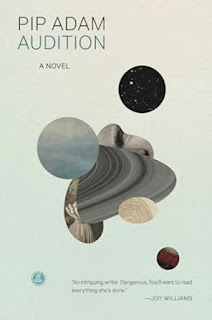
Pip Adam's AUDITION

I am thinking very hard for a moment but trying not to go quiet like we did the last time we tried to think very hard.
One of the sillier, yet rather profound, bits of The Hitchhikers Guide to the Galaxy concerns the Belcerebons of the planet Kakrafoon. Formerly a highly civilized and quiet race, their perceived smugness about their civilization annoyed the rest of the galaxy into afflicting them with the dread social disease of telepathy. Once so punished, in order not to broadcast their every stray thought to the rest of the world, Belcerebons had to keep up a constant stream of chatter, at the expense of all other activity. Their planet thus became a very noisy and inane place.

I mention this because a similar fate, though not under similar circumstances, has seemingly befallen the crew/passengers aboard the star ship Audition, a craft powered by sound. And while any sound would originally have done, these crew members soon have to resort solely to talking because, well, they're not on the Audition because of their superior skills or merits, but because they are afflicted by a freakish and continuous growth. This growth, which has resulted in our characters all having been about three times normal human size in every dimension at the time of the ship's departure from Earth, has left them, as Pip Adam's touching, inventive and at times weirdly theatrical novel, Audition, begins, confined to the three largest spaces on board ship, into which they now barely fit so they can't move anymore, can't make the sounds of footsteps or opening and closing doors or rustling fabric; the only sound they can make is by talking, calling out to one another by way of a continuous babble of conversation, which at first is just status reports on how their legs are losing circulation and maybe gonna die and fall off or how the big skylight on the basketball court where one is trapped is now just a keyhole relative to the size of their still-growing eye. When that runs out, they start trying to piece together how they got there, but are quickly thwarted by a big problem: they don't seem to remember anything from their pasts except that they had been launched into space because they were too big to stay on Earth.
They were the unwanted. That was clear to them, perhaps it had been from the start. They took up too much room.
Then we start to get a little more information about the crew members - Alba, Stanley and Drew - from the perspective of one of their earthside trainers in an extended flashback. The Giants, as they came to be called, have been herded to a big sports stadium in Europe to be trained for their special mission: they are to be sent in giant spaceships to explore and maybe colonize other parts of the galaxy. A joke is made that this will make room for 540 regular sized humans, as many jokes are made at the Giants' expense, for as they have grown, so have the distances that their nerve impulses must travel. Like the dinosaurs to which these poor people are often compared, they seem slow and stupid to the rest of us, and dangerous, and greedy for resources, and did I mention dangerous? People who are different are always dangerous, you guys. Even if they can't accidentally step on you and squash you like a grape.

But so before these Giants get launched into space, they must be "trained" -- really, conditioned, brainwashed even -- to follow patterns of behavior and belief set by the normal-sized humans (though, the Giants always tell us, they hate being called that), and to forget as much as possible their lives before the stadium they've been taught to call the "Classroom." Presumably this is so they don't develop resentments over how they were treated prior to the "launch 'em into space" solution was adopted, but also in general to make them more biddable. Thus all their prior habits of speech in the book's introduction begin to make sense as programmed responses. They've really done a beautiful job with the ship, you guys. The Classroom was beautiful, too. The teachers were so kind. The food was so delicious.

And so they all find themselves in space, unable to recall anything about their previous lives as ordinary human beings, compulsively responding to lights and sounds like trained monkeys and unable to hold on to the simplest thoughts once a behavioral trigger is activated. It's horrible to behold, even just in print, a real tragedy that seems inescapable even before they come up with a seemingly doomed idea: 
We thought if we broke the ship, we'd remember,' Drew says. 'That we'd get it back. Ourselves before the classrooms.' The ship settles again, suddenly, and the sound levels out. 'And we were wrong,' Alba says.
It's pretty much the most tragic observation I've seen made in speculative fiction, and remember, I've read stuff like The Sheep Look Up multiple times. But...

About 2/3 of the way through this gently strange and obscurely distressing book, Audition morphs into a kind of first contact story, and once if the best, in terms of conveying the truly alien, that I've encountered that was not written by Peter Watts. Because what our trio encounters at first adjusts them/itself into something in accord with Alba's and Stanley's and Drew's senses and understanding, accommodating them so beautifully they think they're maybe in Heaven, but then starts pulling them along to meet the new universe and awareness halfway in a very subtle and convincing manner:
Stanley and Drew are beside her and they’re under the tree where they spent the first night. It is changed. Some kind of autumn has come over it. Its branches reach the ground now and it’s a different colour. The sky around it has also turned. Everything is shifting from the pastels into much more saturated colours. The brightening has been happening, Alba now realises, gradually the whole time they’ve been there. But now it’s at a point where it affects everything. The whole world sings in the bath of the colour field that comes from the sky but the tree has definitely changed colour, it isn’t an effect of the sky. The three newcomers who aren’t that new anymore shade their eyes from the brightness but T.J., A.J. and R.J. look at them with open eyes, waiting for them to sit down. The locals are stiffer in their movements and possibly taller. They sit in a more anchored way than the first day they sat together. They are taking up a different space. Alba looks at Stanley and then at Drew and none of them have changed in the same way. No physical change has come over them at all. They are the same as when they first arrived. Which surprises her because her insides feel completely rearranged.

I can't say much more about this aspect of the novel without giving too much away, so I'll just take a moment to marvel at how it transforms the entire rest of the story, including some pretty distressing material that comes up once our trio manages to break their conditioning and remember how they knew each other before the Classroom, before they even became Giants. Audition isn't here to coddle us and our delicate little feelings (though it's not here to brutalize us, either), you guys.

What it is here for, is to ask us to ask ourselves how certain we are that the world has to be the way it is now, that people have to have the relationships that they have, that what we know now about the universe is all that we can know, and that we are right about what we think we do know. That's all a pretty big job for a novelist, but judging from this book, my first read from both author Pip Adams (and from her fascinatingly off-beat U.S. publisher, Coffee House Press, which, more from them very soon!), Pip Adam is up for the job.

I think I'm going to need to read this one again sometime soon.

Wednesday, July 2, 2025

Andy Sharp's THE ENGLISH HERETIC COLLECTION: RITUAL HISTORIES, MAGICKAL GEOGRAPHY

Can we use film geographies to create cultural maps across a slice of time?
A long, long time ago when I first became concerned that all I ever seemed to read or watch was fiction, I made a particular effort to start adding more non-fiction to my cultural diet, went to the University of Wyoming's Coe Library (from which you could check out any number of books for a whole semester), and grabbed a big stack of stuff. One of which was Simon Schama's then-brand-new Landscape and Memory, a book that in many ways changed my life. Among other things, it led me to concoct, sometime later, one of my odder blog posts about how I personally had imagined the landmarks and locations of The Lord of the Rings when I was a kid.

Landscape and Memory is just that kind of read. But it's one that is almost sui generis; it wasn't until I discovered* W.G.Sebald and especially Rings of Saturn that I found anything to compare. 

Now I've found a third such project, a book that sums up a unique artist's strange and fascinating and definitely Ballardian (he even references Simon Sellars!**) oeuvre, English Heretic. A project that seems to have been aimed specifically at my little head but about which I'd been totally unaware until somehow I learned about Andy Sharp and The English Heretic Collection: Ritual Histories, Magickal Geography.***

Imagined in direct opposition to English Heritage and all it stands for, Andy Sharp describes his English Heretic project as a way to "use place as a means of fecundating the imagination." The resulting book is a survey of decades' worth of incredible creativity and energy, rendered in very serviceable prose, with lots of astonishing little insights popping up like graveyard ghouls from a cemetery that's older than my entire country.

As the quote I used to start this post indicates, a lot of Sharp's work begins and ends with film locations and sets, especially those appearing in the low-budget esoterica of the 1970s folk horror masterpieces he loves (many of which can be enjoyed via YouTube or Tubi as of this writing), like Witchfinder General or The Blood on Satan's Claw or The Shout or The Living Dead at Manchester Morgue, aka Let Sleeping Corpses Lie. I have seen precisely none of these films, but I'm looking forward to doing something about that soon. Judging from the trailers, I'm in for a pretty good time!

Anyway, a discussion of the latter film yields exceptional fun: The filming of Living Dead took place partly at a somewhat famous church, Hathersage in Derbyshire, and was interrupted by a coach load of tourists who "on witnessing the zombie orgies informed the authorities." The film crew had been working and camping it there for three days without official permission, of course. By the way:

The tourist party had come to Hathersage to view Little John's grave which takes up seven feet of the burial ground. Little John is the church's most famous inhabitant. I'd like to imagine Little John's reanimated corpse joining forces with Guthrie**** and his undead merry men to reap anthropophagic revenge on the do-gooding snitchers of Hathersage.
Sharp goes on to connect elements of the film's plot with actual local folklore, but leaves us to speculate whether the filmmakers were consciously aware of that folklore when making the movie. I mean, it's way more fun that way, right?

One location I can't believe Sharp didn't write about in any of these projects of his, is Winspit Quarry, though. You may think you don't know this place, but, friends, if you've ever watched much of the original Doctor Who series, you've likely spent rather a lot of time looking at it: it's that quarry Privately owned but publicly accessible at your own risk, this has to be one of the most haunted locations on the Sceptered Isle. It's stood in for so many alien planets, you guys. The psychic ghosts of so many rubber-bodied aliens are stalking it. And it's not like Andy Sharp doesn't know his Doctor Who or his Blake's Seven or anything. But maybe this is simply too famous a location for him.

Sharp isn't only concerned with films, though; another major cultural touchstone for this work is most of my very favorite psychologist, James Hillman's, later works after he developed his "acorn" theory of personality development, which I first encountered in a book he collaborated on with Michael Ventura, We've Had a Hundred Years of Psychotheraphy and the World is Getting Worse.***** The personality at its youngest and least developed is Hillman's acorn, which is tiny and nut-shaped but contains within it the potential to grow into a vast and branching oak tree; as it becomes a sapling it develops "nubs" which Hillman views as behavioral and obsessional interests that hint at the personality's mature form, destiny and role in the world. Sometimes, as with, say, Winston Churchill, Hillman sees these nubs in a kind of negative, as when he considers Churchill's childhood stammer as a kind of fear or intimidation of the promptings his soul was giving him that prefigured that one day he would have to save the world by his speech. I believe Hillman went further with this notion in a book of his that I still haven't read but which turned out to be his most popular, The Soul's Code.

Anyway, Sharp calls on Hillman and his acorn theory as he contemplates personalities as diverse as Aleister Crowley, J.G. Ballard and Max Ernst, all viewed through the lens of place. He particularly goes to town on Ballard, whose fractally fascinating life as a child in a Japanese prison camp, an avant-garde writer of incredible science fiction short stories and a single father who only really got weird with it after his wife's untimely death left him raising four children a stone's throw away from a major film studio.

Of course Sharp is most interested in Crash, though The Unlimited Dream Company and The Atrocity Exhibition get plenty of attention, too. But it's Crash and its unforgettable character of Vaughan who really haunts English Heretic, as a fictional subject of Sharp's "Black Plaque" project, again, in direct mockery of English Heretic's plaques concerning the doings of various celebrated English people in various English places.

Sharp likes the nastier sort of person, of course. Don't we all?

At the rate I'm going, all but homebound on the high plains of the western U.S., I'm never going to get to visit the U.K., will never see any of these places with my own failing eyes. Thank Yog that people like Andy Sharp and Simon Schama are writing the next best thing to being there, books like English Heretic.

*Thanks to my late, lamented friend Lethe Bashar, aka Chris al-Aswad.
**IYKYK
***And no, I don't remember how I found out about this book, and it's driving me crazy. I've interrogated my usual suspects and nobody's owning up. So maybe Andy Sharp has just been beaming this book at my bean since 2020 and my skull is just too thick -- I do famously have incredibly dense bones, like freaking Wolverine -- to have admitted the signal right away. Or something.
****Guthrie played a drowning victim who spends the film as a soaking wet "submarine zombie."
***** A book which I cannot recommend highly enough, old as it is. Hillman and Ventura bounce off each other beautifully, and pushed each other into a lot of wild ideas that the rest of our culture is still catching up with.