Kate Sherrod blogs in prose! Absolutely partial opinions on films, books, television, comics and games that catch my attention. May be timely and current, may not. Ware spoilers.
Before I'd burned down the Emily Dickinson House, they seemed to be normal, healthy, somewhat happy Americans who took vacations and gardened and who'd weathered a rough patch or two... Now they looked like skeletons dressed in corduroy and loafers. Their eyes were sunken and wanting to permanently retreat all the way back into their skulls... Why do we hurt our parents the way we do? There's no way to make sense of it except as practice for then hurting our children the way we do.
I'm rarely as mad as a book as I am at the "wildly and unpredictably funny", "Absurdly hilarious... searingly funny", "wacky and wildly imaginative novel" that "sizzles" and is "funny, profound... a seductive book with a payoff on every page" that is also a "darkly comic" "deadpan satire of all things literary" as all of the dumb little blurbs sprayed all over the book cover of later printings of An Arsonist's Guide to Writers' Homes in New England proclaim it to be. And not, as one might expect, because these blurbs are misleading or mere puffery or in any way inaccurate (for all that they are wholly unnecessary; the title alone was plenty, Brock Clarke. You had me with the title). It's because they are. And also because they really, really aren't.
I know better than to turn to a veddy veddy literary publisher with a name like Algonquin Books for a mere funny read, of course, so I'm not in anyway surprised that what An Arsonist's Guide really is, is an incredibly loving and empathetic argument for the idea that toxic masculinity, while indeed one of the great scourges of our time, does not have to be a life sentence, that, also, it's not exclusively a disorder from which the male of the species alone can suffer (I would argue that the worst sufferer in this novel is a woman) -- indeed, this book might be said to argue that it's high time we rename the phenomenon something more accurate and inclusive like "toxic stoicism."
Dammit, my sentences are getting long again. But anyway, I'm trying to come around to why this book made me mad, without in anyway conveying the idea that I'm mad because my expectations weren't met or anything like that -- apart from my not having been prepared for what a god damned noble piece of fiction writing The Arsonist's Gude really is.
And yeah, part of my annoyance is really just jealousy, because with this book, my first but not my last Clarke that I'll be reading, Brock Clarke has proven to be exactly the kind of writer I love to hate the most, sweet, smug, punchable author photo and all. It's not just that he's good and he knows it, and is as good as anybody I've ever seen at doing the thing that I most enjoy-yet-roll-my-eyes-at thing of simply taking every cliche that pops into the reader's head as she's reading his work, invert it very simply and neatly, and pointing out that it's true either way, in a way that elicits a rueful chuckle if not a pained guffaw if not a full bout of John Trent laughter (iykyk. Do you read Sutter Kane? I bet Brock Clarke does). Though yes, it's a lot of that. And so I'm sitting here looking at my copy, so laden with book darts right now that it positively sparkles and probably weighs twice as much as it did when I got it* trying to find just the right passages to quote to show you what I mean and I can't decide and that, too, is making me angry.
Which, I mean, that's a pretty good problem to have, really? But... I'm just going to start typing strings of expletives here in a second. So I'll stop for now. I'll be back.
But so, OK. An Arsonist's Guide concerns the life and times of one Sam Pulsifer, a man of around my own age, perhaps a bit younger, who grew up in the nice Western Massachusetts college town of Amherst, MA (home, yes, of Emily Dickinson once upon a time, and also of ZooMass), raised by nice upper middle class parents who mostly kept it together bar a few strange incidents that come to loom very large in Sam's later life but only after, in the kind of dumb teenaged accident that can mark a dude for life even if he hasn't been raised in the tradition of upright New England stoicism that I've already compared to Toxic Masculinity, Sam accidentally does indeed burn down the house where Emily Dickinson once lived, also accidentally killing a couple who were trapped inside and thus forever altering not only his life and his parents', but also that of a boy whose own parents were trapped inside the burning Emily Dickinson House and will have a few things to say or do about it later. Much later. Like after Sam serves a prison term, is released into society and starts sort of half-assedly trying to make good, getting a degree in Packaging Science (the sort of non-subject Subject that writers like Brock Clarke are lucky enough to discover is a thing before any other writers do and get to show off to the rest of us the way an intrepid explorer from a prior generation might bring home a Masai spear or something oops I'm jealous-ing again, aren't I?), establishing a lucrative and respectable career as a designer of containers for products that we all use but never noticed, marrying a beautiful and resourceful classmate and having two beautiful children with her -- all without ever telling his poor old parents that he's even back out in the world yet, until The Plot of the Novel Happens.
And all the Secrets come out. Secrets that Sam has kept from his parents, and they from him. Secrets Sam kept from his beautiful wife and children. Secrets festering darkly in the hearts of a hundred or so letter writers who have certain feelings about certain other famous New England writers and who wish that Sam would give those writers' houses the same treatment he gave the Emily Dickinson House. And the not-so-secret secrets of the poor kid whose parents Sam accidentally killed all those years ago. Not all of these secretes get aired out; not all of the mysteries get solved. But the ones that do, do so to devastating effect, making of An Arsonist's Gude rather more of a cathartic than a funny read. But, let's be real. If I'd known this was going to have Oprah levels of emotional cleansing and warm-heartedness and forgiveness, I probably wouldn't have picked it up.
But I'm glad I did.
*Gently used, from Thriftbooks, after the fearless leader of my favorite online book club praised a non-fiction book of Clarke's a few months ago. I went to get a copy of that book, an essay collection, for fuck's sake, but I saw An Arsonist's Guide and I spent my hard-earned on it instead. So it goes. As it were.
What happens when a writer with exceedingly literary pretentions wrangles a contract to novelize a B-movie of the kind most of us nowadays can only imagine watching with the silhouettes of a nebbishy guy and two iconic robots bopping around in the lower right corner of the screen?
Has anyone ever asked this question before?
Well, Rick Moody did. And the results are bananas.
The Four Fingers of Death,for much of its considerable length, directly answers this question by serving us a smorgasbord of pulpy goodness ranging from a crewed mission to Mars (conceived as the last grasp at relevance for a NASA and a United States on the brink of destitution, third world-caliber exploitation by actual world powers, and a concomitant brain drain that has brought us into the world of Mike Judge's Idiocracy but without that film's unfortunate eugenics arguments) to a suddenly self-aware chimpanzee whose pages-long speeches display a surfeit of internet-gleaned erudition*, to an amputated human arm infected with alien bacteria that's mindlessly crawling around Arizona committing murder and a few sex crimes while spreading its disease. Helpful servant Thing, of Addams Family fame, this ain't.
Oddly, the narrative doesn't really play this for laughs, though it acknowledges on nearly every page that its every premise is ridiculous. I mentioned that the fictional writer of this madness, whose own career forms a frame narrative for his novelization of The Four Fingers of Death (a 1960s Technicolor remake, we learn, of an older black and white schlock-classic, The Crawling Hand), has serious literary pretensions; our man Montese Crandall, previously only known for flash fiction so brief that he only ever actually published single sentences, explores in depth and with sensitivity the inner lives of the astronauts on their journey to and through their tragic, pathetic and farcical experiences as the first humans on Mars, the dawning sentience of the experimental chimpanzee, Morton (alas, unable to perform a Caesar and uplift other apes with whom to be strong together), and the plights of the many earthbound humans, at many strata of society, whose lives are affected by the titular hand and its disease.
While also treating us to some over-the-top gross and bawdy sex scenes, very much the funniest I've ever read.
Meanwhile, Moody pulls a kind of The Corrida at San Feliu of a trick, considering and expressing considerable emotion upon different aspects of a common problem -- most prominently, how gifted but emotionally stunted men deal with the loss, to death or desertion, of their wives -- through different narrative layers. In the frame narrative, Crandall is watching his wife slowly waste away and die of chronic disease; in the astronaut layer, Major Jed Richards is kind of in denial of the fact that his long separation from his wife started long before he blasted off for Mars and he's probably not getting her back if he makes it back to earth; and in the chaotic Crawling Hand account, a scientist whose wife died some time ago is keeping her body in cryonic suspension while he experiments on lab animals using cells from her body as he works on a cure for what killed her -- and hasn't leveled with his teenaged son about any of it. The son, meanwhile, often looks poised to repeat his father's emotional mistakes, except he has a girlfriend who is way more healthy and dedicated to making their relationship work than any of the wives in the novel. Seriously, if you don't come out of this with a deep love for Vienna Roberts, I am starting to doubt your commitment to Sparkle Motion.
That this book doesn't collapse under the weight of all of these premises is a source of wonder to me, even weeks after having compulsively read its over 700 pages almost without stopping (after a false start with the audio book, which is so poorly done in so many ways that I didn't even make it halfway through before my spleen erupted and sprayed bile all over a bunch of my Discord buddies, who I think were ready to beg me to switch to any other format when I did just that). Even if I hadn't been deeply emotionally invested in all of these characters and strapped in for all of their plots and subplots, I would have hung in just to see how the hell Moody was going to bring all of this madness to a close, even before I realized he was going to do so in the middle of a howling mad latter day Burning Man analog. But damn me if he didn't stick the landing. And earn a perfect 11 from all of the judges except for that one who actually is just really afraid of apes.
Utterly batshit. And brilliant.
*Obviously this book was written back in the days when web searches were still useful and AI slop not even imagined by the likes of your Corys Doctorow or your Williams Gibson. Ever the peril of science fiction is this race against actual culture towards dystopiae.
"For a while there I wondered whether Jesus Christ is a gerontophile..."
"Excuse me?"...
"Well you see Fidel, it's simple really... Nuns are supposed to be virgin spouses of Christ. They mostly spend their days in convents, untouched, so I assume they're waiting to finally join their husband and, I imagine, to consummate their marriage. Most of these devoted young women turn into withered hags by the time they manage to kick the bucket, you know, especially since they're not supposed to speed up the whole process much in any entertaining way anyway - I don't believe many of them take a lot of drugs or drink themselves to death very young, or die of cholesterol overdose... Anyway, once they finally get to shag the lord, the majority of them are, well, mature, even elderly, or bloody ancient, if we're completely honest. So you see since this suspicious arrangement had to be organized by our lord, and if he himself has decided this is how he wants it.."
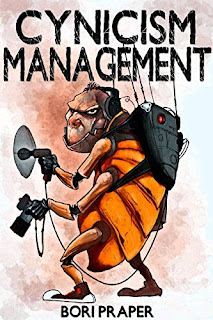
More novels, whether or not they are chiefly concerned with the farings of a newly-formed progressive rock bands in a suburb of Ljubljana, Slovenia, should come with their own soundtrack album. Perhaps there are more than I know of, but until I stumbled across Cynicism Management: A Rock'N'Roll Fablewhile perusing the offerings at corona/samizdat (my new favorite indie press*), I only knew of one in all the world.** But now I know of two, or rather, three, because I see that the sequel to this madness has a soundtrack album of its own.***
This, of course, delights me. It would even if the album was not to my taste, or if it were but the novel was not. But in fact, I'm pretty delighted by both .
Cynicism Managementis the name of a fictional-yet-also actual band comprised of a motley international crew of ridiculously talented but as yet not-very-successful musicians with high standards for themselves and each other, a taste for rather baroque time signatures and somewhat outmoded instrumentation (an early and only slightly heated discussion among the members concerns the practicality of acquiring and incorporating a Hammond organ, for instance) but a punk/metal sensibility and somewhat revolutionary politics.
These are the friends I've always dreamed of having and I began to miss them mere moments after putting the book down: Finnegan Frotz, an "extraordinarily pale" Black Scotsman, the lyricist and main ideas man; Amalia, Scots vocalist, hostess, his on-again off-again lover; her brother Randy, bass player and weed connoisseur; Bogomr, a Ukrainian performance artist/exotic dancer/musician who has been raised to believe he is an actual vampire; Eric, an Australian heavy metal guitarist with an unhealthy fixation on his perpetually receding hairline; and Fidel, an Italian revolutionary by day, kickass prog drummer by night. I mean, come on!
But wait, there's more. Like a group of six women who have all turned up in a certain basement in London where they are employed to monitor feeds from various spy cameras installed in various toilets in various airport bathrooms around the world. And whose employer, the amusingly named Omnipile Industries, a multinational conglomerate so large and far-reaching that its in-house intelligence service has usurped the function of most governments' services, has suddenly sent them all to the Ljubljana suburb to observe the activities of one of Cynicism Management's members. He has a unique tattoo in his nether region that seems to offer the only clue anybody has found to the kidnapping of the children of Omnipile's CEO. Could be a coincidence, but nobody seems to think so.
By the way, the solution to the whole tattoo thing may be the single geekiest solution to any mystery that I have ever encountered in life or in fiction.
Incidentally, about midway through the novel the group of women acquires a thoroughly disrespectful but awesome nickname that I think I'd have enjoyed being called as a younger woman, myself: they are the Bitch Scouts. We never learn their actual names, by the way. They get unique and sometimes humorous personal designations (though one is simply referred to as Another One) but never names. But we don't miss them.
And of course this suburb of Ljubljana is populated by a host of fantastic tavern keepers, would-be-porn soundtrack composers, drunken firemen, pensioners, peasants, lunatics, picturesque trollops and a mayor on the make who can't stop spinning cockamamie economic development schemes that are probably doomed to fail, either entertainingly or depressingly, or both.
So, the resulting tale feels an awful lot like Laszlo Krasnohorkhai and Virginie Despentes decided to collaborate on... a thriller of sorts? Except kind of funny. Sometimes very funny.
The novel starts out a bit scatological -- the way the Bitch Scouts learn about the tattoo that kicks off this whole story is on the gross side but also on the paranoia-inducing -- and makes fun of alcoholism quite a lot (Superman Nap!), and commits many other sins against propriety in all the ways one would expect a so-called "Rock'N'Roll Fable" to commit, but never quite delivers up what we expect, except for equal parts of big, amazed laughs and thrown devil horns. And it's full of weird conversations like the one I quoted at the beginning of this post.
The result is the most sheer fun I've had in reading a novel/listening to an album than I have had in a long, long time. There is a sequel, Pendulum Pet, which I have already acquired on the strength of this one and you'd better believe you'll be hearing about it soon right here at Kate of Mind.
In the meantime, I've got a new album to put on obnoxious heavy rotation, chez moi. My housemates don't like I nearly as much as I do, but even they have to admit that a few of the songs are genuine bangers.
*Note, I originally tried to buy Cynicism Management from corona/samizdat and yes, you do have to wait for them to ship your copies to you from Slovenia but it's totally worth the wait and the shipping charge because they have some cool, cool stuff and publisher Rick Harsch is an excellent human (who is also a writer and you'd better believe you'll hear more about him here soon) BUT he was fresh out of paper copies of this so I had to look elsewhere to get its words into my eyeholes. Fortunately, ebook editions of it also exist and hey, if, like me, you've recently abandoned the Big River for less fashy climes, both Cynicism Management and its sequel, Pendulum Pet are not only available via Kobo but are part of its Kobo Plus subscription, so you can read them that way if you don't want to wait for corona-samizdat to get some more paper copies printed. But I still call dibs on a paper copy if one turns up, Mr. Harsch!
**That one, in case you're interested, is Eating Eight by Lars Paul Linden, a cyberpunk-ish romp about a book -- or actually a comic book script-and-cassette tape combo referred to as a "book-dope-book" that gets you high when you read it. The soundtrack really did come on cassette, featuring music from Linden's band, Penis Fly Trap. It was my honor and joy to receive review copies of these back in the day when I was an occasional scribbler in an underground music and politics 'zine, The Pit Report. Back in the 1990s when I lived in Boston. But rest assured, dear readers, I wasn't cool then, either. But I knew some cool people and got to do some cool things like get high on book-dope-books.
***Here's a link to the main soundtrack album, Tit Augmented over at the least shitty music streaming service I've found, but note: there is additional music featured in scenes from the book that isn't on this album because it's not by the band, but by another musician who is also a character in the novel, Ray Kosmick, who does some very cool electronic music that he (the character at least) intends for porn soundtracks but which I find are great listens just on their own. By the way, here is my very favorite track from Tit Augmented, just because:
I didn't know how much I'd been wanting Ned Beauman to write some actual speculative fiction, preferably also with reduced Nazi content) until Ned Beauman wrote some actual speculative fiction that still made me laugh, bitterly.
Venomous Lumpsucker is even more of a departure from what I've become accustomed to in Beauman's work than the above suggests. Instead of a history-less historical fiction, it is every bit as science fictional as, say, The Mountain in the Seaor War with the Newts. Instead of romantic and sexual obsessions, we have characters seeking redemption and atonement, both for their own sakes and for humanity's. Instead of biting satire, we have envenomed biting satire.
The title fish is an imaginary species of cleaner fish (like pilot fish or wrasse),* that, yes, injects venom in its bite, but more importantly, in its cooperative behavior the lone scientist studying them compares to that of Asian gangsters, it shows signs of significant intelligence. Maybe even greater than dolphin-level. Maybe as great as ours allegedly is. Or as great as that of certain Newts or Octopuses.
It is, of course, on the edge of human-caused extinction in the near-future world of this novel. And if its would-be saviors are anything to go on, it's going to go right over that edge really, really soon.
Karin Ressaint and her accidental partner in species preservation, Mark Halyard, both work in the Byzantine new extinction industry, a complex and insincere global system that makes the fossil fuel industry's token efforts to combat climate change look, well, no, those still look horribly feeble and hollow but, well, actually, it's hard to say which is worse. Suffice it to say that Karin's job is evaluating the intelligence levels of endangered species who will be made extinct by any proposed economic activity in order to determine how much money the proposing enterprise will have to fork over for killing off the species. Intelligent species cost more. There is a whole system of Extinction Credits involved in this that I'm not going to mess with explaining here, but that's basically it. Our future global society, in Beauman's savagely jaundiced view, will have corporations, and thus everybody else, fully accepting species extinction as just another cost of doing business, while nobody even pretends to consider not doing the things that will cause extinctions -- and also a whole gross derivatives market built on top of the credit system. In which executives with inside knowledge occasionally dabble, because of course they do.
Such a one is Mark Halyard, who works for the gigantic sea-bottom mining company whose next project will most likely wipe out the venomous lumpsucker. But since he and his colleagues game the system better than anybody, they're even less worried about things than usual, because they're on the verge of yet another successful attempt at changing the legal definition of "extinction" into something with bigger loopholes to buzz on through; namely that even if the last actual living member of a species dies off, that species won't technically be extinct as long as its genome, tissue samples, brain wave patterns, etc, have all been preserved well enough for them to be brought back to life, Jurassic Park style, in some theoretical future when we'll somehow have magically fixed up the damage we did that killed them off in the first place. Because of course we're totally going to do that someday, guys. It'll be great. Just wait.
At first these two characters would seem to be at odds with one another, but as the plot ramps up and horrible unforeseen happenstances just happen to happen, they find they kind of have a common goal: to minimize the damage done by poorly controlled autonomous mining equipment and Halyard's ill-timed foray into playing the Extinction Credit Market. Oh, and an apocalyptic hack, but we'll get to that.
Along the way they visit corporate-run wildlife preserves (so underfunded but under so much pressure to succeed at any cost that the manager of the one our duo visits has secretly agreed to allow toxic waste to be dumped, in leaky drums, right in the middle of the Pristine Preserve), climate refugee camps (in which a gross new zoonotic disease has emerged that does disgusting cosmetic damage to cattle and the human serfs who herd them -- refugees are cheaper even than robots for some kinds of labor) and a libertarian sea-stead community that might as well be Rapture from Bioshock right before everybody gave it up for lost -- and that's just all in the book's first half. Because they're on the trail of a mystery as well as desperately trying to find other populations of venomous lumpsuckers; they're also on the trail of who or whatever hacked and destroyed the entire system that preserved all of those DNA sequences and tissue samples and recordings of mating calls and habitat data in one swift attack right before Ressaint and Halyard met up.
And every stop shows us more and more examples of cynical depravity on both petty and grandiose scales. I especially howled at a character met in Not-Rapture, a Professional Conservationist who funds his noble and legit operations by taking samples of actually endangered species and, with the help of a Mad Scientist, tweaks the DNA just a little bit, then returns the "evidence" of a "whole new species" to the wild to be discovered by habitat monitoring robots, thus earning tradable Extinction Credits when the government "saves" the nonexistent pseudo-species.
I mean, this is still a Ned Beauman novel.
Once again, the novel has multiple endings, and none of them are exactly satisfying, but I think in this case the unsatisfying endings have a definite point: tidy endings are products of art rather than reality; in the real world, we're all just muddling through and doing what we can at least half-assedly convince others is our "best"; nobody is really in charge; there isn't a plan; problems are never solved but only kicked, can-like, down the road. Anybody who tells you differently probably just embezzled a bunch of money from their employer and wants your help in laundering the loot.
Fucking Ned Beauman.
*Of course I only added that parenthetical note because I think "wrasse" is a cool word that's fun to say or otherwise use.
Admit it: you've been waiting your entire long, lonely, colorless life to read a novel that contains a line of dialogue as brilliantly bizarre-yet-perfectly-contextual as "these are difficult times for sorcerer roosters."
Satisfaction is just a few clicks away. Hurry up and get yourself some format of Angolan novelist Ondjaki's incredible Transparent City, which I caught myself explaining to my mom as "Ulysseswith less stream-of-consciousness and more characters but also imagine if they discovered oil under the slums of Dublin and the Chinese were the economic powerhouse of the day."*
The "sorcerer rooster," by the way, is largely unremarkable except it recently lost an eye when, preparing to do his job and start the day with a mighty crow, he was instead struck in the eye by a stone shot from a great height by a young man in the multistorey apartment building next door -- which building is almost a character in itself, as is an albino cockroach that keeps appearing and stealing scenes -- one morning in 21st century Angola.
The rooster is no more a sorcerer than any other urban bird; he is just referred to as one by a pair of suspicious tax inspectors struggling to make sense of the aforementioned building and its inhabitants, which, get ready for the inhabitants, most of whom sport incredible names like Ciente-the-Grand and Strong Maria and Little Daddy and João Slowly. And our sort-of protagonist, Odonato, which is very close to the insect order Odonata (which includes dragonflies and damselflies and is evolutionarily quite ancient even for insects), derived from the Greek word for "tooth, " and someday is really like to have a look at the original Portuguese text of this novel to see if all the character-names-as- English-words are original to that text or translated from the Portuguese words, and if so why Stephen Henighan left Odonato** alone instead of calling him "Dragonfly" or "Tooth." But that's a project for long winter months instead of brief summer ones.
Odonato is the father of Ciente-the-Grand, and has already begun (but barely) to become the literally transparent man he will be by novel's end when his wayward son gets himself shot in the ass and wanted by the authorities, which sets in motion the incredible mutual aid showcase that is the building most of these characters call home. They have worked out elaborate warning systems to alert one another of any government or other unwanted attention they're getting, have worked out schedules for exploiting the weird pools of water that collect in the first floor hallway (possibly due to deferred maintenance on the city's water systems, but maybe also a feature the building's residents created for themselves. Or both. I'm inclined to say both)***, and are in general very much entangled in one another's lives to a degree we mostly associate with extended families and I had to keep reminding myself that for most of human history this was the default setting for humanity -- mutuality and cooperation whenever possible, competition only when absolutely necessary -- while I caught myself regarding these relationships that pretty much amount to found family, with wistful awe.
As you see from these international book covers, the city is only part of the title in the English language editions, and is thus singular. For once, though, I think I like the English/ American title better; the plural in the romance languages (including the original Portuguese) would more directly translate as something like "The Transparents" as in, perhaps, the transparent people, but making it a singular/collective noun phrase and extending it as a description of the city of Luanda entire, it draws our focus to how most of the many foreign visitors drawn into the story of Odonato's building and its inhabitants must view the city: the petroleum engineers and other consultants brought in by the government to complete plans to exploit the oil that's been discovered literally under the city, for instance, seem to look right through its buildings, its infrastructure, its people (and of course a lot of the oil is under the Angolan equivalent of the famous Brazilian favelas). Even its local officials seem to have shifted to this perspective; those who aren't busy entertaining visiting American geologists are working to capitalize on another, more fleeting and ephemeral natural resource their country has to offer in the form of a coming solar eclipse, which will be total in Angola. As a Wyoming girl, still living in a place that is functionally also a resource colony with delusions of sovereignty that also, just a few years ago, cashed in on eclipse mania, I felt a kinship with the characters in The Transparent City and their ambivalence about the coming opportunities (a homeowner in Wyoming's capital city for many years, and a former journalist who covered the mineral extraction industries, I was always extra wary after learning that I did not own the mineral rights to my own property and that this is standard out here. Meaning of course that if oil, natural gas, etc were ever discovered in my neighborhood there would be swift eminent domain action and I would have to just hope that I'd be offered something reasonable in exchange. These characters, though, in Odonato's building... are they renting tenants? Co-operative owners? Squatters? It's never addressed.).
Ultimately this, like so many good literary novels, is a story of relationships, not so much between family members for all of the Odonato/Ciente plot as between friends, neighbors who have become friends, and yes, a few romantic relationships, such as the long marriages between Odonato and Xilisbaba and between their neighbors Edu (who has a formidable and world famous hernia swelling right next to a testicle that he carries around a little stool to support whenever he gets to sit down) and Nga Nelucha, between the entrepreneurial Joao Slowly and the actually hard-working Strong Maria, and the supportive appreciation the entire building extends toward a character known only as The Mailman, whose only wish in life is to be issued a moped with which to make his rounds delivering the city's mail but who can't even get home anymore because a huge and sprawling unauthorized garbage dump now blocks all access to his house so he sleeps... we don't know where he sleeps. Too, the figure known as Little Daddy, who was separated from his mother in the most recent interlude of Angola's civil war and who is hoping that an upcoming TV appareance will help reunite them. Little Daddy just sort of crashes at the apartment building and maintains goodwill with its official residence and sort of earns his keep by doing any and all odd jobs that need doing, is a lens though which we see a huge variety of tendernesses and neighborly acts of good old fashioned kindness. It's all rather deftly sketched through us in Ondjaki/Henighan's understated style but we get to know everybody well enough to know them as distinct characters and to weep along with them and their friends when a few meet ignominious fates.
About that style, though: if you're not used to, say, Portuguese literary fiction and yes I'm mostly thinking of Jose Saramago here (and hey, this book was awarded the Jose Saramago Prize!), it might take you a while to get used to this text, in which there are phrases and phrases that feel like they could be sentences in that they contain subjects and predicates but are neither capitalized at the beginning nor punctuated at the end with periods, to say nothing of spoken dialogue, which mostly just appears amidst narrative lines, set apart at best with an em-dash. It's not at all good English literary prose like we're taught to respect and to try to produce in school, but its effective and evokes the way real conversations happen and real thoughts occur and real events unfold without resorting to the stream of consciousness text that makes, say, Ulysses so challenging for so many.
I have a lot of candidates for "my very best read of 2023" already as I've no doubt shown in this blog, but were I to explicitly list them all, Transparent City would be one of them, and were I to make a short list it would probably be on that as well, though the year is not yet half-over. The next time you want to feel something from a read, you could do a hell of a lot worse than get your mitts on this, or, I suspect, anything else of Ondjaki's. I'll be looking for more of his work sometime soon.
*This is not to disparage Ulysses, especially not so close to Bloomsday, which I always devote to enjoying that book on audio, but a) Ulysses is on my mind because it is almost Bloomsday and b) I've had more than one person tell me, in my lifetime, that they like the grand tour of Dublin life James Joyce shared with the world but would prefer it without all the interiority and linguistic pyrotechnics. To which a legit reply might be, "then don't read Joyce, read, say, Edward Rutherford instead" but whatever. You do you.
**Though I can certainly see why Odonato's wife, Xilisbaba, is left alone in this regard. What even is that name, though an exceptional name it is to be sure! I thought, of course, of the Mayan underworld, Xibalba upon first encountering this name but that's as close as I could get on this one.
***At first this just sounds like an unfortunate puddle from leaking plumbing that has been neglected and allowed to accumulate a bit but this actually turns out to be at least deep enough to soak in like a hot springs and several scenes take place here with residents of the building and their guests soaking and socializing and affirming belief in the healing or restorative powers of the building's waters. And then the tax inspectors behold it and...
Was Hagbard Celine your bad literary boyfriend long before Hubertus Bigend burst on the spec fic scene? Is "The Talons of Weng-Chiang" your problematic fave? Was your favorite bit of Jodorovsky's The Holy Mountain the roll call of evil tycoons?Were Jules Verne's books not quite as Jules Verne as you were expecting? Do you care about mustaches? How about ebook readers?
Or, to be more succinct, do you like having fun when you read? And what is French for "fnord?"
Jean-Marie Blas de Roblès (who, are all Algerian-born authors simply amazing, or what? Admittedly, my sample size is a bit small, but still...) decided the answers to all of these questions was yes and decided to go them all one better and throw in a pigeon with a hilarious name here and there for good measure.
Speaking of names, get a load of these: Martial Cantarel (dandified man of adventure), his pal Shylock Holmes (who solves crimes with the aid of a genius African butler with a big secret, Grimod, in the mode of his famous grandfather, Sherlock), Inspector Scummington (of Scotland Yard, of course), French tobacco farmer Arnaud Méneste (whose personal bankruptcy -- after making cigars every bit as good as Cuban ones but since they're grown and rolled in France they have no exotic appeal to French smokers -- enables a Chinese syndicate to buy up his ancestral farm to set up an ebook reader factory), and Wang-li Wong, aka Monsieur Wang (the scopophiliac overseer of the ebook reader factory that arises from the unburnt ashes of the tobacco farm and the fancier of the pigeon with the hilarious name)... And there are more.
The action kicks off with an apparent murder mystery that may be connected to the theft from a Scottish castle of the world's largest diamond. While that thievery might be enough of a mystery to get things going, there is also the matter of three severed and saponified human feet, each still encased in elaborate sneakers of a make and brand that do not exist, that have washed up on European beaches. No sooner are Cantarel, Holmes, Grimod engaged by the diamond's former owner (and Cantarel's baby mama) than one of the probable former owners of one of the severed feet turns up spectacularly and publicly dead and the gang is following an ingenious clue to Siberia! To which they travel in mind-bending luxury!
Meanwhile, a wife desperate to please and be pleased by her impotent husband resorts to desperate measures that result in improbable sentences like "His penis looks like a butcher's joke, a microphone made of bratwurst, ending in a big ball of calf liver." So, uh, content warning for bawdy humor though it's no worse than what you'd find in, say, The llluminatus! Trilogy.
I did not evoke Hagbard Celine in jest.
But this isn't much of a conspiratorial romp, nor is it merely a detective story, for all its trappings of both. Roblès has more on his mind than that, and he's been reading his Baudrillard, or at least his Umberto Eco, as we see when the action brings us to Tianducheng, China and an idealized, hyperreal, scaled down version of Paris located there, with all of the City of Lights' famous sights and views perfectly reproduced but more conveniently situated, closer to one another "as if some genie had fulfilled a weary tourist's wish to shrink the city." It's carefully filled with all the expected cliches to populate the architecture, too:
Hundreds of white-skinned extras thus contributed to the authenticity of this immense garden of acclimatization, the designers having spared no expense. Among all these exhibitions of outdated and lost scenes, one display invariably provoked contemptuous chuckles -- that of a bookstore* reconstructed according to the best sources, in the image of those that existed before the digital divide that had finally stamped them out. Inside were fake readers around fake spindly booksellers who sorted piles of fake books.
If this doesn't make you think of Jim Munroe's bitterly awesome Ghosts With Shit Jobs, you really haven't been paying attention, have you? I, for one, can absolutely read the characters from this film as those less fortunate and left behind in North America while their more attractive or better connected relatives made for the bright lights and hyperreal sights of China.
Our trio of detectives and the diamond's owner, the lovely Clawdia MacRae, who happens to have had a daughter out of wedlock by Cantarel and has brought her along for the adventure despite said daughter being comatose (!), wind up traveling the world in grand Edwardian style, which is an odd thing to be doing in a novel that also explicitly contains things like ebooks and the internet and other modern technologies, encountering an array of perversions that would make Robert Shea and Robert Anton Wilson gush with glee as they follow the trail of the three right feet and the diamond. I had a theory about the anachronisms that kept characterizing their story -- the other plotlines in Island of Point Nemo are deeply concerned with storytelling, particularly with oral storytelling in the form, chiefly, of workers designated to read newspapers, essays and novels to their co-workers on the work floors of cigar factories and, later, the ebook factory, to keep them entertained through their drudgery and also to enlighten them (and thus make their overlords a bit less conscience-stricken at how their comfort and enrichment is paid for by that drudgery). I turned out to be right, at least in more ways than I did wrong, which was satisfying.
Where they end up is as incredible and unexpected as any reader could wish, among circus performers, zoo animals, and renegade scientists who have a firm belief that any small repair a person makes to the world is worth doing, even if it's just replacing a bulb in a street light.
A word, as always, about the translation: Hannah Chute had better have been well paid for the effort this must have taken; the English text is so rife with unusual locutions and near-neologisms that one would think Gene Wolfe had had a hand in it. I am a person of a certain age and fairly widely read, but some of the vocabulary (favorite example: "apocolocyntosis") appearing in Island of Point Nemo had me very glad to have an ebook version of the text and thus the ability to immediately look up the dizzying array of references and the unfamiliar words that kept cropping up. I felt like a naughty teenager again, leafing madly through the scandalous pages of the Illuminatus! Trilogy and other RAWiana with a real-life encounter with Robert Anton Wilson still in my future. I wonder if Roblès has a similar anecdote lurking in his back-story. Wouldn't that be delightful?
What is less delightful is pretty much the whole Monsieur Wang storyline. I labeled him a scopophiliac earlier, but he is also a gross sexual harasser of his employees, some somewhat consensually, some decidedly not. If you haven't been scared off by the wilder sex scenes in the other storylines you might take this in your stride, but as someone who rolls her eyes and taps her foot through this sort of thing, well, I guess we're supposed to hate Monsieur Wang anyway? Silly name notwithstanding?
Regardless, I am fairly certain this is going to end up being one of the weirdest, if not the weirdest, books I'll read this year, but then again, it's only February. From the French. What's yet in store? Stay tuned... I'm about to read some French young adult fantasy.
*This has to be a reproduction of Shakespeare & Company, right?
I've been known to use a certain GIF rather a lot to express my reaction to a certain kind of news item or framing of same. I find it needs no explanation - this is a guy laughing his ass off as he simultaneously realizes that he -- and, incidentally, the rest of the world -- is deeply, deeply fucked.*
It's also a pretty good representation of my demeanor whenever one Jason Pargin, the novelist formerly known as David Wong, crashes a podcast, posts a TikTok (which he just started doing recently with some reluctance because he is not of that generation, but let me tell you he's killing it) or publishes another novel in the series originally known as JDATE (acronym for the title of the first novel, John Dies at the End), then as the John and Dave novels, and now for this fourth in the series finally and properly known as the John, Dave and Amy novels, giving Dave's long suffering but immensely capable and patient girlfriend her proper due. But now maybe they need to be called the John and Dave and Amy and Joy the Multiform From Another Dimension novels? But that might become unwieldy if/when he writes more.** Anyway, Pargin is the absolute master of eliciting the particular blend of emotions this GIF depicts, and it's not even close, to wit:
Pargin has made a name (or two) for himself as a tart and wry but painfully accurate commentator on a lot of the dumbest aspects of late 20th and early 21st century culture, first at Cracked and then with his prose fiction and acerbic nonfiction articles. He's like H.L. Mencken with carpal tunnel and mouse elbow.
And he likes horror, which is a genre perfectly suited to examining our dumb culture's greatest failings and dumbest pecadillos, his two boob heroes and the lady who loves them are both the best and the worst people to stand between us and the horrors we are loudly humming not to hear, squinting not to see, hurrying past, but then getting grabbed by a rubbery wig monster or giant hairy spider with a human tongue or [your grossest, most tasteless monster idea here] anyway. Who us gonna call? Sorry, wrong universe for the Ghostbusters, would Jay and Silent Bob with unwanted extrasensory perception and a predilection for shoddy homemade flamethrowers do?
Of course, one of the great unsung pleasures of these novels is watching the original duo, John and Dave (mostly Dave) develop from profane versions of the Scooby Gang But With Actual Monsters into well-rounded and relatively mature individuals capable of maintaining relationships with members of the community, clients, the police (for all that they still refer, in this new novel, to their primary contact as Detective Coiffure because dude uses a lot of hair gel) and each other. So on this fourth outing, they have real insight into why things keep happening the way they do and, most importantly and satisfyingly, real advice to give to people newly in the kind of predicaments in which they specialize. It's stopped being a tasteless joke, their world, for all that it still occasionally involves jaunts into side-universes where you can buy multiple flavors of vaginal cheese at the convenience store.
This new skill of theirs comes in very handy as they confront this novel's Big Bad in the form of a teenaged boy, Bas Galvaston (Bas is short for Sebastian, which, OK), who blundered into joining a sad cult of wannabe wizards only to quickly be singled out as their chosen one because it turns out he actually has powers. And this is where Pargin exercises his talent for extrapolating the worst possible version of current trends, because this cult is firmly convinced that not only is our entire universe a simulation, but that most of the people living in it are NPCs (non-player characters, i.e. just person-shaped software tools generated by the "game") and that the few real humans trapped within it would really be better off if the whole thing could just be shut down. Which Bas will eventually have the power to do, if correctly fostered, and if the cult in the here and now can assist by piggy backing on an incursion from a malign other dimension that has seeded our world with innocent seeming toy egg-with-app combos that, if correctly "fed" by the tyke lucky enough to possess an egg toy, will hatch into a cute stuffed animal of varying degrees of rarity -- except, of course, these eggs actually demand varying levels of human sacrifice ranging from bits of scalp to human teeth to eyeballs to skins and...
So yes, while our characters are somewhat more mature, the subject matter with which they're coping in the cursed town of Undisclosed is still as juvenile and gross as ever. And as universally threatening. It's just now that our heroes are starting to realize that they're not as young as they used to be, they're still in the socioeconomic basement of our society, and that the precarity of their 20s is unsustainable, a theme given particular poignancy as Dave has several encounters with Fancy Dave, an alternate version of himself from a timeline in which John actually died, causing Dave to settle into a somewhat normal life married to Amy and raising children with her. Confronting the fact that this could be possible in any timeline shakes Dave even as he is forced to commit to saving the timeline in which none of it does, making this fourth JDATE the most affecting of them all so far, showing how much Pargin has grown as a storyteller while still very much being the guy who writes about using fireworks to destroy a brain-eating parasite that has caused a poor slob to hallucinate an entire happy relationship with a lady.
I sure hope there are some more of these in the pipeline.
*For those unable to place this, it's the final scene of John Carpenter's woefully underrated 1994 classic In the Mouth of Madness in which an insurance investigator, John Trent (Sam Neil) is sent on a wild shoggoth chase in northern New England to prove that the mysterious disappearance of the world's greatest horror novelist, Sutter Kane (Jürgen Prochnow) was actually a hoax to drum up publicity for his latest blockbuster novel, which is rumored to drive its readers insane. It is simply the best, but it's stupidly hard to find streaming most of the time. It's worth any effort to track it down, though, I assure you.
The piece of chalk Wormoal held slid across the wet surface of the blackboard as he tried to write the words "Eclipse - A Rational Analysis of Myth." Water leaked from the ceiling directly above his head. Chofy watched the words disintigrate. Wormoal shook his head in annoyance. He tried again, and the chalk skidded off the board."
Colonizers and their beneficiaries (which I've decided definitely includes tourists and scholarly types) getting their comeuppance, or better yet, being ignored or swallowed up by the territories they've intended to conquer, are my favorite kind of colonizers if such a thing must exist. I enjoy watching would be conquistadors fail (see Werner Herzog's famous Aguirre the Wrath of God), I think the original Peter Weir version of The Mosquito Coast is even better than Paul Theroux's novel*, and I love, love, love, how Pauline Melville's The Ventriloquist's Tale threatens to combine both of these sub-narratives of the Failed Colonizer right up until another, greater force swoops in and upsets everything.
The Ventriloquist's Tale does have me completely baffled in one respect though: the title. The first chapter of the novel is told in first person by a narrator we don't hear from directly again until the epilogue, and we are told that this narrator is a master of ventriloquism in that he/she can perfectly imitate the call or cry of every animal in the wilderness of Guyana and Brazil, and can make it sound like it's coming from anywhere, but (unless this person turns out to be one character whose birth comes near the novel's end but who would seem to have been killed off? Most likely? And hadn't exhibited this talent in the course of what little of the story concerns them in the text proper?) this seems to have exactly zero bearing on the story being told -- even if this titular ventriloquist/narrator does turn out to be the minor character there is an off chance that they are, what's the point of this establishing chapter? Anyway, moving on.
As I mentioned above, The Ventriloquist's Tale is the story of a handful of people who tried to make their mark on the challenging savannah/rain forest landscapes in the interior of Guyana (but has nothing to do with that other famous failed colonization of Guyana led by the Reverend Jim Jones, thank you very much), a Scottish adventurer who thought he'd come make his fortune in the late 19th/early 20th century, a Catholic Priest who thought he'd convert all the tribes of the Guyanese interior and win their souls for Jeebus, and, in the late 20th century, a researcher who has come to Guyana on the trail of a famous visitor to the region between the World Wars, one Evelyn Waugh, who commemorated his visit in a book, Ninety-Two Days: A Journey in Guyana and Brazil, 1932, which I haven't read, and a much better known short story, "The Man Who Liked Dickens", which I have. Of these, the scholar, Rosa Mendelson, seems more interested in the story than the travel book, and seems to have concluded (though without explicitly saying so) that the character in the story called McMaster was based on a real person, Alexander McKinnon, the aforementioned Scottish adventurer.
Before we meet any of these people, though, we are brought to visit the McKinnon family of the late 20th century, descendants of Alexander, a Scottish transplant to the region who, unsuccessful in business in Georgetown, turned to a rudimentary form of ranching in the countryside and "went native." Following the custom of the Wapsiana tribe in whose midst he settled, he married a pair of sisters and had a whole bunch of children with them around the turn of the 20th century. His children's lives, in particular his son Danny's and daughter Beatrice's Oops! re-enactment of a certain mythic archetype and the consequences that follow, form one of the novel's two main storylines, in which Waugh turns out to have played a laughably insignificant part.
Chief among the late 20th century family members we meet are Chofy, a grandson of Alexander's who is 20 years into a so-so marriage with a Wapsiana woman and has a son with the delightful name of Bla-Bla (!), and his aunt, Wifreda, sister of Beatrice and Danny and the only person left around who recalls anything of Waugh's visit, but doesn't want to talk about it because in her mind all memory of it -- which amounts to a schoolteacher giving the famous author a haircut -- is bound up with the family tragedy caushed by Beatrice and Danny's exploits, and with the doomed efforts of a Catholic Priest, Father Napier, to bring the Good News to the Guyanese, village by village, tribe by tribe. Eventually both Alexander McKinnon and Father Napier leave the region and return to Scotland, with Father Napier having made even less of an impression on the land or its peoples than McKinnon did (for after all, McKinnon, like McMaster in the story, fathered a great many of those people), to say nothing of Waugh, who apparently just got a haircut there. All three are like the chalk marks the anthropologist Wormoal fails to make on the blackboard in the scene I quoted above.
Waugh, though, at least had an effect on the outside world, which is what brings Rosa to Guyana in the late 20th century. Asking around Georgetown, where Chofy has come to work for a while and earn some money for his family back in the village, she learns of the McKinnons, reaches her conclusion about them, and manages to get an introduction to Chofy, who immediately falls in lust with her and becomes her very passionate lover. About which, look: I don't usually enjoy sex scenes, am kind of famously prudish about them, but these are some of the funniest sex scenes I've ever read because Chofy is 1. Very direct about his desires and 2. Very fond of narrating the goings-on. I couldn't not giggle.
Speaking of funny, author Pauline Melville, who was herself born in Guyana to an English mother and a Guyanese father, and her father had some "Amerindian" ancestry, so she could be telling us old family stories for all we'd know -- but she is also an actress. And if you're anything like me, you've seen her in a lot of weird and funny roles. Go look at her IMDB page. That's right; Vyvyan's Mum wrote this book. And wrote it well. I'll be looking for the rest of her stuff, which has won many a literary prize, eventually. If this is any example, it's easy to see why. The Ventriloquist's Tale, funny sex scenes and all, is a profound portait of culture clash, the difficulties of choosing between traditional and modern values, and the monkey wrench that sends all the pieces flying apart that is romantic/sexual love. I did not want it to be over. When's the next eclipse?
*I haven't seen the new TV series, because it's on a streaming service I don't get and my budget for those is 1. Allocated already and 2. Just fine the way it is. So I also won't be seeing Foundation any time soon, unless it gets released on physical media that I can check out from the library. Harumph.
Many years ago, I decided it was finally time to take on a bit of Robert Silverberg, after a particular book of his, The Book of Skulls, had been recommended to me so many times I'd gotten tired of hearing about it. Forewarned against Silverberg's rampant misogyny, I still felt so entirely slapped in the face by it that I actually fantasized about how great it would be if an edition of it could be published without any women in it at all. I mean, think about that for a moment: I was wishing my own gender out of a book. I mean, kind of on the Thumper principle -- if you can't say something nice, don't say anything at all? The Book of Skulls told a really cool story and wrestled with a lot of interesting ideas and depicted some characters who were quite hideous all on their own and I didn't need to see them mistreating women all along their cross-country journey to prove that.
Well, now I seem to have found a companion volume, perhaps a companion author to Silverberg as well. Except instead of a speculative fiction tale of a search for immortality and its costs, composed by an author widely renowned within his genre (but only within his genre), this one is straight-up literary fiction, composed by an author internationally acclaimed but again only in the circles of International Literature and translated fiction. But they have a lot in common.
Albert Cossery, a 20th Century Egyptian Man of Letters (known as "the Voltaire of the Nile") who wrote his letters in France and thus in French, was a terribly interesting and terribly talented man, but as I was warned in James Buchan's introduction*, he did not have a terrific attitude about women. But so don't a lot of terrific writers; Chuck Pahlaniuk, say -- the popular American novelist I was most reminded of besides Silverberg as I took in Cossery's short novel from around the middle of his long but lazy career, The Jokers.
As one might expect from the title, suggesting to us 21st century westerners nothing so much as everybody's favorite Batman villain, The Jokers concerns itself with a special kind of discontents in one of Cossery's unnamed imaginary Middle Eastern/North African cities. Their city , which is impossible not to imagine as basically being William S. Burroughs' Interzone, is ruled by a pseudo-military dictator known in the book simply as "the governor" who has banned begging and is flogging its population sort of half-assedly towards striving to appear a busy and modern city-state, with its people bustling around in a parody of purposefulness amidst glittering mid-century edifices that are mostly just cheaply constructed shells of same disguising the same old mud-brick architecture the place has always had. I could have used a lot more attention being paid to the state of affairs prevailing in a city run this way, but alas, I only got a very amusing opening prank at the expense of a police officer that I could definitely see happening in 2020s L.A. or Portland or NYC.
Anyway, our heroes want nothing to do with this prosperity play, of course, but can't be bothered to organize anything so effortful and banal as an actual armed uprising against the regime. The three we chiefly get to know -- Karim, an educated and capable young man who could easily fit into the machinery of state and do well there for himself and for his people, but who'd rather loaf around, seduce prostitutes and then not pay them, and make and sell kites; Heykal, a successful businessman who learned his trade in the prison system but never learned to read; and Urfy, who runs a small school with his mother, or used to before dementia took hold and left her pretty much helpless and hopeless. -- have convinced themselves that ridicule alone can topple the governor, but not just any ridicule. It must be ironic AF.
Their plot revolves around a poster campaign which will plaster the governor's face all over the city above an absurdly fawning encomium to him that will provoke the citizens to mirth and the rest of the nation and the international community to assuming that the governor is so insecure and pathetic that he has felt the need to mount this over-the-top propaganda campaign. It's an entertaining idea and one that I might have once thought entirely plausible, but now I just imagine a plot like this during The Former Guy's presidency and realize that the governor, were this to happen in real life, would probably just eat up the flattery, and the international community's sniggering would not bother him one bit.
Of course, the comparison doesn't really hold, because Cossery's unnamed city is nowhere near the Big Player on the International Stage that the United States is; it's much easier to laugh at what one has no very great reason to fear. I'm pretty sure the home of Karim, Heykal and Urfy is not a nuclear power.
On the other hand, their plot reminded me more than a little bit of one of my favorite short films of all time, Mat Nix's Me and the Big Guy, in which an ordinary citizen of a totalitarian state modeled on Orwell's 1984 uses the always-on two-way video screen in his home/cell to annoy the dictator into leaving him alone. Again, we now know that this wouldn't work; TFG would never stay tuned in to the film's nebbish protagonist long enough to get annoyed once the initial flattery got stale. Still, it's a glorious little ten minutes I hope to embed here if YouTube hasn't taken steps to prevent that sort of thing nowadays.
The characters in The Jokers entertain no such hopes of being finally allowed to plot revolution in peace, of course; plotting revolution is work, and besides, what would they find to laugh at smugly, to feel superior to, to trade witticisms about, without the greatest joker of all, their city's fearless leader, to kick around?**
Interestingly, Cossery kind of lets us see what it would be like for them in a scene which has Karim having to submit to a police interrogation, which turns out to be the job of an old frienemy, Hatim. Hatim is a bit excited as soon as he sees Karim in the wating room, because he considers Karim a worthy foe, the kind of revolutionary that makes policing worthwhile -- but Karim, as part of the Big Joke, denies any dissatisfaction with the current regime at all, even seizes the opportunity, when the Governor Himself passes by, to kiss the Governor's hand and praise him as a Good Father to His People. Hatim senses this isn't sincere but can't see a way past the irony and is left deeply unsettled by the pointless encounter. Again, I can't help but think, wouldn't it be lovely if this worked? But alas...
I sound like I hated this book, but honestly, I didn't; I generally don't make the effort to write about books I don't like, both because I really don't have the spoons to waste and because I agree with W.H. Auden, who opined long ago that writers of bad reviews are usually just showing off. Better to let bad books sink into obscurity. But so, no, I didn't hate The Jokers, even with its misogyny that I haven't even gotten around to really describing yet, because Albert Cossery, and his translator Anna Moschovakis, have produced a really engaging and compelling little novel here, with just enough of a plot to keep it all going and a lot of ridiculously entertaining scenes, such as one midway through when Heykal, just moments after putting up the very first poster in a casino bathroom, watches a drunk stagger in, try to take a pee, look up and see the dictator's face staring down at him above a ridiculous paragraph of praise to him, and keels over stone dead -- while the dictator himself is sitting in the VIP section of that same casino, fending off the Jokery trio's young friend Soad's badgering attempts to get him to join her on the dance floor. And I like Cossery's insistence on idleness being a virtue, and his dandy-heroes could be my heroes if they would only include people like me in their plans. I can write poster copy, too, guys. Never mind that I could theoretically also have a baby. Guys? Guys?
But so, let's talk a bit about Soad, a 16 year old girl whose father is close in the governor's counsels, and who gladly turns over all the information she can because she has a crush on Heykal. When first we meet her, Humbert Humbert-ish-ly, the first thing we learn about her is that she has a wispy, underdeveloped body. The only point of view we get from her is either fawning admiration of Heykal or waspish hatred for a famous singer, a middle aged woman, who was her father's mistress for a while. Everything else is just cavorting and giving Heykal the eye, which only ever brings Heykal to ponder how much the true object of his admiration is Urfey's poor mad mother, about whom he rhapsodizes emetically:
All the tenderness in him went out toward the face of the old madwoman, Urfy's mother. Her insanity was what he admired more than anything; she existed on a plane free of corruption, an extraterrestrial universe of inviolable purity, immune to the usual abominations. Heykal, who cared about nothing, was jealous of Urfy's crazy mother, this sublime being buried in a basement in an unsavory part of town; the schoolmaster possessed the one thing that could actually move Heykal.
Never mind the poor woman's actual circumstances.
But back to poor Soad. Toward the novel's end, she gets the Susan Pevensie treatment; her father, sensing that the governor's ship is sinking and he's not going to have the mental or economic resources to deal with raising a teenager on his own, has finally given her her late mother's jewelry and made her start dressing like an adult so she can quickly be married off. Her last scene with Heykal is as bad as anything C.S. Lewis wrote about Susan; now that her hair is up and her jewels are on she has no attraction for Heykal, who suddenly shifts to equating her to all the other women in the cafe where they've met for a last exchange of intelligence:
There was the little girl*** and her mother, and apart from that just two other tables occupied by ladies gorging themselves on cake and blabbing quietly to each other. Heykal was nauseated by the women's voraciousness.
I mean, they're just hanging out in a cafe? Having a nice conversation and a bit of cake? They're not, like, wolfing down a ten course meal and talking with their mouths open and spitting crumbs everywhere and looking his way and licking their chops? They're just there? Where they maybe are often because they like to be idle just like Heykal and his friends do? They might even have a more sophisticated understanding of what's going on in the governor's circles? Or just be nice, ordinary people who are hurting no one? But anway... then poor Soad arrives, proud of her new grown-upness and knowing that she looks nice, but when she makes the error of fishing for a compliment, she's told she looks "Superb!... You remind me of my grandmother!" And when she reacts to this as any teenaged girl might, Heykal gives her a dirty look and muses on how
She had just voluntarily crossed the border that separated her from childhood; from now on, she would no longer be able to move him. She was a woman now, and she knew how well he was defended against the ploys and duplicity of her sex.
What? You thought I brought up Lolita by accident?
I really wonder what it was like for Anna Moschovakis to translate stuff like this from the French. Here's another choice passage:
Karim was relaxing. He leaned against the stone parapet that ran along the cliff road and studied the languid asses of the woman strolling by, so plainly visible beneath their light dresses. How different they all were! They came in every shape and size. In the veiled gray light of dusk, these amazing asses took on a life of their own, promising him sensuous delights. The owners of the asses were, for the most part, so ugly that even a sex maniac would run screaming, but Karim barely noticed; he seldom looked at a woman's face.
I mean, maybe I could convince myself that Karim and Heykal are being satirized for their horrible attitudes toward half the human race, if I was being paid very well to do it, but I know that publishers, even the famous NYRB Classics line, pay as little as they can get away with for translations. Let's hope she got a grant.
I'll stress again that I did not hate this book, but I did hate how I felt after finishing it: hopeless, tired and more than a little skeeved out. So I'll say I can see why this book and this author have garnered admiration, but I'll say also that someone is going to have to make a very concerted and sincere effort to get me to read any more of Albert Cossery's work. Humor and style aren't everything, and my TBR pile is still approaching the infinite, y'all.
And, apropos of nothing, I haven't read any Houellebecq beyond his Lovecraft book and The Elementary Particles, either.
*Which I only skimmed at first; I tend to prefer to take my fiction as it was written and only to turn to forewards and whatnot afterwards. Kind of like people who try not to see trailers before they see an actual film, I want a pure experience if I can pull it off.
**In other words, they remind me a lot of a guy who was one of my best friends from age three until we graduated high school, whom I wanted to punch right in the junk when we met up for drinks in 2016 and he told me he really hoped one Donald J. Trump would be the next President of the United States because it would "never be boring." Anybody who values politics as entertainment being more important than at least trying to make other people's lives a little bit more bearable seriously needs a punch in the junk at least once. But I kind of used to do that to him sometimes when we were little, and I was in a public place, so I refrained that time.
***Before Soad's arrival, Heykal has been all but flirting with this little girl, even to the point of imagining spiriting her away from the cafe and her "monstrous" mother.
Mention Gilbert Keith Chesterton to most people nowadays, and they'll probably know him as the author of the Father Brown mysteries and not much else (unless you're mentioning him to Roman Catholics, who might know him for a lot of excellent apologetics for their faith). Unless that person was me, for I have mostly thought of him as that guy who wrote that epic poem about "the last knight of Europe" and the Battle of Lepanto, and I'd have said, "oh, he wrote prose, too?"
So he's kind of like the elephant encountered by all of those blind men who could never agree on what kind of creature they were meant to describe, which is of course hilarious because G.K. Chesterton was himself a pretty large and imposing figure of a man, much like the enigmatic driving force of The Man Who was Thursday, a fantastic allegorical thriller/detective story that (REMEMBER THE VERY BLOG DESCRIPTION TEXT ABOVE SAYS "WARE SPOILERS" SO, YOU KNOW, NO BITCHING) pits a small army of secret policemen against another small army of not-so-secret anarchists, only to eventually lob a bomb of a revelation into the reader's lap that there's actually just the one small army, yuck yuck yuck.
I say yuck yuck yuck as if to mock the story's attempts at humor, but those attempts are actually quite successful. Each plot twist and reveal is skillfully done even as the broad slapstick silliness of each ramps up the broad slapstick silliness of the whole. But where humor usually relieves tension in a scene or story, Chesterton's humor, here, actually manages to make the tension "worse" -- scare quotes here because the worsening of the tension is just so damned enjoyable, whether the reader has yet figured out the final punchline of the joke or not.
I suspect that nowadays, most readers will have anticipated that punchline by at least halfway, if not a quarter of the way, through the story, but as I often maintain (especially when people complain about spoilers), a story that relies solely on surprise for its ultimate effectiveness is not really much of a story. Citizen Kane is still enjoyable if you first heard the secret of Rosebud decades before you actually got to see the film; ditto The Man Who Was Thursday if you've figured out who Sunday "really" is early in the reading.
I put "really" in scare quotes because, of course, Sunday (the characters' names are all their day-of-the-week code names within the anarchist society, the governing board of which meets in glorious public view the better to make the public and the police assume they're just a bunch of ridiculous dilettantes) has an allegorical identity quite beyond his dual role within the world of the story, though both within and without the story, he is the puppetmaster, and seeing him as that and no more is just fine. Seeing him as God, as some chose to do, has about as much impact on the enjoyability of the work as seeing Aslan as Jesus does for the Chronicles of Narnia. Well, aren't you clever.
Regardless of whether one is the kind of reader who seeks to decode literature, who, I suspect, might not like this work quite as much as the kind of reader who is happy to enjoy a surface narrative and maybe idly speculate a little about its Deeper Significance does, The Man Who Was Thursday has quite a lot to offer, quite apart from the slapstick humor of its plot twists and reveals. There are some exquisitely intense scenes when the protagonist provocateur might be about to have his cover blown; there are some genuinely thrilling chase scenes that, as I said before, are even more exciting because they are also funny as hell.
There are surely worse worlds in the multiverse than the one in which David Wong gets to write all of the books.
The podunk white trash Lovecraftian worlds David Wong writes about, for instance. Worlds which might closely resemble our own but for the presence of Shadow Men and titular parasitic eyeball spiders that get up in people's brains and manipulate first their brains and then their biology and turn them into monsters of various imaginative sorts. Those.
John Dies at the End (JDATE to fans) was one of the silliest, weirdest, most messed-up and entertaining books I've ever read (the film adapted from it somewhat less so, but it was still a lot of fun), so my expectations going into this sequel were pretty high, perhaps unreasonably so. They were sort of met, but only sort of.
This Book is Full of Spiders, having a first act like JDATE to follow, did, alas fall short of delivering the same quality of guffaws and jaw-dropping inventiveness JDATE had but I don't think that's what Wong was going for here. For This Book is Full of Spiders gets surprisingly somber at times. Which is all right as far as it goes; while chucklehead slacker heroes John and Dave are terribly amusing to follow, it would be a mistake not to let them learn from their experiences and develop as characters. Which they have done, sort of, at least inasmuch as Dave is a boyfriend now with duties, responsibilities, lots of hand holding and sighing and oh wait, that's Bernard Black. But anyway, you get the idea.
John, thank goodness, is still John, which might surprise people who have the title of the first John and Dave book in mind, but there he is. He's not making cell phone calls that are unstuck in time this go-around, but he still has plenty of stupid ideas that somehow manage to keep the plot from turning into a straightforward bit of disaster porn (but that also mocks the fans of disaster porn, witness the bunch of college hipsters who load up and RV with a whole gun shop's worth of crap and drive it right into the teeth of the crapstorm and insist that videogames have prepared them for apocalyptic good times and they're the only heroes anybody needs, but I digress).
For disaster there most certainly is, in the form of the aforementioned parasitic spiders from another dimension that crawl into people's heads and take them over, spiders that only John and Dave can see as a residual effect of last novel's unwitting experimentation with the multidimensional drug they call Soy Sauce. It starts off small, the spider problem. One is discovered in Dave's bed in the wee hours of one fateful morning, chewing on his leg. He reacts Davishly. He gets John involved. Everything goes wrong and spirals out of control. Because John and Dave.
Along the way, we are treated to more than a bit of pop evolutionary psychology, not all of it coming from Dave's therapist-nemesis, Dr. Tennet; we could read this book as a white trash excursis on the consequences of primate neurology and the fact that our brains are wired to be able to handle a max of about 150 real social connections, but with gunfire and explosions and monsters. This is pulled off pretty well, actually.
What isn't pulled off so well this time around is the narration. JDATE was all first-person, from the entertaining point of view of Dave, who is an undereducated but wickedly intelligent smart ass of a guy with a talent for undercutting the grandiosity of what is around him by boiling a lot down to fart jokes and the like. TBIFOS, however, intercuts his first person narrative with long stretches of third person omniscient whenever the action goes to John or to Dave's girlfriend, the wonderfully down-to-earth and sensible Amy. That all of these sections are often in anything but chronological order -- we frequently get chapter headings telling us that the next bit is, say, eight hours earlier and the like -- is not as annoying as the shift from first to omniscient third is, to me, but then I like my stories to be a bit wibbly wobbly timey wimey once in a while. What I don't like is when they feel lazy or sloppy, and the narration choices here feel a lot like both. Harumph.
Still, I had a good time. If there's another sequel in the works, I'll have a look. If a film gets made of this, I'll watch it. Because John and Dave.
Every new-to-me Walter Moers book I pick up immediately becomes my new favorite Walter Moers book, and thus one of my favorite books, full stop. This has happened ever since I first stumbled across a somewhat battered copy of Rumo and his Miraculous Adventures several years ago at my local public library and wondered what the hell was going on with that. One is always going on with the mix of over-the-top imaginative fantasy, adorable illustrations, sophisticated plotting and outrageous wordplay that is Walter Moers. Oh, do I love this man. And his translator into English, the wonderfully named John Brownjohn, who has the unenviable task of turning all of those invented and ordinary compound German nouns and verbs into something intelligible in English without losing any of the original's wit and charm and, as far as I can tell, succeeds brilliantly.
Or at any rate, if Brownjohn is in any way not hitting Moers' mark, then I'm not sure I could handle more Moers. As such. Feel free to throw something at me now.
The Alchemaster's Apprentice is another Zamonia book, Zamonia being, of course, a lost continent that once took up most of the Atlantic Ocean and was home not only to sentient and literate dinosaurs who achieved a very high standard of culture indeed (at least a high Middle Ages standard), but to a myriad of other astonishing creatures as well, including the new-to-this-fifth-novel Crat. A Crat being a sort of cat who can speak every language, human or animal, in the known world, and whose body fat is an alchemist's, well, I would say an alchemist's philosopher's stone, but everyone knows that the philosopher's stone is the alchemists' philosopher's stone, so something just short of that. At any rate, very desirable indeed.
Enter one Succubius Ghoolion*, titular Alchemaster, who is a sort of Jean-Baptiste Greouille through Moers' funhouse mirror in that, like the perfidious perfumer of Suskind's most famous novel, he is obsessed with capturing the essences of things in the most durable possible form, that form being the rendered fat of rare and fabulous creatures like Crats. Of whom Ghoolion suspects our adorable little hero, Echo the Kitty Crat, to possibly be the very last one. Um.
What follows from this state of affairs is another deliciously daffy Moers adventure -- perhaps the most delicious of all because, when Ghoolion finds Echo, Echo is starving to death and has no fat on him, but Ghoolion is a culinary genius and so sets about fattening his foundling in outlandishly opulent ways. If one doesn't drool through at least a few of these chapters, one is obviously some kind of icky ascetic who subsists on room temperature water and celery sticks or something.** Echo befriends a cyclopean owl-type thing who speaks in spoonerisms (Brownjohn must have had a heck of a time with those. He needs all of the awards for translating. All of them, do you understand me?) and is dedicated to helping Echo escape the terrible fate that awaits him, learns a lot of alchemical secrets, eats a lot of absurdly delicious food, and develops a charmingly weird relationship with Ghoolion in the process.
Along the way he picks up some other weird allies, such as a Cooked Ghost (which Echo helps to cook himself as part of his education), a couple thousand Leathermice (like extraordinarily ugly vampire bats with extremely strange habits of thought. Nobody understands Leathermice, dude. Not even Leathermice), and the last remaining Uggly in the city -- an Uggly being, of course, a sort of itinerant practitioner of a natural/homeopathic/herbal medicine that is pretty much the absolute antithesis of what Ghoolion does. Who despite Ghoolion's long history of persecution of Ugglies in every horrible way imaginable, has a crush on Ghoolion. Yeah, it's complicated.
It all builds to a thrilling and insane climax, Moers' best yet! So yeah, The Alchemaster's Apprentice is my new favorite Walter Moers. At least until the next one.
But yeah, I'm still puzzled about that roast wildfowl Echo was sort of tricked into eating mid-story. That's a head-scratcher of a loose end. But Echo does spend a lot of this novel tripping balls on some hallucinogenic meal or other... so... umm... yeah, I've got nothing.
*The character names are part of the fun of Moers, most of them being anagrams of popular authors' names, though so far I can't figure out whose name became Succubius Ghoolion, and I have tried. Oh, have I tried. But I'm a poor hand at anagram solving.
**Seriously, the food porn in this book is completely off the hook. Imagine Lewis Carroll and China Mieville collaborating on a cookbook and you might just get a hint of the flavor. WOW.