Showing posts with label speculative fiction. Show all posts

Friday, September 11, 2026

Elaine Vilar Madruga's THE TYRANNY OF FLIES (Tr by Kevin Gerry Dunn)

Elaine Vilar Madruga demands only a little of her readers, at first: we must suspend our disbelief enough to accept that an island nation's unofficial Second Family can contain a teenage daughter who is ferociously and very sexually attracted to inanimate objects; a son whose touch causes instant death, which animals as small as ants and as large as monkeys at the local zoo can sense and deeply and frantically desire, so that his own life is constantly accompanied by suicidal animals striving to make contact with him and end their miserable lives; and that it is actually the flies -- as in those annoying little flying pests that get in everywhere to fly around, buzzing, land on everything and immediately poop on it, and find a good juicy smelly food source onto or into which to lay eggs that hatch into squirmy little maggots that gross us out and then metamorphose into a new generation of flies even as their parents die and collect in the bottoms of our light bulbs, those flies -- yes, the flies that rule the world. And their will cannot ever be gainsaid, for how would they even know that you disagree?

I mean, I don't know about you, but I have believed a few, slightly more impossible things than these before breakfast. 

Welcome to The Tyranny of Flies. We've kept a seat for you, warm and soft like the gummy bears from a school bus passenger's pocket.
It takes a real woman to give birth, but it takes one hell of a real woman to admit you will never experience what other mothers do in those first hours, days, and months. Not just because the three babies you brought into this world took a big whopping shit inside of you, what the doctors inaptly call fetal distress but ought to call fecal jubilation*, the slow shattering of the mother's insides, the fetuses former home, with the foulest of substances; not just because you pumped out three kids with gargantuan heads that forced you to enlarge the epistiotomy twice, and not even that was good enough for the third, the breech birth. No, you will never get the same gratification as other mothers because, regardless of gender, each of your kids is a sick son of a bitch.
By the way, there is a third child in this family, and she is perhaps the strangest of them all. But more about Calia, still a poopy-pantsed toddler and despite this is the only one flies don't buzz around, tickle when they land, or vomit on, in a moment. First, though,  let's consider the family as a whole.

As I've already intimated, this is not a family that loves each other. The father, whom we only get to know as Papa, was an up-and-comer in a dictatorial regime, attending a public event in his splendid uniform, already decked out in a few of his ever-growing collection of medals, when he spotted a very pretty but otherwise ordinary girl who would become the family's Mama, and decided that She Would Do, would at least give him the beautiful children that his public presentation would require in order that his Importance might increase. She, being orphaned somewhat young by some truly extraordinary and bizarre circumstances that Papa might have wanted to know about before they married, but too late now, doesn't have any other prospects and so agreed to become his wife and have his children and let him take care of her and buy her pretty high-heeled shoes, and thus a family began.

By the time we meet this family, Papa and Mama have three children, daughter Cassandra (she of the ferocious sexual attraction to various inanimate objects, her passion growing with the size of the objects as she gets older, until at age 16 she is ready to declare that the love of her life is a neighborhood bridge, constructed of iron, genteel-ly rusting away, and certainly giving no indication that it does not welcome or consent to Cassandra's leering advances and eventual, uh, consummation); son Caleb (he of the deadly touch and parade of suicidal animals ever trailing in his wake) and daughter Calia, whom Mama is convinced is a reincarnation of Mama's dead aunt when Calia reveals both intense and non-verbal neurodivergence and a preternatural talent for drawing, even at just three years old, such realistic and lifelike animals that you'd swear that, on her anatomically accurate crayon illustrations of monkey's asses the perfectly rendered hairs would stir in the breeze of your breath if you blew on them. Mama's dead aunt could draw like that, and had other supernatural talents as well. But unlike Calia, Mama's dead aunt could be bothered to acknowledge the presence of other humans now and then.

Have you seen Yorgos Lanthimos' early film, still in Greek with English subtitles, Dogtooth? In which "A controlling, manipulative father locks his three adult offspring in a state of perpetual childhood by keeping them prisoner within the sprawling family compound," there to experiment on them rather unscrupulously by teaching them that, among other things, their canine teeth will fall out someday when they've reached full maturity and that until that happens, they are still children and owe him absolute obedience and credulousness? I think that Elaine Vilar Madruga has, but did Lanthimos one better: what if the kids started out weird and only got weirder? What if their Mama hated them from birth and wasn't shy about letting anybody know, including them? And what if their house's most frequent guest was the all-powerful leader of their country, who loved those children as though they were his own and, well, what if he really was, in some way or another their Papa? By which I mean yes, on top of everything else, there are questions of identity as well as of authorship and the reliability of our sometimes first-person, sometimes third-person narrator that might well turn out to be rather an unusual entity a la Olga Tokarczuk's The Empusium but is probably just Cassandra? Maybe?

Oh, and by the way, Papa has one hell of a stutter, such that he is all but incapable of saying his children's names correctly. Thus we see frequent references to "Cacasandra," "Cacaleb" and "Cacalia," and the visually and to a certain degree sonically implied (as explained with some glee by Kevin Gerry Dunn in his special translator's note at novel's end) scatalogical syllables "caca" are very much intentional; this book does not shy away from toilet humor. Which, should that surprise you, given what two of the children call each other?

Anyway, Cacasandra, Cacaleb and Cacalia do not live in a normal household, even before their Cuba-esque island nation's dictatorial leader begins asking his favorite child, the Bridgefucker, to start spying on her parents. For, you see, the children's aunt and uncle have been found guilty of an assassination attempt against the dictator, whom Cacasandra calls "Pop Pop Mustache" because of his magnificent facial hair (no Castro beard, though), and thus the whole clan, but especially Cacasandra's father, is under a cloud of suspicion, ever gathering, like flies. She is reluctant to become a spy, not so much out of family loyalty as out of concern that becoming a government informant will interfere with her weird and illicit love affair, but ultimately she at least lets the dictator conclude that she's going to cooperate, having learned that a shrug is a good and acceptable answer to most of the proposals of those with power over her, who were going to project their assumptions onto her anyway, after all...

But so, ultimately, The Tyranny of Flies is a story of rebellion, if only of one on the smallest possible scale and with rather disappointing results. Just because it's monkey's asses that are chiefly involved in this story, one mustn't conclude that no monkey's paws were curled closed in its telling! But pay close attention if you want to follow the plot against the dictatorship(s): a lot is going on just out of frame while Cacasandra distracts you with precocious sexual shenanigans and Cacaleb conducts monstrous art out of all of those animal suicides. Can you guess the plan? Would you, too, suffer the fate of the tyrants? Or would they ca-catch you in the act?

Sorry, I couldn't resist. 

*Dude. You cannot tell me Kevin Gerry Dunn did not have a little more fun than usual in translating this book.

Friday, December 19, 2025

William T. Vollmann's YOU BRIGHT AND RISEN ANGELS

Oh, ants, my sisters, good old honeydew-seekers! From close up you are sticky and shiny and gristly; and your nymphs have parasitic red mites stuck to them. You are too intent upon your chewing and gathering to listen to me, but I tell you that despite my warm feelings I really do not like you, and I cannot feel sorry for you in any way because there are too many of you and you are not cute at all. You eat too much of my forests; you are a rebellious tribe, and I will destroy you; I will poison your nests with sweet-smelling traps.
Man, I've known of the existence of this book for decades. I had a vague idea of what it's about and that it was probably going to be something I would love, but I never came across it in a bookstore, back when it was new and a physical store selling physical books, or a public library, was the only way to get them, so I never picked it up for my personal collection or checked it out. Later on, online booksellers became a thing and I went bananas, just like everybody else did, but by then a lot of newer books were on my radar, and then e-books happened and then...

But really? I couldn't tell you why it took me so long to get around to You Bright and Risen Angels, apart from its still never turning up in any bookstores I've managed to hit when I've a bit to spend. And there not being an ebook or audio edition. And there being millions and millions of other books vying for my attention. 

Sigh.

But so, better late than never. And also, thank goodness for my having a few dozen high brodernist friends, many of whom are obsessed with Billy TV and his oeuvre, who selected his Europe Central as a book club read (which I loved and consider one of the best books I read this year, but I'm not ready to write about it yet and think I'm gonna read it again before I do)* and I was jolted into remembering that back in the 90s when I was temping my way around the Greater Boston area (so many bookstores! But I never saw this in any of them. And anyway, Infinite Jest happened, etc.) I was kind of always on the lookout for this big chunk of literary speculative fiction about insects and revolution and hey, online booksellers still exist, and not all of them are avatars of pure evil...

So, anyway, You Bright and Risen Angels is finally in my life. And, as I often but don't always say, it feels like it was written just for me. Well, except for all the gun stuff. There's a fair amount of gun stuff. Which isn't really for me, but I'll put up with it if an author makes it worth my doing so. 

Billy TV sure did! Though he also kind of tricked me in some pretty inventive ways, like providing a rather untrustworthy, though vividly descriptive, table of contents. As such.

This book was written by a traitor to his class. It is dedicated to bigots everywhere. Ladies and gentlemen of the black shirts, I call upon you to unite, to strike with claws and kitchen pokers, to burn the grub-worms of equality’s brood with sulfur and oil, to huddle together whispering about the silverfish in your basements, to make decrees in your great solemn rotten assemblies concerning what is proper, for you have nothing to lose but your last feeble principles.
I'm coming to dislike the phrase "late-stage capitalism" almost as much as I do all the Underpants Gnome-ish fantasizing about the neo-Nuremberg Trials that are surely just around the corner for the current crop of bigoted,  authoritarian oppressors who have come to power in so much of the world. Both memes presuppose that these regimes so obviously carry the seeds of their own destruction that it's just a waiting game for the rest of us; we don't really have to do anything. We certainly don't have to get nasty or violent. We just have to keep the popcorn ready for when the imaginary good guys who are going to swoop in and save us show up and clean house, like they did in World War II. Except somehow, we all seem to think that we're gonna get to skip the war part this time? Or at least that somebody else is going to do the arduous stuff? But on what basis do we think that?

Anyway, YBARA is an elaborate, baroque and challenging allegory of what it's most likely really going to feel like when everybody's finally had enough of the manipulations and empty promises of our current socio-economic systems that keep everyone too scared or hopeless or indoctrinated to be be willing to even imagine a slightly better world anymore. Couched as a giant revenge plot of bugs against bug zappers. 

But that sounds a bit dry and no-fun, doesn't it? But see, those are two things this book ain't, especially if you like weird shit like giant, freakishly long-lived anthropomorphic insects who have teamed up with their more conventionally sized and life-spanned brethren to fight back against human domination and destruction; like sentient agglomerations of electricity that, for their part, seek to preserve the status quo except with themselves in charge instead of stupid humans; like a handful of sinister, immortal oligarchs who both embody the status quo and believe the aforementioned agglomerations of sentient electricity are actually their willing servants and weapons; like a tiny cadre of passionate revolutionaries who were already ready to take matters into their own hands and fight, despite their paltry numbers, and then accept surprise offers of tactical, strategic and actual support from the very gnats that ordinarily would be tormenting them in swarms in their secret lair above the Arctic Circle!

Oh and there's also another oligarch, shadowy, sinister and remote, manipulating affairs from his base of operations on Mars? And a secret race of plant-people who can dramatically alter their own biochemistry to incorporate some industrial products and by-products to give themselves really weird superpowers like remote viewing via developing photographic film at a touch? I mean, you can't say Billy TV is unimaginative. 

All of this is related to us, by the way, by an unreliable narrator who seems to at least *believe* he is the last human survivor of the resulting conflict, who in his loneliness has programmed an elaborate computer simulation** depicting "resurrected" versions of all of the important actors in the scenario (helpfully listed for us with notes on their interrelationships and alignments in a Dramatis Personae at the beginning of the book right before its wild and rather fanciful table of contents). As he boots up his system for the latest iteration of the game, he addresses the personality constructs inhabiting it as his "Bright and Risen Angels" with a melancholy air. But is he really a lone survivor wistfully reliving the actual past of the narrative, or just a frustrated Infocom employee? Heh.

And it is because of this that YBARA often gets categorized as proto-cyberpunk. As this is really barely just a frame narrative, though, I think so promoting it is a mistake. You're not going to see any console cowboys, expensive razorgirls, or Rastafarian satellite-dwellers here,  but nor are you going to get the funky, vaguely creepy pseudo-biopunk of, say, Bruce Sterling's more interesting offerings, or the intensely insect-focused action of "antasy" works like Clark Thomas Carlton's output to date,  which I must confess to having vaguely hoped for back in the early days of my knowing this book exists.

I am by no means disappointed by what I got, for all that it does not even contain what the second half of the table of contents suggests that it will. Because what it's actually in these pages is fascinating in its own right, with its alternate history of the industrialization of the United States, its vision of cryptoterrestrials (again, rather before even most fringe communities were even really talking about certain phenomena in those terms) and its depiction of how rebels are made, not born. This is that rarity of rarities, a genuinely unique book, and one I'm profoundly glad to have finally gotten to read.

Interestingly enough, I seem to have stumbled into what feels awfully like a spiritual sequel to YBARA. Stay tuned right here to find out what it is. 

By the way, I think there's going to be a lot more Billy TV content on this blog in the new year, but don't worry: I'm pretty sure this one is still going to prove to be unique, because this guy's restless intelligence and creativity have legendarily led him never to write the same, or even the similar, book twice. Dayum!

*Yes, I'm in a book club now, at long last, halfway through my sixth decade on this warming, dessicating planet. 

**Recall that this book was first published in 1987, when most high schools in the U.S. boasted, at most, a few Apple IIes awkwardly situated in the library for a handful of nerds to play typing games on. Oregon Trail was still in the unimaginable future for most of us who weren't in the industry or attending a handful of schools adjacent to it. But guess who was working in the industry as a programmer back then? Billy TV!

Tuesday, September 9, 2025

Vladimir Sorokin's BLUE LARD (Tr by Max Lawton

About midway through Vladimir Sorokin's infamous, absurd and obscene Blue Lard, a very au courant couple in an alternate (very alternate) mid 20th century Moscow go out on a very chic date that winds up forming a tableau of the most perfect encapsulation of the state of world culture in the 1990s I've encountered in a long time, maybe ever. It might seem ordinary at first: they attend a performance of Tchaikovsky's Eugene Onegin at the Bolshoi Ballet. But this ain't the stately, ornate palace of the arts you're no-doubt imagining right now. I mean, well, it is, but it's also so much more:

The hall of the Bolshoi Theater constitutes the primary sump of the Moscow sewage system.  Those who are superficially familiar with fecal culture suppose the contents of a sewer system to be a thick, impenetrable mass of excrement. This is not even remotely the case. Excrement makes up only twenty percent of its contents. The rest is liquid. Though this liquid is murky, it is still possible to survey the entire hall with strong enough lighting -- from the floor spread with carpets to the ceiling with its famous chandelier.

To attend a performance at this Bolshoi requires donning a kind of diving suit, and the lobby of the famous theater now functions as an airlock, from which the contents of the auditorium are pumped in and out to facilitate entry to the performances. The rest is pretty much a typical theater-going experience, just murkier. Oh, and you have to attach a special apparatus to your diving helmet to make it compatible with the drinks service in order to enjoy your champagne uncontaminated by #1 and #2 and whatnot. As is ever the concern when ordering comestibles in public, no?

By the way, sorry if any of the above grossed you out too much. But if it did, you might as well stop reading this post, and cross Blue Lard off your TBR, because the vast variety of offensive material packed into this novel, of which the Bolshoi sewer lagoon is by no means the most offensive, means it probably isn't for you. 

Except, well, you'd be missing out on a lot. Even a pretty decent and straightforward plot (well, except for some wibbly wobbly timey wimey bits) mixed in with outrageous scenes, nearly impenetrable slangs (including a lot in a sort of Russian/Chinese pidgin that only dorks like translator Max Lawton and Your Humble Blogger* likely really enjoy; there's a glossary in the back of the NYRB edition**) and off-kilter parodies of the works of most of Russian literature's greatest heroes that, to a 21st century reader, are gonna feel like the output of a Large Language Model force fed on Pushkin and Akhmatova, Tolstoy and Dostoevsky, Platonov and Chekhov, but are somehow both worse and better than that for reasons I'll get into later. 


Later in the book, after a hilariously explicit yet oddly tender sex scene that you've probably already heard about if you've heard anything about this book, the lovers have a bit of a literary discussion for their exhausted and happy pillow talk:

"I've forgotten what a book even is."
"That's forgivable for the leader."
"Are there interesting writers?"
"There are.  But not interesting books."
"In what sense?"
"You see... something is happening with Russian literature. But I still haven't quite understood what."
"Is it rotting?"
"Probably."
"Well, we're all rotting. As soon as a man stops growing, he starts rotting."
"A book isn't a man."
"Do you mean to say that books don't rot?"

Blue Lard is the first book that I've encountered that i truly feel could only have been written in the 1990s, a decade in which public intellectuals were making nonsense declarations about "The end of history" and predicting stagnation and stasis as all we had to look forward to now that the great Cold War had been "won" by the West. At the time I thought this attitude only prevailed in the West -- the former Soviet Union was still living through some mighty interesting times*** -- but here in this book that first saw print in 1999 we have the above arresting image of the flower of Russian arts and culture reduced to its very dregs, passed through a million digestive systems and still being circulated and presented as all there was on offer. And that's just for a start.

Egads, I love this weirdo, Sorokin.

But so,  what does all this have to do with lard, of any color? 

I'm not going to go too deep into the color stuff. Sean over at SFUltra handled all that just fine and I'd just be rehashing him. Suffice it to say that this particular term for the color blue in Russia has come to take on connotations not unlike our old use of "lavender." But what's the Lard?

Buckle up. 

So, for about the first third or so of the book, told by the way, in epistolary form by a technician to his absent lover in the kind of prose that might remind the reader of James Joyce's love letters to his wife, Nora, if James Joyce had been a Russian science fiction writer, concerns a bizarre project. For the good of Mother Russia, hilariously mis-grown  clones of great Russian literary figures of the past are set to work producing new texts, not for the sake of generating those texts (which are shared in full in these letters), but in order to collect the weird and unspecifically powerful residue that these clones produce as a byproduct of their literary efforts, a blue substance very like bacon fat that the clones secrete when writing.

So basically, Blue Lard is misbegotten creativity (the only kind Sorokin foresaw his culture producing as the millennium ended****) made tangible and collected to use as fuel for grander projects. Our correspondent and his coworkers all believe that it will serve as fuel to power a nuclear reactor on the Moon. Russian greatness of the future must consume Russian greatness from the past in order to achieve Russian greatness in the present. Or something. How all of that is supposed to work is beside the point -- very much so, as at no point do we even come close to seeing this reactor, or the Moon at all. What does become of the Blue Lard is so much weirder than that. So much. As Lawton says in his "extraduction" at the end of the book, Blue Lard isn't meant to be understood so much as borne witness to.

Except, and I know this is the very height of hubris to even pretend to say, I feel like I did, in fact, understand that to which I bore witness, here. Just not on a conscious level. Or a rational one. But Vladimir Sorokin and Max Lawton put something in my brain by means of black excrescences on white paper, and that something will live in there forever, inflating the view my inner eye has of my brain, like Tetsuo's body in the last act of Akira, eternally. If you've already read this book, you know exactly what I'm referring to here. Heh.

But so anyway, this whatever that Sorokin and Lawton put into my brain, can I even explain it? In a blog post? You see here that I have tried. But I feel like I've failed, even as most people feel like they have failed to understand Blue Lard. But maybe it's not a matter of understanding, or of bearing witness, but of making the mighty effort to invent a new art form, a new kind of expression, with which we can convey our individual and idiosyncratic experiences of reading Blue Lard. I'm game. How about you?

Rips, ni ma de.

*Recall that Mandarin and Russian are the two languages that I've made the most effort to sort-of learn except my squirrel brain is even worse about hopping from language to language than it is from book to book.

**But you don't really need it. Context clues are usually enough to get the gyst, and I think constantly flipping to the glossary page would just slow you down/annoy you into DNFing long before the real fun of Blue Lard even begins.

***My perspective on this is still, I freely admit, colored by my old Beaudacious Bard College classmate's big ugly book about his experiences in Russia in the 90s.

****I think he's been proven wrong on this score, I'm happy to say. Not only has Sorokin himself continued to publish some fascinating work almost as fucked up as Blue Lard, but so have the Dyachenkos, Tatyana Tolstaya, Eugene Vodolazkin, Victor Pelevin, Dmitry Glukhovsky and Lyudmila Ulitskaya, to name a few whose work I myself have read. Perhaps not all of this will be regarded as immortal work for the ages, but some of it likely will, and none of it is rotted or boring or terribly conventional. I've certainly enjoyed it quite a lot, anyway, some of it, like Vodolazkin's Laurus, I've read more than once and even decided to try reading in the original because I've liked it so much. To say nothing of Belorussian, Ukrainian and other Former Soviet states whose native writers are getting the kind of international attention that used only to be possible for either very orthodox or wildly transgressive Russian nationals 

Saturday, May 31, 2025

Antoine Volodine's RADIANT TERMINUS (Tr by Jeffrey Zuckerman)

Recently I indulged in a buddy read with my old pal, the Popqueenie, of one of my favorite Philip K. Dick novels, Dr. Bloodmoney, so that tale of post-nuclear-apocalypse and mutant psychic superpowers was very much on my mind as I settled into my second foray into the one-man genre of post-exoticism* that comes to us from the many-named author who invented it.

Radiant Terminus has cemented my interest in the work of Antoine Volodine/Manuela Draeger/Elli Kronauer/Lutz Bassman/Infernus Johannes. And damn it, I may have actually to learn French at some point because only some of his books have made it to English translation.

It's also very much an exploration of what life would have been like in post-nuclear Marin County in Dr. Bloodmoney if [REDACTED] hadn't [REDACTED] [REDACTED].** Except instead of the remains of luxurious and affluent northern California, we're in what's left of an old collective farm from the heyday of the world-encircling Second Soviet Union, and instead of the aftermath of a nuclear war, we have a world slowly devastated by Chernobyl-type accidents as the Second Soviet Union, under constant attack by pockets of fascists, slowly receded from its high water mark, leaving collective farm/village complexes like Radiant Terminus to fend for themselves without regular and competent maintenance of their neighborhood nuclear power plants. 
Oops!

We begin our story following the desperate retreat of a trio of survivors of the battle that lost the fictional territory of the Orbise. Slowly dying of radiation sickness and out of food and water, the three have one hope left: if the most able-bodied among them can make it to the next settlement and bring back some water and food.

Unfortunately for this barely-survivor, Kronauer (yes, one of the author's heteronyms), the next settlement is Radiant Terminus, where the nuclear plant has not only failed catastrophically but its core has completely melted down and later sank deep into the earth. The residents now use it as a sort of all-purpose garbage disposal, which they can only do thanks to the heroic efforts of "one of the most valiant figures of the second Soviet union, a legendary survivor, sagging under medals and highlighted in various enlightening stories," the Gramma Ugdal. The Gramma Ugdal, who is only ever referred to this way, has mutated into an immortal woman who cannot be harmed by radiation and thus has become famous for rushing in to help after countless nuclear accidents. Since this is so, she can safely handle contaminated carcasses, bits of furniture and farm equipment, whatever needs disposed of, and push it down into the melted-down core to its destruction. She has found, furthermore, a way to, at least partially, heal radiation damage in some others by the use of various altered waters. And that's not all. Sometimes she can bring them back from the dead. And if she can't with her waters, there's someone else around who probably can.

For the Gramma Ugdal is not the only immortal in Radiant Terminus! Her former husband from her long-ago (like 100 years long ago) youth, Solovyei, is also immortal and their reunion was unexpected and consequential, for he has powers even greater than hers*** for all that he has lived in obscurity where she became an international hero. But see, Solovyei is this novel's Hoppy Harrington, a figure of menace and bizarre psychic powers, who absolutely dominates Radiant Terminus and its environs by dominating the minds and bodies of its people. None of whom has the first idea of how to revolt against their god-king, all of whom have at least been led to believe that they literally owe him their lives, and many of whom are pretty sure that they only even exist because Solovyei has, Borges-like, dreamed them.

Solovyei also has a special hell set aside for any man dumb enough to involve himself, even in the most innocent way, with one of his three weirdly beautiful mutant daughters by "unknown mothers." Take poor Schulhoff, who legally married one of them and seemed genuinely to love her, but whom Solovyei has made to forget her utterly and roam the earth, as he explains upon meeting our veteran, Kronauer: 

Solovyei has made sure it will never pass. He makes me walk from forest to forest, from lake to lake, and when the absence of the woman I love seems a little less unbearable, when the loss makes me suffer a little less, he reintroduces himself in my head and he revives my urge to remember. He whistles in my head until I collapse. He keeps whistling, he sings his sorts of poems. It lasts for days and nights. I can't escape it. I can't die. I'm stuck within his clutches. Within his dreams. No death is available to me. I also wonder if maybe I'm actually inside one of his dreams. It won't pass and I can't escape.
Thus while we might have been expecting a tender reunion between the Gramma Ugdal and her Solovyei,  and a nice autumn twilight love story, what we get instead is a Twilight Zone episode. The one with Billy Mumy as a terrifying and omnipotent child. Except this time he's a gigantic full-grown man with yellow eyes and an axe in his belt and three beautiful mutant daughters and a conviction that no male human being ever born has ever meant anything but harm to the female of the species and must be punished for his bad intentions. And if a man Solovyei encounters actually doesn't have bad intentions towards those daughters, well, not only does Solovyei not believe it but he'll actually warp reality to make his preconceptions true. And then administer "appropriate" punishments.

Yikes.

So, half Hoppy Harrington and half Palmer Eldritch, let's say. Or maybe, the malevolent supercomputer I AM. And a little bit of Prostetnic Vogon Jeltz - Solovyei loves to inflict his poetry on the entire village via a loudspeaker system.

But come to think if it, what Solovyei reminds me of the most is Dr. Haber, the subtly-terrifying-until-he-abandons-subtlety villain of Ursula K. Leguin's The Lathe of Heaven, who parlays his hypnotic control and medical/psychiatric power imbalance over poor George Orr to dream his way to world domination. Like Haber, Solovyei appears to have swollen his physical dimensions to match his massive self-conception; the first thing everybody notices upon meeting him is that he is simply huge, with a big axe shoved through his belt for extra intimidation. It's a classic diversion on both characters' parts, minimizing their actual threat by distracting their victims with the display of a quite different one. Few are guarding against a psychic attack when the likelihood appears to be that the opponent is going to just step up and tear one to pieces with his bare hands.

For all this, though, what Radiant Terminus seems most concerned with is the impact of literature, of Volodine's imagined post-exotic canon, on the people who have read it. The literary star of this novel is one Maria Kwoll, a post-exotic feminist whom even Andrea Dworkin might consider extreme. Because one of Solovyei's daughters is the village librarian and grew up on Kwoll's works, she has made sure that nothing written is left to be read except those works and things like machinery repair manuals and agronomy pamphlets. The result is a village of people, not only utterly under Solovyei's control, but also under Kwoll's influence: to them, sex is inherently aggressive and gross, it's impossible for a male human to think about anything else anyway, and everything such a creature says or does is in "the cock's language."

Which means that yes, even Solovyei is a Kwollite. Kwollian?

There's another element of Radiant Terminus that I can't help but single or for praise: its inventiveness in dealing with the altered landscape of a world that has suffered a thousand nuclear accidents. Volodine conjures up a whole alternate herbarium for his world. It's as if he decided that the Voynich manuscript was an accurate rendering that had just come unstuck in time. We get to learn a bit about them through the character of Kronauer, whose wife was busy on a project to identify all the weird new flora before the fascists murdered her, and about whom he thinks as he mentally catalogs what he sees on his journey to Radiant Terminus: 
Molle-guillotes, malveinés, ashrangs, smallglory captives, willow benaises. Damsels-in-flight, masquerats, four-o’clock beauties, pituitaines, sweetbalers, or midnight Jeannes.****
Like I said, I might have to start working on my French, which I can already kind of parse because of years farting around with Portuguese, Latin and Spanish, just so I can explore the rest of Volodine et al's works set in this bizarre world.

I hope there are lots more Crones in it.

*My first being Manuela Draeger's Eleven Sooty Dreams, another book with a prominent and formidable grandmother-who-isn't-a-grandmother figure -- which I simply love. As for what "post-exoticism" is, it's a sort of Marvel Cinematic Universe but for a group of imaginary and revolutionary writers who form the cultural milieu of a worldwide Marxist-Leninist society, the Second Soviet Union, that was hugely successful and utopian until it wasn't. The post-exotic works of Volodine et al are now its autopsy in print, melancholy and lovely and weird as hell. So, you know, pretty close to being my ideal reading material.

**If you know, you know. If you don't, go read Dr. Bloodmoney.

***Oddly, this gives an author the best excuse ever to use an omniscient narrator, for Solovyei can read minds even at infinite distances in addition to his other uncanny abilities, as is made plain when, almost exactly halfway through the novel, he is revealed to be possessing a crow that has been following some of his banished citizens around. These passages are written in the first person omniscient, but most of the rest of the book is in a very traditional third, which seems like a missed opportunity to have one of the best bastard narrators of all time. Le sigh.

****Those "Jeannes" have a longer name, by the way; they are Jeanne-of-the-Communists. Volodine is nothing if not committed to the Second Soviet but.

Wednesday, April 16, 2025

Solvej Balle's ON THE CALCULATION OF VOLUME, VOLUME ONE (Tr by Barbara Haveland, Narr by Elizabeth Liang)

I have discovered something uncanny. Or at least, it is not something that I have discovered, because I already knew it, but I have discovered that it is uncanny. It's a problem that I cannot solve. There are ghosts and monsters. Thomas is the ghost, and I am the monster.

Back when I could still play video games on a console with a controller, despite the fact that my hands and arms worked perfectly well, even brilliantly (I had a triple digit typing speed with a very low error rate, a skill with which I have earned a better living than any other, to my eventual downfall), I really sucked at them. A great failure at combos, a great button masher in combat, a great repeat wanderer of labyrinthine game maps, and a greater misser of clues was I. Which meant I spent a lot of time playing scenes over and over again so as not to die, so as to pick up the object I'd missed last time that I can't progress without, so as to finally finish the fucking driving level.*

And now someone has captured exactly that experience in a prose novel. Which, quite unexpectedly, does not suck nearly as much as starting all over again for the hundredth, two hundredth, who knows how many hundredth time at the beginning of a level does. Though it tries.

I first learned about the internationally acclaimed On the Calculation of Volume, Volume One, from my dear old booksnobbing pal SJ, she of the dodisharkicorn, who was all but jumping up and down and screaming at me to read this the second she finished it. There are not many people I allow to to this to me, by the way, but when Sarajean says something is good, I add it to the TBR, and when she goes bananas like Eric Cartman at Casa Bonita about something, I prioritize it. And when that thing then goes on to make not only the long but the short list for the International Booker Prize, I know I've got to hurry up and get it before every single Booktuber I follow wrings it dry for content. Even if I have a strong feeling that I've all but read it already as it is. Which, ha ha ha...

But so, why am I talking about repeating video game levels in a post about a critically lauded novel? Because it's a novel of repetition, of course; it's everybody's favorite repetition story, Groundhog Day, or, if you're a real nerd, the Stargate SG-1 episode "Window of Opportunity."

Our heroine, whose name I've already forgotten but can't be arsed to look up and anyway it was a library book with a long waiting list, runs a very specialized antiquarian book dealership with her husband, Thomas, out of their home, and either makes enough money from this to live very comfortably in rural France, or one or both of them brought their own money. I strongly suspect the latter because she mentions that her husband inherited their cozy cottage and has never lived anywhere else. So already this is a super relatable protagonist here and, spoiler alert, I don't much care for her because she's also very boring. But anyway...

As what passes for events start unfolding, she is on a business trip to Paris and has had a pleasantly successful visit, finding several books that fit her very specific rubric and reconnecting with an old friend who runs a beautiful Parisian antiques shop with his brand shiny new girlfriend with whom we at first are led to think there might be some conflict but no, everything is lovely and they have a perfect evening with the exception of a small mishap that leaves our heroine with a slightly burned hand that will become a touchstone through what follows. Touchburn, I guess?

The next morning, she discovers that she is living the exact same day over again. She is not herself compelled to repeat the previous day's actions but everything else around her happens exactly as it did the day before. She spends a few days in Paris trying to test out just how faithfully the rest of the world is repeating itself before deciding to head home and see if her husband can help her figure all this out.

The next chunk of the novel finds her growing increasingly frustrated with her situation and her husband, who never flat out disbelieves her or treats her like she's crazy (again, no conflict is allowed), and does try to help her, but has to have everything explained to him every single day, when he wakes up (mostly) pleasantly surprised to find her home a day early. And she starts to understand that not only is he not going to be much help, but that they are drifting farther and farther apart even as they share meals and make plans and have sex; from her perspective, time is moving forward and she is keeping track of how many times she has repeated this same date (November 18) and sometime during the night he forgets everything they've said and done. From his, it's just another day with his nice wife in his nice life and tomorrow will be another (that she might never see?) one. If this persists for a long enough time, the reader realizes, though she never verbalizes this, she will age while he will not, she will change and he'll stay the same. 

Tara. Her name is Tara. Yes.

Much is made in reviews of this series, which will eventually comprise seven volumes, of how sad and tragic this is, and Solvej Balle her translator, Barbara Haveland, and the almost farcically even keeled narrator, Elizabeth Liang, convey this simply and beautifully, even as our heroine retreats physically from her coexistence with this "ghost" of her husband, moving herself into their guest room and, having long ago memorized her husband's path through his day well enough to predict it, minute by minute, avoiding him altogether while she tallies up hundreds of days and performs half-hearted little experiments to determine the parameters of her imprisonment in time. And comes to think of herself as the monster, secretly sharing her husband's house and consuming its resources.

What keeps this narrative even remotely interesting is the aforementioned parameters of this time loop. The burn on her hand heals a little bit more each day until it's a faint scar; even though it happened in Paris, where she no longer is, from contact with a heater she only touched on the very first November 18th but never even went near on any of the subsequent subjective days. The books she bought in Paris had disappeared when she awakened on Day Two, forcing her to return to the shops where she bought them, but then on Day Three and onward they (mostly) persisted in her possession. But a gift that she bought in Paris and gave to her husband is gone the next day, from her perspective, and, of course, never existed, from his.

Most importantly for her long-term existence, any food she consumes is removed from the universe forever; anything she, for instance, buys from a shop and then eats, will no longer be for sale in that shop on subsequent days, even though in every other way said shop will be identical and the people in it behaving identically unless interacting directly with her. And anything she eats from the pantry or fridge at the cottage will also disappear. Sooner or later there will be nothing left in her village and she will have to go further afield.

So it's really just the mystery of what's going on and how she's going to figure this out that provides any story at all. I mean, eventually she's going to encounter at least a small level of privation in the next six books once she's eaten herself out of her location, but otherwise...? As averse as Balle has been to introducing any drama apart from our heroine's admittedly touching, weary sadness, I can't count on that, though 

One thing that did enchant and intrigue me, though, was an allusion to Adolfo Bioy Casares' uncanny and haunting novella, The Invention of Morel: not only is her friend in Paris surnamed Morel, but there is in the back room of his store a hint of a mysterious device that has the potential to be the key to Tara's entire plight. We only get a tantalizing glimpse of this possibility in this first volume. It is this and only this that truly draws my curiosity toward its sequels.

For otherwise, I have to ask myself, am I up to spending six more novels with this boring, privileged character, who only sort of seems to love her husband (seriously, the way she describes their relationship, even when they're boning, is a snooze) and never gets excited about anything and never even shows any emotion but sadness-about-being-parted-from-Thomas? I'm really not sure. I mean, she's not gonna be golfing into a wormhole anyone soon, iykwim. Still, I might give Volume Two of The Calculation of Volume a chance sometime, because I am still intrigued by the overall situation.

But then again, I could just let the Internet or SJ spoil this for me and move on to all the other shinies still on my TBR. A new set of Internet friends and fellow lovers of what the wags are calling "high brodernism" have convinced me that it's time to read Miss Macintosh, My Darling, which I peeked at and was immediately captivated in a way I wasn't with this, so, you know. 

At least On the Calculation of Volume, Volume One, was short.

*Seriously, had they really been a thing back then, I could have had the worst Let's Play channel on all of YouTube. They'd have maybe paid me not to play!

Sunday, March 30, 2025

Phillip Freedenberg's and Jeff Walton's AMERICA AND THE CULT OF THE CACTUS BOOTS: A DIAGNOSTIC

I have a very special category on my reading tracker app which I call "On Dead Tree Despite the Pain," which, if I have actually finished a book, actually says more about my regard for said book than, say, whether I've managed to write about it here at Kate of Mind. I was not only interested enough in the book to start it despite the pain I knew it would cause me (long time readers of this here blog know that physical "on dead tree" books are extremely uncomfortable for me to read and trade paperbacks are the worst of all), which I only undertake if there's no other option, but also so engaged by said book that I actually suffered its physical effects just to completely experience it at first hand. 

I'm undertaking a modified "read what you own" type challenge*, and have acquired over the last many years a pretty significant stack of books that I really really really want to read but are either only available on dead tree or are unreasonably priced in digital or audio editions (charging more for an ebook than for a new copy in hardcover or paperback will never be ok), so you're going to see quite a few of these in the next few months.

America and the Cult of the Cactus Boots: A Diagnostic is a relatively recent acquisition for me, but the very idea of this book and the buzz around it in my very favorite weirdo literary corners of the internet meant that of all the physical books that I'm ready with which to torture myself, this was the one that most elicited cries of "hurt me, daddy" from my imaginal lips. 

I mean, look at it, for a start. And this is just the front cover, mind.

America and the Cult of the Cactus Boots: A Diagnostic is going to be a very difficult book to talk about because very difficult to do justice to, but it's a book that simply must be discussed at enthusiastic, bewildered, what-the-fuck, best medicine on paper lengths. 

Especially in year one of The Re-Trumpening Muskification, aka the Enshittification of the country about which this novel chiefly concerns itself. 

We learn from the jacket copy that it was written in the last year of our first overtly felonious POTUS' first term, while we all anxiously hoped and waited and worked to get the felon the hell out of there and as we ultimately succeeded (more or less), but the time it now feels like America and the Cult of the Cactus Boots is most needed for is right now.

At least until something even worse happens. 


And look; while this is ultimately a therapeutic and a hopeful read, the fact that this book exists in any form also makes me a little nervous, because the current regime could take some mighty terrible ideas from its pages, if they can persuade anybody with enough smarts and soul to understand it to explain it to them. Like the Total Information Control Initiative, which not only seeks to completely eliminate the written word from humanity's present and future (and even its past inasmuchas once the written word is successfully eliminated, so is most of our collective memory), but has a truly diabolical means of doing so that tells Ray Bradbury's Firemen to not so much hold its beer as go on permanent furlough the better to cross the entire supercontinent of the Americas on foot to fetch a whole new kind of beverage the likes of which do not exist as yet. By which I mean the whole enterprise of destroying books and printing presses and whatnot is not nearly the priority our reading lives have led us to prepare for. Instead, the TICI promulgates a high tech electro-psychotropic screen that the user straps on right over the face, a device so entertaining and so pleasurable to use that nobody (or almost nobody) really needs to be forced to prefer it to reading or possibly even speaking. Supplied free of charge, it is, of course, also subject to constant tinkering and updates to ratchet up its addictive properties and its ability to spy on and later replace the contents of the users' very minds.

I mean, Fuuuuuuuuuuuuuuuuuuuuuuck. Neurolink, everyone?

Never mind that, kind of like Roko's Basilisk, there's not actually any guarantee that such a thing is even possible given stuff like resource availability and the universe's tendency toward entropy and sheer individual human cussedness and the actual feasibility of getting everybody to always react to the same thing in the same way in a world where, for example, people can have paradoxical reactions to medications and some people are actually repelled by sex and some people are genetically disposed to perceive cilantro as tasting like soap ...

Which, of course, is how, within the world of AatCotCB, at least on its Most Pathetic Level of Reality, there are still some dissidents here and there who cling to their books and underground newspapers and shampoo bottles to read on the toilet, including the novel's dual heroes, Phillip Freedenberg and Jeff Walton, who yes, happen to be the metafictional avatars of the author and visualizer/illustrator of this book. On the Most Pathetic Level of this book's Reality, they are employed at a Buffalo, NY print/lithography shop and have, as the story begins, just recently completed a large order of high quality protest signs that demand we all MAKE AMERICA READ AGAIN and seem destined to reap some terrible consequences at the hands of U.S. President RALPH's new Total Information Control Initiative, rumored even now to be approaching their building. 

While this and related tasks had been ongoing, the pair have been eagerly awaiting the arrival from faraway Slovenia (yes, this is more corona/samizdattery) of a novel by Rick Harsch entitled The Manifold Destiny of Eddie Vegas** an actual book in our own world which, at the time of AatCotCB's writing, could only be acquired by emailing the author, one Rick Harsch, sending him the price and shipping costs via an Internet payment service, and then sitting back and waiting for the author (who is also corona-samizdat's publisher, warehouse manager and shipping clerk) to send the book from Izola, Slovenia to your own dear personal mailing address.

While they waited, they were inspired to begin writing and illustrating AatCotCB, which Harsch had already expressed willingness to publish, both in our real world and in the novel's MPLoR.
But so, even as the pair have begun to conceive of this work, it is already bursting into this work and into their world, sometimes in relatively tame ways like their sudden discovery in the attic of their shop a cool antique radio by which they can occasionally receive "Messages from the Great Beyond," more mundanely regarded as weird bursts of very targeted shortwave radio transmissions from none other than the author of the book they're waiting for and who has already agreed to publish AatCotCB, Harsch, who seems eeriely omniscient about their predicament and eager to warn them not only of the imminent approach of the Total Information Control Initiative but also of the presence, just outside their office door, of a full camera crew preparing to shoot the opening scenes of the film adaptation of AatCotCB.

And then the book starts getting weird. 

Like descriptions of competitive clothes ironing as extreme sport weird. Like a giant, near-infinite information processing network constructed on and between the brains of a vast herd of cattle (unknown whether dairy or beef cattle) living in a vast underground facility in the Midwest weird. Like one of the character's two hands disappearing from his body and much later being found, the hands, living independently and working as a park ranger in Alaska weird. Just a pair of youngish male human hands giving you directions and cleaning the latrines and telling you not to pet the grizzly bears. Ho hum.

And there are illustrations. Glorious, glorious illustrations from the demented genius mind and hand of Jeff Walton, who combines the painstaking, detailed realism of a scientific illustrator with his deep insights into the imagination of his longtime friend, author Phillip Freedenberg and a powerful sense of psychedelic whimsy to create the kind of works that belong, in poster form, on every college kid's dorm room wall and many of which would make utterly amazing tattoos if you could find an artist who could do them justice without taking psychic damage. 

And hey, you ergodic literature fans, you freaks pining for a new House of Leaves-style bibliographic experience, AatCotCB has you covered. See, Phillip and Jeff and sometimes a cute little homunculus of Rick Harsch wind up traveling through the "word tunnels" of AatCotCB, The Manifold Destiny of Eddie Vegas, and an unfinished novel Freedenberg started writing some 20 years ago, and the reader must really on subtle textual clues to determine in which book's lines through which they are currently moving or, occasionally, being chased. And one form of attack they occasionally experience takes the form of a "word fever" in which Phillip begins spouting lines and lines and sometimes pages and pages of surreal... I almost want to call it word salad but it's kind of... word salad that hasn't been tossed yet? So it's got defined layers and just enough hints of connection and is still formed into grammatical units that function like sentences and sometimes even seem to be carrying actual meaning but then seem to collapse into incoherence again and start to feel skippable, but Freedenberg has an uncanny sense for how much patience his readers are bringing to the exercise of reading his word fever symptoms and drops in a few lines that actually communicate something right there to keep one going. 

Or at least it seemed that way to me.

Oh, and there are constant other textual tricks that tempt the reader to page back, sometimes hundreds is pages, to reinterpret a scene, image or illustration, which will be great fun for some and really annoying to others. I thought it was fun, mostly. 

But none of this I've said so far adequately conveys the truly tonic effect of this work. It's not just a celebration of creativity but a cry out for it as one of the only things that can save is from "gestures at everything" and the despair to which the everything counts on us succumbing. The whole reason this book exists is to join up its readers in a Unified Field of free thinking, weirdness for its own sake, and the will to create something new, even if it sucks. Maybe especially if it sucks? These seem like very warm-hearted and forgiving guys, the kind of guys who would work extra hard to find something to praise, some way to encourage the creator of, even the most pedestrian work of fiction/drawing/bit of music/piece of fiber art/whatever as long as it was sincerely offered.

The world needs much more of these guys, and much more from them. But, as we got hung up on saying to each other during my very first personal experiment with psychedelics, "You can do it, too. It's not a show!"

Bring it, my darlings. And yes, that includes you, Phill, Jeff, Rick... Actually, Rick is good. I mean, he's even published a cookbook recently.

*I'm making exceptions for things I've previously requested from my public library that, all but at random from my perspective, suddenly come available, and also for a bunch of books I've been longing to read for years that are available via Kobo+ and are thus suddenly within my budget. But otherwise, it's a stack of trade paperbacks sitting in my reading room and the contents of the ebook reader that shall no longer be named. And believe me, there are years and years worth of TBR on there. The story bundles alone are staggering.

**Which is next on my list of books I'll be reading on dead tree despite the pain, so stay tuned. It will be my first Rick Harsch book. I hope it's as delightful as he is.

Monday, March 17, 2025

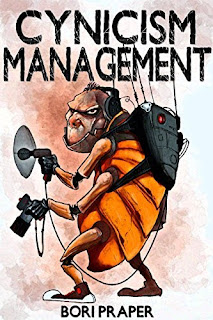
Bori Praper's CYNICISM MANAGEMENT: A ROCK'N'ROLL FABLE

"For a while there I wondered whether Jesus Christ is a gerontophile..."
"Excuse me?"...
"Well you see Fidel, it's simple really... Nuns are supposed to be virgin spouses of Christ. They mostly spend their days in convents, untouched, so I assume they're waiting to finally join their husband and, I imagine, to consummate their marriage. Most of these devoted young women turn into withered hags by the time they manage to kick the bucket, you know, especially since they're not supposed to speed up the whole process much in any entertaining way anyway - I don't believe many of them take a lot of drugs or drink themselves to death very young, or die of cholesterol overdose... Anyway, once they finally get to shag the lord, the majority of them are, well, mature, even elderly, or bloody ancient, if we're completely honest. So you see since this suspicious arrangement had to be organized by our lord, and if he himself has decided this is how he wants it.."
More novels, whether or not they are chiefly concerned with the farings of a newly-formed progressive rock bands in a suburb of Ljubljana, Slovenia, should come with their own soundtrack album. Perhaps there are more than I know of, but until I stumbled across Cynicism Management: A Rock'N'Roll Fable while perusing the offerings at corona/samizdat (my new favorite indie press*), I only knew of one in all the world.** But now I know of two, or rather, three, because I see that the sequel to this madness has a soundtrack album of its own.***

This, of course, delights me. It would even if the album was not to my taste, or if it were but the novel was not. But in fact, I'm pretty delighted by both .

Cynicism Management is the name of a fictional-yet-also actual band comprised of a motley international crew of ridiculously talented but as yet not-very-successful musicians with high standards for themselves and each other, a taste for rather baroque time signatures and somewhat outmoded instrumentation (an early and only slightly heated discussion among the members concerns the practicality of acquiring and incorporating a Hammond organ, for instance) but a punk/metal sensibility and somewhat revolutionary politics. 

These are the friends I've always dreamed of having and I began to miss them mere moments after putting the book down: Finnegan Frotz, an "extraordinarily pale" Black Scotsman, the lyricist and main ideas man; Amalia, Scots vocalist, hostess, his on-again off-again lover; her brother Randy, bass player and weed connoisseur; Bogomr, a Ukrainian performance artist/exotic dancer/musician who has been raised to believe he is an actual vampire; Eric, an Australian heavy metal guitarist with an unhealthy fixation on his perpetually receding hairline; and Fidel, an Italian revolutionary by day,  kickass prog drummer by night. I mean, come on!

But wait, there's more. Like a group of six women who have all turned up in a certain basement in London where they are employed to monitor feeds from various spy cameras installed in various toilets in various airport bathrooms around the world. And whose employer, the amusingly named Omnipile Industries, a multinational conglomerate so large and far-reaching that its in-house intelligence service has usurped the function of most governments' services, has suddenly sent them all to the Ljubljana suburb to observe the activities of one of Cynicism Management's members. He has a unique tattoo in his nether region that seems to offer the only clue anybody has found to the kidnapping of the children of Omnipile's CEO. Could be a coincidence, but nobody seems to think so.

By the way, the solution to the whole tattoo thing may be the single geekiest solution to any mystery that I have ever encountered in life or in fiction.

Incidentally, about midway through the novel the group of women acquires a thoroughly disrespectful but awesome nickname that I think I'd have enjoyed being called as a younger woman, myself: they are the Bitch Scouts. We never learn their actual names, by the way. They get unique and sometimes humorous personal designations (though one is simply referred to as Another One) but never names. But we don't miss them.

And of course this suburb of Ljubljana is populated by a host of fantastic tavern keepers, would-be-porn soundtrack composers, drunken firemen, pensioners, peasants, lunatics, picturesque trollops and a mayor on the make who can't stop spinning cockamamie economic development schemes that are probably doomed to fail, either entertainingly or depressingly, or both.

So, the resulting tale feels an awful lot like Laszlo Krasnohorkhai and Virginie Despentes decided to collaborate on... a thriller of sorts? Except kind of funny. Sometimes very funny.

The novel starts out a bit scatological -- the way the Bitch Scouts learn about the tattoo that kicks off this whole story is on the gross side but also on the paranoia-inducing -- and makes fun of alcoholism quite a lot (Superman Nap!), and commits many other sins against propriety in all the ways one would expect a so-called "Rock'N'Roll Fable" to commit, but never quite delivers up what we expect, except for equal parts of big, amazed laughs and thrown devil horns. And it's full of weird conversations like the one I quoted at the beginning of this post.

The result is the most sheer fun I've had in reading a novel/listening to an album than I have had in a long, long time. There is a sequel, Pendulum Pet, which I have already acquired on the strength of this one and you'd better believe you'll be hearing about it soon right here at Kate of Mind.

In the meantime, I've got a new album to put on obnoxious heavy rotation, chez moi. My housemates don't like I nearly as much as I do, but even they have to admit that a few of the songs are genuine bangers.

*Note, I originally tried to buy Cynicism Management from corona/samizdat and yes, you do have to wait for them to ship your copies to you from Slovenia but it's totally worth the wait and the shipping charge because they have some cool, cool stuff and publisher Rick Harsch is an excellent human (who is also a writer and you'd better believe you'll hear more about him here soon) BUT he was fresh out of paper copies of this so I had to look elsewhere to get its words into my eyeholes. Fortunately, ebook editions of it also exist and hey, if, like me, you've recently abandoned the Big River for less fashy climes, both Cynicism Management and its sequel, Pendulum Pet are not only available via Kobo but are part of its Kobo Plus subscription, so you can read them that way if you don't want to wait for corona-samizdat to get some more paper copies printed. But I still call dibs on a paper copy if one turns up, Mr. Harsch!

**That one, in case you're interested, is Eating Eight by Lars Paul Linden, a cyberpunk-ish romp about a book -- or actually a comic book script-and-cassette tape combo referred to as a "book-dope-book" that gets you high when you read it. The soundtrack really did come on cassette, featuring music from Linden's band, Penis Fly Trap. It was my honor and joy to receive review copies of these back in the day when I was an occasional scribbler in an underground music and politics 'zine, The Pit Report. Back in the 1990s when I lived in Boston. But rest assured, dear readers, I wasn't cool then, either. But I knew some cool people and got to do some cool things like get high on book-dope-books.

***Here's a link to the main soundtrack album, Tit Augmented over at the least shitty music streaming service I've found, but note: there is additional music featured in scenes from the book that isn't on this album because it's not by the band, but by another musician who is also a character in the novel, Ray Kosmick, who does some very cool electronic music that he (the character at least) intends for porn soundtracks but which I find are great listens just on their own. By the way, here is my very favorite track from Tit Augmented, just because:


Friday, August 23, 2024

Nana Kwame Adjei-Brenyah's CHAIN-GANG ALL-STARS

Was Monday Night Rehabilitation your favorite scene of Idiocracy but you wish it was not only serious but a searing indictment of the United States' incarceration- and punishment-focused criminal justice system? Are you looking for some brutal speculative fiction that will also educate you fairly thoroughly (for a novel) about the history of human rights abuses in the prison system, but with a heaping helping of material that illustrates how high technology could make it all magnitudes of order worse? Do you like footnotes* in your novels?

Nana Kwame Adjei-Brenyah has you covered, friends. 

These are not complaints about his book, by the way. Quite the opposite!

Chain-Gang All-Stars is one of those books that you go into expecting to be emotionally and spiritually slapped around and punched in the gut for your own good, and you will be, but it's far from being the mere hybrid of Oz and The Hunger Games that its marketers would have you expect. For one thing, it's primarily a love story, if a most unconventional one. And no, I'm not calling it "unconventional" because the protagonist and her lover are both women. Or both incarcerated. That's actually pretty conventional for stuff that I read. And anyway, I don't mean that kind of love story; this isn't a romance novel. A love story. 

First, though, a basic outline of the book's premise, which alone is enough to induce nightmares. In a dystopia near you, technological advances in prisoner control have reached nightmarish levels, to the point where new inmates are subjected to the implantation of devices that allow their jailers to literally drag their bodies along with magnets, or hold them motionless, or, most horribly, induce levels of direct neurological pain beyond anything previously known to science without doing any actual physical damage. Just a load of psychological damage to personality-warping, or even erasing, levels.

This alone would make for a harrowing story, but Adjei-Brenyah has more horrors for us. For not only are prisons now fully privatized, and seem to have completely absorbed entire sectors of the U.S. economy like manufacturing, food processing, anything that requires, you know, labor -- but the mega-corporations who own them have decided that their neo-slaves should also become the entertainment industry. Select inmates are pulled out of their ordinary prison-hells and turned into modern-day gladiators, forced into nomadic lives marching in small teams called Chains from city to city all over the country, and when they reach the next city on their eternal itinerary, fighting to the death in sports arenas before enormous live crowds and worldwide television (holographic?) audiences.

Oh, and pretty much all their time trudging between cities and camping overnight is a reality show that's every bit as popular as the games. No holds barred. No privacy at all. So, e.g., if our heroine, Loretta "Blood Mama" Thuwar and her lady-love Hamara "Hurricane" Stack choose to enjoy intimacy in their tent at the end of the day, four or five little autonomous drone cameras will be in there with them, getting all the angles for the titillation of millions.

Why would anyone agree to such an existence? Well, first of all, did you pay attention to the horrible coercion technology I described above? And second, it's kind of a way out of the prison system; if you're killed in battle or en route (or in camp by a member of your own Chain), you are regarded as Low Freed. If you survive a set number of battles, you can be High Freed - as in released back into the general population, on your own recognizance. Back in the real world.

We don't just follow Thuwar and Stack on their bloody perambulations, though. Interspersed chapters introduce us to some ordinary prisoners and let us share their brutal daily lives by way of tracing a person's journey from, say,  neo-slave meatpacker to becoming one of the guys destined to face Thuwar's nasty, heavy war hammer or Stack's vicious scythe.

And we also meet a few people on the outside, including the host of the premium sports feed of the actual battles (only the reality show of between-battle life is free; tickets to the fights are hideously expensive, and the telecasts aren't too cheap either) and his wife who is slowly being seduced into becoming a fan of the show, and a handful of activists who still think all of this is wrong, wrong, wrong, and are trying to do something about it.

Most poignant of these is Patricia, a woman who dedicated her career to ending the kind of pain that tormented her father as he slowly died from bone cancer in her youth, but whose work (you can just feel it coming already, can't you?) wound up actually yielding the pain-inducing technology the prison system has come to rely on. Her story alone would make a compelling novel, but is much more devastating woven in here with those of the victims she never intended and the people working for a little bit of clemency for them. 

But remember how I called this a love story? It truly, truly is. Thuwar and Stack are lovers, sure, but not in the, say,  Mickey and Mallory Knox sense that a scenario like this might lead us to expect. They are convicted murderers, both of them, and have each killed many more people since their original crimes, but they are both still committed to maintaining their humanity and dignity -- and to helping the rest of their Chain to do the same. While most Chains are free-for-all blood-baths of treachery and literal back-stabbing, Thurwar and Stack have managed to make theirs more like a family, though it's one of which they, and particularly Thuwar, who is pretty much the G.O.A.T., are in charge, and since it's composed of murderers and rapists turned bloodsport athletes, it's an all but farcically dysfunctional one. 

And the pair have at least partly made names for themselves for extending love not only to their fellow gladiators, but to their opponents (Hamara telling each that she loves them, and holding them tenderly as they die) and even the spectators getting their jollies by ogling them, catcalling them, betting on them and watching them murder other human beings. You know, the thing they got sentenced to prison for. 
Love, too, pervades the stories of the abolitionists trying to end this system, some of whom, we find, have every reason not to want these inmates back in society. Adjei-Brenyah has a fine sense of drama.

He also, and this may make this book more attractive to some readers than it did to me, very good at writing fight scenes and other violence. You players of, like, Mortal Kombat and whatnot will be very satisfied on that score. No character wholly escapes the brutality, and we're not spared it either. It's not stomach-churningly gory, but it's very, very violent. And very, very sports.

I like neither of these things, nor do I like reality TV. But I like books that confront the kind of issues that Chain-Gang All-Stars does, especially when they do it as well as Chain-Gang All-Stars does.
But yes, I skimmed the action scenes. 

*Adjei-Brenyah employs footnotes throughout the book for two distinct and interesting purposes; one, to convey factual information about our own actual world of 2024 in the U.S.A. in all its merciless ugliness, and two, to offer a running meta-commentary on the characters the narrative introduces to us, makes us care about, then kills off spectacularly. The combination forms a unique rhetorical device that I hope does not become a tiresome trend but wouldn't mind seeing a little bit more of. Speaking of which, I really hope there's a sequel to this because I really want to watch what happens to [REDACTED] next!

Wednesday, April 19, 2023

Jack Womack's ELVISSEY

I, too had been cut loose, bereft of work, of friendship, of love, allowed only to devote life and time to readying one in whom I didn't believe for one I couldn't believe to lull those who, against reason, did believe.

I'm going to noodle a lot about language and weird little questions this book inspired, but please don't think that because I do so means this book is not an exciting or eventful read. It is that and more. So much more!

I was last December years old when I realized that Jack Womack's amazing Random Acts of Senseless Violence was part of a series. Or at least a grouping of novels set in a shared Dryco Cinematic Universe. And that there are more than a handful of these Dryco books. Yippee!

The first-for-me* of these other books, Elvissey, is more or less a direct sequel to RAoSV, which I re-read at the beginning of this year. And, if possible, it packs some even bigger emotional wallops than its predecessor. As in buckle up. But also...

The characters in the Dryco universe speak an argot that is easy to understand if you don't try to do so, but gets more difficult to grasp the more you think about it. It's beyond how Lola Harte, the heroine of RAoSV, wrote in her diary that formed that novel, but not in the way I had figured it would be; the overlapping characters, Iz and Judy, are all grown up now but instead of speaking something more like the modern American English that we know, betokening the greater sophistication of adulthood in contrast to 12-year-old Lola's schoolgirl prose, Iz, Judy and all their colleagues sound like they come from Pohl and Kornbluth's Space Merchants world by way of Darmok's planet, with a lot of corporate jargon and buzzwords thrown in. Nouns are verbed, verbs are nouned, aphorisms are condensed (my favorite phrase: "You're mountaining this molehill" with "an exaltation of interpreters" a close second - in which "interpreters" is used in the sense of those who embody and act rather than render speech from one language into another, as a close second. The "exaltation" is one of Elvis impersonators!), all manner of portmanteaus and inherited malapropisms appear, and some terminology is so opaque as to constitute a mystery at least as compelling as any mechanisms of plot or character. "Regooding," for instance. How creepy and Orwellian is this neologism, really? It's baffling as the story starts, and we're left to soak up its meaning via context.**

This would be maddening and even a reason to DNF a novel if a lesser writer than Jack Womack were the author.

But so, what's Elvis got to do, got to do with it? I'll get to that, but first let's enjoy all the different things this title could mean. Perhaps it is an epic journey undertaken, not by Odysseus but by Elvis? Or maybe "Elvissey" denotes a thing or things associated with Elvis, as we might call, say, Graceland or a Las Vegas wedding chapel an Elvissey (like an abbey)? Though I at least would probably wind up sticking an "R" in there to make the stand-alone noun, as in an "Elvisry." Then again, maybe it's an adjective. Hey, that was Elvissey. How Elvissey? A little Elvissey? A lot Elvissey? The Elvisseyest thing ever? We eventually learn that it is none of these things but a completely legit other, proving that Womack thought about this even more than I did. 

See what you've done to my brain this time, Mr. Womack? I hope you happy. Happify?

"All Elvii bewail their lot... Digging oases of pain in deserts of comfort... Such jabbernowling frets and hinders," a character observes early in the story. This little speech is a perfect example of how this argot is both breezily simple and fiendishly complex. Leaving aside what the "Elvii" are for a moment, he's basically rephrasing our contemporary aphorism "some people'd bitch if their water's too wet" (or a yet more contemporary "now and then it's important to stop and bitch about the roses"), and we nod along because ain't that the truth, these Elvii have it great and they're still complaining but then what the hell is "jabbernowling" and is it something that frets, as in performs the act of fretting, or has the argot of Elvissey transformed the simple verb "fret," meaning something like "to fuss or worry about something" into a transitive verb, requiring an object, meaning something like "to cause someone to fuss or worry about something?"

I still haven't parsed what "jabbernowling" is, though I'm pretty sure it has something to do with pointless verbalizing, as in "jabber."
With all this extra musing on language waiting to pounce from every page, Elvissey is a very demanding book for its length and its pulpy plot. 
Because oh yeah, the plot. For there is indeed a plot taking place amid all the Fun With Language.

It's even easy to summarize: Iz, Lola's closest girlfriend from the harrowing second half of RAoSV, survived their teenage years as New York City fell apart and has married a wonderful but troubled man and the two of them have been "Regooded" by Dryco (the only corporate overlord you'll ever need, who have taken over most, if not all, of the functions of government, including the enormous project of rehabilitating New York City with an eye toward making it a utopian City of the Future... for a million inhabitants and no more) as a field team the company sends on vitally important but seemingly impossible missions, though ordinarily she is the administrative assistant to DryCo's second-in-command that being Judy) and her husband is a high-level security guard. 

In this case, Iz and husband John are to travel back in time/ visit a parallel universe and abduct one Elvis Aaron Presley from when he was at the height of his youth and beauty, and thus his value to Dryco... and bring him back to their post-collapse New New York to be the messiah for a cult that already exists (these are the Elvii mentioned above, so no, there are not multiple Elvises Presley running around. Or are there?).

This poses another interesting question, of course. This novel was originally published in 1993, when Elvis had only been dead for 16 years or so. I remember occasionally encountering people back then who staunchly believed that Elvis was still alive, had faked his death so he could be just another guy in the world who just had to deal with being made by his devotees every once in a while, but who had the whole publicity-industrial complex on his side to keep his secret. His fans who "knew better" were just harmless and amusing kooks, back then, decades before Q-Anon had people camping out at Dealy Plaza awaiting the second coming of JFK and JFK Jr. We didn't know how good we had it. 

But anyway, now in our own 2023, 30 years since the publication of Elvissey and some 45 years since Elvis died, with Elvis so long gone that even his only daughter has passed on, if Q-Anon had never happened, would there still be people running around who disbelieve in Elvis' death? Given that he would be 88 years old now and wasn't really looking too good at age 42, would his cult have persisted in our world? I would expect it to be much diminished at the very least, in a world without Q-Anon and all of its weird cultural baggage, but, would there be, or are there, many people in 2023 who are still fanatically devoted to the erstwhile King of Rock'n'Roll?

In Iz's contemporary universe of 2033, the answer to that question is enough to cause problems for John's and her employer, Dryco. Meaning its CEO, Mr. O'Malley is a god-king of a kind we found amusingly improbable back in 1993 but now, well, *gestures at universe*. I mean, people like to argue about whether we live in Huxley's dystopia or Orwell's, etc but a case sure could be made for it really being Womack's.

Anyway, O'Malley's fee-fees are hurt because so many Elvii worship the wrong god-king and thank Elvis for all the good (?) that O'Malley has done for them.

So obviously the solution is to kidnap alt-universe Elvis and let him deal with the Elvii -- but only after he agrees to promote O'Malley's aims and goals and ego. And tell them O'Malley has massive, manly hands, really. 

But then Iz and John cross over -- in a simply amazing car you're going to have to read the book to get to appreciate -- and find just how alternate this other universe is; the culture shock isn't merely that it's 1954. In this universe there was never a U.S. Civil War and slaves weren't freed until 1905, and while we think car culture is bad in our world, the interstate highway system in alt world has massive elevated 20-lane behemoths all over the place; even bigger swaths of the neighborhoods that were sacrificed to the Eisenhower system in our world were obliterated to the point of many of them just not existing anymore. And as for the culture off those highways, it's a gross QOP wet-dream of segregation, sexual harassment, revisionist historical interpretations even of stuff that it shares with Iz's universe, etc.

And so, its Elvis is nothing like what Iz and her people have expected to find. This Elvis is downtrodden and not at all famous (nobody in white supremacy Disneyland wants to listen to a kid who wants to sing blues instead of oom pa pa), more than a bit violent and entitled and wholly unready for what they're going to ask of him. He winds up complicating every aspect of the plot, from Dryco corporate dynamics to Iz's marriage to John, and sends it all spiraling off in unexpected but wholly satisfying directions. 

In other words, holy shit, this book is good!

*There doesn't seem to be a definitive order in which these books are to be read; they're cataloged like a series but without ordinal numbers. I thought of going in publication order but then I saw that this book tells of the adulthood of some characters from RAoSV so I chose this as my first deliberate read in the Dryco universe. 

**"Regooding" as a concept gets increasingly problematic as the Dryco world unfolds. At first it simply seems to mean something like "rescued from bad circumstances" or "rehabilitated" as a neighborhood might be gentrified or a person lifted out of poverty/ignorance/illness, but then a truly icky aspect kicks in: the existence of a drug called Melaway. The "mel" being the same prefix for darkness/blackness as appears in "melanin." As in this drug turns dark skin light, black hair blonde. Add in some blue contact lenses and Iz, a dark-skinned black girl from the meanest pre-Dryco streets, can pass as a white woman on her mission,  to the alternate universe which is, she is repeatedly told, way more racist than her own. But then, on the eve of her journey, she "concludes her bleach" and admires her naked self in the mirror: "Venus atremble at seaside, another regooded resident to best suit our eternal city." While some later language tries to imply that it is not a purely White ideal that is sought but rather a golden-toned racelessness but one is not sure whether that is the sincere aim and context of "regooding" or just lip-service to a less racist goal, you know?

Jack Womack is a brave writer.