Showing posts with label Doctor Who. Show all posts

Monday, September 19, 2022

Christopher Ruocchio's HOWLING DARK (Narr by Samuel Roukin)

I could already tell, less than halfway through the second volume of Christopher Ruocchio's Sun Eater series, that it's going to be one I'll enjoy returning to, even if it doesn't have a conclusion as satisfying as I currently believe it will. I still watch the first three seasons of Battlestar Galactica, the first four of Babylon 5  (and hope ardently that we get to see its reboot/revival), after all. 

As always, here there be dragons, by which I mean spoilers, except maybe I actually mean dragons, hmmm? Of a kind? Waving lots of pale and grasping human hands in the dark?

Howling Dark launches the story of Lord Hadrian Marlowe, renegade interstellar aristocrat, some 50 years into the future from where we left off in Empire of Silence. He's also a long way from the planet where he washed up after escaping his unwanted destiny as a cleric-cum-torturer for the repressive Chantry, the Sollan Empire's state religion. At the end of Empire Hadrian made contact with a small party of Cielcin, members of an alien race with which humanity has been at war for hundreds and hundreds of years. The Chantry and other local powers assumed these Cielcin had come as a vanguard to an invasion force, but Hadrian, the only person on the whole planet who had ever learned any of the Cielcin's language, discovered that they were actually there on a religious pilgrimage, to visit some intriguing ruins left by a long lost ancient civilization that long predated human or Cielcin exploration or conquest. And in so coming to understand that much, Hadrian saw a possibility to try for Peace. There's a being of some kind out in the dark who has a way to actually make contact with a leader of a major clan of the Cielcin (who are so predatory and warlike that they will prey and war on one another as soon as humanity) -- but that entity dwells on a mysterious and possibly only legendary planet!

And so Hadrian has embarked on a unique mission to try to find this entity, The Undying, on that planet, Vorgossos. With him are many of his friends from his gladiator days and one or two from his unpleasant time as a courtier on the backwater planet he's left behind - and a whole lot of new people, most of them military or mercenaries, representing not only the Sollan Empire but a few other human polities as well.

And here we're experiencing a few elements of the 21st century's revival of Doctor Who, and not just because we know that the Hadrian telling us his story is a Hadrian centuries old who has the guilt of genocide on his conscience; we also have elements specifically of Stephen Moffat's controversial habit of introducing new-to-us characters who have established long and deep relationships with our hero off-screen. For one thing, Hadrian has a lover, Jenan, who was originally part of a kind of pirate crew Hadrian's mission fleet tangled with, defeated and absorbed some time over the 50 years since Empire. And while Hadrian is nominally the Lord Commandant of the mission, it's really a career military officer, Bassander Lin, who is calling the shots. Their relationship is mostly cooperative and cordial, until Plot Things Start Happening!

But so, I found a sense of breathlessly having to catch up as Howling Dark opened, very similar to how I felt when I managed to read Malka Older's Centenal Cycle in the wrong order. I suspect that this will someday be an unusual experience, though; the Sun Eater series already has a few side-quels and it wouldn't surprise me a bit if a future novel or novella might be devoted to the early years of Hadrian's ragtag fleet. I would opine, though, that such would really not be necessary (but then, I'm also on Team Never Show Us Jim the Fish). The Sun Eater saga is wonderfully enriched by strong character relationships, but it's got a big looming plot question ahead, as the series' entire point is explaining to us how Hadrian Marlowe became the Sun Eater. How he unseated a tyrannical captain and recruited his crew isn't very important to the arc and these are all very long books already. 

I will say this, though: Ruocchio is way better than Moffat at this trick. I mean, Moffat just dropped the Paternoster Gang on us out of the blue and we never even really got to know much about how they met or why they were so fiercely loyal to the Doctor. Moffat just counted on the characters being too awesome for this to annoy us and just kept jingling the keys. Ruocchio made the new characters awesome and explained where they came from and why. And he did it well enough to make some early scenes of irrevocable parting between them feel earned and honestly affecting. Very affecting. No, you're the one who's crying.

Several unsavory encounters and gripping fight scenes and followings of clues later, Marlowe and his friends have found the legendary Vorgossos (orbiting a brown dwarf star!) and come under the jaundiced eye of its unnaturally immortal ruler, The Undying, whose name is Kharn Segara* (a figure of myth from the founding era of the Sollan Empire) and suddenly we're in yet another literary territory, once which I absolutely did not see coming even though our narrator is surnamed Marlowe! For the interlude on the lost planet whereat Hadrian seeks a contact through which to begin peace negotiations is straight outta Heart of Darkness, my friends, with Kharn Segara a 15,000-year-old Kurtz ruling a mad kingdom at the ass end of known space, and yes, my friends, it gets that dark. Actually, more so, because this heart of darkness is also a demented cyberpunk hell-hole where Kharn employs unspeakable means to prolong his own and his exclusive clients' lives and to satisfy the perversions common to bored playboys everywhere and I was bracing myself for this to get truly icky but Ruocchio is a tasteful writer as well as a talented one.

Unlike in Conrad's most famous tale, though, here Kurtz is only a first or warm-up boss; there is so much worse to come, even in his own realm, than Kharn Sagara, you guys!

Anyway, while we're in Kurtz Kharn's realm, we also get to watch Hadrian's relationship with a character I didn't mention last time, the enigmatic Valka, develop in a lot of interesting directions. Last novel, Valka seemed poised to be a love interest, if one whose levels of education and culture were dizzyingly above Hadrian's and then there's also the fact that she's from a civilization that doesn't share the Sollan Empire's maniacal Butlerian Jihad-esque distrust/hatred of computers and artificial intelligence. In many ways, Valka is straight out of a cyberpunk novel, with a headful of neural augmentations that make her that vital character in every Shadowrun game, the technomancer/hacker, but imagine that character who is also Indiana Jones because she is a xeno-archaeologist in the Dan Sylveste mode (though she wisely mostly stays out of politics). Or a (mostly) law-abiding River Song? Anyway, Valka rocks, and Marlowe knows he is nowhere near worthy of her but wants to try to be, even though he regards her with just enough superstitious dread to basically think of her as a witch -- and hey, she almost got burned as one near the end of Empire of Silence. She still hasn't forgiven him for fighting a duel to save her when she was well on her way to saving herself, of course. Anyway, they spend a lot of time alone in various flavors of guest quarters on Kharn's dark, weird planet trying to figure out the many mysteries of what Kharn is up to, how/if they're going to get what they want out of him, and what his intentions toward the Cielcin prisoner, called Tanaran, that he has stripped them of in the guise of entertaining their petition. Oops!

In an attempt to regain control of Tanaran and of their immobilized spaceship, Hadrian and Valka go exploring and Ruocchio explores a terrifying conjunction of ideas: what if the Vatic Fountain (Gene Wolfe) were a terrifying monster out of the deep past, and what if the Pattern Jugglers (Alastair Reynolds) gave swimmers the ability to See Through Time? Meaning Hadrian gets not one but two cryptic glimpses into his future in this novel, though the first was only really a preview of the second, into his metamorphosis from renegade nobleman/mercenary to figure of superstitious awe and dread? In a terrifying encounter made all the more intense by narrator Roukin's choices in how to voice a weird collective inhumanity waiting in the dark at the end of a cyborg-guarded labyrinth?

Yeah...

While all of this has been going on, the Sollan Empire has not been sitting idle, of course; nor have the Cielcin. We learn late in Howling Dark that the number of star systems the Empire has lost to Cielcin incursion has come to exceed 900, with billions and billions of human beings dead (and eaten!) (most of them) or brutally enslaved and mutilated (in a manner chillingly reminiscent of the fate of Father Sandoz in Mary Doria Russell's The Sparrow, which, yikes).

And of course the conflict between the Empire and the Cielcin follows Hadrian to Kharn Segara's creepy dark planet, first according to Hadrian's design, because he can't start peace talks with the Cielcin without eventually meeting some Cielcin who aren't his prisoners, and then very much not according to Hadrian's design, and this is where Ruocchio goes bigger than big. And also displays a talent for manipulating reader emotions that I almost resent because of the devastating use he made of it here, leading us from baroque horror to tense diplomatic drama to huge boffo combat scenes to almost unbearable character drama (Hey, Hadrian has been warning us from the start that he has often been accused of having a taste and talent for melodrama!).

I suppose the game of spot-the-reference (and hey, we haven't even gotten to what amounts to Hadrian's possessing a light saber, which Ruocchio has managed to make even cooler than the Star Wars version by concocting a plausible-sounding pseudoscientific explanation for how the weapon works and, more importantly, what its limitations are) that I've played here makes it sound like the author has just cherry picked his favorite bits from other novels, is just a kid playing with a mismatched set of action figures and telling his babysitter the story as she indulgently smiles or blatantly ignores his babbling, but that's the least deserved criticism that could be leveled on these books. Ruocchio, who's had a pretty good career as a genre fiction editor, has impeccable taste in science fiction bits and bobs and wields them all with tremendous skill, maturity, intelligence and passion. Even the bits that seem to have no business appearing together are made to feel organically joined and earnestly communicated through Hadrian Marlowe's insightful, frank, erudite and compelling narrative voice. Hadrian is as complicated and well-rounded as a Dorothy Dunnet hero, enacting a Gene Wolfe plot (and occasionally using Wolfean vocabulary**)
through a Mary Doria Russell moral and Alastair Reynolds physical universe. I have, as the kids used to say, no choice but to stan.

Seriously, friends, don't sleep on these. Hadrian's story is already epic AF (and we've gotten the barest taste of how epic it's going to get by the revelation in this novel of why he bears the sobriquet of "Hadrian Half-Mortal) and it's only going to get more so. A fifth volume in the main narrative is coming out in December. There's plenty of time yet to catch up on the series in time to plunge into that with me and Ruocchio's other, too few by my lights, fans. Yeah, they're big fat books but they never get dull and never stop provoking thoughts and ideas and feelings and, well, what the hell do we read novels for if not to have those?

As for me, I've already started listening to Demon in White. And Ruocchio has already made me cry at least once.

*Whose name I was mentally spelling as "Khan" because narrator Samuel Roukin -- still absolutely perfectly cast as our protagonist-narrator, and if these books ever get adapted for the screen I hope it's soon so Roukin is still young enough to play Hadrian -- is very, very British.

**My favorite of Ruocchio's pseudo-Wolfean terms so far is "Xenobite," which Hadrian uses to refer to aliens the way Severian uses "Cacogens", though "Xenobite" is a more accessible and evocative word, employing the "xeno-" prefix to denote otherness while rhyming with "cenobite," which is more than just a name for the monstrous powers of Hellraiser fame. It also denotes monasticism, and those to whom Hadrian generally refers with the word are the Cielcin, whose social structure is fanatically hierarchical and to be a Cielcin's subordinate is by definition to be its (and that is the pronoun; the Cielcin are an asexual race) slave. Interesting, no?

Tuesday, October 25, 2016

Doctor Doctor: George Mann's DOCTOR WHO: ENGINES OF WAR

While I'm never now, thanks to Justin Robinson, going to be able to look at the War Doctor without thinking of the kind of old man who has definitely bought alcohol for a teenager at some point in his life (it's the fauxhawk), I loves me some War Doctor. His appearances have been slight -- one and a 100th of a TV episode, some great Big Finish audio stories, and now this novel -- but he's distinctively awesome, and not just because he's portrayed by the great John Hurt.

So I went into Engines of War with a bit of trepidation, because I just wasn't going to be able to bear it if it wasn't awesome.*

I needn't have worried.

A War Doctor story that's not just going to be another Doctor Who story that happens to feature this incarnation is a tall order, if it's going to be done at all decently. Where the 50th anniversary TV special that is still the only thing most people have encountered the War Doctor in went horribly wrong was in portraying the Time War as a shooting conflict seemingly taking place on just one planet. But this is supposed to be war on an unbelievably massive scale, in which "all of time and space are burning." How the hell do you portray that?

George Mann did a better job of it than the TV writers did, at least.**

The novel opens with a terrific battle scene, in which a giant fleet of "battle TARDISes" (think of a TARDIS with guns, basically) dukes it out with a Dalek stealth fleet that has been quietly waiting to ambush anything that passes through its part of the Vortex, and actually, to a certain degree, uses those battle TARDISes as TARDISes! Meaning time travel is a bit of a factor in the skirmish. Cool.

The War Doctor is the field commander for this conflict, more or less, but in the process he takes a hit and crashes onto a planet that is... Kind of special. Modox is one of a dozen or so human-colonized worlds in a system dominated by a strange-but-beautiful space-time anomaly referred to as the Eye of Tantalus, and the Daleks wanted it very badly.

Soon our man is exploring its secrets with the help of a don't-you-dare-call-her-plucky young Dalek hunter named Cinder (who is the most badass teenage girl in the history of ever, and a more than suitable companion for him, and even tougher than he has become) and what he finds is terrifying, gross and has huge implications for the Time War.

Which means, alas, we end up spending a good chunk of the novel on Gallifrey, which you know I find a tiresome proposition at best, but there you go. Borusa, a former teacher of the Doctor's who later made an ill-advised power play and got trapped for eternity as an embellishment on the tomb of Time Lord founder Rassilon, makes his third appearance in my personal novel-reading time line (he was also in Divided Loyalties and The Eight Doctors), but at least this time he's interesting. Ish.

Look, I find the Time Lords kind of one-dimensional and tedious, and think it's a mistake to base too much of a story on their society, politics or deliberations, but I get why we had to do it, here; it's nice to actually see them through the War Doctor's eyes and see that they more than live up to the hindsight glimpses we've had of them in wartime via the Doctor's later incarnations. As this novel's tag line says, war changes everything, even the Doctor. But, well, the Time Lords don't seem all that different to me, except in that they are now talking about deploying some truly heinous weapons and wreaking destruction on a truly heinous scale. Because Delenda est Carthago the Daleks must be stopped or the whole universe yada yada.

But still no Nightmare Child, etc. Which is both smart, in that they could never live up to the build-up those things get when the Tenth Doctor rants about them on TV, but also a tiny bit disappointing.***

What does get deployed, though, is fully timey-wimey, as is the way the Doctor deals with it, which is very, very satisfying.

And so, ultimately, is this book, Gallifrey scenes aside. And even those Gallifrey scenes? Way better than those in The Day of the Doctor.

As for my Arbitrary and Mercurial rankings, they're maybe not living up to that second adjective so much, for little changes.

Authors:

Alastair Reynolds
Una McCormack
Kate Orman
Mark Gatiss
James Goss
George Mann
Terrance Dicks
Gary Bulis
Mark Morris
Jonathan Morris
Justin Richards
Gary Russell
Keith Topping

Doctors:

Twelfth
Ninth
Sixth
Eleventh
Third
Second
War
Fourth
Eighth
Seventh
Fifth
First
Tenth

Companions:

Ace
Amy
Romana II
Rory
Jamie
Cinder
Ben and Polly
Tegan
Jo
Barbara
Clara
Nyssa
Samantha
Martha
Bernice
Vicki
Adric
Rose
Peri
Ian

Next time: another First Doctor novel! Can Ian possibly redeem himself enough to at least move ahead of Peri in my companion rankings? Where will Susan land on this list? And what about the First Doctor, whom I always want to like but who always annoys me and lets me down? Stay tuned.

*And because author George Mann has written more Torchwood fiction than anything else. Torchwood! I mean come on, except for Children of Earth, that's just foolishness!

**I know, I know, he's got the unfair advantage that all novelists have over makers of  film and TV, an unlimited special effects budget. But still.

***Though it lets me hang on to my pet theory that that creepy and tantalizing phrase, The Nightmare Child, might actually be a reference to the Doctor in this incarnation. I thought maybe it would be a new appellation for him bestowed by the Daleks, for instance. But the one used by them in this novel is fine.

Monday, October 24, 2016

Doctor, Doctor: James Goss' THE BLOOD CELL

And so now my first cycle through the extant Doctors as of this writing is complete with this, The Blood Cell, a novel featuring the Twelfth Doctor (hooray!) and Clara (eh). Do please pardon me while I have some feelings.

OK.

The Blood Cell, part of an early spate of novels featuring this duo -- officially published in September 2014, it appears to have hit NetGalley before most of us had even seen a full episode with Peter Capaldi as the Doctor. And yet author James Goss had figured out exactly what the Twelfth Doctor was going to be like, and did so long before the TV writers seem to have done! And this is not to say that Goss just binged on episodes of In the Loop and projected Malcolm Effing Tucker onto the character of the Doctor; he got a lot more right, too, as I'll discuss in a moment.

Nor is this the only thing to admire about The Blood Cell, which also features two other things that I just love when they are done well: a locked room mystery, and an unreliable narrator. I mean, who's been peeking at my Christmas list, right?

The Blood Cell opens in an extremely high security prison, wherein a prison official is interrogating the newest inmate. There is some nice ambiguity in the first page or so as to which of them might be the Doctor, and I'm going to try really hard not to spoil that for you, but...

One of the things that really makes the Twelfth Doctor shine is his perfect self-assurance, which is so perfect that the man genuinely has nothing left to prove. He so absolutely does not care what anyone else thinks of him that he is perfectly free to disappear into the roles he assumes, with utter conviction, even if they are the lowliest of figures (yes, I'm thinking of "The Caretaker" here). He doesn't mind being completely misunderstood, even reviled, and that aspect of his character, which I tend to think is unique to this iteration of the Doctor (but am willing to discuss*) really shines in this novel. Everybody but Clara (and this is a fairly Clara-lite story, though the bits that do have her are way less annoying than I'd ever have suspected they would be) is working under the misapprehension that the Doctor is a truly reprehensible figure, with a past not so much checkered as nearly completely black. And he just rolls with it.

Meanwhile, of course, mysterious stuff is happening. Dead and broken bodies start turning up while the prison -- which is on an asteroid at the edge of a star system -- and its cobbled-together-by-the-lowest-bidders operating systems start going on the fritz in ways big and small. What's behind it? Who's hiding secrets? Who's to blame for all the chaos? Is it the same person or persons to blame for the bodies?

Some of the answers are telegraphed from the very beginning, but there are still some nifty surprises, and the final act is genuinely horrifying, making The Blood Cell yet another great page-turner of a Doctor Who novel.

And so the Aribtrary & Mercurials do shift a bit, with, for instance, Clara debuting on the companion list at a much higher spot than she might have otherwise. When she's good, she's very very good, and she's at her best -- challenging, a bit mysterious, no-nonsense, executing her tasks perfectly -- here.

Authors:

Alastair Reynolds
Una McCormack
Kate Orman
Mark Gatiss
James Goss
Terrance Dicks
Gary Bulis
Mark Morris
Jonathan Morris
Justin Richards
Gary Russell
Keith Topping

Doctors:

Twelfth
Ninth
Sixth
Eleventh
Third
Second
War
Fourth
Eighth
Seventh
Fifth
First
Tenth

Companions:

Ace
Amy
Romana II
Rory
Jamie
Ben and Polly
Tegan
Jo
Barbara
Clara
Nyssa
Samantha
Martha
Bernice
Vicki
Adric
Rose
Peri
Ian

Next, I'm reading one of the "extras" -- in this case, the War Doctor novel I mentioned last time. Will he hold on to his place just above the universally beloved Fourth Doctor in my A&M rankings? Tune in soon....

*But really, can you see the First Doctor, say, cleaning up vomit with that pink sawdust stuff? The Tenth? The Seventh? Any of them? No.

Friday, October 21, 2016

Doctor Doctor: Una McCormack's THE KING'S DRAGON

I'm just going to say this up front: the only way this book could have been any better would have been if it contained Brian Williams, father of Rory Williams (present), gonna-be father-in-law* of Amy Pond (also present), and gonna-be-grandfather-in-law** of The Doctor (duh). But pretty much every Doctor Who story, maybe ever, would be at least slightly improved by the presence of the elder Williams, and I just have to live with that fact, while still resenting that he's never gotten closure on-screen and probably never will. Ahem.

But that's neither here nor there. Here and there is The King's Dragon, which has shot right up there next to Harvest of Time on my list of best Doctor Who novels, largely because Una McCormack, unlike Amy's creators, actually gets what Amy Pond is all about and stays true to her from page one. But also because it's a good, complete and interesting story, told with elegant economy.

I'd like to visit the parallel universe where Ms. McCormack, and not Mr. Moffat, was the showrunner who took over when Matt Smith and Karen Gillan did. I can't promise that I'd come back, mind.

But so, The King's Dragon. The Eleventh Doctor (one of my favorites, recall), Amy and Rory have come to visit one of the universe's greatest civilizations, the city-state of Greath, a realm that has enjoyed over twelve thousand (12,000) years of peace, harmony, vigorous democracy, and restrained good taste. What a delightful locale to spend part of Rory's infinite stag night!

Of course, decades of Doctor Who watching/reading/listening has taught us all that no high and lovely culture visited by the TARDIS crew is ever going to be encountered at its height. No, no. If the Doctor & co. are going to land there, something is going to have gone horribly off-course. If it's not the TARDIS itself, its the place/time at which it stops. Duh.

So in place of a tastefully decorated and refined civic space of classical elegance, the TARDIS crew finds itself in a gaudy, blinged-out Las Vegas nightmare of a city. And instead of a thriving democracy steeped in humane tradition, the TARDIS crew finds a newly-minted monarchy-cum-cult of personality, centered on an impossibly charismatic and handsome king, Beol*** and his partner The Teller, and the impossibly gorgeous golden dragon idol they've brought into the city.

Plus an intangible but pervasive aura of impending dread, of course.

The best Doctor Who stories are mysteries of this kind. What's gone wrong with history? Why are people X behaving so unlike themselves and why don't they realize it? Something Is Interfering And It's Probably Aliens. Only the Doctor can set things right.

Except, mostly, it's not the Doctor who does so. It's Amy. And, to a degree, Rory. And a few key citizens of the visited world, notably the former democratically elected leader of Geath, a slightly cranky and unimpressed older woman (who I absolutely could not help picturing as played by Diana Rigg in her Queen of Thorns get-up), Hilthe, who seems to be the only person who remembers Geath as it was just months ago. The Doctor is just there to advise, really.

Don't get me wrong; this isn't a "Doctor-Lite" story. He's there in all of his lanky, absurd, slightly cranky know-it-all glory, on pretty much every page. But the plot is driven by his Companions and by the locals.

And especially by Amy. Amy Pond is at her nosy, stubborn, willful, smart, wise and capable best, as we've really not seen her since, say, The Beast Below.*** Even when she is under the influence of this story's Alien Menace (because of course there is one. This one is really, really interesting and original, by the way. Bling!), she's her own person, and that person learned long ago, when a certain Raggedy Man failed to come back for her, that she's really the only person she can count on (though Rory is going to be Rory and thus pretty damned reliable, but he's not yet the "wait until he gets here and I'll just wait and watch while he does all the heavy lifting of punishing you for making me cross" substitute for her agency that Moffat is going to make him), but that that's okay, even if she is pretty much lost in time and space and probably In Over Her Head. Amy can swim.

And again, like all the best Doctor Who stories, while there is plenty of ak-shun and things blowing up and existential peril and whatnot, it's ultimately about getting two opposing sides to understand each other, or at least try to empathize with each other, once those two opposing sides are finally discovered by the TARDIS crew and friends' careful sleuthing and thinking and deducing.

I read this in a single sitting, in a single night. Yes, it is a short work, but McCormack has packed a lot into it (again, like the best DW stories, like the best science fiction, Here There Be Allegories, but they are deftly and subtly handled) and hasn't wasted words. Its length might suggest that it's a lightweight, perhaps even juvenile, read, but don't be fooled.

And now for the Arbitrary and Mercurial rankings. I don't think they're going to surprise you much. The Eleventh Doctor moves up a spot because I just love his silly enthusiasm for things (combined with his old man crankiness and ridiculous physicality) and how he wisely gets out of the way and lets his friends handle things once in a while.

Authors:

Alastair Reynolds
Una McCormack
Kate Orman
Mark Gatiss
Terrance Dicks
Gary Bulis
Mark Morris
Jonathan Morris
Justin Richards
Gary Russell
Keith Topping

Doctors:

Ninth
Twelfth
Sixth
Eleventh
Third
Second
War
Fourth
Eighth
Seventh
Fifth
First
Tenth

Companions:

Ace
Amy
Romana II
Rory
Jamie
Ben and Polly
Tegan
Jo
Barbara
Nyssa
Samantha
Martha
Bernice
Vicki
Adric
Rose
Peri
Ian

Now onward to a Twelfth Doctor novel, then holy cow, I just found a War Doctor novel, and then I'll start the cycle anew with another First Doctor novel. I'm going to keep going in this fashion for as long as there are enough novels for each Doctor, but alas, I'll run out of Classic Doctors much sooner than Seventh and Eighth Doctors, and then my enthusiasm might wane. We shall see.

*This story takes place before their wedding.

**No screaming about spoilers. It says so right at the top of my blog, right there in the header, "ware spoilers."

***I.E. since Moffat remembered that she is a woman and needed to be put in her place.

Monday, September 19, 2016

Doctor, Doctor: Mark Morris' FOREVER AUTUMN

Sweet Jeebus, there's a lot to like about Forever Autumn. A lot! Like, it would be a great seasonal read, a fun horror novel, all on its own, without its being a Doctor Who novel. But, sigh, it's not only a Doctor Who novel, it's a Tenth Doctor, Doctor Who novel.

Forever Autumn -- and see, I even love the title! -- blunders right into Lovecraft territory (albeit modern day Lovecraft territory, a smallish* New England town with a history of weird stuff, a mysterious black tree, etc.) and acts like it owns the place. Kids have the wild hair to dig at the roots of the mysterious black tree, which is so ancient there are Native American legends about how it got there, and dig up a mysterious, creepy, kind of "fleshy" book full of strange names and lettering. It emits a weird green glow, and soon the town is enveloped in creepy green mist. Then tall, thin, tree-like skellingtons are walking around town at night throwing the whammy on unsuspecting citizens. I mean, hell yes!

But then the Tenth Doctor, and his beautiful but boring-as-paint-drying companion, Martha Jones, show up, and start mugging for our attention. And here's the flaw. Novels and Big Finish have rehabilitated Doctors that I've not been too fond of for me, so I had at least some expectation that maybe this, my first Tenth Doctor novel, would maybe do the same. But no.

This book managed to make the Tenth Doctor worse! As portrayed by David Tennant -- who has been marvelous in everything else I've seen -- the Doctor is frenetic, twitchy, disconnected (if the Ninth Doctor is the PTSD Doctor, the Tenth is the ADHD Doctor. Unmedicated) and shouty. He's a distraction rather than a star or a protagonist.

As written, he's all of these things, but turned up to eleven (heh). Author Mark Morris must have been under special orders to emphasize all of these qualities, because in these pages the Doctor can't stand or sit still for even 30 seconds. Maybe because, without an actual actor with biology and whatnot to accommodate, there really are no limits to how spastic he can be? When he doesn't even have to take a breath?

I dunno.

What saved this book for me -- remember, to date I've only ever DNF'd one Doctor Who novel -- was the setting, and the incidental characters. The kids are kind of stock characters, but have personality enough to be enjoyable; the early victim of the novel's main monsters is compassionately portrayed (bonus that one of the kids knows better than to take him lightly as a figure of fun), and the novel's temporary companion, an elderly woman whose family has always had something a bit witchy about them, is a delight. Like I said, this would have been a fine, possibly Bradbury-ish read without the Doctor Who elements.

The climax is fun if kind of telegraphed from a long way off (*cough* Chekov's Evil Clown Costume *cough*), the monster-aliens, a delightfully weird riff on the Pumpkinhead, are cool and genuinely creepy and the book quite a good read. I would have absolutely adored it with pretty much any other Doctor/Companion team; as it is, I merely liked it a lot.

As for my Arbitrary & Mercurial rankings, they don't change a lot. I just get to add a few elements.

Authors:

Alastair Reynolds
Kate Orman
Mark Gatiss
Terrance Dicks
Gary Bulis
Mark Morris
Jonathan Morris
Justin Richards
Gary Russell
Keith Topping

Doctors:

Ninth
Twelfth
Sixth
Third
Eleventh
Second
War
Fourth
Eighth
Seventh
Fifth
First
Tenth

Companions:

Ace
Romana II
Jamie
Ben and Polly
Tegan
Jo
Barbara
Nyssa
Samantha
Martha
Bernice
Vicki
Adric
Rose
Peri
Ian
*Most of you would probably drop the "ish" but I'm from a town with a population under 1600 souls, and spend a lot of time in even smaller burgs, so this town, which is apparently populated enough to allow a year-round dedicated costume shop to not only survive but flourish, it's small-ish. In a true small town, you make your own costumes, or you buy them at the nearest big box store (well over 100 miles away) or luck into them at a second-hand joint if your town's business community manages to support such a thing.

Sunday, September 11, 2016

Doctor Doctor: Justin Richards' THE CLOCKWISE MAN

Happy sigh. As anyone who's been paying attention to my Arbitrary & Mercurial rankings knows, the Ninth Doctor is my favorite Doctor. This is partly because Christopher Eccleston, but also because this Doctor has an angry edge we haven't really seen since the Sixth Doctor (another one that's high in my lists) but is still hilarious with how he handles it (bananas are good), and he's basically the PTSD Doctor, which I can relate.

Indeed his only flaw is his taste in Companions. I wish he'd met Mickey first. Or Jackie. But nothing's perfect, not even the Ninth Doctor.

But I'd love, love, love to read a an adventure of his without Rose Tyler along. I don't know if I'll ever get one unless I write it myself (call me, BBC Books!), but meanwhile, there are a these New Series Adventures that have Nine and Rose, and of these The Clockwise Man was the very first.

The place-time this time is London in 1924 and right away as we meet a domestic servant getting the crap beaten out of him for mysterious reasons and then follow the Doctor and Rose in escorting the servant back to his employer's house, there are definite vibes. Upstairs, Downstairs, tail end of the Forsyte Saga vibes. Oooh lovely!

But those vibes dissipate rather quickly, because in the master's house are... White Russians. No, not as in Lebowski's favorite cocktail. I'm talking exiled Russian aristocrats who, even though the Tsar and his family are long dead, are still plotting to overthrow the Communists and restore the old regime. And they've got a little boy on their hands whom they claim is the heir to the Romanov dynasty. Which little boy immediately decides that Rose is just the greatest, probably because she's the only person he's ever met who doesn't treat him like he's made of glass and actually encourages him to do stuff, like go see the Imperial Exhibition (the ostensible reason for the TARDIS Twosome's visit).

Meanwhile, domestic servants keep getting assaulted, sometimes even killed, and a mysterious masked woman is making the rounds accompanied by a man who speaks rather mechanically and ticks and tocks audibly when he moves about. They Are Sinister. And the TARDIS disappears. Think these all might be connected somehow?

And what's up with all the identical black cats? Is there a glitch in the Matrix?

But so anyway, Late Steampunk. And another "aliens messing about with Earth history" story. I'm longing for a straight-up adventure out there in space. The Daleks menacing some gleepglorks. A human colony has gotten addicted to the secretions of a giant space lizard. Something. But here we go.

Which is to say that I found The Clockwise Man a bit dull for stretches, though things picked up quite nicely at the end, which in a bit on-the-nose fashion takes place behind the scenes in the Tower of Big Ben. The final confrontation in there is a neat bit of intricate plotting, though it would have been even better if the characters enacting it were more developed. There are too many of these, and they've spent most of the novel feeling dully interchangeable until suddenly they aren't! Oh my! But I didn't really care to make the effort of keeping them straight at that point.

I will give the novel bonus points for using the Sonic Screwdriver in ways that actually matter. But otherwise, hmm, yawn. It didn't suck, but it's pretty forgettable, even just ten minutes or so after I finished reading it.

Nonetheless, onto... a Tenth Doctor novel. Oh, I'm not a Tenth Doctor fan, not at all. But maybe, just maybe, without the mugging and the shouting and did I mention the mugging, he won't annoy me quite so much. We'll see.

As for the Aribitrary & Mercurial, nothing much has changed, really. The Ninth Doctor is still my favorite (and he did get some good moments in this novel). I still don't like Rose very much. And Justin Richards gets a meh for now.

Authors:

Alastair Reynolds
Kate Orman
Mark Gatiss
Terrance Dicks
Gary Bulis
Jonathan Morris
Justin Richards
Gary Russell
Keith Topping

Doctors:

Ninth
Twelfth
Sixth
Third
Eleventh
Second
War
Fourth
Eighth
Seventh
Fifth
First
Tenth

Companions:

Ace
Romana II
Jamie
Ben and Polly
Tegan
Jo
Barbara
Nyssa
Samantha
Bernice
Vicki
Adric
Rose
Peri
Ian

Sunday, August 28, 2016

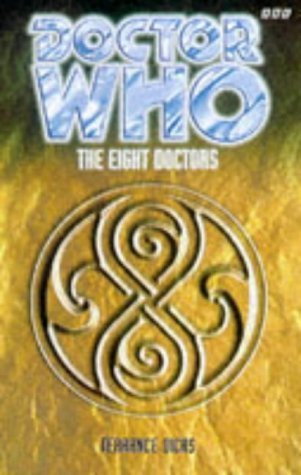
Doctor Doctor: Terrance Dicks' THE EIGHT DOCTORS

Terrance Dicks is perhaps THE name in Doctor Who fiction. Crafter of novelizations of uncounted (by me) television episodes from the classic series, former script editor for the show, gentleman, scholar. So who else would get to launch a series of further adventures for the poor isolated Eighth Doctor, wonderfully portrayed by Paul McGann, utterly wasted in a bad American TV movie and in danger of just being swept under the rug forever.

BBC Books and, later, Big Finish Audio to the rescue! The Eighth Doctor has become beloved after all due to some great prose and audio adventures, of which The Eight Doctors is the very first. Er, sort of.

Possibly out of concern that their British/Commonwealth readers were not prepared to accept the Eighth Doctor as part of Doctor Who continuity, the powers that were decreed that this first "novel" would basically be a very thinly constructed "plot" that forced the Eighth Doctor to hang out with each of his seven prior incarnations to accept a piece of the relay baton, and, er, reassemble it so he could get on with being the Doctor in other stories.

Yeah, it's pretty lame. But this is Terrance Dicks, so it's very professionally and well-informedly lame, so much so that at times, if you squint, it can look a bit less lame and maybe it's just walking through really thick mud or something. Except it's also maybe a little bit clever (though it could have been a bit more clever, about which more below), as each but one of the Past Doctor encounters serves as a sort of post-credits continuation of a famous TV episode. Thus we see the First Doctor towards the end of "An Unearthly Child" (after a silly frame sequence that just happens to take place in a certain junkyard in Coalville), the Second in "The War Games", the Third in "The Sea Devils", the Fourth in "State of Decay", the Fifth in/after "The Five Doctors", and the Sixth in "The Ultimate Foe" (aka the last serial in the infamous "Trial of a Time Lord" season). The Seventh is seen pretty much between "Survival" and his date with regeneration at the beginning of the TV movie, which is a bit of a gyp but o'well.

There's a lot going on here, chiefly in the form of Terrance Dicks doing the most Terrance Dicks thing he possibly could. As in long before there was the continuity-obsessed Stephen Moffat, there was the continuity-obsessed (at least for the writing of this novel; I dunno how much so he might have been during his time as script editor) Terrance Dicks, who must have had a checklist a mile long of stuff that had to be in here before it was the Doctor Who Novel That Made The Eighth Doctor Canon. And had obviously been tortured for years by little inconsistencies and plot holes and whatnot that this particular storytelling gimmick gave him a chance to fix and/or explain.

But so, this could have been a bit more fun for the kind of reader who likes this sort of thing. I would have enjoyed having had to do a bit more work to figure out at what point in each Doctor's timeline the Eighth was meeting them. The bit with the First Doctor at first seemed like it was just going to be the sort of nostalgic look at the show's origins with the Coalville stuff, and so I didn't notice that we'd plunged right into "An Unearthly Child" until I realized what was going on in the Second Doctor encounter. And then the Third encounter goes and blows it all by outright naming the episode on the very first page of that chapter. And the rest of them are so obvious that I don't feel at all bad about "spoiling" them by calling attention to this cute little device of Dick's. Pah.

I will say that, with Dicks being the practiced craftsman that he is, this all hangs together rather elegantly, especially once the Sixth encounter gets going. Dicks manages to broaden the issues at stake in the silly trial stuff and make it all more meaningful, which was very gratifying. BUT.

Ain't there always a but?

But, the framing device is ridiculous. It's not inherently silly to go back to Coalville, as Stephen Moffat et al have proven, but in The Eight Doctors we're going there solely to meet and pick up a new Companion for the Eighth Doctor, without really introducing said character, Samantha Jones, at all. We know she's a Coalville student, that she's principled and brave and... um. Because, you see, she only appears at the very beginning and the very end. She plays ZERO part in the Doctor's past self encounters. Boo. I'd much rather just meet her organically in a proper Doctor Who adventure, that's just telling one new story instead of retelling seven old ones. But hey.

Not much change to the Arbitrary and Mercurial lists. I was tempted to bump Dicks down a spot out of pique at the lame idea, but he did execute it well, so he stays at #3. The Eighth stays where he is. I almost nudged Romana II up a spot because (unlike the other companions appearing in this novel), she actually did some cool stuff in the "State of Decay" coda, but even so I still don't love her more than Ace.

As for new companion Samantha Jones? I've seen even less of her than I have of Bernice Summerfield, but what little I saw of Samantha was more interesting than Bernice, so in she goes above the professor.

As always, these'll change and change and change like a TARDIS with a functioning Chameleon Circuit.

Authors:

Alastair Reynolds
Kate Orman
Mark Gatiss
Terrance Dicks
Gary Bulis
Jonathan Morris
Justin Richards
Gary Russell
Keith Topping

Doctors:

Ninth
Twelfth
Sixth
Third
Eleventh
Second
War
Fourth
Eighth
Seventh
Fifth
First
Tenth

Companions:

Ace
Romana II
Jamie
Ben and Polly
Tegan
Jo
Barbara
Nyssa

Samantha
Bernice
Vicki
Adric
Peri
Ian

Friday, August 26, 2016

Doctor Doctor: Kate Orman's THE LEFT HANDED HUMMINGBIRD


A long time ago, in a TV universe far, far away (smirk), a character known as The Doctor, a doddering old codger having adventures through time and space with his granddaughter and two of her kidnapped teachers took a jaunt to the height of the Mexica Empire to spend some time among the Aztecs. The chief tension of that adventure lay in teacher Barbara's efforts to stop the Aztecs' slaughtering prisoners by the thousands to appease the blood-hunger of their war god (avatar, a hummingbird, because dude, have you ever watched hummingbird's at war over a backyard feeder?). She of course failed, because the First Doctor wasn't about messing with or influencing history. Oh no.

Fast forward hundreds and hundreds of years, both in our time and the personal timeline of The Doctor, and in The Left Handed Hummingbird he returns to his old haunt in his Seventh incarnation, accompanied by his friends Ace and Professor Bernice Summerfield (a fan favorite* who first appeared in a short story that appeared in Doctor Who magazine and then spread to other media). Except first stop, modern day (OK, circa 1994) Mexico City, where they quickly meet a sweet but panicky guy named Cristian, who says he met them back in 1968 in London and sent a message through bizarre channels begging for them to help him yet again. Of course none of the TARDIS crew has ever seen him before.

Their effort to help the poor guy -- a latent psychic and Aztec descendant -- sends them back to Aztec times and to London in 1968. And then to other times and places, but we'll get there. In both milieus, the TARDIS crew encounters a terrifying psychic force Cristian refers to as The Blue, that has insinuated itself into the spiritual life of the Aztecs and into the acid-droppin' hippie life of a houseful of hippies who mistake its distorting effects on their lives for enlightenment, man. But it's not. Oh, no.

In the process, The Doctor trips balls several times, Ace gets into a ton of fights, and Bernice, who is a Space Archaeologist from the Future (decades before River Song was that), does a lot of research, and everybody runs afoul of another non-TV character, one Hamlet MacBeth ("my parents hated me"), a former member of UNIT who founded its short-lived Paranormal Division (which, see Milkweed from Ian Tregillis' triptych), who interferes as only a UNIT guy can.

It's a pretty good, tight but convoluted plot, which alone makes this an enjoyable read (especially since it explores Meso-America, which not enough speculative fiction does. There's Aliette de Bodard's Obsidian & Blood trilogy and then there's... what? If anybody knows of more, please tell me. I love me that setting), but author Kate Orman is also a lovely prose stylist, with some passages manifesting as downright lyrical, as when she describes the TARDIS' famous groaning noise as "the arrogant music of equations shoving aside the particles of the air."

Really, the book's only flaw is its awkwardly shoehorned and totally unnecessary side trip into the life of John Lennon*, for reasons I don't really get except maybe because he was a peace guy, and his influence was, like, so important that it thwarted the Blue? 'Scuse me while I puke and die. Ha ha ha ha.

But so anyway, Kate Orman zooms up near the top of my author list, which is a good thing because she's written a LOT of Doctor Who novels. If they're all as good as this one (which even made me like The Gnome a bit more), I'm in for happiness!

So, speaking of those author rankings, after this one and Palace of the Red Sun, here are all the rankings, which, yes, have changed slightly. As I always warn, they are both Arbitrary and Mercurial.

Authors

Alastair Reynolds
Kate Orman
Mark Gatiss
Terrance Dicks
Gary Bulis
Jonathan Morris
Justin Richards
Gary Russell
Keith Topping

And the Doctors:

Ninth
Twelfth
Sixth
Third
Eleventh
Second
War
Fourth
Eighth
Seventh
Fifth
First
Tenth

And a reader has demanded that I take a stab at formally ranking companions. So, solely including what I've had in the novels thus far:

Ace
Romana II
Jamie
Ben and Polly
Tegan
Jo
Barbara
Nyssa
Bernice
Vicki
Adric
Peri
Ian

So next up is the Eighth Doctor, of whom I'm terribly fond because HELLO PAUL MCGANN. The TV movie was terrible but he's just wonderful in the Big Finish audio dramas he's made. So I'm excited. But instead of just picking what strikes my fancy to read first, since the Eighth Doctor Adventures really are, I think, meant to constitute his lost seasons, continuity might matter (as, actually, it does a bit with the New Doctor Who Adventures, as there was some stuff in The Left Handed Hummingbird that was carrying over from previous Seventh Doctor novels. O'well), so I'm going to read those in order as I go. Which means, yep, The Eight Doctors is next, even though it's by Terrance Dicks, one of whose novels I've already read in this first tour de Doctor novels.

Anyway, see you then!

*Which, funny about this, the few times when it really looked like the bits regarding the Beatles were looking to hijack my cool Aztec/Mexico story, I got super mad and started composing a rant in my head about how I'd always felt like Doctor Who was a sort of special present that the Silent Generation made for Generation X and why did the Baby Boomers have to go shoving their culture into everything, with an excursis into just how tired I really am of the damned Beatles, but then I looked up author Kate Orman and she's only two years older than Your Humble Blogger. So she was 12 years old when Lennon was assassinated and so that event probably meant more to her than it ever did to me and my ranty pants went back onto their hanger in my complainy closet.

Tuesday, July 5, 2016

Doctor Doctor: Christopher Bulis' PALACE OF THE RED SUN

Blogger's Note: This review may need revision later on because there might be a bit of a rubber band effect going on here. That's because this is my second attempt at a Sixth Doctor novel for this series after spending almost two months bogged down in another one that I'm not even going to name here but you can follow this link to see what it was if you really want to know. I finally got so annoyed with it that I filed it under Did Not Finish and that's all I'm going to say about that.

On to this delightful little romp, which I thoroughly enjoyed even though it's a Sixth Doctor and Peri story. And yes, that means it may have even rehabilitated that character a bit for me. It helps not to have poor Nicola Bryant's actual voice actually straining after that bad American accent, I think. And also, they're not bickering quite so much. But mostly, Peri actually gets stuff done, displaying resourceful adaptability and really not whining much at all. Very refreshing!

But so, she and Sixie land on a planet or planetoid that appears at first to be just one giant immaculate English garden, zealously maintained by a staff of robots for some unknown masters. Our duo is soon separated (though perhaps not soon enough. This not, for once, a complaint about bickering, though; things just get off to a very slow start generally) and the fun begins. Peri meets some locals and looks to share their plight as despised and oppressed scavengers (who are enslaved and worked to death by the robots if caught), while the Doctor meets up with a robot gardener who has managed to develop sentience -- and to realize that there are sinister secrets at the heart of this pleasure planet.

The exposure of these secrets and their larger relevance to a framing plot that involves a galactic dictator hunting the escaped leaders of his latest conquered planet and the sleazy journalist who documents his career proceed apace, revealing some satisfying timey-wimeyness in the process. The result is a pleasant, clever read with the bonus of maybe rehabilitating a hated companion a bit.

I shall look forward to more of Mr. Bulis' Doctor Who fiction in future, and update my Arbitrary and Capricious rankings when I'm not on vacation.

Until then, see you in Time. As such.

Saturday, January 9, 2016

Doctor, Doctor: Gary Russell's DOCTOR WHO: DIVIDED LOYALTIES

From the very first episode, "An Unearthly Child", the Doctor (Who) has been an enigmatic figure, about whom very little backstory has dribbled out over 50+ years. We know he's a Time Lord, a being with two hearts, at least 13 lives, and a vastly alien and nearly omniscient perspective on time and space. We've met a few of his fellow Time Lords, both of the sort who stayed behind on their home planet of Gallifrey to mind the shop and the handful of "renegades" who chose to come out and play in the rest of the universe. Of this latter group, of course, all but the Doctor are villains, and they are all generally as enigmatic in terms of back-story as he is.

Now there are some fans who hanker after every scrap of "knowledge" about the Doctor's history and upbringing and life on Gallifrey as a Time Tot and whatnot, and they would probably just love a once-and-for-all prequel/origin story all about this someday.

There are also those fans who hope this never, ever happens, who prefer the mystery, the room for speculation, the sense of sheer alien incomprehensibility that a character like the Doctor and a species like the Time Lords inherently have. I am one of this latter sort.

For those of the other sort, well, have I found the novel for you. And I wish you joy of it. For me, though... Eh.

Divided Loyalties brings the Fifth Doctor, Adric, Nyssa and Tegan face to face with one of the more enigmatic and unknowable -- and under-utilized -- Doctor Who villains: The Celestial Toymaker. It should surprise no one that he is one of my favorite Doctor Who villains (which is odd, because on the whole I don't like near-omnipotent heroes OR villains, but hey). For those not familiar with him, he is a being from a whole 'nother universe, who exercises near limitless power in this one -- he is supposed to be of a kind with the Black and White Guardians of Key to Time fame*** -- but who uses it chiefly to put lesser beings through a series of cruel and almost-but-not-quite unwinnable games in his Toyroom. Losers of his games he either enslaves or turns into doll-statues and imprisons forever as decor for said Toyroom. He dresses like a Chinese Mandarin (or at least like a British stage magician pretending to be an inscrutable Chinese Master dresses, minus the Fu Manchu facial hair and badly done stage makeup that's meant to suggest epicanthic folds to an audience who has never seen an actual Asian) and really, really hates the Doctor, who has beaten and will beat him at every encounter.

So this sounds promising as hell, right? Even if one isn't a huge fan of the Fifth Doctor, the poutingest pretty boy Doctor EVAR, I used to think, but then the Tenth Doctor came along and knocked his pouty prettiness into a cocked hat. He's still the Doctor, and so I at least like him, and here he is matching wits with the best villain, but... but...

Well, the Toymaker, aka the Guardian of Dreams, is messing with people via their dreams, dreams that play on their regrets and fears from the darkest moments of their past, on their guilty consciences, and when it's finally the Doctor's turn OH MY GOD IT GOES ON FOREEEEEEEEEEEEEVER. The middle third-or-more of this novel is just one giant (somewhat distorted, because the Toymaker is messing with things, so yeah, not all of it matches canon but get over it, nerds, the Toymaker is messing with things) dream sequence flashback to the Doctor's student days at Hogwarts the Prydon Academy and his youthful hijinks with his youthful pals in Gryffindor the Deca and remember how much I really don't like Harry Potter you guys? I don't like Harry Potter. Except for Neville Longbottom.*

Anyway, yes, it's all about the Deca, and this part is only sort of interesting in that we get glimpses of the young Master (except he's going by the name of Koschei, which name he doesn't canonically come up with until much later in his lives, but hey, Toymaker) and a young version of another fantastic but underutilized Time Lord villain, the Rani (whose real name is Ushas, which fits because that's the Vedic goddess of the dawn and "Rani" is a term for "Queeen" in Hindi)** along with young versions of pretty much other named Time Lord we've met in the TV series but it's really just interesting to see Lil' Master and Lil' Rani except no, we don't even get much of that, because it's all about the precocity of the Doctor (dur) and two other Time Cadets, Millennia and Rallon, who are destined to take on the Toymaker in their own little story and lose and...

Yawn.

But as I said, some of you fans who want everything explained and mapped out and whatnot are going to just love that bit.

What I wanted, though, was the Doctor and the Toymaker. Which I only kind of got.

But hey, the book does have other kind of cool things to offer. For everything except the Eternal Flashback, our point of view character is basically Tegan, a character who was never really a fan favorite but gets a bit of love here, because Russell portrays her as usually immediately regretting the rude and impatient things she's always saying, and always on the verge of apologizing and trying to make amends right before Trouble Strikes, and that makes her a lot more bearable, perhaps even likeable.

Adric, though, is still a cock. As for Nyssa, she's barely there, except when she has her own experience with the Toymaker and his torments.

But really, this is kind of Tegan's book, Eternal Flashback plot aside. For the planet the Toymaker has fashioned into his latest Doctor Trap is a populated one, and its population have a prophecy about a Chosen One who will come, and said Chosen One is Tegan. It's a nice chance for her to have a bit of her own story that, for once, doesn't involve her being possessed by the Mara (or at least it doesn't involve that very much) and does a nice job of exploring what an Earthling Companion's inner life might have been like before the modern TV series conveniently sonic'd everybody's cell phones so they could phone home from any point in time and space. I would have liked this story to have had a bit more prominence in the book, or at least get as much attention as the Eternal Flashback did. But, no.

As for my Arbitrary and Mercurial lists, here is the author list as of this book:

Alastair Reynolds
Mark Gatiss
Terrance Dicks
Jonathan Morris
Justin Richards
Gary Russell
Keith Topping

And the Doctors:

Ninth
Twelfth
Sixth
Third
Eleventh
Second
War
Fourth
Eighth
Fifth 
Seventh
First
Tenth

Yes! Five moved up a space, largely because he was kind of nice to Tegan in this novel. I got the impression that he was fully aware that she was trying not to be such a bitch, anyway, and that counted for something.

And yes, I wound up liking Tegan a bit more than usual this time around. She's still in the low middle of the horde, but were I tracking it more precisely, she'd probably move up a spot or two as well. Adric, though, Adric is way down there with Peri and Mel and Ian. Nyssa... I dunno how I feel about Nyssa. Big Finish has been good to her, though, so I like her a lot more than I did during her TV tenure, but she was pretty much just there because she was supposed to be there in this book.

On to a Sixth Doctor novel, now. Sixie gets all the best Big Finish stories, so my hopes are a bit high, in that I hope the prose authors are as good to him as the audio drama authors are. There is lots of overlap in these, so I feel justified in my hope. Plus, I'm that rare bird, someone who liked him in his TV run. I may even have had a bit of a crush on Colin Baker. Yes, even the coat. Dude got to have no ducks to give to rock a coat like that, and I respect that.

*Which, there is totally a Neville Longbottom figure here, Runcible the Hall Monitor, but they're way meaner to him than the Hogwarts crew ever were to Neville so there, I've found one tiny thing in the HP universe that is better than something in Doctor Who. Popqueenie is punching the air.

**Some extra fan service is to be had here, by the way, for this book has tied the Whoniverse rather explicitly to the Cthulhu mythos, via these beings. And there's a connection to Gene Wolfe, too (and I promise, I'm going to finish Suns, Suns, Suns, oh yes I am), in that Ushas is the name by which Urth comes to be known at the end of his Solar Cycle. Oh, and the chapter titles are all the names of OMD songs. Shrug.

***So really they should have gotten an Indian actress to portray her, but you know, Kate O'Mara pwned it, so that's okay.

Sunday, January 3, 2016

Doctor, Doctor: Jonathan Morris' DOCTOR WHO: FESTIVAL OF DEATH

First and foremost, let us contemplate the glorious awesomeness of the title: Festival of Death. Is that not the pulpiest pulp that ever pulped a pulp? Even before we throw in the goofiest of Doctors, Number Four, and his robot dog, K-9, and his best straight-man-cum-Time-Lady, Romana?

Then the reader quickly realizes that author Jonathan Morris was rather more ambitious about this project than these pulp promises portend (heh), because this is a proper time travel story of the kind that modern fans like to refer to as "timey-wimey"; even as the TARDIS crew arrives at the setting for this story (about which more anon) they come upon the aftermath of a terrible disaster -- and crowds of people clamoring to express their gratitude to the Doctor, Romana and K9 for saving them.

But so, look at the cover art, here. Look at the expression on Tom Baker's face. Isn't that exactly how a person reacts when he's congratulated for deeds of derring do he hasn't performed yet? Um, whut. And yes, you could say that he should maybe be used to this, being a time traveling hero and all, but generally he and his friends are locked into the progress of a linear narrative as soon as the TARDIS lands because they thus become "part of a chain of events," so I say he is legit stunned, here.

Festival of Death really, really wants to be the perfect Fourth Doctor novel, and really could have been except for how hard its author tried to make it so. There is so much plot crammed into this novel that there's really not room for anything else, but Jonathan Morris had to cram in as much as he could of what he understands the Fourth Doctor to be all about -- namely the oeuvre of one Douglas Adams -- so that the reader is constantly being distracted by all the rib-digging cleverness of recycled Adamsiana (there is even a character named Hoopy, for Bob's sake), to the detriment of her being able to enjoy the plot. This is a terrible shame because it's quite a good and clever plot, one that sends the TARDIS crew back into their own time stream many times over, so that they are having constantly to avoid meeting themselves and destroying the Web of Time. Which is awesome.

Equally awesome is the setting: a hundred-plus spaceship pile-up crash, trapped in a hyperspace bypass (sigh) and turned into a tourist attraction called G-Lock (short for "gridlock"). Which tourist attraction has become a bit old hat and is seeing a decline in visitors until a mad scientist shows up to put his demented life's work in motion to revitalize the G-Lock's reputation and economy. Which demented life's work allows tourists to lie down in a coffin and have, not merely a near-death experience, but an actual death experience, and then come back forever awed and changed by it.

So this should be a great Doctor Who novel, but it winds up merely being a good one. My assessment of this one might change on subsequent re-readings, which this intricate and crazy plot kind of cries out for, but that might not ever happen because to re-experience the plot I'll have to re-experience all the eye-rolling, and who wants to do that when so much other fun fiction yet beckons?

And yes, some of it by Jonathan Morris, who is going to be impossible to avoid because he's written a great deal of Doctor Who for every medium but television, including quite a lot of Big Finish audio plays, some of which I have already heard and enjoyed so... Hmm. But for now, my Arbitrary and Mercurial Author Ranking after Festival of Death is:

Alastair Reynolds
Mark Gatiss
Terrance Dicks
Jonathan Morris
Justin Richards
Keith Topping

But my A&MDR is unchanged:

Ninth
Twelfth
Sixth
Third
Eleventh
Second
War
Fourth
Eighth
Seventh
Fifth
First
Tenth
As for companions, I'd forgotten just how much I like Romana II. She's right there after Evelyn with Donna and Jo.

Now, onward to a Fifth Doctor novel, which I've already chosen, and about which I am super excited. Stay tuned!

Monday, December 21, 2015

Doctor, Doctor: Terrance Dicks' CATASTROPHEA

After not liking Byzantium! too much and thus becoming just a leetle bit discouraged by what I'd taken on in setting out to read as much Doctor Who prose fiction as I could find, I needed something that I was reasonably sure I could trust that I would enjoy, while still kind of following the notion that I've had that I'd read these in numerical order by Doctor*, and boom: Catastrophea, by none other than Terrance Dicks!**

And Terrance Dicks wrote a story in which the Third Doctor and Jo travel in time and space, to the far future and another planet! The last time this happened for me was, well, when Alastair Reynolds took the Third Doctor out for a spin in Harvest of Time, which was brilliant. So, whoa. I mean, I had to sit down and catch my breath before even starting this.

Marvelously, that was the perfect frame of mind for me to be in as the action of Catastrophea (the title being an in-universe joke playing on the name of the planet on which this story takes place, properly named Kastopheria) as The Third Doctor and Jo are just coming away from their adventures on Spiridon, which means Jo's time with the Doctor is almost over and she's going to meet her husband very soon and so immediately there are ALL THE FEELS, which the Doctor experiences right along with us because Terrance Dicks knows his audience...

And BOOM. Right in the middle of the White Man's Human's Burden: a colony with all the problems that entails, including an enslaved-but-possibly-gonna-revolt race simply known as The People (who don't look anything like Cthulhu, thank you very much, but yeah, hard not to think of the Ood now, but this book was written in 1998 and I don't think the Ood were even a spark in Russell T. Davies' brain***) and a rival power, and the rival power is the Draconians! So much hooray! I kind of love the Draconians, especially after having fairly recently enjoyed the Sixth Doctor/Charley Pollard Big Finish romp Paper Cuts!

Not that we get to them immediately, of course. No, first we have the colonists, straight out of the reign of Queen Victoria (except, of course, not) fretting over what to do about a myriad of problems, including a resurgent John Company-type exploitation firm, a host of meddling bleeding hearts who want to protect the natives from said Company, various flavors of evil mercenary scum and smugglers, and a growing tendency among the docile natives for individuals to go berserk and kill everything in sight -- and enter the Doctor and Jo, who were making a beeline back to good old 1970s Britain until the Doctor was overwhelmed by the projected psychic pain of a whole planetful of beings that he couldn't ignore.

Now, you don't think it's the human colonizers' pain he responded to, do you?

The resulting tangle of competing interests and big blustery personalities has a very predictable and familiar feel, but contains just enough twists to stay fun, helped along by a cast of well-developed and engaging supporting characters, and just enough Venusian Aikido to keep things moving right along. The Third Doctor is elegant and active; Jo is cute, spunky and insightful. It all hangs together beautifully and one can almost convince herself it's the novelization of a late tenth season serial that she just kept missing on television. Which only makes sense, because Terrance Dicks!

And so now, just for fun and maybe to be a bit of a crank, in addition to my A&MDR, I'm going to start an A&MAR, too (A for Author, dur). So far, including Harvest of Time, I've read five, count them, five Doctor Who novels, by five different authors, and I'm going to read lots more because Terrance Dicks did his job and re-ignited my excitement for this project, but here they stand for now:

Alastair Reynolds
Mark Gatiss
Terrance Dicks
Justin Richards
Keith Topping

I'll just tell you right now, though, that Reynolds is going to be very hard to beat, because he is one of my favorite authors, full stop, and so anyone who's going to challenge him for the crown is going to have to really really bring it -- especially if, as I dearly hope will happen someday, Al writes another Doctor Who novel. I'd love to see what he could do with, say, the Ninth Doctor. Or, OMG, the War Doctor!!!!

Speaking of the War Doctor, you totally owe it to yourself to pony up for Big Finish's amazing and splendid and damned near perfect Only the Monstrous, which is a full-cast War Doctor adventure and yes of course it's John Hurt as the War Doctor. I'm pretty sure that this thing could make a believer of even the crankiest foot-stampy old school fanboi (I know there are some out there who think the whole Time War/War Doctor thing is a load of hooey). I'd blog about it as its own entry but it would pretty much just be a series of exclamation points, and that's boring to look at. So just go! If you've ever trusted me about anything (and, of course, you like Doctor Who), go!

So with these things in mind, my Arbitrary and Mercurial Doctor Ranking after Catastrophea and Only the Monstrous:

Ninth
Twelfth
Sixth
Third
Eleventh
Second
War
Fourth
Eighth
Seventh
Fifth
First
Tenth
 
And while like I said last time there are too many companions for me to rank, I'll at least play with the ones that have recently occupied my brainpan in various media. So Evelyn Smythe is still my favorite, with Donna probably tied with Jo for second, and then Jamie, then *everybody else*, Peri and Mel, and Ian still at the bottom.

On to a Fourth Doctor novel!

*Though yes, I started with a Second Doctor novel, but that's because lots of people screamed I was underrating that Doctor and they were right!

**Who wrote for the original show, served as script editor for the show, wrote a whole lot of novelizations of TV episodes, and is the author of a whole lot of original Doctor Who prose fiction as well. As in WOO-HOO TERRANCE DICKS!

***Though the double-episode that introduced us to the Ood, The Impossible Planet/The Satan Pit, owes a very, very great deal to this book in oh, so many ways. As in all of the good stuff in those episodes is more or less lifted from Catastrophea, but none of the bad except for, you know, the Tenth Doctor and Rose Tyler.

Friday, December 18, 2015

Doctor, Doctor: Keith Topping's DOCTOR WHO: BYZANTIUM!

I feel more like I've read a really long homily on the trials and tribulations of the early Christians than like I've read a Doctor Who novel this time around, you guys. Indeed, I half-suspect that Byzantium! started out life as a religiously proselytizing historical novel, complete with portentous/pretentious chapter titles AND a Bible quote at the beginning of each chapter, and just got the TARDIS crew (in this case, the First Doctor, Barbara, Ian and Vicki) shoehorned in when it got no takers for its original market.

And no, I have no idea why the exclamation mark is there in the title.

But so, anyway, Byzantium. The city that will be called Constantinople during the rule of the Byzantine Empire, and Istanbul when the Turks take over, started out life as a strategically placed dump of a Greek town when the Romans muscled in, and is still kind of a dump (according to its inhabitants) by the time the TARDIS has one of its messier landings there near the start of our story (I say "near" because we get quite a lot of background detail before the TARDIS shows up, including a pretty graphically described crucifixion of another one of those pesky Christians that are starting to be such a nuisance ca. 64 A.D.). A dump we shall explore in exhausting and somewhat repetitive detail as our four heroes... all pretty much enact the same plot four times over after they get separated by the Team Separating Crisis du Jour.

But so, the Doctor winds up hiding among a small but ultimately very important and influential band of early Christians (as in they're friends at just one or two removes from some of the original Disciples as well as of Saul/Paul etc -- and are in the process, as the Doctor encounters them, of writing what will become the Gospel of Mark); Barbara winds up in the home of a high-ranking Jewish priest, more or less at whose bidding a horde of violent Zealots occasionally raise hell at public events in Byzantium and at whose orders any Christians (er, sorry, Followers of the Nazarene; call them Christians in Barbara's host's presence and he gets psychotically angry) get crucified; Vicki winds up sheltering with a kindly but strict Greek family who is all about teaching her to behave like a properly meek and obedient first century teenager, even if they have to beat it into her; and as for Ian...

Oh, Ian. Ian lies his way into the household of the Prefect of the city, where he is constantly and unsubtly hit on by every female who lays eyes on him (and "hit on" is really too soft a term; it's practically sexual assault), leading him to participate a little too gladly in round after round of "who can make the most misogynist joke" with the men of the house, over and over and over again. But eventually he sort of gets sucked into a slightly more interesting plot, involving a conspiracy against the Prefect and a popular general. Anyway, by about halfway through the story I was pretty much hating Ian, though I knew that it was author Keith Topping that was really horking me off because he portrayed all the women Ian encountered as single-minded, one-dimensional narcissists who would fail the Bechdel test so hard that they'd spill over and wipe out the passing scores of 20 other novels and thus seeming like they justified the treatment they got. Ugh.

The book is not without virtues, however. It manages a very good portrait of the First Doctor, crotchety, old, tired, fragile, impatient, compassionate in only the gruffest of ways, and ticking all of the boxes that made him unique among the Doctors: He has pretty much no sense of humor. He has gadgets with the word "Year" in their names. He has unexplainable and detailed foreknowledge of the ultimate fate of one of his companions. He takes none of his companions' crap. He is super-unimpressed with the efforts of the dudes writing the Bible and basically calls them hacks.* He changes into period appropriate clothing. No, for reals. Dude dons a toga before leaving the TARDIS, yo.

Another thing this novel did well is something I've really got to admire. I mock "Doctor Who jeopardy"** quite a lot on this blog, with good reason, and, again with good reason, tend to extend that mockery to situations that seem to threaten his Companions. Somehow in Byzantium!, though, I found myself empathizing with the burden of unknowing with which all four members of the TARDIS crew were struggling following their split-up. Barbara's worries that her friends were all dead were especially moving (though I can't say the same for Vicki's; she got pretty much the same treatment that all the bitchy Roman and Jewish ladies did, though instead of being depicted as vain and rapacious or violently controlling, Vicki was just whiny. So whiny. The major turning point in her story is when she gets to sit down with a nice old man and whine out loud to him instead of internally to us. Sigh.). And hey, while I'm on Barbara again, yay Barbara, the only one of the four who extricates herself from her (icky) situation and actually goes looking for the others! Even though by that point in the story almost every one of them has received some kind of intelligence as to where the others can be found!

But so, this book is a bit of a hot mess, and I can certainly see why a lot of people have hated on it. It's not a gripping read, for all that it's weirdly full of sex and violence (yes, there are sex scenes in a Doctor Who story! Umm?), the TARDIS crew are all stuck in iterations of the "outsider has to try to gain the acceptance of a mistrustful and insular tribe" plot, and Ian's whole story will turn many stomachs and could make people come to hate Ian. But it's a great portrait of the First Doctor, contains some pretty good writing, and handles one of Doctor Who fiction's greatest difficulties -- overcoming Doctor Who jeopardy -- very well. It's no Roundheads, but as I knew going into this project, very few of these will be.

Shrug.

As for what this has done for my Arbitrary and Mercurial Doctor Rankings, well, it actually made me like the First Doctor a bit less, for all that it was slightly amusing watching him chew out the scribes compiling the Bible. He displays no sense of humor in this story (at least all the other Bastard Doctors who rank highly on my list are funny when they insult people), makes zero effort to find his lost companions when they're separated (yes, yes, concussion, he's suffering from a concussion, but ZERO EFFORT PEOPLE. If [REDACTED] hadn't fortuitously turned out to know pretty much everyone in Byzantium and put two and two together and said "hey, you know this chick?" the First Doctor might still be in a Byzantine cave to this day, arguing with the distant descendants of those poor scribes over their translations of St. Mark's terrible grammar and handwriting and the other three would have died by the turn of the second century) and, well it doesn't help that I'm not a huge fan of these companions of his, either. Especially not after Ian's Roman Romp.

So the A&MDR after Byzantium! is as follows:

Ninth
Twelfth
Sixth
Third
Eleventh
Fourth
Second
War
Eighth
Seventh
Fifth
First
Tenth

A final note: I've been dared to rank the Companions as I've done the Doctors, but damn, there are so, so many of them (especially if you throw in the Big Finish Companions, which I would have to because I love me some Big Finish), some I haven't seen enough of to even remember if I've liked them or not. I will say, though, that for right now I do indeed have a least favorite Companion to balance out my for-sure favorite Companion (Evelyn Smythe), and until he somehow redeems himself, Ian, you're it. I hate you even more than Peri and Mel, right now. Dude, you suck.

*And no, I couldn't help thinking about River Tam grabbing Shepherd Book's Bible and "fixing" it for him, here. Was she fixing what the Doctor broke? Probably not, but it's an amusing thought, no?

**Simply put, the absurdity of any cliffhanger or other moment of danger in which the Doctor's life appears threatened, which absurdity is the result of the viewer/reader/listener knowing full well that the Doctor has had/will have/is in the midst of 13 lives (and counting) and so the question of his survival is not ever a question at all, especially not in NuWho, when we know exactly when a regeneration is coming, and even know what the next Doctor is going to look like months in advance.

Tuesday, December 15, 2015

Doctor, Doctor: Mark Gatiss' DOCTOR WHO: THE ROUNDHEADS

A historical that feels like it could have been ripped right out of Patrick Troughton's run as the Second Doctor in the 1960s, Mark Gatiss' The Roundheads would make a perfectly fine introduction to this incarnation of The Doctor and companions Jamie, Ben and Polly -- or would even work as a nice stand-alone read for someone who was just looking for a fun time travel story.

The Doctor and the gang, still coping with a whimsically unreliable TARDIS, are still trying to get back to Ben & Polly's native London of the Swinging Sixties. Every time the door creaks open, these two are hoping to be back in 1966. Someday, kids, but not yet. But hey, at least it's London...

In the mid-1600s... At the close of the English Civil War... Right before King Charles I is to be beheaded... Which Polly kind of concludes must have already happened, Ben doesn't find too interesting, and Jamie might be expected to remember (he's from only about 100 years later, after all) but doesn't and needs some help from the Doctor and a children's book explaining the War and the Protectorship that followed it.* Which it takes the Doctor a while to find because it's not in the TARDIS library and of course he gets lost in there anyway and meanwhile...

Well, of course everyone gets split up. I mean, come on. That's a lot of people to manipulate through a single plot, and Gatiss has far more interesting plans for each. Sailor Ben gets shanghai'd onto a mysterious ship for a mysterious voyage full of madcap nautical derring-do, Polly gets overheard blathering about the Big Beheading in a pub and gets nabbed by some plotters who want to know how in the world that's even going to happen and can they maybe prevent it with her help, and as for the Doctor and Jamie, well, it's hardly a Doctor Who historical in England without someone getting imprisoned in the Tower of London, is it?

Mark Gatiss has written some of the most interesting episodes of the TV show, and his talent with the genre-unto-itself that is Doctor Who is wonderfully displayed here. Everybody's sub-plot is interesting, every plot well-paced and timed, and it all fits beautifully into, you know, actual historical events, without really changing any of them.

All that and a setting/period which is in itself perfectly fascinating, especially if, as I have, you've recently spent a big chunk of time re-enjoying something like Neal Stephenson's fantastic Baroque Cycle. I would not have been shocked at all if, say, Polly, happened to meet Drake, if not Daniel, Waterhouse in her adventure, or if the Doctor had maybe managed to pop in on Robert Hooke. Has he met Robert Hooke at some point? Or (though this is a bit later in time) Samuel Pepys? I'm not a walking Doctor Who encyclopedia and I'm too lazy right now to research that, but my gut says no. Man, that would be awesome. Maybe Mr. Gatiss will send the Twelfth Doctor out to Epsom during the Plague to dissect dogs with the Royal Society, or something. He could turn out to be the real identity of Enoch Root! Wouldn't that be a hoot. Hey, BBC, call me if Mark isn't interested...

But I digress. Surprise. At any rate, this book is a blast, and very nicely rooted in the essential natures of this particular Doctor (and not just because he toots on his recorder in his prison cell) and these companions. The Doctor is especially well served here as he drags Jamie around sampling the delights of the 1648 Frost Fair, his wonder almost but not quite childlike in that way that only Troughton (and maybe Matt Smith) had at one moment, and then "practically hopping with frustration" when the state of affairs deteriorates. Jamie the Jacobite, too, has a unique set of challenges in Roundhead England, as he's still none too good at explaining himself. He can almost get away with his slip that he was guarding Prince Charlie... but then he has to go and admit that it was not the future Charles II he's talking about. And Bonnie Prince Charlie hasn't even been born yet...

Their escape from this predicament -- and this is not a spoiler because, duh, Doctor Who jeopardy -- is a real thigh-slapper, by the way.

But there is far more going on here than just a lark through Revolutionary London. Real people of every station, with deftly sketched in back stories and everything at stake, are sharing the snowy streets and dreary corridors and cheerful taverns with the TARDIS crew. Even Charles I gets a turn as a surprisingly sympathetic character, both in his own right and in the reminiscences of Oliver Cromwell, who met the king when they were children, and found him sad. Mark Gatiss could have a nice career of writing straight-up historical fiction if he wanted.

I know not all of the Doctor Who novels I've piled onto Mount TBR are going to be as good as this one, but knowing that at least one of them might be has me very jazzed for this new project.

So now, dear readers, Who's next. Of which Doctor shall I read an adventure now? Hit me up on social media or in the comments!

And because certain crotchety fangirls are going to ask, yes, thiis reading has altered my highly arbitrary and utterly mercurial Doctor Rankings as follows, mostly because I'd forgotten just what a lovely blend of goofy/cranky Patrick Houghton brought to the role:

Ninth
Twelfth
Sixth
Third
Eleventh
Fourth
Second
War
Eighth
Seventh
First
Fifth
Tenth

*Which book becomes, of course, a plot device when it falls into the wrong hands, which is both hilarious and a bit sad (the guy who finds the book gets his feelers hurt). This is also very, very Second Doctor; it's just the sort of mishap that he eventually got punished for by the Time Lords (who, of course, forced him to regenerate into the earthbound Third Doctor, who, at least, finally had some time to find clothes that fit.).