I, too had been cut loose, bereft of work, of friendship, of love, allowed only to devote life and time to readying one in whom I didn't believe for one I couldn't believe to lull those who, against reason, did believe.
Kate Sherrod blogs in prose! Absolutely partial opinions on films, books, television, comics and games that catch my attention. May be timely and current, may not. Ware spoilers.
Wednesday, April 19, 2023
Jack Womack's ELVISSEY
Thursday, January 26, 2023
Toshikazu Kawaguchi's BEFORE THE COFFEE GETS COLD (Tr Geoffrey Trousselot)
Monday, November 7, 2022
Cole Haddon's PSALMS FOR THE END OF THE WORLD
Tuesday, May 24, 2022
Emily St. John Mandel's SEA OF TRANQUILITY
Monday, December 13, 2021
Annalee Newitz' THE FUTURE OF ANOTHER TIMELINE
It's been a while since I indulged myself in some fun time travel shenanigans, and my trusted guides to all things cool, the maginificent Prince Jvstin and the ever-correct Popqueenie, have often mentioned Annalee Newitz as a trusted source for the kind of shenanigans we like, so I kind of feel some egg dripping down the deepening crevices in my face that it took a big fat sale at Audible to get me to finally actually read them.
Better late than never. Even if it's time travel. Or especially if it's time travel?Wednesday, August 18, 2021
Kim Bo-Young's I'M WAITING FOR YOU AND OTHER STORIES (tr by Sophie Bowman and Sung Ryu)
There are only two stories in Kim Bo-Young's I'm Waiting for You and Other Stories, and they're both humdingers.
There are four stories in Kim Bo-Young's I'm Waiting for You and Other Stories, and they're all humdingers.
There are nine stories in Kim Bo-Young's I'm Waiting for You and Other Stories, and they're all humdingers.
There are 37 stories in Kim Bo-Young's I'm Waiting for You and Other Stories, and not all are humdingers but are still very good indeed.
There is only one story.
I sound gimmicky as hell, but those are the kind of thoughts that kept running through my mind as I marveled at what South Korean speculative fiction hot shot Kim Bo-Young and her two translators have achieved here. Including making me marvel at the porousness of the boundaries between the stories within it, how they relate to each other, and how the whole came together as, originally, an engagement gift written for a friend.
I suppose most usefully this book is talked about as a collection of four stories, though the first "I'm Waiting for You" and the final "On My Way to You" are really two point-of-view chapters in a shared story, with the middle "The Prophet of Corruption" and "That One Life" serving as a story and its sequel, though perhaps since "That One Life" is much shorter and more contained, it's really a story and its coda. But even so, not only do they all feel like they're set in the same story universe, they feel like they chiefly concern the same two characters.
I'll explain.
"I'm Waiting for You" and "On My Way to You" are each epistolary stories of 15 letters each*, with "I'm Waiting for You" presenting a bridegroom's and "On My Way to You" his bride's experiences as the pair each struggle with the consequences of fateful decisions that displace them in space and time. Our bride embarked on a trip to Alpha Centauri before her wedding that will delay that momentous day by a few months, in her subjective time, but nine years would go by back on Earth. It's the ultimate escape from her family (and there are suggestions that it's an abusive one); they are emigrating to Alpha Centauri and she's riding out with them and then coming straight back because doing so qualifies her somehow for better jobs and there are tax advantages as well, so on paper this seems like a great idea.
Our bridegroom, for his part, has decided to shorten those months with a spaceship journey of his own, on a sort of voyage to nowhere that is undertaken solely so that people like him who have been Left Behind Because Relativity can keep up with those who have left them. As the bride explains it,
...you came in with an armful of pamphlets on interstellar marriage and said that if you saved up for about four and a half years, you'd be able to buy a ticket to take what they call the Orbit of Waiting. You explained that it was a ship that circled around the sun at the speed of light so that the passengers could get to the same time as other people traveling in from other stars.
This is already plenty weird and engaging even before things inevitably go wrong on both trips, and not just messages go astray and get out of sync. Poignantly, our groom returns to Earth several times in his struggles to re-sync with his beloved, only to see destruction and decay advancing to the point where he is only able to return to his lonely time-delaying journeys, ultimately aboard a one-man ship, through improbable luck and what sometimes feels like divine help. Which, I'll get to that.
Meanwhile, in "On My Way to You" his bride has her own struggles more or less re-enacting the story of Aniara, except instead of cults and existential despair she encounters class war and megalomania as the captain of the ship she is rescued by devises a scheme to keep visiting the disintegrating port in Korea, seeding it with families each time until there's a population there that will regard he and the upper echelons of the ship's personnel as gods and will rebuild civilization per His direction.
The other story-pair at first seems to have nothing to do with these most star-crossed of lovers, concerned as it is with a sort of speculative fictionalization of Buddhist ontology. We find ourselves among a protean collection of characters in "a" bardo rather than "the" Bardo that we have occasionally encountered when western SF writers play with these concepts (cough, Kim Stanley Robinson). Each character (and I'm using the term very, very loosely here, as you'll see) has their own bardo in which they reflect on the lessons learned in their most recent lives in the Lower Realm and regain their memories of all of their other lives, all the way back to when they first divided into a small number of individuals from an original single all-encompassing consciousness. Which they can choose to undo at any time if everbody consents except for those occasions on which somebody's consent really isn't necessary because all of this malarkey about separate entities is really just an illusion anyway. I am me, this grass is also me (and I can divide myself into millions of other little entities that are all blades of grass anytime I want, or reabsorb all of those blades of grass on the ground right now that are also really just me).
Our main character in these is a being called, most of the time, Naban, who being one of the small number of original entities that were the result of the first division, has a lot of power and responsibility. Naban interacts with several others at this level as they try to figure out a source of corruption that has emerged in the Dark Realm (where the bardos are), with "corruption" essentially being defined as "persisting in the belief that separate things are actually separate things". At first it seems that the problem rests with one of Naban's original "children" (also called "students"), Aman, who really digs being their own being, resists merging or sharing, and has persuaded all of their own children that the Lower Realm is real and their separateness is real and Differences Matter -- and seems to be in the process of convincing many of the other Aman-level and even maybe some Naban-level beings of the same. But is Aman really the source of corruption, or, since Naban originally "created" Aman, is the ultimate corruptor Naban? All of this is explored in a series of sort-of-chapters that could almost stand as stories in their own right, some of which, as Naban deals with yet another possibly corrupted entity, take place on a bardo formed as a spaceship that is later docked on an asteroid (and an asteroid impact on Earth seems to have been part of the problems besetting the world in "I'm Waiting for You" and "On My Way to You". Hmm. There are lots of little motifs like this that unite the stories artistically), and have Naban considering the use of lasers and torpedos to get through to that stubborn Aman. Who is Naban. And yet doesn't think they're Naban. Or anything but Aman and Aman's children. Who are not Aman. Except they are.
Really, this story gave me a bit of a headache, but it never gets boring if you're willing to meet it at its level, which is, as you see, incredibly heady and challenging and rich. I had to take a day off after reading it before I proceeded with "That One Life", which takes Naban down into our own Lower Realm, but one in which the corruption from the Dark Realm and the Lower Realm have developed a wicked feedback loop and a whole lot seems to be going wrong. Naban themself is exhibiting this in their very nature in the Lower Realm as they've incarnated as a 15-year-old-girl who is immortal, the better to watch the corruption and decay, and the better, also, to continuously pursue Aman through many incarnations in which Aman is Naban's spouse or child or friend or lover or boss or commander, until one of their fellow entities, Tushita steps in and explains what Naban has forgotten from the previous story and it all sort of works out?
For I am Naban, one who remembers the beginning of time. For I know nothing in the universe is not me. For I know that no one part of a whole is more valuable than another; one is simply larger or smaller. For I know corruption arises when one tries to exclude another from a world. For I am not corrupt now.
I mean, this would be a great lesson for all the people who are least likely to take up a speculative fiction short story collection written by a Korean woman that was also translated by women** (and while both translators have done a beautiful job -- Sophie Bowman helps give both the bridegroom and bride distinctive voices in "I'm Waiting for You" and "On My Way To You" -- I'm really just stunned at how Sung Ryu handled all this to-me-incredibly-unfamiliar material and made me feel, at least while I was reading it, that of course I understood it and it just felt like a neat spec fic story until I was done and it punched me in the brain). But it's not really much fun to read for all the feeling that one has earned some kind of merit for doing so.
At least it's not very much fun until you realize how the piquant Buddhist ontological filling of this speculative fiction sandwich really informs and is almost just another iteration of soft and tasty starship-crossed lovers bread. I find myself now, having read the whole thing, feeling like the bridegroom and bride are Naban and Aman in one of their lives. Possibly more than one of their lives. Because everything is Naban and Aman, and it's only dumb decisions and silly delusions that ever keep them apart, right?
I did not go into this book expecting a giant profound take on St. John-of-the-Cross (Songs Between the Soul and the Bridegroom)****, but I sure did get it!
Clicking around on the internet, I see that Kim Bo-Young has actually been tickling my brain for quite some time, as she worked on a little old hit film that became a TV series called Snowpiercer, and that this is far from Kim Bo-Young's first collection, and isn't even her first collection in English. She's already a Big Deal in Korea, and deserves to be one everywhere else, too.
I think I'll be attempting to merge with some of her other books very soon in This Life.
*And yes, each of these letters feels like it's own little story. See what I did there in that ridiculous introduction to this piece?
**And hey, by the way, August is Women in Translation Month! And bonus: there is an exchange of letters between the two translators (as well as a lot of cool other supplementary material, including a glossary of terms and names in "The Prophet of Corruption" and "The One Life) that gives us a glimpse of their relationship with one another as real life friends, and the interesting challenges posed by Kim Bo-Young's work, including matters of gender and the prayer-like cadences of some passages, that are super fascinating reading for fans of translated literature.
***I wonder how this, my favorite bit from that, in an old translation by Roy Campbell, would come across in Korean:
Diffusing showers of grace
In haste among these groves his path he took,
And only with his face.
Glancing around the place,
Has clothed them in his beauty with a look.
Thursday, February 20, 2020
William Gibson's AGENCY
I didn't realize until my second reading of this book's predecessor, The Peripheral, that Lowbeer was going to be the Hubertus Bigend of this trilogy. Partly this was because so many of the other characters were so interesting that Lowbeer kind of faded into the background a lot (a "problem" Agency doesn't have, but we'll get to that) but mostly because she didn't feel that much like a character yet, more a figurant -- kind of like Hubertus Bigend!
Ostensibly, the protagonist of Agency is Verity, a young woman in the middle of an exciting if precarious career as a sort of "app whisperer" in 2017.** She's just been hired to test an exciting new product that lives in a Google Glass-ish set-up but is startingly un-app-like to the point of pretty much laughing itself to death at the mere thought of being administered a Turing test. That's right, William Gibson has finally made an Artificial Intelligence into an actual character! But one so awesomely powerful and resourceful and such a quick study that our Verity basically becomes a Lemmiwinks.*** Which could still be cool, only pretty soon the cool AI (named Eunice because the actual name is an acronym I can't remember but corresponds to EUNISS) is absent, and Verity is just left to enact Eunice's plan to Save the World only no one ever, you know, tells Verity the plan (an, to be honest, I still don't understand how all this to-ing and fro-ing Saved the World), so she's just ferried around on motorcycles by surly coffee shop waiters or in funky helicopter-type things owned by her Tech Billionaire ex-boyfriend or, in one ridiculous scene, actually disguised as a dummy and hauled up many stories in a sling, and at this point I just decided Gibson was trolling us with this title. I mean, Lowbeer works for an Agency in the future and there are a few agents of an Agency or two sort of lurking around in Verity's present, but also there is a fully autonomous AI (the world's first!) exercising bucketloads of Agency but, like Lowbeer, only at a remove and meanwhile our heroine has so little Agency she has to hang there in the sling and not move while she is ratcheted up to the penthouse suite via the building's exterior.
Oh, and kind of the least interesting character from The Peripheral shows up and does some stuff, which, whatever, but also the most interesting character from The Peripheral shows up and let's talk about Coner for a moment. Spoilers for The Peripheral, obvs. but it says Ware Spoilers right in this blog description text.
Coner is from the "stub" explored in the first book, which is basically a near-future West Virginia in which 3D-printing has become commonplace but also so advanced that it can be used to manufacture drugs, so think of the Opioid Crisis dialed up to 11 and in this world, in addition to the rather delightful heroine of The Peripheral there is Coner. Coner is a veteran of an unspecified war but we can just assume, really, that it's still in the Persian Gulf area only now there are "haptic recon" units, i.e. soldiers with implanted technology that allows them to, e.g., operate drones a continent away in a very intimate fashion. Except, you know, it was still imperfect tech, so most veterans like Coner are a bio-mechanical mess even with the implants out, and also still have PTSD. But then there's Coner, who also managed to get himself actually blown up, and lost all but one of his limbs and a good bit of his torso and now depends on very advanced nearly-full-body prosthetics to live a very limited existence in his backwater timeline. He gets a taste of other possibilities in The Peripheral, in which the quantum computer that allows contact with The Past from Lowbeer's world doesn't just allow conversation but a limited degree of action via the control of, in Coner's world, dopey telepresence drones that are basically an iPad stuck to a Segway, and in Lowbeer's the full experience of running a vat-grown nearly-human body as though it were your own. In The Peripheral Coner gets to spend some time in a top-of-the-line martial arts training body, and since he was originally a military powerhouse even without his implants, well, just imagine. There's a great line in Gibson's first novel, Neuromancer, in which a "console cowboy" who's been neurologically maimed and can no longer access cyberspace falls "into the prison of his own flesh." Now imagine if that flesh consists of, like, one messed up arm, your chest and your head. That's Coner, after.
But Lowbeer is a benevolent goddess, as well as one that needs mortals to do her bidding, so she has made sure that Coner still gets opportunities to be in better bodies via the mysterious quantum computer.**** As long as he does her bidding once in a while; here he is dispatched to Verity's world, but of course her world doesn't even really have very good iPads on Segways yet, so he's controlling, e.g. hobby drones and various smart devices, while still being very much the Coner that I grew to love in the first book. He gets some fantastic scenes and pulls off some exciting stunts and, really, his bits are the best in this book. I would absolutely read a book from his point of view, telling his actual story. Hint to the universe.
Having him as the POV character instead of Verity would instantly have made Agency a better read, at any rate. Not that, and I feel I must stress this because I feel like I'm bitching a lot, not that Agency isn't a pretty good read. It has lots of interesting ideas and poses lots of interesting questions and contains both Ainsley Lowbeer and Coner, plus a bit of Eunice, so, you know, it's fine. I was never in danger of DNF-ing it. BUT, I didn't risk sleep deprivation and un-done chores to devour it, either. It's not Gibson's best work, is all. But it's still more than worth the reading, and I'm still in for a sequel or two, but please, Mr. Gibson, some more Lowbeer? Please?
*If you're new to this series, and it seems many are opting to go ahead and plunge into Agency without having first read The Peripheral, in Ainsley Lowbeer's far-future post-apocalyptic time, someone has stumbled across a mysterious quantum computer that can connect to digital communications technology in the past, but every time contact is established it creates a new timeline, because Lowbeer's timeline is not one in which contact was ever made. Certain people in Lowbeer's world are so rich and bored that they connect to and interfere with the past for fun. These newly-created timelines are formally referred to as "continua", informally as "stubs" (as in Wikipedia perhaps?), and the people who fart around with them are the "hobbyists" I referred to above. Most just act like tourists but there are a special few who treat the past as their personal Let's Game It Out and deliberately try to ruin everything for everybody.
**Not our 2017, though. See, a continua hobbyist, one who makes Josh from Let's Game It Out look like a merciful angel/fairy godmother who can't coddle his NPCs enough, manipulated events so that in 2016 Secretary Clinton, and not Game Show Host Trump, won the presidential election, only, get this, it was part of a strategy to lead to armagedddon, meaning somehow the outcome I think the lion's share of Gibson's fan base and Gibson himself would have preferred is painted as the Darkest Timeline, an intriguing idea that did not get nearly enough exploration here.
***A South Park joke, referring to a character who has little or no, umm, agency, but is simply bossed around and sent on fetch quests by others. A fetch quest is... why am I explaining all this shit anyway? This is the internet. You can look it up. I've been spending entirely too much time with octogenarians who believe stuff on Facebook (and yes, 80+ year olds use Facebook. It's 2020. Hi, I'm Kate, and this is 2020, and honestly, this is the first time I've made that joke. I get a turn, too, right?).
****Which, I'm trusting there's a third volume of this Lowbeer series in the works, and I hope we get some answers about this tech. Nobody in Lowbeer's world knows where it is or who originally found it, let alone who developed it or how it works. An undercurrent I could have just imagined faintly suggests that maybe Lowbeer's native continuum isn't the "original" and is just as much of a stub as the ones its hobbyists play with, but I'm hoping it's not quantum McGuffin turtles all the way down, you guys.
Tuesday, November 1, 2016
Doctor, Doctor: Christopher Bulis' CITY AT WORLD'S END
All is not as it seems, of course, as if ever the case in a Doctor Who story. The city, Arkhaven (nudge nudge nudge NUDGE NUDGE NUDGE NUDGE), has indeed built a giant spacecraft that can take a huge number of people to safety, and there seems to be an orderly evacuation plan, BUT, as the Doctor quickly susses out from his unfortunate position as an internee in a refugee camp, there's an awful lot about this situation that doesn't make sense. At all.
Wait, refugee camp? Yes. Wait, you didn't think they were going to evacuate the entire planet, did you? Save everybody? Give everyone an equal chance? Ha ha ha ha ha ha, then why would the Doctor be there?
For this doomed planet is hopelessly class-ridden, in so many ways. There's a hereditary aristocracy. There is a seriously powerful religious institution. There have been terrible wars that have driven the population to drastic measures that made for refugees even before the meteor showers began to randomly devastate huge swathes of the planet. And there are nasty secrets. All over the place.
So this is a perfect early Doctor Who-era story. Even the rocket as described just screams 1960s sci-fi. The social criticism, too, is of its era: no concerns about racism, sexism or ableism, just about how the Elites and the Church are so myopically concerned about preserving their privilege that they're hampering the technocrats' efforts to save the human race.
Meanwhile, the TARDIS crew. Of course they get split up early, so that Susan can get borderline fridged (but only for a little while) and Barbara can get put through hell. This launches both of them into pretty admirable Self-Rescuing Princess routines (though Barbara's is unquestionably the harder road) while the Doctor harumphingly Consults with the rocket builders and Discovers Secrets and Ian, well, to Ian's credit, at least this time around (unlike in the first First Doctor novel I read, Byzantium!) he spends most of his time trying to rescue one of the women (whom this novel persists in referring to as girls, I guess because history, or something?).
Like a lot of Doctor Who stories of any era, this one suffers a bit from just having too many adversaries/complications stirred into its plot. A setting of inherent jeopardy and difficulty, which is already hiding layers and layers of secrets, is also stalked by a weird monster called The Creeper, AND there is a weird but ultimately satisfying sub-plot around Susan's fridging, which sub-plot winds up being what propelled me through some of this novel's duller bits in the middle. Kudos to author Christopher Bulis for pulling that off! This lands him just above the middle in the Arbitrary & Mercurial authors list:
Authors:
Alastair Reynolds
Una McCormack
Kate Orman
Mark Gatiss
James Goss
Terrance Dicks
Gary Bulis
Mark Morris
Jonathan Morris
Justin Richards
Gary Russell
Keith Topping
Doctors:
Twelfth
Ninth
Sixth
Eleventh
Third
Second
War
Fourth
Eighth
Seventh
Fifth
First
Tenth
Companions:
Ace
Amy
Romana II
Rory
Jamie
Ben and Polly
Tegan
Jo
Barbara
Clara
Nyssa
Samantha
Martha
Bernice
Vicki
Adric
Rose
Peri
Tuesday, October 25, 2016
Doctor Doctor: George Mann's DOCTOR WHO: ENGINES OF WAR
So I went into Engines of War with a bit of trepidation, because I just wasn't going to be able to bear it if it wasn't awesome.*
I needn't have worried.
A War Doctor story that's not just going to be another Doctor Who story that happens to feature this incarnation is a tall order, if it's going to be done at all decently. Where the 50th anniversary TV special that is still the only thing most people have encountered the War Doctor in went horribly wrong was in portraying the Time War as a shooting conflict seemingly taking place on just one planet. But this is supposed to be war on an unbelievably massive scale, in which "all of time and space are burning." How the hell do you portray that?
George Mann did a better job of it than the TV writers did, at least.**
The novel opens with a terrific battle scene, in which a giant fleet of "battle TARDISes" (think of a TARDIS with guns, basically) dukes it out with a Dalek stealth fleet that has been quietly waiting to ambush anything that passes through its part of the Vortex, and actually, to a certain degree, uses those battle TARDISes as TARDISes! Meaning time travel is a bit of a factor in the skirmish. Cool.
The War Doctor is the field commander for this conflict, more or less, but in the process he takes a hit and crashes onto a planet that is... Kind of special. Modox is one of a dozen or so human-colonized worlds in a system dominated by a strange-but-beautiful space-time anomaly referred to as the Eye of Tantalus, and the Daleks wanted it very badly.
Soon our man is exploring its secrets with the help of a don't-you-dare-call-her-plucky young Dalek hunter named Cinder (who is the most badass teenage girl in the history of ever, and a more than suitable companion for him, and even tougher than he has become) and what he finds is terrifying, gross and has huge implications for the Time War.
Which means, alas, we end up spending a good chunk of the novel on Gallifrey, which you know I find a tiresome proposition at best, but there you go. Borusa, a former teacher of the Doctor's who later made an ill-advised power play and got trapped for eternity as an embellishment on the tomb of Time Lord founder Rassilon, makes his third appearance in my personal novel-reading time line (he was also in Divided Loyalties and The Eight Doctors), but at least this time he's interesting. Ish.
Look, I find the Time Lords kind of one-dimensional and tedious, and think it's a mistake to base too much of a story on their society, politics or deliberations, but I get why we had to do it, here; it's nice to actually see them through the War Doctor's eyes and see that they more than live up to the hindsight glimpses we've had of them in wartime via the Doctor's later incarnations. As this novel's tag line says, war changes everything, even the Doctor. But, well, the Time Lords don't seem all that different to me, except in that they are now talking about deploying some truly heinous weapons and wreaking destruction on a truly heinous scale. Because
But still no Nightmare Child, etc. Which is both smart, in that they could never live up to the build-up those things get when the Tenth Doctor rants about them on TV, but also a tiny bit disappointing.***
What does get deployed, though, is fully timey-wimey, as is the way the Doctor deals with it, which is very, very satisfying.
And so, ultimately, is this book, Gallifrey scenes aside. And even those Gallifrey scenes? Way better than those in The Day of the Doctor.
As for my Arbitrary and Mercurial rankings, they're maybe not living up to that second adjective so much, for little changes.
Authors:
Alastair Reynolds
Una McCormack
Kate Orman
Mark Gatiss
James Goss
Terrance Dicks
Gary Bulis
Mark Morris
Jonathan Morris
Justin Richards
Gary Russell
Keith Topping
Doctors:
Twelfth
Ninth
Sixth
Eleventh
Third
Second
War
Fourth
Eighth
Seventh
Fifth
First
Tenth
Companions:
Ace
Amy
Romana II
Rory
Jamie
Ben and Polly
Tegan
Jo
Barbara
Clara
Nyssa
Samantha
Martha
Bernice
Vicki
Adric
Rose
Peri
Ian
*And because author George Mann has written more Torchwood fiction than anything else. Torchwood! I mean come on, except for Children of Earth, that's just foolishness!
**I know, I know, he's got the unfair advantage that all novelists have over makers of film and TV, an unlimited special effects budget. But still.
***Though it lets me hang on to my pet theory that that creepy and tantalizing phrase, The Nightmare Child, might actually be a reference to the Doctor in this incarnation. I thought maybe it would be a new appellation for him bestowed by the Daleks, for instance. But the one used by them in this novel is fine.
Monday, October 24, 2016
Doctor, Doctor: James Goss' THE BLOOD CELL
OK.
The Blood Cell, part of an early spate of novels featuring this duo -- officially published in September 2014, it appears to have hit NetGalley before most of us had even seen a full episode with Peter Capaldi as the Doctor. And yet author James Goss had figured out exactly what the Twelfth Doctor was going to be like, and did so long before the TV writers seem to have done! And this is not to say that Goss just binged on episodes of In the Loop and projected Malcolm Effing Tucker onto the character of the Doctor; he got a lot more right, too, as I'll discuss in a moment.
Nor is this the only thing to admire about The Blood Cell, which also features two other things that I just love when they are done well: a locked room mystery, and an unreliable narrator. I mean, who's been peeking at my Christmas list, right?
The Blood Cell opens in an extremely high security prison, wherein a prison official is interrogating the newest inmate. There is some nice ambiguity in the first page or so as to which of them might be the Doctor, and I'm going to try really hard not to spoil that for you, but...
One of the things that really makes the Twelfth Doctor shine is his perfect self-assurance, which is so perfect that the man genuinely has nothing left to prove. He so absolutely does not care what anyone else thinks of him that he is perfectly free to disappear into the roles he assumes, with utter conviction, even if they are the lowliest of figures (yes, I'm thinking of "The Caretaker" here). He doesn't mind being completely misunderstood, even reviled, and that aspect of his character, which I tend to think is unique to this iteration of the Doctor (but am willing to discuss*) really shines in this novel. Everybody but Clara (and this is a fairly Clara-lite story, though the bits that do have her are way less annoying than I'd ever have suspected they would be) is working under the misapprehension that the Doctor is a truly reprehensible figure, with a past not so much checkered as nearly completely black. And he just rolls with it.
Meanwhile, of course, mysterious stuff is happening. Dead and broken bodies start turning up while the prison -- which is on an asteroid at the edge of a star system -- and its cobbled-together-by-the-lowest-bidders operating systems start going on the fritz in ways big and small. What's behind it? Who's hiding secrets? Who's to blame for all the chaos? Is it the same person or persons to blame for the bodies?
Some of the answers are telegraphed from the very beginning, but there are still some nifty surprises, and the final act is genuinely horrifying, making The Blood Cell yet another great page-turner of a Doctor Who novel.
And so the Aribtrary & Mercurials do shift a bit, with, for instance, Clara debuting on the companion list at a much higher spot than she might have otherwise. When she's good, she's very very good, and she's at her best -- challenging, a bit mysterious, no-nonsense, executing her tasks perfectly -- here.
Authors:
Alastair Reynolds
Una McCormack
Kate Orman
Mark Gatiss
Terrance Dicks
Gary Bulis
Mark Morris
Jonathan Morris
Justin Richards
Gary Russell
Keith Topping
Doctors:
Twelfth
Sixth
Eleventh
Third
Second
War
Fourth
Eighth
Seventh
Fifth
First
Tenth
Companions:
Ace
Amy
Romana II
Rory
Jamie
Tegan
Jo
Barbara
Clara
Samantha
Martha
Bernice
Vicki
Adric
Rose
Peri
Ian
*But really, can you see the First Doctor, say, cleaning up vomit with that pink sawdust stuff? The Tenth? The Seventh? Any of them? No.
Friday, October 21, 2016
Doctor Doctor: Una McCormack's THE KING'S DRAGON
But that's neither here nor there. Here and there is The King's Dragon, which has shot right up there next to Harvest of Time on my list of best Doctor Who novels, largely because Una McCormack, unlike Amy's creators, actually gets what Amy Pond is all about and stays true to her from page one. But also because it's a good, complete and interesting story, told with elegant economy.
I'd like to visit the parallel universe where Ms. McCormack, and not Mr. Moffat, was the showrunner who took over when Matt Smith and Karen Gillan did. I can't promise that I'd come back, mind.
But so, The King's Dragon. The Eleventh Doctor (one of my favorites, recall), Amy and Rory have come to visit one of the universe's greatest civilizations, the city-state of Greath, a realm that has enjoyed over twelve thousand (12,000) years of peace, harmony, vigorous democracy, and restrained good taste. What a delightful locale to spend part of Rory's infinite stag night!
Of course, decades of Doctor Who watching/reading/listening has taught us all that no high and lovely culture visited by the TARDIS crew is ever going to be encountered at its height. No, no. If the Doctor & co. are going to land there, something is going to have gone horribly off-course. If it's not the TARDIS itself, its the place/time at which it stops. Duh.
So in place of a tastefully decorated and refined civic space of classical elegance, the TARDIS crew finds itself in a gaudy, blinged-out Las Vegas nightmare of a city. And instead of a thriving democracy steeped in humane tradition, the TARDIS crew finds a newly-minted monarchy-cum-cult of personality, centered on an impossibly charismatic and handsome king, Beol*** and his partner The Teller, and the impossibly gorgeous golden dragon idol they've brought into the city.
Plus an intangible but pervasive aura of impending dread, of course.
The best Doctor Who stories are mysteries of this kind. What's gone wrong with history? Why are people X behaving so unlike themselves and why don't they realize it? Something Is Interfering And It's Probably Aliens. Only the Doctor can set things right.
Except, mostly, it's not the Doctor who does so. It's Amy. And, to a degree, Rory. And a few key citizens of the visited world, notably the former democratically elected leader of Geath, a slightly cranky and unimpressed older woman (who I absolutely could not help picturing as played by Diana Rigg in her Queen of Thorns get-up), Hilthe, who seems to be the only person who remembers Geath as it was just months ago. The Doctor is just there to advise, really.
Don't get me wrong; this isn't a "Doctor-Lite" story. He's there in all of his lanky, absurd, slightly cranky know-it-all glory, on pretty much every page. But the plot is driven by his Companions and by the locals.
And especially by Amy. Amy Pond is at her nosy, stubborn, willful, smart, wise and capable best, as we've really not seen her since, say, The Beast Below.*** Even when she is under the influence of this story's Alien Menace (because of course there is one. This one is really, really interesting and original, by the way. Bling!), she's her own person, and that person learned long ago, when a certain Raggedy Man failed to come back for her, that she's really the only person she can count on (though Rory is going to be Rory and thus pretty damned reliable, but he's not yet the "wait until he gets here and I'll just wait and watch while he does all the heavy lifting of punishing you for making me cross" substitute for her agency that Moffat is going to make him), but that that's okay, even if she is pretty much lost in time and space and probably In Over Her Head. Amy can swim.
And again, like all the best Doctor Who stories, while there is plenty of ak-shun and things blowing up and existential peril and whatnot, it's ultimately about getting two opposing sides to understand each other, or at least try to empathize with each other, once those two opposing sides are finally discovered by the TARDIS crew and friends' careful sleuthing and thinking and deducing.
I read this in a single sitting, in a single night. Yes, it is a short work, but McCormack has packed a lot into it (again, like the best DW stories, like the best science fiction, Here There Be Allegories, but they are deftly and subtly handled) and hasn't wasted words. Its length might suggest that it's a lightweight, perhaps even juvenile, read, but don't be fooled.
And now for the Arbitrary and Mercurial rankings. I don't think they're going to surprise you much. The Eleventh Doctor moves up a spot because I just love his silly enthusiasm for things (combined with his old man crankiness and ridiculous physicality) and how he wisely gets out of the way and lets his friends handle things once in a while.
Authors:
Alastair Reynolds
Kate Orman
Mark Gatiss
Terrance Dicks
Gary Bulis
Mark Morris
Jonathan Morris
Justin Richards
Gary Russell
Keith Topping
Doctors:
Ninth
Twelfth
Sixth
Third
Second
War
Fourth
Eighth
Seventh
Fifth
First
Tenth
Companions:
Ace
Jamie
Ben and Polly
Tegan
Jo
Barbara
Nyssa
Samantha
Martha
Bernice
Vicki
Adric
Rose
Peri
Ian
*This story takes place before their wedding.
**No screaming about spoilers. It says so right at the top of my blog, right there in the header, "ware spoilers."
***I.E. since Moffat remembered that she is a woman and needed to be put in her place.
Monday, September 19, 2016
Doctor, Doctor: Mark Morris' FOREVER AUTUMN
Forever Autumn -- and see, I even love the title! -- blunders right into Lovecraft territory (albeit modern day Lovecraft territory, a smallish* New England town with a history of weird stuff, a mysterious black tree, etc.) and acts like it owns the place. Kids have the wild hair to dig at the roots of the mysterious black tree, which is so ancient there are Native American legends about how it got there, and dig up a mysterious, creepy, kind of "fleshy" book full of strange names and lettering. It emits a weird green glow, and soon the town is enveloped in creepy green mist. Then tall, thin, tree-like skellingtons are walking around town at night throwing the whammy on unsuspecting citizens. I mean, hell yes!
But then the Tenth Doctor, and his beautiful but boring-as-paint-drying companion, Martha Jones, show up, and start mugging for our attention. And here's the flaw. Novels and Big Finish have rehabilitated Doctors that I've not been too fond of for me, so I had at least some expectation that maybe this, my first Tenth Doctor novel, would maybe do the same. But no.
This book managed to make the Tenth Doctor worse! As portrayed by David Tennant -- who has been marvelous in everything else I've seen -- the Doctor is frenetic, twitchy, disconnected (if the Ninth Doctor is the PTSD Doctor, the Tenth is the ADHD Doctor. Unmedicated) and shouty. He's a distraction rather than a star or a protagonist.
As written, he's all of these things, but turned up to eleven (heh). Author Mark Morris must have been under special orders to emphasize all of these qualities, because in these pages the Doctor can't stand or sit still for even 30 seconds. Maybe because, without an actual actor with biology and whatnot to accommodate, there really are no limits to how spastic he can be? When he doesn't even have to take a breath?
I dunno.
What saved this book for me -- remember, to date I've only ever DNF'd one Doctor Who novel -- was the setting, and the incidental characters. The kids are kind of stock characters, but have personality enough to be enjoyable; the early victim of the novel's main monsters is compassionately portrayed (bonus that one of the kids knows better than to take him lightly as a figure of fun), and the novel's temporary companion, an elderly woman whose family has always had something a bit witchy about them, is a delight. Like I said, this would have been a fine, possibly Bradbury-ish read without the Doctor Who elements.
The climax is fun if kind of telegraphed from a long way off (*cough* Chekov's Evil Clown Costume *cough*), the monster-aliens, a delightfully weird riff on the Pumpkinhead, are cool and genuinely creepy and the book quite a good read. I would have absolutely adored it with pretty much any other Doctor/Companion team; as it is, I merely liked it a lot.
As for my Arbitrary & Mercurial rankings, they don't change a lot. I just get to add a few elements.
Authors:
Alastair Reynolds
Kate Orman
Mark Gatiss
Terrance Dicks
Gary Bulis
Jonathan Morris
Justin Richards
Gary Russell
Keith Topping
Doctors:
Ninth
Twelfth
Sixth
Third
Eleventh
Second
War
Fourth
Eighth
Seventh
Fifth
First
Tenth
Companions:
Ace
Romana II
Jamie
Ben and Polly
Tegan
Jo
Barbara
Nyssa
Samantha
Bernice
Vicki
Adric
Peri
Ian
*Most of you would probably drop the "ish" but I'm from a town with a population under 1600 souls, and spend a lot of time in even smaller burgs, so this town, which is apparently populated enough to allow a year-round dedicated costume shop to not only survive but flourish, it's small-ish. In a true small town, you make your own costumes, or you buy them at the nearest big box store (well over 100 miles away) or luck into them at a second-hand joint if your town's business community manages to support such a thing.
Sunday, September 11, 2016
Doctor Doctor: Justin Richards' THE CLOCKWISE MAN
Indeed his only flaw is his taste in Companions. I wish he'd met Mickey first. Or Jackie. But nothing's perfect, not even the Ninth Doctor.
But I'd love, love, love to read a an adventure of his without Rose Tyler along. I don't know if I'll ever get one unless I write it myself (call me, BBC Books!), but meanwhile, there are a these New Series Adventures that have Nine and Rose, and of these The Clockwise Man was the very first.
The place-time this time is London in 1924 and right away as we meet a domestic servant getting the crap beaten out of him for mysterious reasons and then follow the Doctor and Rose in escorting the servant back to his employer's house, there are definite vibes. Upstairs, Downstairs, tail end of the Forsyte Saga vibes. Oooh lovely!
But those vibes dissipate rather quickly, because in the master's house are... White Russians. No, not as in Lebowski's favorite cocktail. I'm talking exiled Russian aristocrats who, even though the Tsar and his family are long dead, are still plotting to overthrow the Communists and restore the old regime. And they've got a little boy on their hands whom they claim is the heir to the Romanov dynasty. Which little boy immediately decides that Rose is just the greatest, probably because she's the only person he's ever met who doesn't treat him like he's made of glass and actually encourages him to do stuff, like go see the Imperial Exhibition (the ostensible reason for the TARDIS Twosome's visit).
Meanwhile, domestic servants keep getting assaulted, sometimes even killed, and a mysterious masked woman is making the rounds accompanied by a man who speaks rather mechanically and ticks and tocks audibly when he moves about. They Are Sinister. And the TARDIS disappears. Think these all might be connected somehow?
And what's up with all the identical black cats? Is there a glitch in the Matrix?
But so anyway, Late Steampunk. And another "aliens messing about with Earth history" story. I'm longing for a straight-up adventure out there in space. The Daleks menacing some gleepglorks. A human colony has gotten addicted to the secretions of a giant space lizard. Something. But here we go.
Which is to say that I found The Clockwise Man a bit dull for stretches, though things picked up quite nicely at the end, which in a bit on-the-nose fashion takes place behind the scenes in the Tower of Big Ben. The final confrontation in there is a neat bit of intricate plotting, though it would have been even better if the characters enacting it were more developed. There are too many of these, and they've spent most of the novel feeling dully interchangeable until suddenly they aren't! Oh my! But I didn't really care to make the effort of keeping them straight at that point.
I will give the novel bonus points for using the Sonic Screwdriver in ways that actually matter. But otherwise, hmm, yawn. It didn't suck, but it's pretty forgettable, even just ten minutes or so after I finished reading it.
Nonetheless, onto... a Tenth Doctor novel. Oh, I'm not a Tenth Doctor fan, not at all. But maybe, just maybe, without the mugging and the shouting and did I mention the mugging, he won't annoy me quite so much. We'll see.
As for the Aribitrary & Mercurial, nothing much has changed, really. The Ninth Doctor is still my favorite (and he did get some good moments in this novel). I still don't like Rose very much. And Justin Richards gets a meh for now.
Authors:
Alastair Reynolds
Kate Orman
Mark Gatiss
Terrance Dicks
Gary Bulis
Jonathan Morris
Justin Richards
Gary Russell
Keith Topping
Doctors:
Ninth
Twelfth
Sixth
Third
Eleventh
Second
War
Fourth
Eighth
Seventh
Fifth
First
Tenth
Companions:
Ace
Romana II
Jamie
Ben and Polly
Tegan
Jo
Barbara
Nyssa
Samantha
Bernice
Vicki
Adric
Rose
Peri
Ian
Sunday, August 28, 2016
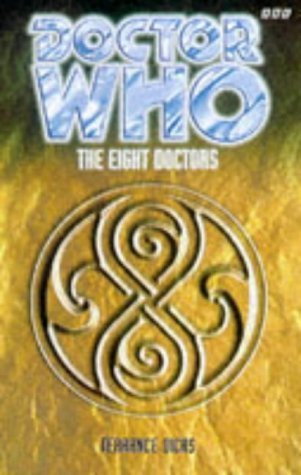
Doctor Doctor: Terrance Dicks' THE EIGHT DOCTORS
BBC Books and, later, Big Finish Audio to the rescue! The Eighth Doctor has become beloved after all due to some great prose and audio adventures, of which The Eight Doctors is the very first. Er, sort of.
Possibly out of concern that their British/Commonwealth readers were not prepared to accept the Eighth Doctor as part of Doctor Who continuity, the powers that were decreed that this first "novel" would basically be a very thinly constructed "plot" that forced the Eighth Doctor to hang out with each of his seven prior incarnations to accept a piece of the relay baton, and, er, reassemble it so he could get on with being the Doctor in other stories.
Yeah, it's pretty lame. But this is Terrance Dicks, so it's very professionally and well-informedly lame, so much so that at times, if you squint, it can look a bit less lame and maybe it's just walking through really thick mud or something. Except it's also maybe a little bit clever (though it could have been a bit more clever, about which more below), as each but one of the Past Doctor encounters serves as a sort of post-credits continuation of a famous TV episode. Thus we see the First Doctor towards the end of "An Unearthly Child" (after a silly frame sequence that just happens to take place in a certain junkyard in Coalville), the Second in "The War Games", the Third in "The Sea Devils", the Fourth in "State of Decay", the Fifth in/after "The Five Doctors", and the Sixth in "The Ultimate Foe" (aka the last serial in the infamous "Trial of a Time Lord" season). The Seventh is seen pretty much between "Survival" and his date with regeneration at the beginning of the TV movie, which is a bit of a gyp but o'well.
There's a lot going on here, chiefly in the form of Terrance Dicks doing the most Terrance Dicks thing he possibly could. As in long before there was the continuity-obsessed Stephen Moffat, there was the continuity-obsessed (at least for the writing of this novel; I dunno how much so he might have been during his time as script editor) Terrance Dicks, who must have had a checklist a mile long of stuff that had to be in here before it was the Doctor Who Novel That Made The Eighth Doctor Canon. And had obviously been tortured for years by little inconsistencies and plot holes and whatnot that this particular storytelling gimmick gave him a chance to fix and/or explain.
But so, this could have been a bit more fun for the kind of reader who likes this sort of thing. I would have enjoyed having had to do a bit more work to figure out at what point in each Doctor's timeline the Eighth was meeting them. The bit with the First Doctor at first seemed like it was just going to be the sort of nostalgic look at the show's origins with the Coalville stuff, and so I didn't notice that we'd plunged right into "An Unearthly Child" until I realized what was going on in the Second Doctor encounter. And then the Third encounter goes and blows it all by outright naming the episode on the very first page of that chapter. And the rest of them are so obvious that I don't feel at all bad about "spoiling" them by calling attention to this cute little device of Dick's. Pah.
I will say that, with Dicks being the practiced craftsman that he is, this all hangs together rather elegantly, especially once the Sixth encounter gets going. Dicks manages to broaden the issues at stake in the silly trial stuff and make it all more meaningful, which was very gratifying. BUT.
Ain't there always a but?
But, the framing device is ridiculous. It's not inherently silly to go back to Coalville, as Stephen Moffat et al have proven, but in The Eight Doctors we're going there solely to meet and pick up a new Companion for the Eighth Doctor, without really introducing said character, Samantha Jones, at all. We know she's a Coalville student, that she's principled and brave and... um. Because, you see, she only appears at the very beginning and the very end. She plays ZERO part in the Doctor's past self encounters. Boo. I'd much rather just meet her organically in a proper Doctor Who adventure, that's just telling one new story instead of retelling seven old ones. But hey.
Not much change to the Arbitrary and Mercurial lists. I was tempted to bump Dicks down a spot out of pique at the lame idea, but he did execute it well, so he stays at #3. The Eighth stays where he is. I almost nudged Romana II up a spot because (unlike the other companions appearing in this novel), she actually did some cool stuff in the "State of Decay" coda, but even so I still don't love her more than Ace.
As for new companion Samantha Jones? I've seen even less of her than I have of Bernice Summerfield, but what little I saw of Samantha was more interesting than Bernice, so in she goes above the professor.
As always, these'll change and change and change like a TARDIS with a functioning Chameleon Circuit.
Alastair Reynolds
Kate Orman
Mark Gatiss
Terrance Dicks
Gary Bulis
Jonathan Morris
Justin Richards
Gary Russell
Keith Topping
Doctors:
Ninth
Twelfth
Sixth
Third
Eleventh
Second
War
Fourth
Eighth
Seventh
Fifth
First
Tenth
Companions:
Ace
Romana II
Jamie
Ben and Polly
Tegan
Jo
Barbara
Nyssa
Samantha
Bernice
Vicki
Adric
Peri
Ian