Showing posts with label Mark Lawrence. Show all posts

Saturday, July 15, 2023

Mark Lawrence's THE BOOK THAT WOULDN'T BURN

It's always the books you don't have that call to you, you know that. Not the ones already on your shelf. They can wait.
A new trilogy from Mark Lawrence is an inherently wonderful prospect, but one set in a giant, labyrinthine library that not only fills an entire hollowed-out mountain but whose inside is probably bigger than the outside and allows people who explore it enough to engage in a limited form of time travel? Aww, Mr. Lawrence, you wrote a(nother) book just for little old me? You shouldn't have. But I'm glad you did.
 
The Book that Wouldn't Burn is kind of set in the same world as Lawrence's Broken Empire pair-of-trilogies-and-some-sidequels*, but absolutely does not require any knowledge of those other books to enjoy. There are simply a few Easter eggs to tell us that the Library and its people exist somewhere in that world's timeline, plus the name of the city at the base of the Library's Mountain is Crath, as in Jorg of Ancrath. It might prove, in the projected next two books, to have more and more definite ties to the Broken Empire, but it needn't; they'd just be grace notes for Lawrence's fans, of whom I am one.

We explore this tiny-yet infinite world with one Livira, whom we meet as a little girl who shares a precarious existence with a kin-unit of maybe 40 people in a settlement out in The Dust, living on a meager bean crop carefully tended with water from a single well. We figure out quickly that Livira, nicknamed for a tenacious desert weed, is another avatar of the girl Lawrence likes best to write: smarter than her society expects or wants her to be, fierce, inquisitive and bluntly practical. Her perilous existence out in the Dust where she regularly gets into scraps with boys much bigger than she and fetches water from a well her settlement keeps having to deepen to continue its usefulness (and their survival) would be a fascinating study on its own, a Fremen tale without a sietch, like the original settlers on Arrakis, but Lawrence has different designs for little Livira.

For a start, humans are not/no longer the only sentient species on this broken earth, as we quickly learn when a vicious band of Sabbers (the word just means "enemy" in the common language of Livira's people) attack and destroy and round up all the human children they can find, whether to eat or sell as slaves, they're not telling, but no sooner has Livira discovered that at least one of them can sort of speak her language and has started annoying that individual with endless questions, than the Sabber train gets derailed by a loosely organized military or paramilitary band from Crath City, locus of the famous Library, to which it has always been Livira's secret wish to immigrate someday. 
Be careful what you wish for, etc.

Livira quickly learns that, while the Sabbers are regarded by Crath City's inhabitants and their King (who has everybody convinced he's descended from the original builder of the library and no, it is not possible to encounter mention of him and not wonder if he's an ancestor or descendant of Jorg of the first Broken Empire series) as barely more than animals -- it is Known that they interbreed with dogs, for example -- "Dusters" like Livira and her friends are considered hardly any more human; her kind are fit only to work and live in the city's sewers.

But of course Livira is not going to settle for being perceived or treated like that, and by the time she actually enters the city, she has already convinced one of her new captors, a man named Malar who quickly became my favorite character, that she might be worth a bit more to him if given a chance. Eager to be rid of this tiny pain in the ass, Malar steers her into the notice of a mysterious man named Yute. Yute sees her potential even more clearly, and picks her for a point-making stunt in the "Allocation" process that assigns young Crathians to their future roles in the adult world. When she then bulls her way into making an even bigger Point than Yute probably intended, she ends up as his latest protégé and a trainee inside the Library.

Interwoven with Livira's story is that of Evar, a young man who is trapped and has grown up, Piranesi-style, with four other children deep inside the Library itself, which is, of course, completely uninhabited and falling to ruin, but a Chamber within it has been semi-repurposed for human survival with a central pool and book-soil in which a small crop of foodstuffs can be grown. Evar and his siblings all emerged as young children from a mysterious Library device called The Mechanism, about which more in a bit, into which each had disappeared at various points in the distant past, not having aged despite having been missing for perhaps centuries. Alll, except for Evar, have come out of the ordeal with a preternaturally acute and useful skill set that amounts to superhuman expertise. One is a master psychologist, one the greatest assassin since the word was coined, another has most of the history of the world crammed into his head, and the group's only girl is a one-woman army, with a headful of tactics, strategy and weapons-lore that matches her homicidal hatred of the Sabbers. Evar, though, just has a hole in his memory and a vague notion that he spent his Mechanism-time with a beloved Woman whom he knew, even as a little kid, was his Destiny.

Evar and his "siblings" have been raised by strange and powerful android-like functionaries of the Library that reminded me of nothing so much as the bakelite robots who raise Ishmael the Cyclops Boy in B. Catling's Vorrh Trilogy, the Assistant and the Soldier. We learn much more about these two mysterious guardians as the novel unfolds, but that way lies way too much spoileration, even for this blog.

The Mechanism from which Evar emerged is a fascinating bit of kit, even for an infinite Borgesian Library: a person who enters it with a book winds up experiencing that book in a very direct and lifelike way that alters that person's character and experience of the world forever. This is how Evar's siblings all acquired their superpowers originally: they wen't into the Mechanism with authoritative non-fiction books under various circumstances (the one female in Evar's world, for instance, whose name is Clovis, was hidden in the Mechanism as a small girl with a Big Book of War Stuff right after watching Sabbers slaughter her entire family and kin-group and yes, Clovis is very much more like Lawrence's typical tough little girl and serves here perhaps to show us what Livira would have been like without the Library), and as part of their continuing education when the five of them came out of the Mechanism together, Evar's siblings have all continued to use the Mechanism to broaden and deepen their abilities. Evar, though, avoids the Mechanism, emotionally haunted by his lack of real memories of his experiences within it. The big difference we know of between Evar's and his siblings' Mechanism backgrounds is that Evar went into the mechanism with a novel.

Considerable space in the plot is devoted to the wanderings of Livira and of Evar through the fascinating mysteries of the Library**, which eventually bring them together, but once they're very tenuously together, Lawrence explodes both of their worlds in fascinating and (for me at least) surprising fashion. It is telegraphed early on that little Livira will eventually grow into Evar's mysterious dream woman, but none of that prepares us for how this develops; I thought I had anticipated the nature of the obstacles to their relationship but I was delightfully wrong! And the actual antagonistic forces pack even more of an emotional wallop than I'd been bracing for. 

There is also some of Lawrence's best prose-craft to date, as when Evar, freshly parted from Livira by cruel fate, contemplates how much she means to him:
...he could do nothing but love, need and want her. Whatever she looked like and whatever crimes her people had wrought, she was Livira, coiled around his heart, woven through his veins. He would find her again... at least there would be an honest parting between them, not one forced by sudden circumstance. And having lived his life within the confines of a library Evar knew that endings were important.
I haven't yet read everything that Lawrence has published -- for reasons beyond me, for instance, my local public library has yet to purchase either of the sequels to The Girl and the Stars -- but this feels like somewhat new territory for Lawrence's fierce skinny weed-girl heroine, whose relationships with other characters usually revolves around friendship and sisterhood rather than romantic love. He writes the latter as well as the former, all while also crafting my favorite kind of novel hands down: one that begs to be read again immediately from the beginning after a revelation near the end invites me to completely change my understanding of key story elements.

I really, really hope that Mark Lawrence and his crew at Random Penguin don't dilly dally too much in letting me back into the Library, is what I'm saying. I haven't been this tortured by the immediate unavailability of a book's sequels in a long, long time and I'm not sure what I'm going to do with myself while I'm waiting, besides, of course, read The Book that Wouldn't Burn again.

*Or at least it takes place in a world that can access the Broken Empire World via its Lewisian Wood Between the Worlds-esque "Exchange." And yes, Livira and Evar have some very Digory and Polly moments together there, but, as Livira eventually comes to discover, in whatever iteration of the old stories she is thinking, she herself contains both the Witch and the Princess, because Mark Lawrence is serious about his fantasy.

**The biggest of which are what it's really for and if it is a net good for the world or not. We come to learn that civilizations have destroyed themselves utterly in possibly planet-killing ways, over and over again, always with the help of the knowledge they recover once somebody discovers the Library. We just never seem to overcome the warlike side of our nature that leads us to harness knowledge for its destructive killing power, and this entire novel serves very strongly as an indictment of the alas, still very common, perspective that knowledge isn't any good unless it's practical, that culture and the humanities are useless and the people who want to study them are frivolous drains on society's resources, but Lawrence doesn't err on the side of "no, the humanities are More Important," just keeps firmly pointing out that knowledge without philosophy is dangerous as fuck.

Wednesday, June 17, 2015

Mark Lawrence's THE LIAR'S KEY


The first book in this second/concurrent Broken Empire series, Prince of Fools, confounded my expectations a bit, presenting us in Prince Jal with a hero way more likeable than the sort-of-psychopath Jorg Ancrath of the original series and showing us a completely different part of these princes' shared post-apocalyptic fantasy universe -- a latter day Scandanavia teeming with nu-Vikings and necromancers and other monstrous delights, oh my. So it was quite a delightful read.

So, I'm happy to say, is this second volume. The Liar's Key is named for an artifact that Jal's bound-by-magic traveling companion and sort-of friend, Snorri, wrested from enemies at the end of the Prince of Fools. The titular key, ostensibly created by Loki, yes, that Loki, the god of mischief/evil/etc, can open any door, anywhere, even the doorway to the land of the dead. Where Snorri very much wants to visit, since he wants to pull an Orpheus and get back his dead wife -- and children, including an unborn son that died when his wife was killed. To mix mythologies a bit, as one does.

As we might imagine (shades of that fantastic miniseries The Lost Room), lots of entities want that key, including the Big Baddie from the original trilogy, the Dead King (and no, it's not Marius Helles, though wouldn't that be fun?). So now Jal and Snorri and the last surviving member of Snorri's Viking clan, the marvelously un-stereotypical Tuttugu, are on the run even as they follow a trail of clues that purport to lead them to death's door.

But... this is the middle volume of a trilogy, and so Lawrence is still more interested in deepening, rather than explaining/solving his mysteries. And mysteries do abound, as Jal and company leave Scandinavia and head south and east to Jal's homeland and beyond, with everybody chasing them, Hallelujah Trail-like, and setting traps for them.

In the process, we learn more about Hal as he learns more about himself -- literally -- through the magical efforts of one of his new traveling companions, Kara.* Anytime he tastes his own blood (which is fairly often, what with all the fighting he and his little crew get up to), he either flashes back to forgotten-but-shocking events from his own childhood (he witnessed his mother's murder when he was seven! And he knows the guy who killed her! It's very fishy that he forgot this!), or from his grandmother's, the Red Queen's, and that of her uncanny siblings, Garyus and the Silent Sister. The Silent Sister being the witch who's spell bound Jal to Snorri in the first place...

So, like Jorg before him, Jal is even more complicated than he seemed. Like Jorg before him, Jal's mind has been tampered with. Another unreliable narrator, another red herring of a story. Because it looks like all of what we've been watching in both Broken Empire series has really been a distraction. Don't look at the mages in the corners. Look at the princes, Psycho and Chickenshit. Aren't they fascinating? Pay no attention to the creepy half-blind woman behind the curtain...

And hurry up with the next volume please, Mr. Lawrence!

*The other is a fierce little red-haired Viking orphan boy, Hennan, who serves as this novel's hook into this hero's conscience. Mark Lawrence always thinks of the children.

Friday, April 17, 2015

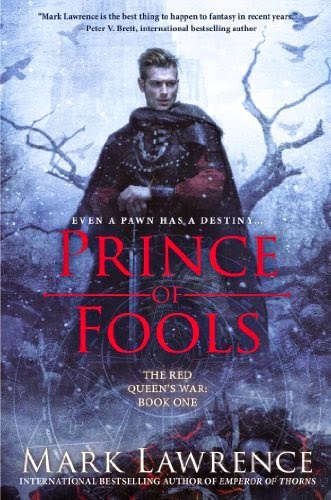
Mark Lawrence's PRINCE OF FOOLS

I absolutely loved Mark Lawrence's Broken Empire trilogy, so there was no way I was not going to dive right into this sidequel pretty damned soon. The world created around the story of Jorg Ancrath begs to be further explored, and Lawrence is a master at creating unique character-narrators to lead one's expeditions. So I had very high expectations heading into Prince of Fools, first of a new series titled The Red Queen's War.

They weren't entirely met, but I didn't really notice that as I was reading, because my expectations were beside the point. Lawrence was revisiting his world but doing so in a completely different way from what I'd come to expect, and doing it brilliantly. So Prince of Fools, for all its familiar settings and cameo appearances by characters from the other books, is very much its own thing, and its sort-of-hero, Prince Jalal Kenreth, is very much his own man. Well, at least as much as Jorg was. I mean, look how problematic Jorg turned out to be!

Jalal, or Jal as he wishes people would not call him, is also problematic, but not quite so much so as was Jorg. Jalal is relatively simple (or at least seems so, so far): he is a self-professed and unapologetic coward, and tells us so clearly and distinctly every few pages. He's proud of what a good coward he is, very good at making fun of what a really almost perfect coward he is, and very entertaining and droll on the general subject of his mastery of the finer points of cowarding.

Except, of course, he isn't. Because one thing that he never seems to have noticed about actual cowards is that they never admit to being cowards. Far from it. They always have very high-flown, high-horse riding reasons for their actions that are actually quite noble and brave and necessary, thank you very much. And if you use the C word in their presence, they might just slap you with a glove and demand you meet them on the field of honor. At which they'll not show up because they had some highfalutin' duty to perform. Yeah, that's it.

No, Jal is really pretty much a hero, but doesn't want that to become known, because then people will expect things of him. Jal, can you rescue this maiden, Jal, can you solve this dilemma, Jal can you fend off this invading army that threatens our very existence, Jal can you marry this homely but rich maiden for the good of the Realm. If there's anything he fears, it's that. Far more pleasant to drink and gamble and whore around, leap from noble bedchamber window to noble bedchamber window to have a go at the sister, etc.

Until plot things happen that bind him magically to a by-gods Viking whose very involved backstory has left him a prisoner of Prince Jal's grandmother, the Red Queen. Said Viking due to be released until Jal gets a load of his overwhelming brawniness and diverts him into the fighting pits instead so that Jal can make some money off him. And then magic.

The tale thus becomes a different kind of road narrative from that we enjoyed with Jorg and his Brotherhood. Jal and Snorri (well, of course the Viking is named Snorri. Read your sagas!) must travel north to do battle with evil forces that have destroyed Snorri's family and realm, forces that he at first just thinks are rival Viking bands but turn out to be closely related to the Big Evil that so warped Jorg's tale and against whom Jal's grandmother and her eerie and witchy Silent Sister are subtly arrayed.

The resulting book is a bit less complex than the Broken Empire books (or at least seems so thus far!), a bit less uncomfortable to enjoy, but compensates for all this by being a lot more fun. Snorri is a hilarious hero straight out of the sagas (he'd sweep all the categories except maybe Outlawry if the guys at the Saga Thing podcast were for some reason to take on this story), whose many notable witticisms manage to keep things amusing even when Jal stops cracking wise as narrator. Their story and the weird magic that binds them is compelling and occasionally hair-raising. There were plenty of undead/necromancy encounters in the Broken Empire books, but the walking dead in Prince of Fools are much scarier, even if they do maybe owe a lot to A Song of Ice & Fire's White Walkers. Or do they?

This is how you do a sidequel, kids. Now I'm seven kinds of psyched for the sequel to the sidequel. Sesidequel? Sedequel?

Sunday, March 8, 2015

Mark Lawrence's EMPEROR OF THORNS

Jorg Ancrath, hero/anti-hero of Mark Lawrence's Broken Empire trilogy (Prince of Thorns, King of Thorns) is all grown up, and more complicated than ever in this final volume, Emperor of Thorns.

And as the title and the cover give away, he's going to achieve his ultimate ambition, of re-uniting the very post-apocalyptic neo-feudal Broken Empire (which is pretty much what is left of Europe plus a chunk of North Africa) under his rule. We've pretty much suspected this was going to happen from the beginning, because Jorg is one ruthless little monster and he always gets what he wants, even if he has to kill people he likes or loves in order to do it.

So the question has always been, not if he will become Emperor, but how. And the how has been a most tantalizing, challenging question, because the traditional way to the Imperial Throne is not unlike that to the throne of the Holy Roman Empire of days gone (very much) by; there is a set of Electors, kings and dukes and lords of the empire's constituent lands, who must come to a consensus on who is to be the boss. If they can't, no emperor. Ususally, they can't, for a number of reasons, chief of them being 1. Instead of just a handful of electors, there are 100 and 2. Since the imperial throne has been empty for over a century, the imperial court is pretty much just a big empty city of ceremony full of officials and functionaries and guardsmen (the imperial guard is the chief sink for the empire's ambitious second and third sons who don't want to become priests), leaving the kings and dukes and lords with most of the real power, which they do not want to give up.

King of Thorns dealt largely with Jorg's ruthlessly clever elimination of his greatest single obstacle to achieving his ultimate ambition, but left our man more unpopular, feared, etc. than ever before. But the Imperial selection process is pretty much a popularity contest. Oh noes!

So lots of Emperor deals with politicking, though not as much as I'd expected. And what there is is pretty indirect-seeming and circuitous; Jorg makes friends chiefly via saving his enemies from bigger and more powerful enemies, meaning ALL THE SUBPLOTS YOU GUYS, but said subplots go a long way toward seriously enriching our understanding of Jorg (again, via a whole chunk of the book taking place "four years ago", still set after all the events of the prior book, but four years earlier than the most immediate narrative of Jorg's pilgrimage to the Imperial City for the vote), who emerges as an even more complicated figure than he already was as the usual transitional events leading to adulthood leave their marks on his already very marked-up self.

The same is true of his world, about the nature of which we learn even more as we follow Jorg's progress through it; not only in terms of its geography and inhabitants, but of its nature as a post-apocalyptic feudal mess, still littered with "Builder" technology and artifiacts and, as we learned in the second novel, haunted by Builder ghosts.

And yes, by the end of Emperor, the urge to go back and re-read from the beginning is strong; you will have a completely different understanding of the driving forces of Jorg's life and character and probably have a different take on the narrative itself.

And yes, the ending is satisfying in almost all of the ways we want it to be, and the way that it isn't is just fine, really, because one of the major points of Jorg's story is the hollowness of vengeance, after all. Bad things happen; punishing the baddies doesn't make them un-happen, it just uses up a lot of your time and energy that are better spent pursuing more important goals.

Magnificent!

Friday, February 13, 2015

Mark Lawrence's KING OF THORNS

When I wrote earlier this month about the first volume in Mark Lawrence's Broken Empire series, Prince of Thorns, I made some comparison to Gene Wolfe's Book of the New Sun, but said that Lawrence's grimly unlikeable antihero was a much more reliable narrator than Severian.

As I've finished the second novel in the series, King of Thorns, I find I need to retract that statement somewhat. Jorg isn't always telling the truth as he leads us through the layers of his story, but I'm not sure his intent is to deceive anyone so much as to discover himself what is true, of what he is actually guilty, whose motivations he has actually acted upon, what manner of character he really possesses. It's really, really complicated. Deliciously so.

As the novel opens, Jorg has been king of the little nation he wrested from his uncle (the guy who had Jorg's mother and little brother killed. Or probably the guy) for several years and is getting married to a slip of a girl who seems like a bit of a simp but turns out to be anything but. Meanwhile, his little kingdom is under an enormous assault, being attacked and invaded by something along the order of 20,000 men under the command of a destiny-driven knight in shining armor, the Prince of Arrow, who is an almost perfect foil to Jorg in that everybody loves him and for good reason -- he is everything a royal should be, accomplished, daring, fair, kind, good, noble, handsome, trustworthy. And prophesied to unite again the Broken Empire of 100 Kingdoms that once dominated Europe in the years between the nuclear apocalypse that turned our world into Jorg's and Jorg's own time.

Oh, and Jorg is going to have to fight off -- or bend the knee to -- the Prince of Arrow on his very wedding day. And if he fights, he only has 300 men or so. Yes, he addresses the whole Thermopylae thing. A very well-read young man is our narrator Jorg.

But don't worry! He has a plan! Only, sort of Doctor Who style, he doesn't know it! Because like in the last novel, Jorg is still beset by subtle, sneaky, nasty wizards who can manipulate men's minds as well as reading them. But he found a way to beat that nasty subtle wizardry, oh yes! He found a wizard of his own who could cherry pick and remove Jorg's memories and seal them in a little metal box that is impervious to the workings of Jorg's magical foes! Jorg can judiciously access these a little at a time, but only a little. This results in a lot of Bill and Ted type shenanigans in which Jorg and his men are constantly stumbling across amazingly helpful things by surprise as Jorg's deliciously complex and devious defense scheme plays out. Joy!

So see, much of the time we've been reading Jorg, we've only been reading bits of Jorg, because he's hidden so much even from himself, and thus from us. He's working from a heavily redacted script, and drawing many false conclusions about his role thereby. It's absolutely fascinating.

So after two novels, I'm no longer sure exactly how detestable Jorg really is. Oh, he's still plenty brutal and spends lives like Napoleon and is still hell-bent on revenge and is an amazing killing machine, but it seems that some of his most heinous deeds might not really be layable at his door. Then again, they yet may.

This all unfolds again in multiple time frames and multiple layers. In addition to the wedding day battle plot, we again follow a parallel narrative from four years before, when King Jorg hit the road with what's left of his brothers and toured his world, gathering allies here, re-encountering old foes there, losing brothers, gaining powers, and exploring in greater detail the origins of this strange semi-fantastic semi-science-fictional world of his. The careful reader will pick up lots of hints as to Jorg's deliberately-forgotten battle plans as well as develop a more complex picture of what Jorg's all about.

And then there's a scene between Jorg and his step-aunt, Katherine, with whom he has an obsession that is almost romantic but definitely sexual, most of which is part and parcel of the memories he had removed from his head and stored in his box to unfold piece by piece along with his strategy. Thus the relationship between Jorg and Katherine is also subject to reinterpretation. Deliciously so.

And then there is a narrative from Katherine's point of view, told in snippets from her diaries. For much of the book, these feel kind of unnecessary and unsuccessful, but they lend tremendous weight to the novel's final revelations as the stage is set for Jorg's run for the imperial thorne, to be detailed in the last book of the trilogy, Emperor of Thorns, which of course I'll be reading very, very soon. Deliciously so, I am sure.

Wednesday, January 28, 2015

Mark Lawrence's PRINCE OF THORNS

Admit it. You've always wished that George R.R. Martin was gutsy enough to let Joffrey Baratheon have the odd point of view chapter. So, apparently, did Mark Lawrence. And he did something about it.

Admit it. You loved Gene Wolfe's Book of the New Sun in all its occult glory, but wished it had a reliable narrator, and would give bonus points if said reliable narrator was a boy psychopath. So, apparently, did Mark Lawrence. And he did something about it.

And here's the kicker -- he did both of these things in the same damned book! And thus Prince of Thorns and its two Broken Empire sequels came to be. So we have an extremely post-post-apocalyptic setting, in which civilization has been bombed back to medieval France but there is so much bizarre and inexplicable leftover technology and other phenomena about that it's basically an epic fantasy setting chock full'o'magic... and we have a boy psychopath, a prince of the blood with a thirst for revenge and a giant cauterized wound where his conscience might be, leading us through it from his perspective.

This is not a pretty book, folks (especially not for someone coming off the ravishing loveliness of A Song for Arbonne), but damn, is it a compelling one.

It does perhaps require something in the order of a trigger warning, though. Our boy, who rejoices in the name of Prince Honorus Jorg Ancrath, is truly a wicked one. Though only 13 years old when we first meet him, he's already a murderer, a thug, a manipulator, and, yes, a rapist (though the rapes occur offscreen). The book itself starts off with rape and murder and violence, as such is Jorg's origin story; when he was nine, he, his mother the Queen, and his little brother were waylaid on their travels; mama was raped and murdered; little brother was mutilated and murdered; Jorg only survived because he got tangled up in the world's wickedest briars and was held helpless and out of sight by the thorns, hence the book's title. He has scars inside and out, yo.

To make matters worse, his father the king declines to take revenge on the attackers. It's politically inexpedient. You'll understand when you're older. Be a good boy and go page through your Plutarch and leaf through your Livy and don't leave too many stiffened socks for the servants to clean up.

Wrong answer, dad.

So by the time the lad is 13 (the nine/ten-year-old Jorge we meet in judicious flashbacks), he's left home and become the head of a band of ruthless bastards. And these aren't fun, funny bastards like Scott Lynch has made us love. These are evil, violent, bloodthirsty marauders who you will find yourself a little abashed to be rooting for (more or less).

Some readers have complained that it's impossible for a 13 year old boy to take control of such a band. I'll let his friend Sir Makin answer that, as he did when Jorg asked him what he meant when he said Jorg is good: "Playing a role. Filling in for lost years with that intuition of yours. Replacing  experience with genius."

And then there is the matter of some mages. Sneaky, powerful, subtle, nasty mages, who can manipulate other people like puppets. Arguments can be made that some of Jorg's precocity, and maybe some of his ferocity, aren't entirely his own.

Maybe.

Regardless of who the baddest guy really is, though, regardless of how nasty things get, because Lawrence has presented Jorg's point of view so convincingly, so clearly, so logically, the reader winds up in some way rooting for him. Even if we find him utterly irredeemable, we love watching him go.

Yeah, you'd better believe I'm going to read the rest of his saga. With frequent showering in between chapters, but I'm going to be reading it. Soon.

Maybe I'll intersperse it with Guy Gavriel Kay. You know, just so I don't wind up hating humanity altogether 8)