Showing posts with label ASOIAF. Show all posts

Friday, April 17, 2015

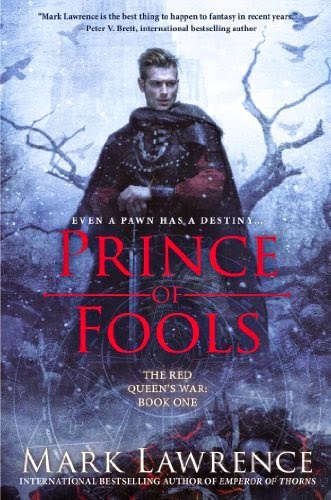
Mark Lawrence's PRINCE OF FOOLS

I absolutely loved Mark Lawrence's Broken Empire trilogy, so there was no way I was not going to dive right into this sidequel pretty damned soon. The world created around the story of Jorg Ancrath begs to be further explored, and Lawrence is a master at creating unique character-narrators to lead one's expeditions. So I had very high expectations heading into Prince of Fools, first of a new series titled The Red Queen's War.

They weren't entirely met, but I didn't really notice that as I was reading, because my expectations were beside the point. Lawrence was revisiting his world but doing so in a completely different way from what I'd come to expect, and doing it brilliantly. So Prince of Fools, for all its familiar settings and cameo appearances by characters from the other books, is very much its own thing, and its sort-of-hero, Prince Jalal Kenreth, is very much his own man. Well, at least as much as Jorg was. I mean, look how problematic Jorg turned out to be!

Jalal, or Jal as he wishes people would not call him, is also problematic, but not quite so much so as was Jorg. Jalal is relatively simple (or at least seems so, so far): he is a self-professed and unapologetic coward, and tells us so clearly and distinctly every few pages. He's proud of what a good coward he is, very good at making fun of what a really almost perfect coward he is, and very entertaining and droll on the general subject of his mastery of the finer points of cowarding.

Except, of course, he isn't. Because one thing that he never seems to have noticed about actual cowards is that they never admit to being cowards. Far from it. They always have very high-flown, high-horse riding reasons for their actions that are actually quite noble and brave and necessary, thank you very much. And if you use the C word in their presence, they might just slap you with a glove and demand you meet them on the field of honor. At which they'll not show up because they had some highfalutin' duty to perform. Yeah, that's it.

No, Jal is really pretty much a hero, but doesn't want that to become known, because then people will expect things of him. Jal, can you rescue this maiden, Jal, can you solve this dilemma, Jal can you fend off this invading army that threatens our very existence, Jal can you marry this homely but rich maiden for the good of the Realm. If there's anything he fears, it's that. Far more pleasant to drink and gamble and whore around, leap from noble bedchamber window to noble bedchamber window to have a go at the sister, etc.

Until plot things happen that bind him magically to a by-gods Viking whose very involved backstory has left him a prisoner of Prince Jal's grandmother, the Red Queen. Said Viking due to be released until Jal gets a load of his overwhelming brawniness and diverts him into the fighting pits instead so that Jal can make some money off him. And then magic.

The tale thus becomes a different kind of road narrative from that we enjoyed with Jorg and his Brotherhood. Jal and Snorri (well, of course the Viking is named Snorri. Read your sagas!) must travel north to do battle with evil forces that have destroyed Snorri's family and realm, forces that he at first just thinks are rival Viking bands but turn out to be closely related to the Big Evil that so warped Jorg's tale and against whom Jal's grandmother and her eerie and witchy Silent Sister are subtly arrayed.

The resulting book is a bit less complex than the Broken Empire books (or at least seems so thus far!), a bit less uncomfortable to enjoy, but compensates for all this by being a lot more fun. Snorri is a hilarious hero straight out of the sagas (he'd sweep all the categories except maybe Outlawry if the guys at the Saga Thing podcast were for some reason to take on this story), whose many notable witticisms manage to keep things amusing even when Jal stops cracking wise as narrator. Their story and the weird magic that binds them is compelling and occasionally hair-raising. There were plenty of undead/necromancy encounters in the Broken Empire books, but the walking dead in Prince of Fools are much scarier, even if they do maybe owe a lot to A Song of Ice & Fire's White Walkers. Or do they?

This is how you do a sidequel, kids. Now I'm seven kinds of psyched for the sequel to the sidequel. Sesidequel? Sedequel?

Sunday, April 5, 2015

Guy Gavriel Kay's SAILING TO SARANTIUM

There is a lot of attention to and respect for craft in Canadian fantasist Guy Gavriel Kay's fiction, and not just as a source of metaphor, though the tapestries of Fionavar and, here, the mosaics of the pseudo-Byzantine Sarantine empire, certainly serve as highly effective over-arching ones for the story structures he's created.

There were, though, no weavers in Fionavar. The tapestry was woven by a god, though not one of the gods who romped and fought and occasionally fornicated in the land -- they had personalities and desires and whims. The Weaver of Fionavar was much more impersonal, not a character.

But in Sailing to Sarantium, while yes, the overall story can be seen as a mosaic created by a divine mosaicist, there is also a real and earthly artisan who is a master of that art, and his story is the main one of this first novel in the Sarantine diptych.

Said artisan is one Crispin, who begins the novel far from the fabled city of Sarantium. Crispin is a Rhodian -- a citizen of this world's western Roman empire after it was sacked by this world's Visigoth analogues* -- and a mosaicist of considerable skill and dedication, if not yet reputation. The reputation is all his partner's, and it is his partner who is invite-commanded by the emperor to come to Sarantium and work on the novel's Hagia Sophia analogue. The partner,though, is old, and tired, and Crispin is merely middle-aged and embittered, so they decide it is he who will go "Sailing to Sarantium" in the novel's idiom for finally getting a shot at the big time, though because the imperial courier dawdled with the message it's too late in the year for safe sailing and so Crispin must travel overland.

So far this sounds about as fantastic as a Lars Brownworth podcast**, and I will just spill the non-fantastical beans here and say that, well, a Clark Ashton Smith story this is not. There is very little magic here, and not much in the way of mythical creatures either -- about as much as you'd see in, say, four or five chapters of A Song of Ice and Fire. But like those books, you're not going to be reading this for the dragons and centaurs and necromancers. You'll read it for the characters and the intricate and crazy court politics and for Crispin's story, the story of an artisan, the kind of guy we can never know any real story about (hence, I posit, the decision to make of this tale a fantasy instead of just a historical novel set in Byzantium. At least in part.) because artisans' names and biographical details did not make the history books until, overall, the Renaissance.

And also because, so far in my experience at least, when Kay writes fantasy, he's interested in exploring one of the more interesting possibilities that the fantasy genre offers: that of examining a world in which religion and its attendant rituals are not matters of mere faith/belief, as they are in our world, but matters of fact. Gods exist and prove their existence by directly interacting with humans (sometimes quite intimately). Ignoring them, to paraphrase Philip K. Dick, does not make them go away. And neglecting to propitiate them has real and tangible consequences that can't be argued about (or at least not much). We saw this in spades in Fionavar; here it's all a bit more subtle. There are pagans still in the Sarantine world, and we get at least one spectacular encounter with the reality of their pantheon and program during Crispin's journey to the great city from the sticks, but there is also a monotheism where, at least in this first novel, no proof is offered. It's all more like ours. It's all about belief.

Which lets Kay explore at one remove the schism between Western and Eastern Christianity that was just really developing in Byzantiume during Justinian's reign. The official religion of the Sarantine empire has sort-of-pagan trappings in that its single deity, Jad, is a sun god, but, just as Christianity was through its history, there's monotheism and there's monotheism. Pagan tugs at believers' heartstrings have some venerating a pantheon of martyrs almost as deeply as the god, and many arguing over whether the deity's incarnated earthly son was or was not as divine as the god itself.

All of this may turn off some readers, but those who have the patience for it are amply rewarded. The theological nitpicking deeply informs some of Crispin's very real and intense experiences, and his plans and visions for his coming triumph, the decoration of the pseudo-Hagia Sophia, which is to be more than a little bit of an assertion of doctrine given form in stone and mortar and prismatically lovely glass tesserae.

As I said, Kay loves exploring craft, and takes it as seriously as fodder for stories as he does his own practice. The care of Crispin for not merely design but construction and composition mirrors Kay's own attention to his craft. The result is as splendid as the dome of Hagia Sophia must have been in Justinian's day.

All this and some crazy action, too. Chariot races! Chariot crashes! Fighting! Sometimes in a bathhouse! And intrigue. So much intrigue. Crispin's arrival upsets many, many applecarts.

A caveat, though; as others have complained, Sailing to Sarantium ends feeling incomplete. Very little is resolved; most is saved for the second volume Lord of Emperors (which I'm already reading, of course). If you're going to read this, then, do yourself a favor and make sure you have the second book ready at hand.

Go, Blues!

*And let's just get this all out of the way and say that, fantasy trappings aside, this novel is basically set in Byzantium in the reign of Justinian and Theodora. All the events of that period are mirrored here, from the Nika riots and Theodora's famous quote about how imperial purple is a good color in which to be buried to the near-eternal conflict between the Blue and Green factions that are really only nominally about the two major colors striving for supremacy in the chariot racing marvel of the Hippodrome (as in the real Byzantium, the two factions also correspond to sides in a religious schism), to the need, after said riots, to rebuild the city and especially its primary religious edifice. It's all so on the nose, but as Byzantium is woefully under-represented in fiction, I happily allow it.

**If you've not listened to the marvelous Twelve Byzantine Rulers, go! Listen! It's glorious! I promise!

Saturday, May 26, 2012

100 Books #47 - Brand Gamblin's DISCOUNT MIRACLES


"When your sovereign catches fire and takes off like a bird in flight, all ties are in question."

Readers of this blog already know that I'm bullish on Brand Gamblin's imagination. I'm terribly pleased to share, therefore, that with this new release, his stock is still rising: the storytelling is still beguilingly top notch and appropriate for all ages, and the niggling little complaints I had about the editing of his previous novels have been addressed, leaving even picky readers like me with nothing to worry about but enjoying the tale.

And enjoy it I did!

Discount Miracles could do very well as a lost/extended Firefly script, if Mal, Kayleigh and Jayne survived a bad crash onto an inhabited planet with a gender-swapped Saffron (not a member of the crew, he is just as amoral and manipulative as Saffron but he is indeed a dude) and had to make their way through a society at a superstitious and medieval level of development. Their only stock in trade: science, which they find themselves pressured by various forces of necessity and local politics into using to stage "miracles" -- a practice with many short-term advantages, but with potentially longer-term consequences. Too much success and they risk persecution as witches; failure means exposure as frauds. Either has definite pitchforks-and-torches potential.

And of course there are lovely complications. Robert, the somewhat brainier Jayne figure, is furious with the rest of the crew for seeming to give up so easily on getting back into space; Anvir, the Saffronesque rogue, is all about manipulating the rubes for the sake of manipulating the rubes; Dannia, the charming Kayleigh analog, has fallen for a local woodcutter whose love notes to her take the form of flaming wooden crop circles only visible from her "metal broomstick."

Adding to the fun is the crew's main, if unwitting, client for their miracles, the uncommonly born commoner, Dayner Raeburn, whose status as the thirteenth son of a thirteenth daughter has vaulted him not only into the spotlight but into royalty: there is a prophecy on this world saying that such a boy will ascend to some kind of transcendent state on his 20th birthday and Make Everything Better. He's spoilt and willful and snotty and basically comes off, quite a bit of the time, as a less homicidal Prince Joffery*, which is most enjoyable. Once he "ascends" and leaves behind a power vacuum, the novel takes on a whole new dimension, full of schemes and double-crosses and hardball politics, even as a lot of the action has moved to the other side of the planet.

The novel, too, invokes Star Trek, as the ship's crew and stowaway find themselves rather hotly debating how much technology it's safe -- and ethical -- to reveal and share, whether or not helping Prince Raeburn's "ascension" is worse than some of the trading the stowaway has done on the side, and, of course, whether or not they have any chance at all to be rescued.

I could have done with a smidgeon more battling, especially in the climax, but I'm probably one of those bad, bad people who have become desensitized to violence, and Gamblin does try to keep his appeal as broad across the generations as possible. This book is not as sweet or charming as its predecessors, but it's still something that I, were I a parent, would be happy to let any young science fiction fans in the family read after I was done with it.

*See George R.R. Martin's A Song of Ice and Fire, in the first two novels of which Joffery is one of the more over-the-top villains. Indeed, in more ways than one, the elevator pitch for this book could be Firefly meets a G-rated Game of Thrones, with a soupcon of H.P. Lovecraft.

Thursday, July 21, 2011

George R.R. Martin's A DANCE WITH DRAGONS


So now you know why I haven't blogged much here of late. I've been eyeball-deep in the lastest installment of George R.R. Martin's A Song of Ice and Fire. Now, though, I am done, and I am weirdly tired.

I'm going to strain after a physics metaphor here, for which I apologize.

The first book of this enormous series (each volume is around 1000 pages), A Game of Thrones, more or less as I have observed in other posts here, set up something big and then blew it apart. The pieces flew and collided with stuff all through A Clash of Kings and A Storm of Swords with immensely satisfying effect, and then...

Then came A Feast For Crows, Martin's placeholder book, clearly published to placate the fans who were howling for the next book and getting very impatient. He hacked out, the conventional wisdom said, the less important and mostly less interesting bits of his original planned fourth book, which was getting just too big and unwieldy, and assembled them into a section of story (or, as some have observed, really just a pile of pages) and tossed it to the direwolves outside his door. The good stuff, we were told, was waiting for us in A Dance with Dragons and meanwhile, hey, enjoy these B rolls -- which did admittedly contain some good stuff but at the expense of a lot of oomph. The energy propelling the fragments sent flying by the explosions of A Game of Thrones was dissipating anyway, and sadly, A Feast for Crows didn't so much as let the force and velocity dwindle as artifically retard it further.

So this fifth book (or really, fourth-and-a-half) needed to find a new source of energy before everything stopped altogether. It needed it badly.

Did it? Ehh, not so much.

A Dance with Dragons, for my money, wound up relying too much on the readers' gratitude to finally be walking alongside the (remaining, as in still alive) core characters who first enchanted us and most of whom original readers have been missing for... let's see, eleven years (since A Storm of Swords was first published in 2000, yeah, eleven. As in this one goes up to. Ugh. My heart truly goes out to the fans who were with this series from the beginning, who endured that wait. My own wait was a mere and merciful month). Our reunions were sweet and joyful; just seeing a beloved character's name as a chapter heading was enough to make me squee as I started reading. But is that enough energy to propel a story through another thousand pages?

Not quite.

So what else is supplying the needed force now? Well, much like in A Feast for Crows, there is a lot of traveling -- marching, sailing, riding. But as the fans know, Winter Is Coming so this is a lot more arduous and slow. Chapters following one party from the Wall to Winterfell feel three times as long as they are even without the point of view character constantly chanting to herself that the distance is 300 leagues. This isn't quite "A highborn maid of threescore and ten..." territory but border skirmishes are possible.

A fan favorite (if not the fan favorite) character spends a lot of this book playing cyvasse, which as far as I can tell is this world's version of chess. It has somehow become his primary means of interaction with other people: sitting in a room - a tavern, a ship's cabin, a tent - moving a bunch of pieces around on a board and, usually, letting the other guy defeat himself.

It's really hard not to see this as a metaphor for what Martin is doing here. Which is too bad. He's obviously got big plans for all of his characters. The story is awash in prophecy and everything is still very much up for grabs; we are still nowhere near that point where a system settles into its new ground state at this point. There's still lots at stake. And the consistency with which his characters act and his situations develop really do argue for an eventual grand finale. I'm pretty sure he knows what's coming for everybody. But like his cyvasse player, he is cautious, whether because he doesn't trust his game plan as much as he arguably should, or because it's fun watching his opponent (that would be us) squirm (I suspect the former; he doesn't seem like the kind of guy who would deliberately torment the multitudes). And so he feints. J'adoube.

All of that said, Martin did not forget to continue exploiting the strengths developed in the prior books. No character is safe, so when one is in jeopardy the reader feels it. And there is one beloved character who may well be dead now. Another may be captured, another may be executed, another may never leave his found sanctuary again, another whom we have loved for four books may be becoming a baddie. And as in every one of the books so far there are some new characters, many of whom are just as fascinating as the ones we have lost (and yes, one theory about a certain someone was definitively proven false, but it was an outside chance anyway that it was true and, oh well)... there is good stuff in here. And because of that, because I care about these characters and my heart is in my throat over the fate of a few (lots of cliffhangers!), god damn it, I'm looking forward to the next one.

And it's going to be a long-ass wait.

And, well, as I've said before, the waiting may all be for naught.

But god damn it, we need some new spin.