It's been a while since I had a new "Antasy" to enjoy -- though it's rather bittersweet to be doing so right after we lost the great E.O. Wilson -- but at long last Clark Thomas Carlton has come through with the third in his bizarre and delightful series that began with Prophets of the Ghost Ants and continued in The Prophet of the Termite God. When I first encountered these books, I described them as "Dune with ant-riders" but as we move into this third novel it has so much more in common with George R.R. Martin's big unfinished fantasy series that this could almost be called "A Feast for Ant-Crows" or some such. Except, you know, not horrifyingly repetitive.
It is, however, as grim as AFfC for much of it. We'll leave aside for the moment some questionable tactics in this continuation of our boy Anand's quest to save the people he persuaded into a new way of life way back in the first novel (I guess there's neither a Security Council nor any Geneva Conventions in his world) because they are employed defensively (but make for rough reading if you're at all sensitive to things like biological or chemical warfare because trigger warning if you are); those aside this is still the darkest view of this world, in which humans have evolved into near-microscopic creatures who ride ants like horses (see cover art) and have entered into more-or-less symbiotic relationships with many other insects despite most of those insects being much larger than humans are, that we've yet seen.Kate Sherrod blogs in prose! Absolutely partial opinions on films, books, television, comics and games that catch my attention. May be timely and current, may not. Ware spoilers.
Showing posts sorted by relevance for query carlton. Sort by date Show all posts
Wednesday, January 5, 2022
Clark Thomas Carlton's THE GHOST ANTS OF GRYLLADESH
We get a somewhat bewildering array of new and returning POV characters who, I guarentee, will send you scurrying back to the helpful dramatis personae at book's beginning just to keep straight*. They all have very intense adventures once again as the world of the Antasy reels from the wars fought in prior novels, only to find itself embroiled in new conflicts as forces held down or blocked by the evil Hulkrite Empire are now free to seek revenge, conquer lost territory, and wreak general havoc on Anand and his forces -- and on the civilians who have been caught in the middle of it all.
Like in GRRM's opus, we get the perspectives of people on all sides of the conflict(s), including a refugee princess (Trelanna) who finally, after three novels, garners reader sympathy (she suffered plenty in the prior novels, but elicited schadenfreude rather than pity or sorrow, at least from this reader), not by enacting a redemption arc so much as just really becoming abject and pitiful as she gets swept up in an invading army's progress to attack her homeland and has a forced marriage to its leader to look forward to once her unborn children (by Anand!) are got rid of, one way or the other. Did I mention that The Ghost Ants of Grylladesh is grim? The Ghost Ants of Grylladesh is grim.
Of course, Trellana's mother Polexima, who joined with Anand in establishing a new nation based on freedom, tolerance, and an abandonment of her native land's absurdly rigid hierarchy, in previous novels, had it even worse and bore up much better, never wavering in her commitment to the new way even when hamstrung and hobbled and repeatedly raped by the terrifying army Anand defeated in the second book, so feeling for Trellana only goes so far.
Then there's Anand's cousin-I-think Terraclon, elevated last novel to what amounts to the pope of the religion devoted to Goddess Ant Queen and the series' sole LGBTQA+ representation (unless we count [REDACTED] the non-POV character who becomes his lover by this novel's end), who has pretty much held Anand's forces together while Anand has hared off on weird mission after weird mission on the back of a high-flying locust. Pleckoo, the main villain of the last two novels, gets a quick cameo but is basically fridged, while a new royal lady, Fewlenray has quite an arc of her own while, in one of the things I like best about Clark Thomas Carlton's work (besides the arthopods, of course), several villains get point of view chapters that win, if not our sympathy, at least our empathy as their plans clash with Anand's, assuring that no matter how this ends, somebody we've come to love, like a little, or at least respect, is going to be brought low and we'll cry along with them at least a little bit -- recalling that arch-villain Pleckoo started out his Antastic life as Anand's best friend and cousin, after all...
But the novel is still very much about Anand, whose character deepens and becomes yet more complicated as circumstances and his own shortcomings tempt him into atrocities of his own. He is still that poor nobody from the midden at heart, and while his time among the freedom-loving Dranverites taught him a lot and gave him the courage to share what he learned with his former society, he still reacts at times like that scared and bullied young man, even as he also copes with the fact that both of his very pregnant wives are captives of the very hostile nations who threaten his co-creation of Bee-jor. He becomes a little less lovable but a whole lot more believable in this book, does Anand. Would you have made different choices? Could you have thought of better solutions to his problems?
The novel ends on even more cliffhangers than did The Prophet of the Termite God, so I sure do hope CTC doesn't take our least favorite page out of GRRM's book. Write fast and stay healthy, Clark!
*Indeed, I dithered as I read over whether or not I should backtrack and read The Prophet of the Termite God again because for a lot of these characters, I was uncertain about whether they were completely new for the third novel, or just newly prominent and having emerged from the background of the previous two. I think I should have backtracked.
Sunday, January 27, 2013
Clark Thomas Carlton's PROPHETS OF THE GHOST ANTS
Oh man. Ever hear about a book that sounded so exactly like it was written just for you that you were almost afraid to read it because there was no possible way it was as brain-explodingly awesome as you desperately wanted it to be and so you let a whole year go by between OMG MUST BUY NOW purchase and actually starting to read it?
I mean, come on, tiny, tiny humans who ride ants and locusts around like horses! Who share mounds and pheromone signatures with various species of ants! As if Edmund O. Wilson started writing science fiction! Or at least epic fantasy! I mean, who's been peeking at my Christmas list?
So yeah, my expectations for this were unreasonably high going in, and I had to sort of grit my teeth and risk them being unmet to even start reading this book. The question thus becomes: were they met?
More like confounded. Prophets of the Ghost Ants is one of the most unusual novels I've ever read, and may genuinely qualify as unique. Though I suppose there might be some who want to describe it as Dune with insects, that still doesn't quite capture it. For one thing, the fanatical monotheistic desert tribe are the bad guys. Though there is something very Muad'Dib-ish about our hero.
Anand*, starts out life as the lowest of the low, a bottom-of-the-heap half-caste** among a vast tribe of humans-and-leafcutter ants (the humans are essentially parasitizing the ants, but no one but Anand ever wants to face up to that fact) but soon learns a bit more about his true heritage and special destiny, like so many fantasy heroes do. In this case, it's because his mother came from a tribe of roach-herders, and while this bit of interbreeding makes Anand even more revolting to the leafcutter people, the roach-herders think he's destined to improve their lot, by improving the way they get treated. He gets betrothed to a very pretty girl and just has to wait until he's sixteen to take up his exalted role in his mother's tribe.
But until then, he's stuck being an ant guy. And when the human queen of the leafcutter tribe gives birth to a daughter, by tradition and necessity, the mound must fission (after the fashion of anthills), with a certain percentage of the mound's ant and human populations striking off to found a new colony elsewhere. Guess who has to go with them.
Even worse: there are other populations of insects-and-people out there, also expanding their territories. And some of them don't like what leafcutters do to the landscape, no, not at all. And while some of them are secular, somewhat happy-go-lucky quasi-anarchist/demarchist types who ridicule the idea that people should be as socially stratified as ants, some others are religious fantatics, who live with and ride the titular ghost ants (though for the purposes of this book, ghost ants are all the way transparent, and don't just have see-through abdomens. Oh, and they're also huge [for ants] and aggressive as hell, so, um, yeah) and won't rest until all the humans in their world worship the termite god who originally gave them succor in the desert to which their founders were banished long ago -- a desert caused by the defoliating, despoiling ways of the leafcutter tribes. D'oh!
So in the midst of its speculations about what life might be like for a humanity that is the only vertebrate land animal to survive a series of stellar disasters, and could only do so by evolving into something as small as the arthopods that are the planet's only other survivors, Prophets of the Ghost Ants is at bottom a clash of civilizations. The leafcutter tribe is top-down, its rigid social structure not dictated so very much by its coexistence with/parasitism on its ants as by a set of inherited religious beliefs enforced by a fat and lazy priestly caste; the anarchic freedom-lovers are willing to live and let live as long as no one tries to coerce anybody; the ghost ant riders are a dire threat to both. And moving among them all as a sort of triple (if not quadruple) agent is Anand, emissary to the leafcutters from the democracy, spy on the ghost ant fanatics, but really only looking to reconnect with his beloved roach tribe and his destined bride. Would I have enjoyed this without the insect angle? Probably not nearly as much, since stripped of its entomological content it would just be another bog standard fantasy plot, albeit with a welcome attention to the idea that feudalism isn't the only way to go, with a little bit of Moses of the Mandricanthites thrown in for good measure.
What saved it for me was the little things, like for instance, the way that water behaves in this world, which Carlton got very, very right. At the scale of an ant, surface tension becomes much more of a force than we experience at this scale; an ant can pick up a drop of water, hold it above its head, and collapse it into its mouth.**** And this is very much in evidence in Prophets of the Ghost Ants, as when Anand, in a highly symbolic gesture, "made a show of dunking his hands in the bulging dome of water in the basin." This coupled with details about scents and pheromones, and the relish with which Anand plays on the fact that even in this world, most people have an unreasoning fear/disgust reaction to roaches, kept it fun for me.
Oh, and the battle scenes. I think Carlton had the most fun cooking those up and imagining all the different military applications for, e.g., rhinocerous beetles and night wasps and locusts, oh my. Wonder if he's read Jeff Lockwood.
Of course it turns out this is merely book one of a planned "Antasy" trilogy. Aren't they all. Except, well, he had me at Antasy.
*This is the second time in as many books I've run into an important character seemingly named after an important disciple of the Buddha; a professor in Nexus was explicitly so named, as befits a Thai monk and teacher. Here, though, we only get sly references to the possible, er, additive qualities of such a name. Amusing coincidence, anyway.
**It's one of the conceits* of Prophet of the Ghost Ants that the teeny tiny humans adopt the rigid social structures of the species with which they co-habitate, from a queen who gives birth to multiple (as in five or six) sons almost every time (daughters are rare, and have consequences) and who actually rules the mound through, in the case of Anand's leafcutter ant people, 127 castes of worker.
***He has written some literary fiction, Anthill, but I've yet to read it.
****I first learned of this from Richard P. Feynman. Yes, that Feynman. Of the diagrams and figuring out what went wrong with Challenger. He was a curious character.
I mean, come on, tiny, tiny humans who ride ants and locusts around like horses! Who share mounds and pheromone signatures with various species of ants! As if Edmund O. Wilson started writing science fiction! Or at least epic fantasy! I mean, who's been peeking at my Christmas list?
So yeah, my expectations for this were unreasonably high going in, and I had to sort of grit my teeth and risk them being unmet to even start reading this book. The question thus becomes: were they met?
More like confounded. Prophets of the Ghost Ants is one of the most unusual novels I've ever read, and may genuinely qualify as unique. Though I suppose there might be some who want to describe it as Dune with insects, that still doesn't quite capture it. For one thing, the fanatical monotheistic desert tribe are the bad guys. Though there is something very Muad'Dib-ish about our hero.
Anand*, starts out life as the lowest of the low, a bottom-of-the-heap half-caste** among a vast tribe of humans-and-leafcutter ants (the humans are essentially parasitizing the ants, but no one but Anand ever wants to face up to that fact) but soon learns a bit more about his true heritage and special destiny, like so many fantasy heroes do. In this case, it's because his mother came from a tribe of roach-herders, and while this bit of interbreeding makes Anand even more revolting to the leafcutter people, the roach-herders think he's destined to improve their lot, by improving the way they get treated. He gets betrothed to a very pretty girl and just has to wait until he's sixteen to take up his exalted role in his mother's tribe.
But until then, he's stuck being an ant guy. And when the human queen of the leafcutter tribe gives birth to a daughter, by tradition and necessity, the mound must fission (after the fashion of anthills), with a certain percentage of the mound's ant and human populations striking off to found a new colony elsewhere. Guess who has to go with them.
Even worse: there are other populations of insects-and-people out there, also expanding their territories. And some of them don't like what leafcutters do to the landscape, no, not at all. And while some of them are secular, somewhat happy-go-lucky quasi-anarchist/demarchist types who ridicule the idea that people should be as socially stratified as ants, some others are religious fantatics, who live with and ride the titular ghost ants (though for the purposes of this book, ghost ants are all the way transparent, and don't just have see-through abdomens. Oh, and they're also huge [for ants] and aggressive as hell, so, um, yeah) and won't rest until all the humans in their world worship the termite god who originally gave them succor in the desert to which their founders were banished long ago -- a desert caused by the defoliating, despoiling ways of the leafcutter tribes. D'oh!
So in the midst of its speculations about what life might be like for a humanity that is the only vertebrate land animal to survive a series of stellar disasters, and could only do so by evolving into something as small as the arthopods that are the planet's only other survivors, Prophets of the Ghost Ants is at bottom a clash of civilizations. The leafcutter tribe is top-down, its rigid social structure not dictated so very much by its coexistence with/parasitism on its ants as by a set of inherited religious beliefs enforced by a fat and lazy priestly caste; the anarchic freedom-lovers are willing to live and let live as long as no one tries to coerce anybody; the ghost ant riders are a dire threat to both. And moving among them all as a sort of triple (if not quadruple) agent is Anand, emissary to the leafcutters from the democracy, spy on the ghost ant fanatics, but really only looking to reconnect with his beloved roach tribe and his destined bride. Would I have enjoyed this without the insect angle? Probably not nearly as much, since stripped of its entomological content it would just be another bog standard fantasy plot, albeit with a welcome attention to the idea that feudalism isn't the only way to go, with a little bit of Moses of the Mandricanthites thrown in for good measure.
What saved it for me was the little things, like for instance, the way that water behaves in this world, which Carlton got very, very right. At the scale of an ant, surface tension becomes much more of a force than we experience at this scale; an ant can pick up a drop of water, hold it above its head, and collapse it into its mouth.**** And this is very much in evidence in Prophets of the Ghost Ants, as when Anand, in a highly symbolic gesture, "made a show of dunking his hands in the bulging dome of water in the basin." This coupled with details about scents and pheromones, and the relish with which Anand plays on the fact that even in this world, most people have an unreasoning fear/disgust reaction to roaches, kept it fun for me.
Oh, and the battle scenes. I think Carlton had the most fun cooking those up and imagining all the different military applications for, e.g., rhinocerous beetles and night wasps and locusts, oh my. Wonder if he's read Jeff Lockwood.
Of course it turns out this is merely book one of a planned "Antasy" trilogy. Aren't they all. Except, well, he had me at Antasy.
*This is the second time in as many books I've run into an important character seemingly named after an important disciple of the Buddha; a professor in Nexus was explicitly so named, as befits a Thai monk and teacher. Here, though, we only get sly references to the possible, er, additive qualities of such a name. Amusing coincidence, anyway.
**It's one of the conceits* of Prophet of the Ghost Ants that the teeny tiny humans adopt the rigid social structures of the species with which they co-habitate, from a queen who gives birth to multiple (as in five or six) sons almost every time (daughters are rare, and have consequences) and who actually rules the mound through, in the case of Anand's leafcutter ant people, 127 castes of worker.
*And this novel has many conceits, starting with the idea that humans that tiny would still be as intelligent and neurologically plastic as you and I are, though I'm not sure a brain reduced to that scale could possibly be complex enough? Anyway, this strikes me as almost as funny as the stereotypical giant human-sized insect scenario which I know for a fact is physically impossible because the muscle-to-exoskeleton ratio of creatures that big would not allow them to move at all. So what; we've rolled with Them! all this time, so I can roll with ant-sized people with human-sized intellects. And yes, this is my first footnote of a footnote. I'm turning into David Foster Wallce.
***He has written some literary fiction, Anthill, but I've yet to read it.
****I first learned of this from Richard P. Feynman. Yes, that Feynman. Of the diagrams and figuring out what went wrong with Challenger. He was a curious character.
Saturday, July 30, 2016
Laline Paull's THE BEES
To compare Laline Paull's entomological fantasy, The Bees,to Watership Down is an almost irresistible temptation, and probably made a pretty good elevator pitch for the book, but to do so, to simply say "bees instead of rabbits" is to sell both novels short. Yes, they're both magnificent novels that are much, much more than human stories acted out by animals, but that's pretty much where the similarities end.
The Bees concerns the life-span of one individual worker bee, Flora-717 (Flora is her "kin"; there are hundreds of Floras and she is but one. But...) within the larger life of a domesticated hive kept by a human beekeeper to pollinate his orchard (his sole "Visitation" to collect some honey is a terrifying scene I'd pit right up against the harrowing extermination scene from the animated film version of Watership Down, but it's somehow more horrifying because the reader knows the beekeeper believes he's a kindly husband to his hive, its benevolent father-god just collecting his tithe).
From her emergence from the cell in which she metamorphosed from a larva to an adult worker bee forward, Flora-717 (or just Flora; other members of her kin group are referred to as floras with a lower case "f" for clarity) is marked out as different. A member of the lowly sanitation caste, she is already considered ugly and brutish, but she's also huge for a worker bee, so huge that the "fertility police" almost kill her as deformed. Only the experimental kindness of a high-caste "Sage" (of royal kin) saves her, and sets her on her unique path.
Flora gets to be a nurse in the royal nurseries for a while, then goes back to janitoring, then gets the opportunity to join the elite corps of "foragers" -- the bees who fly out in search of new sources of nectar and pollen and come back to the hive to dance out not only directions but also detailed stories about how they found the food and what terrors they encountered -- crows, wasps, spiders, cell phone towers* -- on the way there.
All of this is presented with great attention to our current actual scientific understanding of bees and beehives, which lends a lot of plausibility (and earns a lot of willing suspension of disbelief) to Flora's story. At times, though, Paulli can't help herself. These bees "talk" in perfect English sentences and, furthermore, have a powerful form of telepathy that is kind of top-down in that higher caste bees seem to have greater ability than lower but also allows our heroine to download a whole load of knowledge from a dying forager bee at one point. One may snort at this, but let it go.
The prose is lovely, and so is the emotional journey of our Flora as she experiences both a sexless and sexual life of a kind, motherhood of a kind (only the Queen is supposed to breed, but as we've established, Flora is special -- and her origins, if not how she learns of them, plausibly explain her specialness) and life as a tiny part of a greater whole. I'm not at this stage 100% sure that I'm going to read this one over and over again as I have the rabbit book, but since I do happen to love insects rather a lot more than I do rabbits, well...
Anyway, as the best entomological fiction to hit the book world since Clark Thomas Carlton's Prophets of the Ghost Ants, this one is not to be missed!
*A whole thread that entertains all of the suggested and accepted factors that contributed to colony collapse disorder is present here. Paulli wisely favors none of the theories specifically, nor does she get didactic about it all; it's merely texture, background detail on what the life of bees must actually be like. Well, what it would actually be like if they "spoke" and all.
The Bees concerns the life-span of one individual worker bee, Flora-717 (Flora is her "kin"; there are hundreds of Floras and she is but one. But...) within the larger life of a domesticated hive kept by a human beekeeper to pollinate his orchard (his sole "Visitation" to collect some honey is a terrifying scene I'd pit right up against the harrowing extermination scene from the animated film version of Watership Down, but it's somehow more horrifying because the reader knows the beekeeper believes he's a kindly husband to his hive, its benevolent father-god just collecting his tithe).
From her emergence from the cell in which she metamorphosed from a larva to an adult worker bee forward, Flora-717 (or just Flora; other members of her kin group are referred to as floras with a lower case "f" for clarity) is marked out as different. A member of the lowly sanitation caste, she is already considered ugly and brutish, but she's also huge for a worker bee, so huge that the "fertility police" almost kill her as deformed. Only the experimental kindness of a high-caste "Sage" (of royal kin) saves her, and sets her on her unique path.
Flora gets to be a nurse in the royal nurseries for a while, then goes back to janitoring, then gets the opportunity to join the elite corps of "foragers" -- the bees who fly out in search of new sources of nectar and pollen and come back to the hive to dance out not only directions but also detailed stories about how they found the food and what terrors they encountered -- crows, wasps, spiders, cell phone towers* -- on the way there.
All of this is presented with great attention to our current actual scientific understanding of bees and beehives, which lends a lot of plausibility (and earns a lot of willing suspension of disbelief) to Flora's story. At times, though, Paulli can't help herself. These bees "talk" in perfect English sentences and, furthermore, have a powerful form of telepathy that is kind of top-down in that higher caste bees seem to have greater ability than lower but also allows our heroine to download a whole load of knowledge from a dying forager bee at one point. One may snort at this, but let it go.
The prose is lovely, and so is the emotional journey of our Flora as she experiences both a sexless and sexual life of a kind, motherhood of a kind (only the Queen is supposed to breed, but as we've established, Flora is special -- and her origins, if not how she learns of them, plausibly explain her specialness) and life as a tiny part of a greater whole. I'm not at this stage 100% sure that I'm going to read this one over and over again as I have the rabbit book, but since I do happen to love insects rather a lot more than I do rabbits, well...
Anyway, as the best entomological fiction to hit the book world since Clark Thomas Carlton's Prophets of the Ghost Ants, this one is not to be missed!
*A whole thread that entertains all of the suggested and accepted factors that contributed to colony collapse disorder is present here. Paulli wisely favors none of the theories specifically, nor does she get didactic about it all; it's merely texture, background detail on what the life of bees must actually be like. Well, what it would actually be like if they "spoke" and all.
Laline Paull's THE BEES
To compare Laline Paull's entomological fantasy, The Bees,to Watership Down is an almost irresistible temptation, and probably made a pretty good elevator pitch for the book, but to do so, to simply say "bees instead of rabbits" is to sell both novels short. Yes, they're both magnificent novels that are much, much more than human stories acted out by animals, but that's pretty much where the similarities end.
The Bees concerns the life-span of one individual worker bee, Flora-717 (Flora is her "kin"; there are hundreds of Floras and she is but one. But...) within the larger life of a domesticated hive kept by a human beekeeper to pollinate his orchard (his sole "Visitation" to collect some honey is a terrifying scene I'd pit right up against the harrowing extermination scene from the animated film version of Watership Down, but it's somehow more horrifying because the reader knows the beekeeper believes he's a kindly husband to his hive, its benevolent father-god just collecting his tithe).
From her emergence from the cell in which she metamorphosed from a larva to an adult worker bee forward, Flora-717 (or just Flora; other members of her kin group are referred to as floras with a lower case "f" for clarity) is marked out as different. A member of the lowly sanitation caste, she is already considered ugly and brutish, but she's also huge for a worker bee, so huge that the "fertility police" almost kill her as deformed. Only the experimental kindness of a high-caste "Sage" (of royal kin) saves her, and sets her on her unique path.
Flora gets to be a nurse in the royal nurseries for a while, then goes back to janitoring, then gets the opportunity to join the elite corps of "foragers" -- the bees who fly out in search of new sources of nectar and pollen and come back to the hive to dance out not only directions but also detailed stories about how they found the food and what terrors they encountered -- crows, wasps, spiders, cell phone towers* -- on the way there.
All of this is presented with great attention to our current actual scientific understanding of bees and beehives, which lends a lot of plausibility (and earns a lot of willing suspension of disbelief) to Flora's story. At times, though, Paulli can't help herself. These bees "talk" in perfect English sentences and, furthermore, have a powerful form of telepathy that is kind of top-down in that higher caste bees seem to have greater ability than lower but also allows our heroine to download a whole load of knowledge from a dying forager bee at one point. One may snort at this, but let it go.
The prose is lovely, and so is the emotional journey of our Flora as she experiences both a sexless and sexual life of a kind, motherhood of a kind (only the Queen is supposed to breed, but as we've established, Flora is special -- and her origins, if not how she learns of them, plausibly explain her specialness) and life as a tiny part of a greater whole. I'm not at this stage 100% sure that I'm going to read this one over and over again as I have the rabbit book, but since I do happen to love insects rather a lot more than I do rabbits, well...
Anyway, as the best entomological fiction to hit the book world since Clark Thomas Carlton's Prophets of the Ghost Ants, this one is not to be missed!
*A whole thread that entertains all of the suggested and accepted factors that contributed to colony collapse disorder is present here. Paulli wisely favors none of the theories specifically, nor does she get didactic about it all; it's merely texture, background detail on what the life of bees must actually be like. Well, what it would actually be like if they "spoke" and all.
The Bees concerns the life-span of one individual worker bee, Flora-717 (Flora is her "kin"; there are hundreds of Floras and she is but one. But...) within the larger life of a domesticated hive kept by a human beekeeper to pollinate his orchard (his sole "Visitation" to collect some honey is a terrifying scene I'd pit right up against the harrowing extermination scene from the animated film version of Watership Down, but it's somehow more horrifying because the reader knows the beekeeper believes he's a kindly husband to his hive, its benevolent father-god just collecting his tithe).
From her emergence from the cell in which she metamorphosed from a larva to an adult worker bee forward, Flora-717 (or just Flora; other members of her kin group are referred to as floras with a lower case "f" for clarity) is marked out as different. A member of the lowly sanitation caste, she is already considered ugly and brutish, but she's also huge for a worker bee, so huge that the "fertility police" almost kill her as deformed. Only the experimental kindness of a high-caste "Sage" (of royal kin) saves her, and sets her on her unique path.
Flora gets to be a nurse in the royal nurseries for a while, then goes back to janitoring, then gets the opportunity to join the elite corps of "foragers" -- the bees who fly out in search of new sources of nectar and pollen and come back to the hive to dance out not only directions but also detailed stories about how they found the food and what terrors they encountered -- crows, wasps, spiders, cell phone towers* -- on the way there.
All of this is presented with great attention to our current actual scientific understanding of bees and beehives, which lends a lot of plausibility (and earns a lot of willing suspension of disbelief) to Flora's story. At times, though, Paulli can't help herself. These bees "talk" in perfect English sentences and, furthermore, have a powerful form of telepathy that is kind of top-down in that higher caste bees seem to have greater ability than lower but also allows our heroine to download a whole load of knowledge from a dying forager bee at one point. One may snort at this, but let it go.
The prose is lovely, and so is the emotional journey of our Flora as she experiences both a sexless and sexual life of a kind, motherhood of a kind (only the Queen is supposed to breed, but as we've established, Flora is special -- and her origins, if not how she learns of them, plausibly explain her specialness) and life as a tiny part of a greater whole. I'm not at this stage 100% sure that I'm going to read this one over and over again as I have the rabbit book, but since I do happen to love insects rather a lot more than I do rabbits, well...
Anyway, as the best entomological fiction to hit the book world since Clark Thomas Carlton's Prophets of the Ghost Ants, this one is not to be missed!
*A whole thread that entertains all of the suggested and accepted factors that contributed to colony collapse disorder is present here. Paulli wisely favors none of the theories specifically, nor does she get didactic about it all; it's merely texture, background detail on what the life of bees must actually be like. Well, what it would actually be like if they "spoke" and all.
Friday, December 19, 2025
William T. Vollmann's YOU BRIGHT AND RISEN ANGELS
Oh, ants, my sisters, good old honeydew-seekers! From close up you are sticky and shiny and gristly; and your nymphs have parasitic red mites stuck to them. You are too intent upon your chewing and gathering to listen to me, but I tell you that despite my warm feelings I really do not like you, and I cannot feel sorry for you in any way because there are too many of you and you are not cute at all. You eat too much of my forests; you are a rebellious tribe, and I will destroy you; I will poison your nests with sweet-smelling traps.
But really? I couldn't tell you why it took me so long to get around to You Bright and Risen Angels, apart from its still never turning up in any bookstores I've managed to hit when I've a bit to spend. And there not being an ebook or audio edition. And there being millions and millions of other books vying for my attention.
Sigh.
But so, better late than never. And also, thank goodness for my having a few dozen high brodernist friends, many of whom are obsessed with Billy TV and his oeuvre, who selected his Europe Central as a book club read (which I loved and consider one of the best books I read this year, but I'm not ready to write about it yet and think I'm gonna read it again before I do)* and I was jolted into remembering that back in the 90s when I was temping my way around the Greater Boston area (so many bookstores! But I never saw this in any of them. And anyway, Infinite Jest happened, etc.) I was kind of always on the lookout for this big chunk of literary speculative fiction about insects and revolution and hey, online booksellers still exist, and not all of them are avatars of pure evil...
So, anyway, You Bright and Risen Angels is finally in my life. And, as I often but don't always say, it feels like it was written just for me. Well, except for all the gun stuff. There's a fair amount of gun stuff. Which isn't really for me, but I'll put up with it if an author makes it worth my doing so.
Billy TV sure did! Though he also kind of tricked me in some pretty inventive ways, like providing a rather untrustworthy, though vividly descriptive, table of contents. As such.
This book was written by a traitor to his class. It is dedicated to bigots everywhere. Ladies and gentlemen of the black shirts, I call upon you to unite, to strike with claws and kitchen pokers, to burn the grub-worms of equality’s brood with sulfur and oil, to huddle together whispering about the silverfish in your basements, to make decrees in your great solemn rotten assemblies concerning what is proper, for you have nothing to lose but your last feeble principles.
I'm coming to dislike the phrase "late-stage capitalism" almost as much as I do all the Underpants Gnome-ish fantasizing about the neo-Nuremberg Trials that are surely just around the corner for the current crop of bigoted, authoritarian oppressors who have come to power in so much of the world. Both memes presuppose that these regimes so obviously carry the seeds of their own destruction that it's just a waiting game for the rest of us; we don't really have to do anything. We certainly don't have to get nasty or violent. We just have to keep the popcorn ready for when the imaginary good guys who are going to swoop in and save us show up and clean house, like they did in World War II. Except somehow, we all seem to think that we're gonna get to skip the war part this time? Or at least that somebody else is going to do the arduous stuff? But on what basis do we think that?
Anyway, YBARA is an elaborate, baroque and challenging allegory of what it's most likely really going to feel like when everybody's finally had enough of the manipulations and empty promises of our current socio-economic systems that keep everyone too scared or hopeless or indoctrinated to be be willing to even imagine a slightly better world anymore. Couched as a giant revenge plot of bugs against bug zappers.
But that sounds a bit dry and no-fun, doesn't it? But see, those are two things this book ain't, especially if you like weird shit like giant, freakishly long-lived anthropomorphic insects who have teamed up with their more conventionally sized and life-spanned brethren to fight back against human domination and destruction; like sentient agglomerations of electricity that, for their part, seek to preserve the status quo except with themselves in charge instead of stupid humans; like a handful of sinister, immortal oligarchs who both embody the status quo and believe the aforementioned agglomerations of sentient electricity are actually their willing servants and weapons; like a tiny cadre of passionate revolutionaries who were already ready to take matters into their own hands and fight, despite their paltry numbers, and then accept surprise offers of tactical, strategic and actual support from the very gnats that ordinarily would be tormenting them in swarms in their secret lair above the Arctic Circle!
Oh and there's also another oligarch, shadowy, sinister and remote, manipulating affairs from his base of operations on Mars? And a secret race of plant-people who can dramatically alter their own biochemistry to incorporate some industrial products and by-products to give themselves really weird superpowers like remote viewing via developing photographic film at a touch? I mean, you can't say Billy TV is unimaginative.
All of this is related to us, by the way, by an unreliable narrator who seems to at least *believe* he is the last human survivor of the resulting conflict, who in his loneliness has programmed an elaborate computer simulation** depicting "resurrected" versions of all of the important actors in the scenario (helpfully listed for us with notes on their interrelationships and alignments in a Dramatis Personae at the beginning of the book right before its wild and rather fanciful table of contents). As he boots up his system for the latest iteration of the game, he addresses the personality constructs inhabiting it as his "Bright and Risen Angels" with a melancholy air. But is he really a lone survivor wistfully reliving the actual past of the narrative, or just a frustrated Infocom employee? Heh.
And it is because of this that YBARA often gets categorized as proto-cyberpunk. As this is really barely just a frame narrative, though, I think so promoting it is a mistake. You're not going to see any console cowboys, expensive razorgirls, or Rastafarian satellite-dwellers here, but nor are you going to get the funky, vaguely creepy pseudo-biopunk of, say, Bruce Sterling's more interesting offerings, or the intensely insect-focused action of "antasy" works like Clark Thomas Carlton's output to date, which I must confess to having vaguely hoped for back in the early days of my knowing this book exists.
I am by no means disappointed by what I got, for all that it does not even contain what the second half of the table of contents suggests that it will. Because what it's actually in these pages is fascinating in its own right, with its alternate history of the industrialization of the United States, its vision of cryptoterrestrials (again, rather before even most fringe communities were even really talking about certain phenomena in those terms) and its depiction of how rebels are made, not born. This is that rarity of rarities, a genuinely unique book, and one I'm profoundly glad to have finally gotten to read.
Interestingly enough, I seem to have stumbled into what feels awfully like a spiritual sequel to YBARA. Stay tuned right here to find out what it is.
By the way, I think there's going to be a lot more Billy TV content on this blog in the new year, but don't worry: I'm pretty sure this one is still going to prove to be unique, because this guy's restless intelligence and creativity have legendarily led him never to write the same, or even the similar, book twice. Dayum!
*Yes, I'm in a book club now, at long last, halfway through my sixth decade on this warming, dessicating planet.
**Recall that this book was first published in 1987, when most high schools in the U.S. boasted, at most, a few Apple IIes awkwardly situated in the library for a handful of nerds to play typing games on. Oregon Trail was still in the unimaginable future for most of us who weren't in the industry or attending a handful of schools adjacent to it. But guess who was working in the industry as a programmer back then? Billy TV!
Friday, August 16, 2013
#DTTATDIWSF - aka the Definitive Top Ten All Time Desert Island Works of Speculative Fiction
Author, Parsec Award-winning podcaster, screenwriter and former professional wrestler Matt Wallace is often provocative, as a writer and as a tweeter. Today he challenged his followers to cook up their own personal "Definitive Top Ten All Time Desert Island Works of Speculative Fiction" list, as an exercise in figuring out what we most appreciate in the genre. Matt's own list is right here, but since Tumblr is blocked at work I haven't been able to peek at it as of this writing.
I've been ruminating on this for quite a while now, and below is what I've come up with. Note these are in no particular order except in which I thought of them -- which is probably meaningful enough, right there.
1. Philip K. Dick's The Man in the High Castle. For me this is a desert island book by any definition you care to name. It would even be on my list if that list were merely of objects of any kind. Fire starter, soap, water bottle, knife, Man in the High Castle. I do not exaggerate. Something to occupy the mind is as vital as being able to catch and kill and cook and eat, and this book has everything I look for in a good read: provocative ideas (like an alternate history in which the Axis won WWII and Germany and Japan divided up North America between them), delicate passages of philosophical speculation, sensitive characterizations and a weird plot that feels a little different every time I read it. Dick always claimed that the I Ching wrote this novel and he's just the dude that cast the yarrow stalks. Whether you believe in that stuff or not, the result is unlike anything you'll ever read.
2. John Brunner's The Sheep Look Up. Self-denying prophecy you should thank whatever you believe in didn't come true, combined with a fascinating series of intertwined plots. Because Desert Island reading shouldn't always be comfort reading. Click on the linked title for my original blog post on it. I've only read it once, but I know I'll be returning to it again and again. I'm a bit of a masochist that way.
3. Tim Powers' Last Call. Really, it's a toss-up for me between this one and The Anubis Gates, but I knew that one of them had to be on this list. This is another book that ticks every box for me, in which the archetypes of the Tarot meet the warty fat man in the famous Mandelbrot fractal and Bugsy Siegel was once the Fisher King of the American West. I could almost recite it by heart, but I have yet to tire of it, and I've read it probably even more times than I've read The Man in the High Castle (but only because I got my hands on this one first).
4. Theodore Sturgeon's Godbody. Far more than simply a parable-with-Jesus-figure, Theodore Sturgeon's last (and best) novel is just good medicine. It might be argued that this is literary, rather than speculative fiction; its miracles are of understanding and of the power of fellowship and love (brotherly more than romantic), its technical achievement -- each chapter is written by a different character, in the first person, and Sturgeon gives each narrator such a distinctive voice that fellow spec fic master Robert A. Heinlein famously observed that if you had someone pick a page at random and read it aloud to you, you could tell instantly which character was speaking within just a line or two -- one I wish were more widely known and appreciated by the mainstream. This is the book I turn to when despair or serious biting misanthropy threaten to overtake me. I'm always the better for enjoying it again.
5. Harlan Ellilson's Angry Candy. Many might argue that Unca Harlan has produced better short story collections, or at least more famous ones, but this one holds the most deeply felt and personal significance for me. Each story -- and its howlingly bitter and painful-to-read preface by the author -- is a reaction to the grim realities of death and loss. Sometimes it treats of the grieving process, or what happens when you get stuck in it, as does "The Function of Dream Sleep" (the single most important short story in my world). Others speculate on what might be done with one last hour of time that's been knocked loose in the universe -- who wouldn't want to grab it for him or herself to spend with a lost loved one? -- and "The Paladin of the Lost Hour"'s role in protecting it from abuse. Then there's "Eidolons", telling a bizarre story in a series of searingly wonderful aphorisms and passages like this one:
6. Walter Moers' Rumo & His Miraculous Adventures. OK, this is another toss-up. I might actually love A Wild Ride Through the Night a bit more, but this is a Zamonia book, and furthermore the first one of those I got to read, and so holds a special place in my sentimental little heart. Plus, I'm a dog person, and how can one not love a Wolpertig? Which is, of course, a sentient, superintelligent, superbrave antlered dog? Who also inhabits a world of sentient shark grubs and highly literary dinosaurs and puns in every language and talking swords... yes, talking swords! Rumo himself has one named Dandelion. Moers is one of the most delightful writers ever to have existed and this is for sure his most delightful book. If it does not charm you, you have neither a brain nor a heart and how is it you're even reading this blog?
7. Jorge Luis Borges' Labyrinths. My first and still my favorite Borges collection, at least that could by any stretch be included as speculative fiction (his poetry collection The Gold of the Tigers would bump it a bit on a more general books list). This is a bit of a sneaky choice on my part since it includes some of Borges' essays as well, but hey, it also has most of his greatest thought-experiment-cum-short-stories, in which his characters rewrite Don Quixote word for word from scratch and thereby produce a "richer" version of the original, dream up a whole 'nother human being fiber by fiber and actually creates that being, and a condemned man makes his last minute of life stretch into infinity. To name just a few. Borges inspired pretty much everyone else in the genre whom I respect; he still blows me away to this day.
8. Gene Wolfe's Book of the New Sun. All twelve volumes of it. Yes, this is totally cheating. What are you going to do about it. I'm not afraid of you? Well, I might be afraid of you if you're Matt Wallace, but actually I had a drink with him once and found him very pleasant company, so there. Anyway, Wolfe's tightly written yet sprawling, maddeningly obtuse is-this-the-past-or-the-future-or-the-present-or-all-of-it science fiction/fantasy hybrid about an ordinary guy (who might be a god but then again might just be some schmo) who somehow winds up tasked with traveling across time and space to find the McGuffin That Will Reignite the Sun (and who also may or not be 1. Along for the ride on a generational spaceship in the form of a hollowed-out comet and 2. Living amongst the weird inhabitants of the dual planetary system to which that ship travels, which system might just actually be Earth/Urth depending on which theory) will no doubt keep me scratching my head and dropping my jaw for the rest of my life. I develop a different theory about what's going on every single time. And I promise I'll get back to the Suns Suns Suns post series soon. Because there is SO MUCH MORE I want to say about these books. Oh, and the above cover to the very first book, Shadow of the Torturer, is one of my favorite book covers of all time.
9. Clark Thomas Carlton's Prophets of the Ghost Ants. Is this one of the greatest works of speculative fiction of all time? Probably not. But this is my list, and of all the books I've ever read, this one feels the most like it was written just for me, and I love it. It's got insects galore (a key to my happiness, six-legged arthopods), a well-done, an admittedly kind of standard fantasy plot but with peculiar Dune-like grace notes that are all about individual vs collective choices and question very strongly the role of religion and received belief in any life that could remotely be called human ,well-realized and imaginative world-building, and did I mention insects? Ants, roaches, wasps, more ants, termites, beetles... you get the idea. True, I might get sick of it if I'm stuck on that desert island for decades, but you know that by then I'll be writing Antasy fan fiction on palm leaves in my own blood by then anyway.
10. Alastair Reynold's Century Rain. Reynolds is my favorite living science fiction author, as I have said many times on his blog. When it comes to one of his books, it's not a question of love or merely like (let alone dislike), but only of how intensely do I love. This story of a future archaeologist who has built a career on investigating the aftermath of a nanotech disaster that made Earth uninhabitable, and the weird planet-sized diorama of mid 20th century Earth that is discovered at the end of a wormhole in space is loaded with gorgeous details, eerie speculation, cosmic awe, factional tension and just plain awesomeness. I would prefer to just get to take all of my Reynolds with me, but if I had to pick just one, it would be this. Just because it's so pretty and jazzy and lovely and cool.
Honorable mentions, just because: Frank Herbert's Dune, Bruce Sterling's Distraction, Ken MacLeod's The Star Fraction, Hugh Howey's Wool Omnibus and Ramez Naam's Nexus.
I've been ruminating on this for quite a while now, and below is what I've come up with. Note these are in no particular order except in which I thought of them -- which is probably meaningful enough, right there.
1. Philip K. Dick's The Man in the High Castle. For me this is a desert island book by any definition you care to name. It would even be on my list if that list were merely of objects of any kind. Fire starter, soap, water bottle, knife, Man in the High Castle. I do not exaggerate. Something to occupy the mind is as vital as being able to catch and kill and cook and eat, and this book has everything I look for in a good read: provocative ideas (like an alternate history in which the Axis won WWII and Germany and Japan divided up North America between them), delicate passages of philosophical speculation, sensitive characterizations and a weird plot that feels a little different every time I read it. Dick always claimed that the I Ching wrote this novel and he's just the dude that cast the yarrow stalks. Whether you believe in that stuff or not, the result is unlike anything you'll ever read.
2. John Brunner's The Sheep Look Up. Self-denying prophecy you should thank whatever you believe in didn't come true, combined with a fascinating series of intertwined plots. Because Desert Island reading shouldn't always be comfort reading. Click on the linked title for my original blog post on it. I've only read it once, but I know I'll be returning to it again and again. I'm a bit of a masochist that way.
3. Tim Powers' Last Call. Really, it's a toss-up for me between this one and The Anubis Gates, but I knew that one of them had to be on this list. This is another book that ticks every box for me, in which the archetypes of the Tarot meet the warty fat man in the famous Mandelbrot fractal and Bugsy Siegel was once the Fisher King of the American West. I could almost recite it by heart, but I have yet to tire of it, and I've read it probably even more times than I've read The Man in the High Castle (but only because I got my hands on this one first).
4. Theodore Sturgeon's Godbody. Far more than simply a parable-with-Jesus-figure, Theodore Sturgeon's last (and best) novel is just good medicine. It might be argued that this is literary, rather than speculative fiction; its miracles are of understanding and of the power of fellowship and love (brotherly more than romantic), its technical achievement -- each chapter is written by a different character, in the first person, and Sturgeon gives each narrator such a distinctive voice that fellow spec fic master Robert A. Heinlein famously observed that if you had someone pick a page at random and read it aloud to you, you could tell instantly which character was speaking within just a line or two -- one I wish were more widely known and appreciated by the mainstream. This is the book I turn to when despair or serious biting misanthropy threaten to overtake me. I'm always the better for enjoying it again.
5. Harlan Ellilson's Angry Candy. Many might argue that Unca Harlan has produced better short story collections, or at least more famous ones, but this one holds the most deeply felt and personal significance for me. Each story -- and its howlingly bitter and painful-to-read preface by the author -- is a reaction to the grim realities of death and loss. Sometimes it treats of the grieving process, or what happens when you get stuck in it, as does "The Function of Dream Sleep" (the single most important short story in my world). Others speculate on what might be done with one last hour of time that's been knocked loose in the universe -- who wouldn't want to grab it for him or herself to spend with a lost loved one? -- and "The Paladin of the Lost Hour"'s role in protecting it from abuse. Then there's "Eidolons", telling a bizarre story in a series of searingly wonderful aphorisms and passages like this one:
Did you have one of those days today, like a nail in the foot? Did the pterodactyl corpse dropped by the ghost of your mother from the spectral Hindenburg forever circling the Earth come smashing through the lid of your glass coffin? Did the New York strip steak you attacked at dinner suddenly show a mouth filled with needle-sharp teeth, and did it snap off the end of your fork, the last solid-gold fork from the set Anastasia pressed into your hands as they took her away to be shot? Is the slab under your apartment building moaning that it cannot stand the weight on its back a moment longer, and is the building stretching and creaking? Did a good friend betray you today, or did that good friend merely keep silent and fail to come to your aid? Are you holding the razor at your throat this very instant? Take heart, comfort is at hand. This is the hour that stretches. Djam karet. We are the cavalry. We're here. Put away the pills. We'll get you through this bloody night. Next time, it'll be your turn to help us.
7. Jorge Luis Borges' Labyrinths. My first and still my favorite Borges collection, at least that could by any stretch be included as speculative fiction (his poetry collection The Gold of the Tigers would bump it a bit on a more general books list). This is a bit of a sneaky choice on my part since it includes some of Borges' essays as well, but hey, it also has most of his greatest thought-experiment-cum-short-stories, in which his characters rewrite Don Quixote word for word from scratch and thereby produce a "richer" version of the original, dream up a whole 'nother human being fiber by fiber and actually creates that being, and a condemned man makes his last minute of life stretch into infinity. To name just a few. Borges inspired pretty much everyone else in the genre whom I respect; he still blows me away to this day.
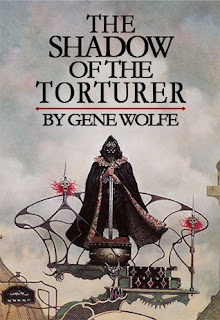
8. Gene Wolfe's Book of the New Sun. All twelve volumes of it. Yes, this is totally cheating. What are you going to do about it. I'm not afraid of you? Well, I might be afraid of you if you're Matt Wallace, but actually I had a drink with him once and found him very pleasant company, so there. Anyway, Wolfe's tightly written yet sprawling, maddeningly obtuse is-this-the-past-or-the-future-or-the-present-or-all-of-it science fiction/fantasy hybrid about an ordinary guy (who might be a god but then again might just be some schmo) who somehow winds up tasked with traveling across time and space to find the McGuffin That Will Reignite the Sun (and who also may or not be 1. Along for the ride on a generational spaceship in the form of a hollowed-out comet and 2. Living amongst the weird inhabitants of the dual planetary system to which that ship travels, which system might just actually be Earth/Urth depending on which theory) will no doubt keep me scratching my head and dropping my jaw for the rest of my life. I develop a different theory about what's going on every single time. And I promise I'll get back to the Suns Suns Suns post series soon. Because there is SO MUCH MORE I want to say about these books. Oh, and the above cover to the very first book, Shadow of the Torturer, is one of my favorite book covers of all time.
9. Clark Thomas Carlton's Prophets of the Ghost Ants. Is this one of the greatest works of speculative fiction of all time? Probably not. But this is my list, and of all the books I've ever read, this one feels the most like it was written just for me, and I love it. It's got insects galore (a key to my happiness, six-legged arthopods), a well-done, an admittedly kind of standard fantasy plot but with peculiar Dune-like grace notes that are all about individual vs collective choices and question very strongly the role of religion and received belief in any life that could remotely be called human ,well-realized and imaginative world-building, and did I mention insects? Ants, roaches, wasps, more ants, termites, beetles... you get the idea. True, I might get sick of it if I'm stuck on that desert island for decades, but you know that by then I'll be writing Antasy fan fiction on palm leaves in my own blood by then anyway.
10. Alastair Reynold's Century Rain. Reynolds is my favorite living science fiction author, as I have said many times on his blog. When it comes to one of his books, it's not a question of love or merely like (let alone dislike), but only of how intensely do I love. This story of a future archaeologist who has built a career on investigating the aftermath of a nanotech disaster that made Earth uninhabitable, and the weird planet-sized diorama of mid 20th century Earth that is discovered at the end of a wormhole in space is loaded with gorgeous details, eerie speculation, cosmic awe, factional tension and just plain awesomeness. I would prefer to just get to take all of my Reynolds with me, but if I had to pick just one, it would be this. Just because it's so pretty and jazzy and lovely and cool.
Honorable mentions, just because: Frank Herbert's Dune, Bruce Sterling's Distraction, Ken MacLeod's The Star Fraction, Hugh Howey's Wool Omnibus and Ramez Naam's Nexus.
Labels:
fantasy fiction,
favorites,
friendship,
memes,
science fiction,
the internet
Subscribe to:
Posts (Atom)


