"For a while there I wondered whether Jesus Christ is a gerontophile...""Excuse me?"..."Well you see Fidel, it's simple really... Nuns are supposed to be virgin spouses of Christ. They mostly spend their days in convents, untouched, so I assume they're waiting to finally join their husband and, I imagine, to consummate their marriage. Most of these devoted young women turn into withered hags by the time they manage to kick the bucket, you know, especially since they're not supposed to speed up the whole process much in any entertaining way anyway - I don't believe many of them take a lot of drugs or drink themselves to death very young, or die of cholesterol overdose... Anyway, once they finally get to shag the lord, the majority of them are, well, mature, even elderly, or bloody ancient, if we're completely honest. So you see since this suspicious arrangement had to be organized by our lord, and if he himself has decided this is how he wants it.."
More novels, whether or not they are chiefly concerned with the farings of a newly-formed progressive rock bands in a suburb of Ljubljana, Slovenia, should come with their own soundtrack album. Perhaps there are more than I know of, but until I stumbled across Cynicism Management: A Rock'N'Roll Fable while perusing the offerings at corona/samizdat (my new favorite indie press*), I only knew of one in all the world.** But now I know of two, or rather, three, because I see that the sequel to this madness has a soundtrack album of its own.***
This, of course, delights me. It would even if the album was not to my taste, or if it were but the novel was not. But in fact, I'm pretty delighted by both .
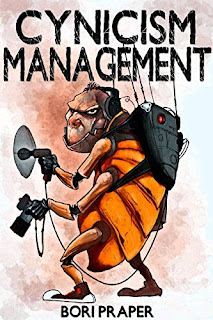
These are the friends I've always dreamed of having and I began to miss them mere moments after putting the book down: Finnegan Frotz, an "extraordinarily pale" Black Scotsman, the lyricist and main ideas man; Amalia, Scots vocalist, hostess, his on-again off-again lover; her brother Randy, bass player and weed connoisseur; Bogomr, a Ukrainian performance artist/exotic dancer/musician who has been raised to believe he is an actual vampire; Eric, an Australian heavy metal guitarist with an unhealthy fixation on his perpetually receding hairline; and Fidel, an Italian revolutionary by day, kickass prog drummer by night. I mean, come on!
But wait, there's more. Like a group of six women who have all turned up in a certain basement in London where they are employed to monitor feeds from various spy cameras installed in various toilets in various airport bathrooms around the world. And whose employer, the amusingly named Omnipile Industries, a multinational conglomerate so large and far-reaching that its in-house intelligence service has usurped the function of most governments' services, has suddenly sent them all to the Ljubljana suburb to observe the activities of one of Cynicism Management's members. He has a unique tattoo in his nether region that seems to offer the only clue anybody has found to the kidnapping of the children of Omnipile's CEO. Could be a coincidence, but nobody seems to think so.
By the way, the solution to the whole tattoo thing may be the single geekiest solution to any mystery that I have ever encountered in life or in fiction.
Incidentally, about midway through the novel the group of women acquires a thoroughly disrespectful but awesome nickname that I think I'd have enjoyed being called as a younger woman, myself: they are the Bitch Scouts. We never learn their actual names, by the way. They get unique and sometimes humorous personal designations (though one is simply referred to as Another One) but never names. But we don't miss them.
And of course this suburb of Ljubljana is populated by a host of fantastic tavern keepers, would-be-porn soundtrack composers, drunken firemen, pensioners, peasants, lunatics, picturesque trollops and a mayor on the make who can't stop spinning cockamamie economic development schemes that are probably doomed to fail, either entertainingly or depressingly, or both.
So, the resulting tale feels an awful lot like Laszlo Krasnohorkhai and Virginie Despentes decided to collaborate on... a thriller of sorts? Except kind of funny. Sometimes very funny.

The novel starts out a bit scatological -- the way the Bitch Scouts learn about the tattoo that kicks off this whole story is on the gross side but also on the paranoia-inducing -- and makes fun of alcoholism quite a lot (Superman Nap!), and commits many other sins against propriety in all the ways one would expect a so-called "Rock'N'Roll Fable" to commit, but never quite delivers up what we expect, except for equal parts of big, amazed laughs and thrown devil horns. And it's full of weird conversations like the one I quoted at the beginning of this post.
The result is the most sheer fun I've had in reading a novel/listening to an album than I have had in a long, long time. There is a sequel, Pendulum Pet, which I have already acquired on the strength of this one and you'd better believe you'll be hearing about it soon right here at Kate of Mind.
In the meantime, I've got a new album to put on obnoxious heavy rotation, chez moi. My housemates don't like I nearly as much as I do, but even they have to admit that a few of the songs are genuine bangers.
*Note, I originally tried to buy Cynicism Management from corona/samizdat and yes, you do have to wait for them to ship your copies to you from Slovenia but it's totally worth the wait and the shipping charge because they have some cool, cool stuff and publisher Rick Harsch is an excellent human (who is also a writer and you'd better believe you'll hear more about him here soon) BUT he was fresh out of paper copies of this so I had to look elsewhere to get its words into my eyeholes. Fortunately, ebook editions of it also exist and hey, if, like me, you've recently abandoned the Big River for less fashy climes, both Cynicism Management and its sequel, Pendulum Pet are not only available via Kobo but are part of its Kobo Plus subscription, so you can read them that way if you don't want to wait for corona-samizdat to get some more paper copies printed. But I still call dibs on a paper copy if one turns up, Mr. Harsch!
***Here's a link to the main soundtrack album, Tit Augmented over at the least shitty music streaming service I've found, but note: there is additional music featured in scenes from the book that isn't on this album because it's not by the band, but by another musician who is also a character in the novel, Ray Kosmick, who does some very cool electronic music that he (the character at least) intends for porn soundtracks but which I find are great listens just on their own. By the way, here is my very favorite track from Tit Augmented, just because:


