Showing posts with label corona samizdat. Show all posts

Friday, May 2, 2025

Rick Harsch's THE MANIFOLD DESTINY OF EDDIE VEGAS

Did you ever wonder what kind of books our culture would have to enjoy if, instead of ho-hum Europe, the Old World, James Joyce had spent his expat years in the United States? Specifically the western United States? Specifically specifically the years when this part of the world still mostly belonged to its indigenous inhabitants and there were no railroads or interstate highways or even JC Penneys? Which, sure, that means Joyce would have needed access to a time machine, but I'm already deep in the realm of counterfactual conjecture here, so, why not?

But so anyway, did you ever wonder that? Because I think I have the answer. So, did you? Wonder that? No?

Oh dear. 

Well, anyway, I want to tell you about Rick Harsch's The Manifold Destiny of Eddie Vegas, a book that I've already mentioned twice on this here blog, which I was insanely excited to read while awaiting my copy but, yes, also dreading a bit because it's another maximalist  chonk of a novel that is only available in print. Meaning yep, another On-Dead-Tree-Despite-The-Pain read for Your Humble Blogger.

I first learned of the existence of this novel, of author Rick Harsch, and of the cult publishing phenomenon, corona/samizdat, when I saw a few BookTube videos about Philip Freedenberg's and Jeff Walton's America and the Cult of the Cactus Boots: A Diagnostic, which, on the most pathetic level of reality at least, is about what happens to a writer and illustrator while they are waiting for a copy of The Manifold Destiny of Eddie Vegas to get shipped to them from faraway Slovenia.

Which means I was expecting another heavy dose of crazy, extremely post-modern meta-fictional shenanigans. But that's not quite what I got.

Not that I am in any way disappointed by what I did get. Far from it!
Because this is not the quintessential American experience, for that is too grand a theme. This perhaps is the quintessential endangered American experience. Canada, Mexico, the entire south - that will define the American experience over time. This will all be seen as excrescence, rude corruption of being hyper-aware, vapid, utterly disconnected from enduring life. This America, this United States of, has been making last stands from the beginning, practicing the last stand until they get it right and finally can indeed stand for the last time. No, this scene here, this man and his undershirt oiling his gun before a silent television, this scene has nearly been perfected to extinction.
The Manifold Destiny of Eddie Vegas is a much more conventional narrative, more in the vein of, say, Cryptonomicon than of America and the Cult of the Cactus Boots or any of the other, weirder fare I tend to favor. Like Cryptonomicon, the narrative is more or less divided into two sections, taking place in different eras of history. We get a lot of background on some of one of our main characters' ancestors, who had colorful and thrilling adventures in the USA's frontier/Old West period (and one of whom was an Indigenous woman) in one narrative, while the other traces that character's, Donnie Garvin's, travels with his brand-new best friend, Drake Fondling, in early 21st century Europe and the United States, while also following a bit of Donnie's father's efforts to catch up with the duo. And since a decent amount of the novel takes place in and around good old Las Vegas, there's also more than a little bit of a more grounded/mundane Last Call here, too.

There now, I've mentioned two of my favorite, most fun reads of all time, so that must mean that Eddie Vegas* is fun, too, right? Well, yes and no. As I said, the narrative is pretty straightforward, even mundane, for all that at one point one of Eddie's ancestors gets lifted into the air and bodily flung at a grizzly bear, whether as a weapon or as a distraction doesn't really matter, and somehow survives to become one of Eddie's ancestors. But what one really reads this novel, and, I suspect, most of Harsch's work for, is the over-the-top wordplay. I have a lot of examples of this, and the text includes several lists that other reviewers have correctly categorized as "Rabelasian", but here are some passages that I marked with my little book darts (one of the pleasures I'd almost forgotten of reading a physical book that I own is using these cunning little tools) and then more or less just flipped to at random.
For instance, raw recruits looked at him and thought "Sure is rough out thar"; Douglas Stompett, Chief Factor and father figure for future factoti for a fee (fie!) (Foe of fumblers) and Friends of the Hudson's Bay Company...
And
On the walls of the spaces where the politics of his parents and their friends were diminished by upright plastered scorn were thematic reproductions, a Chinese room, a surrealist room, an impressionist room -- What of a childhood that renders Dali trite? a Dalit rite? a trolley ride, a trollop's rights, a flop all right, a polite oversight, a maggot white, a dollop bright, a scallop of shite, a pallette of, a mallet of... on the fucking head...
And
The Sick Man of Europe was such a healthy metaphor, diseased body parts still being sold off a century later, the moribund fellow fascinating in his decrepitude, shrinking as they do like healthy verdure under a too intense dry sun, the regimen of the new model of health was ignored until it was too late, the doctors all gone psychotic like any Freudian subject over-thrilled with the death of the other.
That last passage is from a whole chapter of profoundly insightful musings Harsch attributes to the character of Ethel Gravel, another of Eddie's formidable female forebears (I couldn't resist), a woman of profound historical imagination whom one might fear is going to waste in a still-backwater-ish Reno, Nevada of the early 20th century, but whose business acumen, general intelligence and indomitable will have assured her descendants' the kind of start in life that will allow sons to become dilettante scribes and professors who marry improbably named poets and have children whose own potential seems poised to be harnessed to ridiculous business ventures by heirs to mercenary company fortunes and oh, you just have to read this book to see all of the unlikely but compelling goings on. I haven't even begun to describe the compelling small figure of Nordgaard, or of Setif, or of Hermione, or of...

But as this all comes to an end, what The Manifold Destiny of Eddie Vegas is really about is just plain old love, especially that between a son and a father, against whose relationship the entire world has seemed to conspire but who have chosen to care about each other anyway, to share their thoughts and feelings in the least toxic example of masculinity I've encountered in this sort-of-genre of maximalist "Brodernism." Even if the hundreds of pages preceding the novel's satisfying denouement weren't as entertaining as they are, it would all be worth it just to enjoy this at the end. Bravo, Mr. Harsch. I'm already looking forward to my next read from you.

*Eddie Vegas is the name a character assumes in the novel, but we don't know which character takes on this alias until about halfway through. This adds the pleasing note of ambiguity that perfects many a book, in my opinion.

Sunday, March 30, 2025

Phillip Freedenberg's and Jeff Walton's AMERICA AND THE CULT OF THE CACTUS BOOTS: A DIAGNOSTIC

I have a very special category on my reading tracker app which I call "On Dead Tree Despite the Pain," which, if I have actually finished a book, actually says more about my regard for said book than, say, whether I've managed to write about it here at Kate of Mind. I was not only interested enough in the book to start it despite the pain I knew it would cause me (long time readers of this here blog know that physical "on dead tree" books are extremely uncomfortable for me to read and trade paperbacks are the worst of all), which I only undertake if there's no other option, but also so engaged by said book that I actually suffered its physical effects just to completely experience it at first hand. 

I'm undertaking a modified "read what you own" type challenge*, and have acquired over the last many years a pretty significant stack of books that I really really really want to read but are either only available on dead tree or are unreasonably priced in digital or audio editions (charging more for an ebook than for a new copy in hardcover or paperback will never be ok), so you're going to see quite a few of these in the next few months.

America and the Cult of the Cactus Boots: A Diagnostic is a relatively recent acquisition for me, but the very idea of this book and the buzz around it in my very favorite weirdo literary corners of the internet meant that of all the physical books that I'm ready with which to torture myself, this was the one that most elicited cries of "hurt me, daddy" from my imaginal lips. 

I mean, look at it, for a start. And this is just the front cover, mind.

America and the Cult of the Cactus Boots: A Diagnostic is going to be a very difficult book to talk about because very difficult to do justice to, but it's a book that simply must be discussed at enthusiastic, bewildered, what-the-fuck, best medicine on paper lengths. 

Especially in year one of The Re-Trumpening Muskification, aka the Enshittification of the country about which this novel chiefly concerns itself. 

We learn from the jacket copy that it was written in the last year of our first overtly felonious POTUS' first term, while we all anxiously hoped and waited and worked to get the felon the hell out of there and as we ultimately succeeded (more or less), but the time it now feels like America and the Cult of the Cactus Boots is most needed for is right now.

At least until something even worse happens. 


And look; while this is ultimately a therapeutic and a hopeful read, the fact that this book exists in any form also makes me a little nervous, because the current regime could take some mighty terrible ideas from its pages, if they can persuade anybody with enough smarts and soul to understand it to explain it to them. Like the Total Information Control Initiative, which not only seeks to completely eliminate the written word from humanity's present and future (and even its past inasmuchas once the written word is successfully eliminated, so is most of our collective memory), but has a truly diabolical means of doing so that tells Ray Bradbury's Firemen to not so much hold its beer as go on permanent furlough the better to cross the entire supercontinent of the Americas on foot to fetch a whole new kind of beverage the likes of which do not exist as yet. By which I mean the whole enterprise of destroying books and printing presses and whatnot is not nearly the priority our reading lives have led us to prepare for. Instead, the TICI promulgates a high tech electro-psychotropic screen that the user straps on right over the face, a device so entertaining and so pleasurable to use that nobody (or almost nobody) really needs to be forced to prefer it to reading or possibly even speaking. Supplied free of charge, it is, of course, also subject to constant tinkering and updates to ratchet up its addictive properties and its ability to spy on and later replace the contents of the users' very minds.

I mean, Fuuuuuuuuuuuuuuuuuuuuuuck. Neurolink, everyone?

Never mind that, kind of like Roko's Basilisk, there's not actually any guarantee that such a thing is even possible given stuff like resource availability and the universe's tendency toward entropy and sheer individual human cussedness and the actual feasibility of getting everybody to always react to the same thing in the same way in a world where, for example, people can have paradoxical reactions to medications and some people are actually repelled by sex and some people are genetically disposed to perceive cilantro as tasting like soap ...

Which, of course, is how, within the world of AatCotCB, at least on its Most Pathetic Level of Reality, there are still some dissidents here and there who cling to their books and underground newspapers and shampoo bottles to read on the toilet, including the novel's dual heroes, Phillip Freedenberg and Jeff Walton, who yes, happen to be the metafictional avatars of the author and visualizer/illustrator of this book. On the Most Pathetic Level of this book's Reality, they are employed at a Buffalo, NY print/lithography shop and have, as the story begins, just recently completed a large order of high quality protest signs that demand we all MAKE AMERICA READ AGAIN and seem destined to reap some terrible consequences at the hands of U.S. President RALPH's new Total Information Control Initiative, rumored even now to be approaching their building. 

While this and related tasks had been ongoing, the pair have been eagerly awaiting the arrival from faraway Slovenia (yes, this is more corona/samizdattery) of a novel by Rick Harsch entitled The Manifold Destiny of Eddie Vegas** an actual book in our own world which, at the time of AatCotCB's writing, could only be acquired by emailing the author, one Rick Harsch, sending him the price and shipping costs via an Internet payment service, and then sitting back and waiting for the author (who is also corona-samizdat's publisher, warehouse manager and shipping clerk) to send the book from Izola, Slovenia to your own dear personal mailing address.

While they waited, they were inspired to begin writing and illustrating AatCotCB, which Harsch had already expressed willingness to publish, both in our real world and in the novel's MPLoR.
But so, even as the pair have begun to conceive of this work, it is already bursting into this work and into their world, sometimes in relatively tame ways like their sudden discovery in the attic of their shop a cool antique radio by which they can occasionally receive "Messages from the Great Beyond," more mundanely regarded as weird bursts of very targeted shortwave radio transmissions from none other than the author of the book they're waiting for and who has already agreed to publish AatCotCB, Harsch, who seems eeriely omniscient about their predicament and eager to warn them not only of the imminent approach of the Total Information Control Initiative but also of the presence, just outside their office door, of a full camera crew preparing to shoot the opening scenes of the film adaptation of AatCotCB.

And then the book starts getting weird

Like descriptions of competitive clothes ironing as extreme sport weird. Like a giant, near-infinite information processing network constructed on and between the brains of a vast herd of cattle (unknown whether dairy or beef cattle) living in a vast underground facility in the Midwest weird. Like one of the character's two hands disappearing from his body and much later being found, the hands, living independently and working as a park ranger in Alaska weird. Just a pair of youngish male human hands giving you directions and cleaning the latrines and telling you not to pet the grizzly bears. Ho hum.

And there are illustrations. Glorious, glorious illustrations from the demented genius mind and hand of Jeff Walton, who combines the painstaking, detailed realism of a scientific illustrator with his deep insights into the imagination of his longtime friend, author Phillip Freedenberg and a powerful sense of psychedelic whimsy to create the kind of works that belong, in poster form, on every college kid's dorm room wall and many of which would make utterly amazing tattoos if you could find an artist who could do them justice without taking psychic damage. 

And hey, you ergodic literature fans, you freaks pining for a new House of Leaves-style bibliographic experience, AatCotCB has you covered. See, Phillip and Jeff and sometimes a cute little homunculus of Rick Harsch wind up traveling through the "word tunnels" of AatCotCB, The Manifold Destiny of Eddie Vegas, and an unfinished novel Freedenberg started writing some 20 years ago, and the reader must really on subtle textual clues to determine in which book's lines through which they are currently moving or, occasionally, being chased. And one form of attack they occasionally experience takes the form of a "word fever" in which Phillip begins spouting lines and lines and sometimes pages and pages of surreal... I almost want to call it word salad but it's kind of... word salad that hasn't been tossed yet? So it's got defined layers and just enough hints of connection and is still formed into grammatical units that function like sentences and sometimes even seem to be carrying actual meaning but then seem to collapse into incoherence again and start to feel skippable, but Freedenberg has an uncanny sense for how much patience his readers are bringing to the exercise of reading his word fever symptoms and drops in a few lines that actually communicate something right there to keep one going. 

Or at least it seemed that way to me.

Oh, and there are constant other textual tricks that tempt the reader to page back, sometimes hundreds is pages, to reinterpret a scene, image or illustration, which will be great fun for some and really annoying to others. I thought it was fun, mostly. 

But none of this I've said so far adequately conveys the truly tonic effect of this work. It's not just a celebration of creativity but a cry out for it as one of the only things that can save is from "gestures at everything" and the despair to which the everything counts on us succumbing. The whole reason this book exists is to join up its readers in a Unified Field of free thinking, weirdness for its own sake, and the will to create something new, even if it sucks. Maybe especially if it sucks? These seem like very warm-hearted and forgiving guys, the kind of guys who would work extra hard to find something to praise, some way to encourage the creator of, even the most pedestrian work of fiction/drawing/bit of music/piece of fiber art/whatever as long as it was sincerely offered.

The world needs much more of these guys, and much more from them. But, as we got hung up on saying to each other during my very first personal experiment with psychedelics, "You can do it, too. It's not a show!"

Bring it, my darlings. And yes, that includes you, Phill, Jeff, Rick... Actually, Rick is good. I mean, he's even published a cookbook recently.

*I'm making exceptions for things I've previously requested from my public library that, all but at random from my perspective, suddenly come available, and also for a bunch of books I've been longing to read for years that are available via Kobo+ and are thus suddenly within my budget. But otherwise, it's a stack of trade paperbacks sitting in my reading room and the contents of the ebook reader that shall no longer be named. And believe me, there are years and years worth of TBR on there. The story bundles alone are staggering.

**Which is next on my list of books I'll be reading on dead tree despite the pain, so stay tuned. It will be my first Rick Harsch book. I hope it's as delightful as he is.

Monday, March 17, 2025

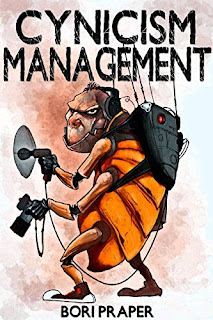
Bori Praper's CYNICISM MANAGEMENT: A ROCK'N'ROLL FABLE

"For a while there I wondered whether Jesus Christ is a gerontophile..."
"Excuse me?"...
"Well you see Fidel, it's simple really... Nuns are supposed to be virgin spouses of Christ. They mostly spend their days in convents, untouched, so I assume they're waiting to finally join their husband and, I imagine, to consummate their marriage. Most of these devoted young women turn into withered hags by the time they manage to kick the bucket, you know, especially since they're not supposed to speed up the whole process much in any entertaining way anyway - I don't believe many of them take a lot of drugs or drink themselves to death very young, or die of cholesterol overdose... Anyway, once they finally get to shag the lord, the majority of them are, well, mature, even elderly, or bloody ancient, if we're completely honest. So you see since this suspicious arrangement had to be organized by our lord, and if he himself has decided this is how he wants it.."
More novels, whether or not they are chiefly concerned with the farings of a newly-formed progressive rock bands in a suburb of Ljubljana, Slovenia, should come with their own soundtrack album. Perhaps there are more than I know of, but until I stumbled across Cynicism Management: A Rock'N'Roll Fable while perusing the offerings at corona/samizdat (my new favorite indie press*), I only knew of one in all the world.** But now I know of two, or rather, three, because I see that the sequel to this madness has a soundtrack album of its own.***

This, of course, delights me. It would even if the album was not to my taste, or if it were but the novel was not. But in fact, I'm pretty delighted by both .

Cynicism Management is the name of a fictional-yet-also actual band comprised of a motley international crew of ridiculously talented but as yet not-very-successful musicians with high standards for themselves and each other, a taste for rather baroque time signatures and somewhat outmoded instrumentation (an early and only slightly heated discussion among the members concerns the practicality of acquiring and incorporating a Hammond organ, for instance) but a punk/metal sensibility and somewhat revolutionary politics. 

These are the friends I've always dreamed of having and I began to miss them mere moments after putting the book down: Finnegan Frotz, an "extraordinarily pale" Black Scotsman, the lyricist and main ideas man; Amalia, Scots vocalist, hostess, his on-again off-again lover; her brother Randy, bass player and weed connoisseur; Bogomr, a Ukrainian performance artist/exotic dancer/musician who has been raised to believe he is an actual vampire; Eric, an Australian heavy metal guitarist with an unhealthy fixation on his perpetually receding hairline; and Fidel, an Italian revolutionary by day,  kickass prog drummer by night. I mean, come on!

But wait, there's more. Like a group of six women who have all turned up in a certain basement in London where they are employed to monitor feeds from various spy cameras installed in various toilets in various airport bathrooms around the world. And whose employer, the amusingly named Omnipile Industries, a multinational conglomerate so large and far-reaching that its in-house intelligence service has usurped the function of most governments' services, has suddenly sent them all to the Ljubljana suburb to observe the activities of one of Cynicism Management's members. He has a unique tattoo in his nether region that seems to offer the only clue anybody has found to the kidnapping of the children of Omnipile's CEO. Could be a coincidence, but nobody seems to think so.

By the way, the solution to the whole tattoo thing may be the single geekiest solution to any mystery that I have ever encountered in life or in fiction.

Incidentally, about midway through the novel the group of women acquires a thoroughly disrespectful but awesome nickname that I think I'd have enjoyed being called as a younger woman, myself: they are the Bitch Scouts. We never learn their actual names, by the way. They get unique and sometimes humorous personal designations (though one is simply referred to as Another One) but never names. But we don't miss them.

And of course this suburb of Ljubljana is populated by a host of fantastic tavern keepers, would-be-porn soundtrack composers, drunken firemen, pensioners, peasants, lunatics, picturesque trollops and a mayor on the make who can't stop spinning cockamamie economic development schemes that are probably doomed to fail, either entertainingly or depressingly, or both.

So, the resulting tale feels an awful lot like Laszlo Krasnohorkhai and Virginie Despentes decided to collaborate on... a thriller of sorts? Except kind of funny. Sometimes very funny.

The novel starts out a bit scatological -- the way the Bitch Scouts learn about the tattoo that kicks off this whole story is on the gross side but also on the paranoia-inducing -- and makes fun of alcoholism quite a lot (Superman Nap!), and commits many other sins against propriety in all the ways one would expect a so-called "Rock'N'Roll Fable" to commit, but never quite delivers up what we expect, except for equal parts of big, amazed laughs and thrown devil horns. And it's full of weird conversations like the one I quoted at the beginning of this post.

The result is the most sheer fun I've had in reading a novel/listening to an album than I have had in a long, long time. There is a sequel, Pendulum Pet, which I have already acquired on the strength of this one and you'd better believe you'll be hearing about it soon right here at Kate of Mind.

In the meantime, I've got a new album to put on obnoxious heavy rotation, chez moi. My housemates don't like I nearly as much as I do, but even they have to admit that a few of the songs are genuine bangers.

*Note, I originally tried to buy Cynicism Management from corona/samizdat and yes, you do have to wait for them to ship your copies to you from Slovenia but it's totally worth the wait and the shipping charge because they have some cool, cool stuff and publisher Rick Harsch is an excellent human (who is also a writer and you'd better believe you'll hear more about him here soon) BUT he was fresh out of paper copies of this so I had to look elsewhere to get its words into my eyeholes. Fortunately, ebook editions of it also exist and hey, if, like me, you've recently abandoned the Big River for less fashy climes, both Cynicism Management and its sequel, Pendulum Pet are not only available via Kobo but are part of its Kobo Plus subscription, so you can read them that way if you don't want to wait for corona-samizdat to get some more paper copies printed. But I still call dibs on a paper copy if one turns up, Mr. Harsch!

**That one, in case you're interested, is Eating Eight by Lars Paul Linden, a cyberpunk-ish romp about a book -- or actually a comic book script-and-cassette tape combo referred to as a "book-dope-book" that gets you high when you read it. The soundtrack really did come on cassette, featuring music from Linden's band, Penis Fly Trap. It was my honor and joy to receive review copies of these back in the day when I was an occasional scribbler in an underground music and politics 'zine, The Pit Report. Back in the 1990s when I lived in Boston. But rest assured, dear readers, I wasn't cool then, either. But I knew some cool people and got to do some cool things like get high on book-dope-books.

***Here's a link to the main soundtrack album, Tit Augmented over at the least shitty music streaming service I've found, but note: there is additional music featured in scenes from the book that isn't on this album because it's not by the band, but by another musician who is also a character in the novel, Ray Kosmick, who does some very cool electronic music that he (the character at least) intends for porn soundtracks but which I find are great listens just on their own. By the way, here is my very favorite track from Tit Augmented, just because: