Showing posts with label entertaining non-fiction. Show all posts

Wednesday, July 2, 2025

Andy Sharp's THE ENGLISH HERETIC COLLECTION: RITUAL HISTORIES, MAGICKAL GEOGRAPHY

Can we use film geographies to create cultural maps across a slice of time?
A long, long time ago when I first became concerned that all I ever seemed to read or watch was fiction, I made a particular effort to start adding more non-fiction to my cultural diet, went to the University of Wyoming's Coe Library (from which you could check out any number of books for a whole semester), and grabbed a big stack of stuff. One of which was Simon Schama's then-brand-new Landscape and Memory, a book that in many ways changed my life. Among other things, it led me to concoct, sometime later, one of my odder blog posts about how I personally had imagined the landmarks and locations of The Lord of the Rings when I was a kid.

Landscape and Memory is just that kind of read. But it's one that is almost sui generis; it wasn't until I discovered* W.G.Sebald and especially Rings of Saturn that I found anything to compare. 

Now I've found a third such project, a book that sums up a unique artist's strange and fascinating and definitely Ballardian (he even references Simon Sellars!**) oeuvre, English Heretic. A project that seems to have been aimed specifically at my little head but about which I'd been totally unaware until somehow I learned about Andy Sharp and The English Heretic Collection: Ritual Histories, Magickal Geography.***

Imagined in direct opposition to English Heritage and all it stands for, Andy Sharp describes his English Heretic project as a way to "use place as a means of fecundating the imagination." The resulting book is a survey of decades' worth of incredible creativity and energy, rendered in very serviceable prose, with lots of astonishing little insights popping up like graveyard ghouls from a cemetery that's older than my entire country.

As the quote I used to start this post indicates, a lot of Sharp's work begins and ends with film locations and sets, especially those appearing in the low-budget esoterica of the 1970s folk horror masterpieces he loves (many of which can be enjoyed via YouTube or Tubi as of this writing), like Witchfinder General or The Blood on Satan's Claw or The Shout or The Living Dead at Manchester Morgue, aka Let Sleeping Corpses Lie. I have seen precisely none of these films, but I'm looking forward to doing something about that soon. Judging from the trailers, I'm in for a pretty good time!

Anyway, a discussion of the latter film yields exceptional fun: The filming of Living Dead took place partly at a somewhat famous church, Hathersage in Derbyshire, and was interrupted by a coach load of tourists who "on witnessing the zombie orgies informed the authorities." The film crew had been working and camping it there for three days without official permission, of course. By the way:

The tourist party had come to Hathersage to view Little John's grave which takes up seven feet of the burial ground. Little John is the church's most famous inhabitant. I'd like to imagine Little John's reanimated corpse joining forces with Guthrie**** and his undead merry men to reap anthropophagic revenge on the do-gooding snitchers of Hathersage.
Sharp goes on to connect elements of the film's plot with actual local folklore, but leaves us to speculate whether the filmmakers were consciously aware of that folklore when making the movie. I mean, it's way more fun that way, right?

One location I can't believe Sharp didn't write about in any of these projects of his, is Winspit Quarry, though. You may think you don't know this place, but, friends, if you've ever watched much of the original Doctor Who series, you've likely spent rather a lot of time looking at it: it's that quarry Privately owned but publicly accessible at your own risk, this has to be one of the most haunted locations on the Sceptered Isle. It's stood in for so many alien planets, you guys. The psychic ghosts of so many rubber-bodied aliens are stalking it. And it's not like Andy Sharp doesn't know his Doctor Who or his Blake's Seven or anything. But maybe this is simply too famous a location for him.

Sharp isn't only concerned with films, though; another major cultural touchstone for this work is most of my very favorite psychologist, James Hillman's, later works after he developed his "acorn" theory of personality development, which I first encountered in a book he collaborated on with Michael Ventura, We've Had a Hundred Years of Psychotheraphy and the World is Getting Worse.***** The personality at its youngest and least developed is Hillman's acorn, which is tiny and nut-shaped but contains within it the potential to grow into a vast and branching oak tree; as it becomes a sapling it develops "nubs" which Hillman views as behavioral and obsessional interests that hint at the personality's mature form, destiny and role in the world. Sometimes, as with, say, Winston Churchill, Hillman sees these nubs in a kind of negative, as when he considers Churchill's childhood stammer as a kind of fear or intimidation of the promptings his soul was giving him that prefigured that one day he would have to save the world by his speech. I believe Hillman went further with this notion in a book of his that I still haven't read but which turned out to be his most popular, The Soul's Code.

Anyway, Sharp calls on Hillman and his acorn theory as he contemplates personalities as diverse as Aleister Crowley, J.G. Ballard and Max Ernst, all viewed through the lens of place. He particularly goes to town on Ballard, whose fractally fascinating life as a child in a Japanese prison camp, an avant-garde writer of incredible science fiction short stories and a single father who only really got weird with it after his wife's untimely death left him raising four children a stone's throw away from a major film studio.

Of course Sharp is most interested in Crash, though The Unlimited Dream Company and The Atrocity Exhibition get plenty of attention, too. But it's Crash and its unforgettable character of Vaughan who really haunts English Heretic, as a fictional subject of Sharp's "Black Plaque" project, again, in direct mockery of English Heretic's plaques concerning the doings of various celebrated English people in various English places.

Sharp likes the nastier sort of person, of course. Don't we all?

At the rate I'm going, all but homebound on the high plains of the western U.S., I'm never going to get to visit the U.K., will never see any of these places with my own failing eyes. Thank Yog that people like Andy Sharp and Simon Schama are writing the next best thing to being there, books like English Heretic.

*Thanks to my late, lamented friend Lethe Bashar, aka Chris al-Aswad.
**IYKYK
***And no, I don't remember how I found out about this book, and it's driving me crazy. I've interrogated my usual suspects and nobody's owning up. So maybe Andy Sharp has just been beaming this book at my bean since 2020 and my skull is just too thick -- I do famously have incredibly dense bones, like freaking Wolverine -- to have admitted the signal right away. Or something.
****Guthrie played a drowning victim who spends the film as a soaking wet "submarine zombie."
***** A book which I cannot recommend highly enough, old as it is. Hillman and Ventura bounce off each other beautifully, and pushed each other into a lot of wild ideas that the rest of our culture is still catching up with.

Wednesday, January 26, 2022

Rebecca Solnit's ORWELL'S ROSES

Thinking about Orwell's roses and where they led was a meandering process and perhaps a rhizomatic one, to deploy a word that describes plants such as strawberries that send out roots or runners to spread in many directions. The word was adopted by the philosophers Gilles Deleuze and Felix Guattari to describe a decentralized or nonhierarchical model of knowledge. "Any point of a rhizome can be connected to anything other, and must be," they declared. "This is very different from the tree or root which plots a point, fixes an order."

The above passage from Rebecca Solnit's Orwell's Roses could serve as a thesis statement for the book as a whole, for while I've seen this book described as a sort of biography of George Orwell, it's really only a tiny bit that, as I'll discuss below. 

Eric Blair, aka George Orwell, is a foundational writer for me, for all that the only fiction of his that I had ever read until unusually late in life for a lit major was Animal Farm*. For me, what I've always loved him for the most has been his essays, many of which I can quote almost word for word. I've enjoyed pseudo-biographies of him before, especially Emma Larkin's hyper-focused and fascinating Finding George Orwell in Burma, which does just what it says on the tin: locates important experiences and settings from Orwell's well-known years as a member of the British government's Indian Imperial Force as inspirations for a lot more of his work than just his first novel. Among its more interesting insights came from Larkin's conversation with a local on a visit to what is now Myanmar in which at first her conversation partner didn't know who she was talking about when she mentioned Orwell by either his pen or actual names, but then realized she was talking about "the prophet."

Orwell's name is on every tongue in this dumb century of ours, usually as a shorthand way of demonizing one's political opponents. Wearing masks to contain the spread of a killer virus is somehow Orwellian (though I really doubt he'd agree). Insisting that counterfactual insanity is still somehow true despite mountains of actual evidence that the crowd wasn't that big, and that your guy is in photographs with Jeff and Ghislaine, too, is Orwellian. Vaccine requirements are Orwellian? People wishing it was maybe a little harder for unhinged teenagers or mentally ill spouse-abusers to get access to automatic weapons is Orwellian? Insisting that you can't trust anything you hear in the press is pretty Orwellian. Orwellian, Orwellian, Orwellian.**

So while I still think everybody who uses his pen name in vain should have to read Larkin's book if not re-read Orwell directly***, it's a pretty interesting time for something like Orwell's Roses to make an appearance.

Right as I started reading it, I was brought back to one of my favorite reads from last year (you know, 2020 And Some Months), Dean King's Patrick O'Brian: A Life Revealed, a biography of another of my favorite writers of all time that focused quite a lot on O'Brian's cozy-sounding yet strenuously laborious domestic arrangements over the years. Here, too, quite a lot of attention is paid to its subject writer's housing, focusing on his house in Wallington, Hertfordshire, England, where he lived from 1936 to 1940 when he wasn't off at the Spanish Civil War, and where he planted the roses that first captured Solni'ts imagination.

Even more attention, though, is paid to what it means to plant roses in the first place, and Orwell's Roses turns into something much more interesting than another Orwell biography could be; Solnit has let her curiosity, her knowledge and her understanding of the writer's life, the life of the politically aware, and of what industrialization has done to all life on earth, lead her to all sorts of interesting ideas and connections between the man and his roses -- and each of us. The result is a book that makes me think of W.G. Sebald more than of anyone else, except Solnit isn't content to just show us fragments; she wants to pull them together into something, if not whole, at least whole enough for us to see how the fragments might fit together, and how there might be more than one way to fit them. This is pure black magic to me, making Orwell's Roses the best example of "the kind of book I wish I could write" that I've yet found.

Orwell's Roses take Solnit to some unexpected places, such as Bogota, Columbia, a city that is now surrounded by vast greenhouses and the infrastructure to process, package and ship their sole product: scentless, immature roses on an industrial scale, destined for supermarkets, airport booths and florist's shops in the United States. The roses we give one another for Valentine's Day and Mother's Day to celebrate love and beauty are grown by overworked, underpaid, exploited workers in their thousands, who are, Solnit discovers, made into walking billboards for Orwellian slogans by the text printed on their coveralls: "Effort and passion make us feel satisfied in our work", "The attitude depends on you. The rest we want you to learn here" are some choice examples, printed in Spanish on the actual garments, of course.

And, while she doesn't travel there, her musings also lead her to Russia and the Soviet Union under Stalin, and especially to the stories of Nikolai Vavilov and Trofim Lysenko, respectively the pioneering geneticist who strove to save the world from hunger through slow and careful plant breeding and seed saving, and the Lamarckian pseudoscientist who convinced Stalin that all that plodding around with the scientific method was a waste of time and they could fake it until they made it when it came to improving crops and crop yields, which lead to years of famine and death while Stalin bragged about how well his plans were working and even famously exported grain while the people growing it starved.

But it's not just to the grim in Orwell's world or ours that Solnit points us; the man, Eric Blair, had a great love for the simple beauty of the mundane, the close at hand, the homely, and especially the English -- the countryside, the junk shops, the soil in which so much could be grown that he and his first wife, Eileen, could often feed themselves from their garden, and Solnit celebrates this side of Orwell and of life right alongside his and her accounts of his experiences in miserable coal mines, on the battle fronts in the Spanish Civil War, and suffering in tuberculosis wards as his hard, active, risk-taking way of life caught up with him and took him young. 

The result is a book that I didn't expect but also didn't know I needed: a good beginning for what's sure to be another Orwellian year. 

*A first American edition of which is still one of my most cherished possessions, one of those things they'll have to pry from my cold dead fingers.

**Late in the book one of Solnit's companions in travel and exploration for the book wonderis "whether the word Orwellian should perhaps mean something other than ominous, corrupt, sinister, deceitful, a hypocrisy or dishonesty so destructive that it is an assault on truth and thought and rights" because Orwell, the actual man, was as concerned with beauty and pleasure (Solnit embarked on a re-reading of 1984 for this project and found, to her surprise that even in his totalitarian horror story there is beauty and pleasure throughout, for Winston's entire rebellion is an effort to hold on to these, and one can't depict something being clutched at without describing what is being clutched) as with brutality and deceit, but they ultimately conclude that Orwellian has become too useful a word, and too embedded in our culture, to try to change now.

***Except even back when Animal Farm first appeared, to say nothing of 1984, right-wingers were already misunderstanding the point so hard that Orwell felt he had to issue a declaration more or less from his deathbed that no, dummies, "My novel Nineteen Eighty-Four is notintended as an attack on socialism, or on the British Labour party, but as a show-up of the perversions to which a centralized economy is liable, and which have already been partly realized in Communism and fascism."

Thursday, January 20, 2022

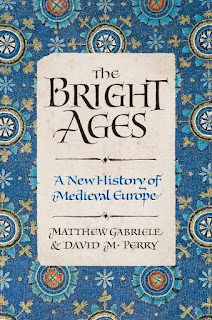
David M. Perry's and Matthew Gabriele's THE BRIGHT AGES: A NEW HISTORY OF MEDIEVAL EUROPE

"It's always the historian's job to say 'it's more complicated than that.'

Lots of pixels are already being spilled on behalf of and about this book by people better acquainted with its subject matter than I, so I'm just going to focus on the sheer enjoyment and the new thoughts that The Bright Ages: A New History of Medieval Europe gave me during my brief turn with our public library's copy -- brief not only because I was enjoying it and so tore through it with my usual voraciousness, but also because I knew a lot of other people were waiting for it (shakes fist at Libby app). I hope it gets very widely read after I'm done. 

Like Dan Carlin likes to say, I'm a fan of history rather than a student of it, and I'm such a wretched fan that I didn't know that my previous favorite history book about the period covered by David M. Perry and Matthew Gabriele was not in favor until I looked at some reviews of it prior to writing this post. I don't even recall how I got my hands on William Manchester's A World Lit Only By Fire: The Medieval Mind and the Renaissance, but once I did, I didn't let it go for years.* I read it so many times that lines or sometimes whole passages from it intruded on my thoughts when I was reading historical fiction. William Manchester lived rent-free in my head as I first read the great Dorothy Dunnett, for instance.

I think he was maybe squatting a bit in Perry's and Gabriele's heads, too, though; I didn't think of his book at all while reading this until a sly little reference to its title showed up in The Bright Ages. It comes about halfway through, in the midst of a discussion of gothic church architecture and how its system of buttresses and other tricks allowed for walls composed as much of beautiful stained glass as of stone:

In a world made of wood, stone impressed; but for a world before electricity, more important was light. This wasn't a world lit only by fire, but more important, one illuminated by the sun. Allowing that sunlight inside, allowing an interior to gleam, was to capture something of the divine. So heavy stone walls were replaced by translucent and radiant colored glass.**

Underlining mine; italics theirs.

Really, that passage is a thesis statement for this whole book. The period between the canonical Fall of the Roman Empire (but Philip K. Dick taught me that The Empire Never Ended...) and the start of the Renaissance is still most commonly described by the loaded phrase "The Dark Ages" but culturally, intellectually, politically, materially, that period of time was no darker than our own in a lot of key respects. In the literal terms the quoted passage begs us to consider, for example, the sun shone for the same number of hours per day as it does now (and through much cleaner air); it was only at nighttime or deep indoors in windowless rooms that the visible world shrank down to what could be lit by a flame.

And if one zooms back camera (and yes, I'm totally thinking of Alejandro Jodorowsky's last line in The Holy Mountain, here) and takes in all of the then-known world, civilization and all of the ideas and traits we associate with it wasn't suddenly extinguished when Alaric sacked the city of Rome; rather, like a balloon a bunch of kids take turns batting around a room to keep it from touching the carpet, its light was passed from place to place via trade and the travels of scholars and pilgrims and on the backs of war horses and yes, even in the minds of "ignorant" tribesman types gawking at the aqueducts and roads left behind by the classical Roman empire.

And the idea of Rome didn't die, either; people like Galla Placidia, daughter of one Roman Emperor, wife of another (and before that of a Visigothic king) and mother to yet another, never thought of herself as anything but Roman even though she had witnessed the famous sack and led a tumultuous existence that could make anyone agree with Gandhi that Western Civilization was something they should maybe try sometime. Following her the rulers of the Byzantine Empire called themselves Romans and still had chariot races (boy did they have chariot races) and adopted laws and customs from the classical empire even as they embraced this newfangled Christianity. And the idea persisted in some ways even until the Hapsburgs presided over something that by axiom was neither Holy, nor Roman, nor an Empire, except they themselves might have disputed it when they weren't busy keeping their subject kingdoms from trying to destroy each other and engendering cultural conflicts that are still affecting us even in this stupid 21st century that convinces me more every day that a whole lot of people who desperately cling to the idea that the Dark Ages were totally a thing because it props up their dumb culture war talking points also seem to think that it would be great if we could Make the Age Dark Again.

Oh no, Kate's getting political again, but Perry and Gabriele went there before I did; their whole point in writing this book is to debunk and deconstruct the hundreds of years of post-Renaissance bad history and to point out how that bad history has been used to justify everything from the 17th-19th century return to slavery as a justifiable institution despite being pretty un-Christian, to the 21st century talking head hobby of blathering about "clashes of civilizations" to justify Antisemitism, Islamophobia, sexism and, of course, racism. History is written by the victors, sure, but the losers had a habit of finding ways to record their existences and leave traces for us to read as well, and we ignore those traces to our cost.

And this is where the duo really shines. For the most part, they're using the same sources as Edward Gibbons and his heirs always have, but look at them with an eye to why people like Procopius wrote what he did, rather than just taking what he did write as face value, ignoring the fact that his public and private writings frequently contradicted each other, and picking out the bits that agree with a predetermined thesis. Look at the circumstances under which the man worked and what he said and why he said it can make more sense, especially if its backed up by archeological evidence or other primary sources or just the lived experience of standing in the Hagia Sophia even after centuries of alterations... to say nothing of the fruits of hundreds of years of scientific research that has yielded all kinds of insights into the daily realities of The Little People.

The two really do zoom back, by the way, to take in, as I said, the entire known world, including the rise of Islam and the importance of its scholars to what would come to be Europe's Renaissance but also their presence as ordinary residents of the Iberian peninsula where they lived alongside Christians of many kinds (one thing I like is the emphasis in this book on the fact that right from the start there were always many Christianities, plural) and Jews, and the odd pagan hangover in varying degrees of peaceful coexistence -- though Perry and Gabriele are very careful not to fall into the trap of romanticizing this coexistence as This is the Past That Liberals Want.

The Mongols, too, get a turn in the spotlight as carriers of goods and ideas (and, most likely, according to modern archeological and genetic research, probably the Black Death) back and forth, just as the Vikings did. Remember that, famously, one in 200 men now living have some of Genghis Khan's DNA, and not all of them are in Asia.

Hard to share chromosomes without sharing a few other things.

The book ends with a return to Ravenna a thousand years after Galla Placidia built her mausoleum with its marvelous interior sky of lapis lazuli and gold-infused glass tesserae, to consider Dante Aligheri, exiled from Florence by political strife and writing The Divine Comedy's quest for divinity, imagined as light -- and then considers Petrarch, the first great populizer of the idea that the thousand or so years that preceded his personal awesomeness had been universally ignorant, violent and dark (or, as a later scholar would describe the whole of human existence, nasty, brutish and short!), inviting us first to ponder why he found it necessary so to characterize the times that spawned him, and whose interests it has served later historians to perpetuate and intensify Petrarch's errors. As the authors conclude near the end of The Bright Ages, they were "not simple or clean, but messy and human, and that's as close as we can come to the truth."

I hope someday the same kindness is employed in talking about us. 

Now excuse me; this would be a very interesting time to finally read The Cheese and the Worms: The Cosmos of a Sixteenth Century Miller, which I've owned for 20+ years but never finished. 

*And while I absolutely see how Manchester's book merits criticism for perpetuating stereotypes about the period he covers, that book us how I first learned to see Henry VIII as more than a wife devouring monster (listen to the music he composed sometime!), to appreciate Magellan, and to empathize with Lucrezia Borgia. So I'll not abandon it wholly. 

**And of course, any discussion of French cathedrals and the like always brings me around to my beloved Orson Welles and my single favorite few minutes of cinema yet created, this bit from his wonderful F for Fake in which he is moved to unparalleled eloquence as he contemplates Chartres:


 Go on singing.

And speaking of singing, if you're a bi-sensuous reader like I am, who likes to listen to relevant music while reading a particular book, I bring you a few selections for your listening enjoyment. The first is some of the Byzantine Secular Classical music brought to us through time by composer and musicologist Christodoulos Halaris. I first found this stuff at a used record store in Central Square, Cambridge, MA when I was living in the area in the 90s and I still love it.


And here's some music composed by the six-wived Henry VIII that is good enough to make me sometimes feel like forgiving him a tiny bit for some of his bullshit:


People are complicated, and always have been!

Saturday, October 8, 2016

Nancy Marie Brown's IVORY VIKINGS: THE MYSTERY OF THE MOST FAMOUS CHESSMEN IN THE WORLD AND THE WOMAN WHO CARVED THEM

More people, I imagine, recognize the Lewis Chessmen than realize that they do. They're the models for the set Harry Potter and pals use in their films. Some illustrations for Lewis Carroll's works draw on them. Etc. Or, like me, they heard of the set on the amazing History of the World in 100 Objects podcast and looked them up and spent untold hours just admiring them. The beserker rooks as they bite their shields, the elaborately enthroned kings with their swords on their knees, the knights astride their stocky little ponies, the queens with their faces resting pensively (or worriedly?) in their hands...

For such people, I wouldn't call Ivory Vikings essential reading, as such, but it's pretty interesting nonetheless. The book explores the set -- or rather, sets, for bits of four sets of chessmen were dug up on that Scottish beach in 1831 -- piece by piece, beginning with the knights, modeled after late Viking warriors, and in the process makes a particular argument as to their nature and origin, a nature and origin intimately tied to some of the later and lesser read Bishop's Sagas of Iceland, as well as to some of the more famous Family Sagas, on which author Nancy Marie Brown draws for ideas of legendary/historical characters that might have inspired these personality-filled bits of walrus ivory and whalebone.

By the way, if you're not familiar with these sagas, you can pick them up pretty cheaply in "Saga Six Packs" over at Amazon, or, and I highly recommend this even if you're not going to read them (though you should read them!), go have a listen to the Saga Thing podcast, in which a pair of scholars summarize, dissect, and rate the sagas in terms of "best bloodshed" and "nicknames" and "notable witticisms" and such. Trust me. It's even more fun than it sounds!

But back to Ivory Vikings, which I wanted to like a lot more than I actually did. The problem is structural; while the idea of building the arguments as though one were slowly setting up pieces on a chess board is an intriguing one, the execution of same is very sloppily done, here. For instance, the final chapter, ostensibly considering the pawns, outlines the known history and provenance of the pieces since their discovery in 1831, and thus feels like it belongs at the book's beginning (especially since offhand references to stages in their journey from the island of Lewis' Uig Bay to various museum exhibits are made throughout the rest of the book, and phrased as though the reader is merely being reminded of something already discussed, to baffling and annoying effect). Too, and perhaps more irritatingly, anecdotes from the history of the North Sea in the ninth through 13th centuries are often repeated almost verbatim in several places, while others are fragmented and scattered throughout the book's chapters. The resulting narrative is rather more like a fever dream than a thoughtful work of non-fiction.

Still, these anecdotes and ideas -- that the famous/infamous Gunnhild the Grim may be the model for the queens (and now I can't but picture her holding her hand to her face as she considers what curse would be best for her lover Hrut, for instance), that Pall Jonsson not only might have commissioned the pieces but is also a living avatar of the modern chess bishop that was no bishop in the original Arabian game that became our modern chess, that a woman referred to briefly in a saga of his life might have been the carver of the set -- are fascinating and fun to consider, even as one realizes, through one of the more coherent threads in the book, that the mystery of these remarkable chess pieces might not ever be solved. Locations that might hold the answers to our questions are also locations of existing archaeological digs that would be damaged, if not destroyed, if we wanted to go deeper, as we'd have to, say, in Iceland's Skaholt, where an important 16th century site may sit right on top of the 11th or 12th century site we'd want to examine.

The reader who can be patient with the book's weird structure, and has an interest in chess, history, art history, commerce, archaeology, craftsmanship -- anything, really -- will enjoy this excuse to think about all of these things while admiring these whimsical, enigmatic, arresting little works of art. The reader who can't, will probably want to skip this one.


As for me, I'm off to read or re-read some sagas. Even as I shake my fist that a lot of the ones I'm now most curious about have not yet been translated into English. Ah, me.

Monday, September 1, 2014

Tim Butcher's THE TRIGGER: HUNTING THE ASSASSIN WHO BROUGHT THE WORLD TO WAR

Not since I first encountered Simon Schama's wonderful Landscape and Memory have I experienced a book that so powerfully evokes the power of place as Tim Butcher's The Trigger: Hunting the Assassin who Brought the World to War. For while the book is ostensibly concerned with Gavrilo Princip, whose murder of Archduke Franz Ferdinand in 1914 touched off the First World War, I would argue that the region itself -- the lands occupied by Princip's beloved "southern slavs" that would be united (more or less) as Yugoslavia for much of the 20th century -- is the real "trigger" for World War I and many subsequent conflicts.

It's Butcher's uniquely haunted perspective on the region that lets the brutal realities of the landscape eclipse the story of its most famous son. The result may disappoint seekers after a mere biography of Princip (but hey, details on the man's life are scant enough to where such seekers should be used to disappointment -- but should be delighted by Butcher's encounter, early in the book, with Princip's modern relatives, who cherish a sort of folk memory of their famous great-great uncle that is, as far as I know, all new-to-us material), but readers who can get over that small disappointment will still be rewarded by a remarkable book.

Butcher was a journalist on assignment in the Balkans during the horrific conflicts that broke out after the Warsaw Pact gave up the ghost and the nation of Yugoslavia (the name means essentially, southern Slavs, implying a union of same that might have been dear to Princip's heart, though one wonders what he'd think of Tito as a replacement for the Hapsburgs/Ottoman Turks/etc) dissolved into bloody ethnic conflict. As he follows Princip's journey from his poor and remote home village to Sarajevo, Belgrade and back to Sarajevo, Butcher can't help but recall how the vistas he encounters and the people he (re-) connects with in 2012 looked back in the 1990s, even as he tries to imagine his way back to the early 1910s.

This sounds like a recipe for maudlin mourning or peacenik preaching, but Butcher doesn't let either flavor spoil the dish. For every scene of survivor's guilt or tragic and harrowing story behind a destroyed building or a desecrated monument, there is a scene of enduring charm (Fishing with the Imams) or of newly adopted, moving and meaningful rituals (the march commemorating the escape of thousands of Bosnian Muslims from Srebrenica).

The result is a difficult but rewarding read, and one I would recommend to absolutely anyone.

Wednesday, December 11, 2013

Jessica Mitford's THE AMERICAN WAY OF DEATH REVISITED

In 1963, investigative journalist Jessica Mitford, youngest of the amazing brood of literary siblings that includes my beloved "U and Non-U" Nancy, published a tartly observed expose of the American funeral industry that opened a lot of eyes and angered a lot of undertaker funeral director grief therapists and made her a hero to the kind of flinty-eyed, savvy observers and consumers of American culture that I would most like to be myself.

At that time, The American Way of Death focused mostly on the racket of coffin casket sales and marketing and the budding collusion between undertakers and florists and other providers of goods and services used in disposing of honoring the dead during the apex of American civilization. The coming of giant funeral home conglomerates, industrial-scale mausoleum development and aggressive "pre-need" marketing was hinted at but still, in the 1960s, still all just potential. For this newer edition, published in 1998, The American Way of Death Revisited took on those developments with just as jaundiced, as funny, as tartly observed glee as the original work, and while yes, it disgusted me in many ways, it also made me laugh the way Paul "Dumbing of America" Fussell makes me laugh: bitterly but heartily.

I haven't had direct experience with this industry as yet, but sooner or later I will, and I'm already mad at the kind of crap they're going to try to pull. Suggesting, for instance, that cremation is disrespectful but that if I must I still have to buy a casket to cremate someone in (not true). Insisting that the body is required by to be embalmed as a public safety measure (not true). Intimating that I'm a bad, cold, unfeeling person if I don't shell out for embalming and for a big fancy satin lined casket and an open casket funeral so everybody can look at the deceased one last time looking better than he or she ever did in life (!) and a for vault to go over the casket and protect it from the elements and by the way it's really more tasteful to buy a bronze plaque to go over the hole in the ground where you stash the meat than to have a headstone made by a monumental mason. Because the bronze plaque manufacturers are our sort but those headstone people are really not the thing, you know. And don't even talk about scattering ashes, horrors!

By the way, as Mitford confirms (I had long suspected it but never been sure) embalming isn't really preservation at all; it's pretty much just an exercise in human taxidermy, its aim to make the corpse look good for that open casket funeral; its effects start to go to crap almost before the earth hits the coffin lid internment. You're paying to have your loved one (wink at Evelyn Waugh fans) stuffed and mounted like an elk head for display so that your friends and family can admire the taxidermist's embalmer's handiwork* so they'll choose him or her when it's their turn to let someone go.

 But I'm only scratching the surface of what's disinterred here. The Death Industry has, we learn, lobbyists every bit as powerful and persuasive as Wall Street, and they've skewed so many laws and codes in that industry's favor that it's hard to tell what the consumer's rights still even are. I'm sure it's only gotten worse since 1998. I'm waiting for pre-need funeral ads to start showing up in the margins of my Gmail. And the grief therapist marketing spam. And...

And it's all such a horrible mess, really, because the majority of Americans seem to think a big showy expensive open casket funeral is traditional and only decent and anyone who doesn't opt for this must be an unfeeling jerk who hated his deceased; i.e., the marketing has been successful as hell. So now the "conventions" the Death Industry pretty much invented to squeeze more money out of the recently bereaved (preying on their emotional vulnerability unconscionably) really are what's expected. Only the very strong and stubborn are coming out of the experience with their fleeces intact, I suspect.

But, you know, you can't take it with you. Whatever your culture's funeral customs.

*It's impossible not to think of John Waters' gleeful turn as a funeral director in My Name Is Earl, he of the "living tableau." And yes, Six Feet Under too, of course. But I think Waters did it way better. Because John Waters. Der.


Monday, September 3, 2012

100 Books #83 - Jeff Gordinier's X SAVES THE WORLD


My best friend from college and I were just across the Hudson River from Saugerties, NY the weekend of Woodstock '94, snarling and sneering the whole time at what we'd been very, very sure was going to be a mountain of suck, the Baby Boomer Generation having yet another stab at putting us in our place. We passed around a cartoon that his co-worker had drawn of what Woodstock '94 should really be like: mohawked punk stick figures stomping hippies into the ground, black helicopters spraying machine gun fire, a mushroom cloud detonating on the horizon. It gave us even greater satisfaction than the news that came over local and national media as that foolish weekend wore on that it was exactly the giant corporate suckfest we'd figured it would be, that we were right.

The first third or so of Jeff Gorinier's book is a lot like that, a litany of memories and realities that fueled a bitterness that I had kind of forgotten I'd had.* And for that reason I almost put it aside, despite the recommendations of someone for whom I have more respect than just about anyone on the internet, the blogger who tweets as TamaranOrBust, who has quite an inspiring and interesting post on this topic (actually a series of posts, but the one I link to here is possibly her finest).

Man, am I glad I stuck with this book, though. For the rest of it is an eye-opening, bumptious, raucous, giddy celebration of what we have done while being ignored and what we might still have in us to do. I poured a glass of wine, cranked up a '90s alternative music "station" on Slacker Radio, and smiled my way through the rest of it.

I've been hearing bits here and there of late about how it's time my generation (born in 1970, I'm an Xer by pretty much every measure anyone has suggested) came out of hiding and started taking another stab at keeping what we care about alive in this world: authentic culture, new and old; the right to live a life on the margins without giving up having a say in matters (the analogy of hypermodern chess comes to mind); the right not to be Boomers or Millennials eagerly participating uncritically in a hive mind serving interests that really aren't our own.

But rather than a call to arms or a lecture about the need to start new causes or take on the Boomers who, let's face it, aren't ever going to let go of their economic and cultural dominance while they're on this side of the dirt (but are perfectly willing to finish throwing our parents, the Silents, under the bus, and have found in Paul Ryan the perfect GenX patsy cheerleader to help them do it), Gordinier is more interested in pointing out to us that what we're already doing is (cough) changing the world, by saving the best bits of everything that has come before it it, one hyperfocused hobbyist at a time (like, say, that wonderful soul who put all of that Byzantine Secular Classical Music on YouTube -- to say nothing of those wonderful souls who invented YouTube!), and continually innovating ways to keep bouncing forward all that good stuff AND making new stuff of our own.

And yes, part of what made reading this book such a pleasure for me was the way it forced me to look at how I'm conducting myself through my early 40s, especially as an artist, and to realize that what I'm doing really does matter, even if mass culture doesn't understand or respect it. You guys do. And that's plenty! Which is how this sonnet, describing a rare chance meeting with a fellow beneficiary of my idyllic footnote below, came about.

Really, all I can think of right now, sipping wine and bouncing around my room to Nirvana and Soundgarden, is in The Two Towers (film or book, it doesn't matter, but the moment in the film is nicely done) when Gandalf talks about how the Ents are about to wake up and realize they are strong.

Might just be that we need to pay a little more attention to what our peers are doing and tune out the screech of the Boomillenials a bit more. I've gotten really, really good at the latter, but I could do so much better with the former.

*I had an idyllic, out-of-sync childhood in rural Wyoming, the land the Boomers kind of forgot. That's not to say there weren't any of that age group, far from it, but in a place that takes pride in slogans like "come to Wyoming and turn your clock back 30 years" even the 30-somethings of my childhood were pretty much just Silent Generation types with less grey hair and fewer wrinkles. Us kids had it really, really good in Saratoga, WY in the 1970s, beneficiaries of a sort of Silent Generation conspiracy to filter out most of the crap of the larger world and bring us the good stuff. The Utah Symphony played concerts in our crappy school gymnasium. An amazing old-timey historical tent show called Chatauqua came through every summer. The Texas Opera company staged full on performances in that same crappy gym where the Utah Symphony played and where from time to time mid-level touring ballet companies performed, too. I had an almost-complete collection of Horizon magazines at my disposal. We had a river to splash around in, bike trails to get us anywhere but keep us (mostly) out of car traffic, and a series of truly extraordinary schoolteachers who taught us how to make stone-age hunting tools and build snow caves along with our three Rs. So I was ill-prepared for the real world of the East Coast, where the hostility of Boomers was waiting to dump bucket after bucket of freezing, stinging salt water over my head before I'd even gotten my bearings. I endured it for almost a decade before deciding I'd had enough and moved back to Wyoming, where I was welcomed back with open arms. I tried to give a new generation the kind of advantages I'd enjoyed in my same hometown, but I didn't have enough co-conspirators to achieve the critical mass to pull it off. Ah, me. But now, here I still am, and now there is the internet. Sing praise, Gaudeamus.

Tuesday, May 1, 2012

100 Books #37 - Alan Baxter's WRITE THE FIGHT RIGHT


I have never been in a fight.* Until just very recently (and I mean very recently, like last week), I had never even seen a fight. I hope never to see one again, and I really hope I never have to be in one.

Unless I want my fiction to be unrelievedly dull and full of talking heads, though, at some point I'll probably have to write a fight scene or two in my career. Indeed, I have already had to at least once, but luckily for me it was for a graphic novel script, which means the illustrator gets to do most of the heavy lifting on that one.

Enter my good pal Alan Baxter, urban fantasy novelist and martial artist extraordinare, who has been teaching workshops on writing fight scenes at various conventions in his adopted home of Australia for quite some time, and finally allowed his fans to prevail on him to publish the wisdom he has been sharing that way in book form.

The resulting work is informative as hell (at least from this non-fighter's perspective), short and vivid, just like a good fight scene should be. Baxter reminds us that the fights we see in film and television are not accurate depictions of real fights: nobody takes turns, blocking only works for a little while, size matters, so does footwork, and you only ever really see someone taking punch after punch and staying in the fight on bad TV.

Baxter illustrates his principles with examples of good (quick, lively, exciting, accurate) and bad (wordy, clinical, slow, wrong) fight-writing and a gentle sense of humor that somewhat belies his subject. Nor does he just focus on the mechanics of fighting itself; he devotes a decent amount of copy to the sights, sounds and smells of fighting as well.

All of which are things I'm perfectly happy to take his word on, thank  you. Because while I might get off my lazy butt and take a self-defense class someday (my recent experience has left me a bit shaken), I don't ever, ever want to have first-hand knowledge of this stuff.

This is seriously the best how-to-write-combat book I've found since J. Daniel Sawyer's Throwing Lead: A Writer's Guide to Firearms (and the People Who Use Them). And since it covers rather a different aspect of combat, it's a most welcome addition to my reference library. I think a few would-bes and wannabes on my  list are absolutely getting this one for Christmas, if not sooner.

*Obviously not counting the odd schoolyard scuffle. And even those, I can't really count as fights, because fighting implies more than one participant and my level of participation amounted to my pulling a Samwell Tarly (i.e. taking a few hits and crying like the little girl that I was, running  home, and then telling my parents I'd fallen off the monkey bars because I didn't want to cause any more trouble than there had already been).

Blogger's note: this is another short one, but I promise you, I'm making up for the short length of these last two by also tackling (and enjoying) some longer stuff that it's just taking me, duh, a longer time to get finished and blogged. The Recognitions, for instance. It's 956 pages long.

Monday, April 23, 2012

100 Books #33 - Charles Duhigg's THE POWER OF HABIT


I'm usually not so timely in taking up books that are in the news, am I? As a rule, I stubbornly withhold my attention from books that are getting talked up on TV or heavily plugged via SMDs and adds on sites I frequent. I still haven't read The Satanic Verses because I avoided doing so while everybody was, and just haven't gotten around to it yet.

That's a habit, but not one I'm too terribly concerned about, because I do not in any way consider it my responsibility to keep up with the latest reading trends. I'm generally more interested in digging up stuff folks might have missed, or at least in coming around to things in my own time. And anyway, no one is clamoring for me to become more timely.

But I have lots of other habits that do concern me. And I've been talking a lot with a good friend about them, and he pointed me to this book, half pop neuroscience and half corporate/organizational case study, and while I balked at the Kindle price (the agency model still irks me to my ears), I agreed to check out the sample.

What I found in that sample was intriguing as hell (Duhigg, if snagging readers like me was a priority, did it right in leading off with interesting neuroscientific case studies), and my friend was so persuasive about the book's worth, that I decided I'd pay the inflated Kindle price and get the whole book -- which I was then unable to put aside for others like I usually do -- just this once.

A habit I'm trying very, very hard to fight is that of being price insensitive to books, and buying them on impulse, which having a Kindle makes very, very hard to defeat. Um.

So just as, once upon a time, I decided I needed to learn more about insects to overcome my overwhelming phobia for them (my friends already know how well that took!), it seemed like it was time to learn about habits, how they develop, how they work, how they can, perhaps, be altered if not eliminated.

Enter Mr. Duhigg, a reporter for the New York Times and a wonderfully curious person as well as a fine distiller of stories and facts into useful narratives and arguments. His book is a lot lighter on neuroscience than I'd expected, but the anecdotes he has shared about how habit works and how it can be exploited, for good or ill, are fascinating in the same way Freakonomics is fascinating; that is, his examples and stories are very good at illuminating some of the secrets behind our behavior, which it is very good, in this world we've created, to know, because other people know, and are going to use that knowledge to guide and govern us (see the magnificent BBC series Century of the Self for more on that) whether we like it or not.

But we all, most of us anyway, know that already. What's really interesting about Duhigg's book is what it has to say about changing habits, about deliberately reprogramming yourself to divert bad habits into better ones (there is ample evidence that habits never go away, so one cannot hope to eradicate them, alas). It requires quite a bit of self-reflection, which may be an activity alien to some but is worth doing in its own right. One first must notice the cues, the triggers that cause one to engage in the habitual behavior, and then must identify the reward he or she enjoys as a result of indulging the habit (pleasure, relief, conformity, etc.). These are not going to change. What can change is what happens between cue and reward: the routine. An example in the book is nail biting, which a young woman managed, with effort, to replace with knocking her knuckles on a hard surface when the nervous cue to bite them occurred -- the reward, she had found, for biting her nails was the stimulation she felt in her fingers, which could be had in other ways.

This is not, though, a self-help book; it's more of an inquiry into how habits affect us on the individual level and on a larger scale. Lots of examples from Starbucks' corporate culture (which seems to have taken on the mission of making up for the lack of training in discipline and self-control on the part of parents and the public education system), from how Alcoa turned itself around by focusing on developing organizational habits that promoted the control of perfect safety records, and Olympic multi-medalist Michael Phelps' deeply ingrained preparation routines, which he has been working on since he was seven years old, illustrate how deliberate habit cultivation (again, identifying a desired habit and then finding the proper cue and reward to encourage it) can make a positive difference in a single human life or in a giant corporation or church.

Oh, and an early student of deliberate habit-forming and -changing? William James.

Whether you're seeking to make changes yourself (I've made some plans as I've read this book) or just interested in how other people do it, this is a good read for curious people. I'm glad I took my friend's advice about it!

But I'm still worried about the whole Kindle thing.