Kate Sherrod blogs in prose! Absolutely partial opinions on films, books, television, comics and games that catch my attention. May be timely and current, may not. Ware spoilers.
"If I have seen further, it is by standing on the shoulders of giants." - Isaac Newton in a letter to Robert Hooke, 1675.
Memes are older than the Internet. We just used to call them "aphorisms" or "quotations" or "folk wisdom". And back before we called them "memes" they were pretty hard to trace to sources. Pretty hard but also, as mid-century intellectual delight Robert K. Merton has proven in his utterly wonderful On the Shoulders of Giants: A Shandean Postscript, a whole lot of fun!
Anyone who's spent more than ten minutes reading this blog knows that my favorite novel, probably ever, is Umberto Eco's Foucault's Pendulum, which I'll be reading again later this summer as not one but two of the Discord Servers I hang out on are brewing up giant buddy reads of this book.
I'm going to encourage all of them to try to track down a copy of On the Shoulders of Giants (or OTSOG, as Merton himself has charmingly dubbed it and elucidates late in this work as a versatile new word which by all rights should have entered our vernacular but has largely been replaced by the less amusing but also less opaque "humblebrag")as either a companion read or a chaser. It's just the perfect example of what I've always imagined as the ideal way to live a life, as Casaubon attempted to do in Eco's novel:* be the "Sam Spade of Culture "
The mystery here being, while most modern people think it was Isaac Newton who first said "If I have seen further, it was by standing on the shoulders of giants,"** intellectuals know he was condensing and paraphrasing a much earlier thought. A meme. But where did he get it? And where did that person get it? And the person he (or she, or [singular] they, but let's be honest, probably he, at least in that for most of recorded history only men got to record their thoughts in any durable way. So probably he, though who knows if he got it from his wife or sister or mom?) who passed it on from distant antiquity? But how distant?
Helpfully, once Merton has spent many pages (in the form of a letter to Bernard Bailyn, whom I chiefly know as a the author of The Idealogical Origins of the American Revolution***, a book beloved of libertarians, both with and without the capital L) teasing out the history and provenance of the phrase all the way back to the 12th century and perhaps to even earlier, he presents us with a helpful table suitable for copying out and hanging on the wall to remind us all that no idea is truly original, that immature artists borrow from the mature artists who originally stole them from Oscar Wilde, etc.
But so, OTSOG would really seem to have no business being as entertaining as it is, but the fact remains: this is the most fun I have had with a piece of non-fiction in years. This is because Merton, while a serious scholar, indeed the "father of modern sociology" (who has a lot of fun in one of this book's many digressions considering this matter of intellectual fatherhood of things like anatomy and physiology and many other arts and sciences) is also a very funny and playful writer, at least in this work, which, after all, takes its subtitle from the novel that was post-modern before there was any modern of which to be post-, The Life and Opinions of Tristram Shandy, Gentleman. It is a very Shandean work with its wide-ranging and curious approach to its subject, its willingness to stray off its mapped-out path (but always to find its way back. Eventually) and its overall tone, which, get ready for that.
Consider this, a meditation on the word "stand" into which Merton enters after spending some time comparing versions of the aphorism, in English and other languages, some of which are ambiguous about the position of the dwarfs in relationship to their giants -- standing versus sitting:
The OED**** requires 38 columns of tight-packed print to set out 104 meanings of the word and its various formations. After studying a few dozen of these meanings, one suffers and an attack of paranomasia. One doesn't know whether one is standing on one's head or on one's feet. In such cases, one must suppose, the only sound position is a stand-pat policy if one is to stand committed to truth and be prepared to stand the consequences. This may stand one a high price, but as things stand, to stand firm may stand one in good stead and may indeed be the only way to stand off abominable ambiguities. One must simply stand one's ground if one stands for something rather than nothing. If, I say, one stands for standards, if one is more than a stand-in for a scholar, if one wishes to preserve one's scholarly standing and to stand on good terms with one's peers, then one must take a strong stand. In the end each of us stands under the heavy obligation to stand guard and to stand to our guns in the face of the standing threat to single-sensed clarity. To stand upon ceremony in these matters or to stand much upon one's dignity would only mean that we have little else to stand upon. United we stand, provided that we do not stand upon our differences but stand together, side by side, rather than stand apart, aside or astrut. We must stand by not, not back, if we are to stand off the standing threat or at least bring it to a standstill. Only so, do we even stand a chance; only so, can we achieve a common understanding. This is no mean venture and the question is: can you stand it?"
This is merely my favorite example of the kind of writing to be enjoyed in OTSOG. There are so many others, so many fascinating nuggets of information and of speculation about the information he has found. When I first started reading OTSOG I was ashamed to realize that I had owned my personal copy for over 20 years; as I read, though, I found that only now, and maybe not even only now, had I the personal resources to appreciate its many pleasures: I already knew the names of most of the scholars Merton discusses, from my own academic studies and also from my repeated readings of things like Neal Stephenson's Baroque Cycle, a trilogy of novels teeming with historical figures, including Isaac Newton, Robert Hooke and Samuel Pepys, who figure so deeply in the middle sections of the delicious gossip on offer in OTSOG.
It even gave me a clue or two as to where some of my other favorite works of fiction may have gotten some of their ideas, including, of all things, that of Tim Powers! A detail from his The Stress of Her Regard was very likely taken from a source mentioned in OTSOG, which Merton discusses when quoting from Tristram Shandy as the hero's father, still awaiting Tristram's birth, is trying to clear up a footnote:
Should you think this is just another invention of Stern's parturient imagination, you would be badly mistaken. There actually was an ignorant physician and man-midwife, William Smellie, who did indeed... mistake the caption of the drawing of a petrified child just taken from its mother's womb as the name of an author.
How could I not think of the detail in The Stress of Her Regard about a baffling section of a medical text being mistaken for the removal of a petrified infant when it was "really" (in Powers' delightfully magic- and monster-riddled version of the early 19th century) instructions on how to implant a tiny statue into a human body, to create a link between Powers' stony monster race and humans, to allow to monsters free reign in our world?
I have no idea how easily a copy of OTSOG may be to find these days; my own I got at an out of the way used bookstore in the middle of Wyoming at the tail end of the 20th century. It was exactly the sort of weird medicine I needed right now as we begin a summer full of stupid foreboding and anti-intellectualism at levels not even the most hidebound clerical authorities of the "dark ages" seem to have striven for. I needed its reminder that it is fun to be smart, that knowing things can be a source of enjoyment second only to finding things out. Your own joke about dwarfs and giants and seeing far here.
*Eco, you may note if you can read the crummy scan of the cover art that I had to use here, wrote an introduction to the edition that I own and it is every bit as charming and witty as we might expect from the god who created Causaubon, Diotallevi and Jacopo Belbo.
**In a letter to fellow Baroque Cycle character Robert Hooke. I'm not going to pretend to be the intellect that Merton is; I first learned about Robert Hooke (and Samuel Pepys and many others besides) from Neal Stephenson.
***Who, based on copyright dates for the original editions of these two books, might well have been working on that very book while Merton was writing him this "letter." So yes, I might be reading that again soon...
****The Oxford English Dictionary, the latest edition of which runs to 20 volumes in print; it has since ceased to be published in print due to its mass, which is now measured in megabytes. Over 500 of them.
My home only celebrated its centennial as a U.S. state when I was 20 years old, so it's quite a thing to contemplate a land with over 5,000 years of recorded, settled history. So for me to read Bartle Bull's extensive and exhaustive history of Iraq was to regard our planet's oldest civilization from one of its youngest.
Then, too, while I am slightly knowledgeable or in a few cases fairly so about certain periods of the region's long history -- chiefly the Sumerian and Alexandrian eras -- I've been largely ignorant of great swaths of it between then and my first personal awareness of Iraq, when the modern nation fought a war against Iran in my childhood. And, of course, when my college campus erupted in "No Blood for Oil" protests when the U.S. took it upon itself to rescue tiny little Kuwait from its big, bad neighbor.
And then when the second President Bush and his ilk maneuvered us into "finishing" the fight the first one didn't, of course.
And I've read the Koran (in an English translation, of course; I have the merest smattering of Arabic, chiefly picked up while studying Urdu in grad school when I should have been doing my actual course work) long ago, always meaning to read it again sometime as a more mature and better informed adult, but my grasp of the origins and nature of, say, the Sunni/Shia schism was tenuous at best.
It's always bugged me, this barely-more-than ignorance of mine, so when I saw Land Between the Rivers: A 5,000 Year History of Iraq available on Netgalley, I gladly grabbed it, thinking it would serve my purpose well.
I had underestimated just how well it would serve, though. Or how compulsively readable it would be. Bull, I knew, is chiefly a journalist, rather than a historian, so I expected a better than average narrative out of this book, but what I got was a truly exceptional as well as informative read! There's something that feels very illuminating about a history that takes in all of the great figures, all the different peoples and cultures, who had an impact on this part of the world, in a single big narrative, Ur to Babylon to Baghdad.
There's a section where Bull makes a choice I find peculiar, though. When it comes time to discuss the Ottoman Empire, sometime opponent of the then-Persian/Iranian powers that held most of Iraq and sometimes that power itself, he chooses to do so thorough the lens of one Ogier de Busbecq, the Hapsburg Empire's marginalized ambassador to the Ottoman court of Suleiman the Magnificent. Heretofore mostly devoid of explicitly European perspectives in favor of sources much closer to the experience of the actual denizens of Iraq and its many conquerors, it seems weird to me to do so at this point in history, where surely a modern scholar has access to more direct sources about life in this fascinating period, especially since Busbecq never visited Iraq. But I am just a humble blogger who's never been anywhere, so who am I to pick this nit?
Except it happens again in later chapters, which are more about European archaeologists digging up the ruins of cities we visited earlier in this history. This is less jarring since it is through their efforts that anyone even knows a lot of what we do about places like Mosul and Nineveh, and this figures like Sir Austen Henry Layard are quite legitimately figures in Iraqi history. But Busbecq?
Anyway...
After years kicking his heels in Constantinople, Layard finally gets funding for a proper dig in what was then Ottoman-controlled Iraq.What Layard encounters as he approaches the likely site of the ancient, Old Testament city of Nimrud is very much the kind of information I hoped to find in these pages:
"The tiny party alit in the gloaming and made their way on foot to the local village. It was empty, deserted, a "heap of ruins," without even the dogs that Layard was used to seeing in Arab villages. Then, through "the entrance to a miserable hovel," Layard saw the glow of a small fire.
Inside the ruined house was a sight typical of the devastated country around. An Arab family - a father, three wizened wives, some half-naked children, and "one or two mangy greyhounds" - had taken shelter in the abandoned village. When Layard entered, the family cowered, thinking he and his party were "Osmanlis." Seeing that the newcomers were not Turks but Europeans, the Arabs relaxed. Layard heard their story from the father. "Plundered by the pasha," their sedentary tribe had dispersed across the countryside. This family had taken refuge alone in the abandoned village.
One man's archaeological site is another man's refuge, and the father of the family becomes the nucleus of the European's workforce. How very colonial.
And so begins a long history of locals being employed to dig up amazing artifacts, possibly the work of their own ancestors' hands, to be exported to fill Western Museums and private collections (Hi, Hobby Lobby).*
As I've said, this is an exhaustive work of historical writing, including biographical details of figures from Cyrus the Great through Alexander the Great through Suleiman the Magnificent and King Faisal I of (first) Syria and (later) Iraq in plenty of context. This may be more than most readers are looking for, who want to understand the modern nation of Iraq and its ancient ancestor states a bit better, but I suspect that most readers will not notice that while they're reading. I found no point in this book when I got exhausted and wanted to know how much further I had to go, for instance.
This was a particularly illuminating read in concert with Emmanuel Carrere's V13, in which some of the West's sins with regard to this region of the world were forcibly brought home to roost, meaning this is also an excellent book to which to refer when trying actually to understand "why they hate us" or how Islam can both claim to be a religion of peace and inspire brutal terrorism; indeed, it is the best exploration of many of the divides and schisms in that religion that I have yet found.
Bartle Bull has done us all a great service in producing this outstanding book.
*Of course, it is only due to this colonial extraction that I have ever been able to look at such things with my own eyes at places like the Metropolitan Museum of Art in NYC.
With its vast, 400+ year, scope and its long, scholarly title, Our History is the Future may seem like it's going to be a dry and academic study, but it's actually one of the most readable and emotionally affecting books of its kind I've ever encountered, full of candid interviews (wherever possible) with witnesses to and participants in, not only the protest named in the title, but the entire history of interactions between the Indigenous peoples of North America's Great Plains region and the waves and waves of mostly white settler colonists who came to take their land and water, kill them and their non-human relatives (especially the bison herds), infect them with diseases, sell them guns and alcohol, condescend and proselytize to and massacre them. So in addition to the scenes most of us saw on television in 2016, at which Estes (a member of the Oceti Sakowin nation who recently and proudly sent a delegate to the Democratic National Convention. The guy speaking on behalf of the Seven Council Fires? That means the Oceti Sakowin, which most of us know as the Sioux) was present, he also has much to share about the original contact, conflict and forced migrations that characterized most of the 19th century, the United States unending history of breaking treaties with Indigenous peoples, the Ghost Dance, lesser known efforts to enforce or insist on treaty rights in the early 20th century, the humongous negative impact of the Army Corps of Engineers' post-World War II Pick-Sloan plan that created several large reservoirs in the Dakotas but flooded out thousands of acres of productive Indigenous lands that were helping to feed several reservations' worth of people, and yes, both battles at Wounded Knee, in 1890 and in 1973.
He also saves a whole chapter for something that many of us -- me, for example -- never knew a thing about: continuing efforts to achieve international recognition of North American Indigenous sovereignty via the United Nations and through shared programs of solidarity with Palestinians, South American Indigenous Groups, and other ethnic and cultural minorities striving to regain or retain their rights all over the world. Estes pays special attention here with the Oceti Sakowin and other groups' joint efforts with the Palestinians -- many Palestinian activists have acted as Water Protectors since the #NoDAPL actions started, partly in reciprocation for North American Indigenous help with Palestinian protest actions over the years. As this book was published before the current genocidal war between Israel and Hamas that is killing Palestinians right and left every day, the current tragedies are not mentioned here but are impossible not to think about and weep over through every page of this chapter. I wonder if there are Oceti Sakowin or other peoples over there trying to help the Palestinians right now; I'm sure some are out there lending their voices to protests against the killing.
Indigenous Resistance is not a one-time event. It continually asks: What proliferates in the absence of empire? Thus, it defines freedom not as the absence of settler colonialism, but as the amplified presence of Indigenous life and just relations with human and non-human relatives, and with the earth.
Estes isn't nearly as interested in documenting the United States' (and some of Canada's) crimes against Indigenous peoples, though, as he is in telling the stories of those who tried to stop them, both well known ones like Crazy Horse and Sitting Bull but also Moving Buffalo Robe Woman and Deskaheh and Madonna Thunder Hawk. There is much more pride in Estes' tellings than there is sorrow.
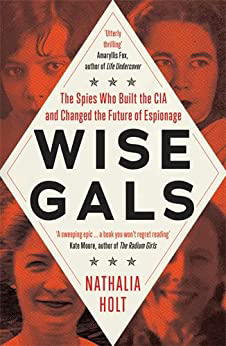
There is a whole category of books that I can't help but categorize as "stuff I need to read to make up for the fact that my U.S. History teacher in high school was very Not Good" to which Nathalia Holt's excellent and illuminating Wise Gals: The Spies Who Built the CIA and Changed the Future of Espionagemost surely belongs. Which means that every other page left me wanting to scream out that I should have known about something already but at least I know now, no thanks to you, Mr. [REDACTED]!
In the case of Wise Gals, the biggest revelation (besides the incredible stories of the titular gals) was that a World War II battle had taken place on American soil, just six months after Pearl Harbor, except kind of six months plus one year after Pearl Harbor because it took the U.S. a long time to land troops to engage the Japanese who had invaded and taken the Aleutian island of Attu, part of the then territory and now state of Alaska.
So of course I'm going to have to read all about that pretty soon because Wikipedia won't do when you're... me. I've already located a book about it in my local public library!
Also, Gloria Steinem worked for the CIA for a hot ten minutes or so in the early 1960s! "In my experience," she said later, "the agency was completely different from its image; it was liberal, nonviolent and honorable."
Ok, Boomer.
Anyway, Wise Gals is a fantastic book about the lives and unsung careers of yet another group of amazing women -- one of whom, Jane Burrell, was the first CIA agent ever to die in the field -- who quietly changed the world despite all the garbage that patriarchy kept shoving at them. In this case, the women were instrumental and fundamental to the development of the United States' intelligence services during World War II and the early stages of the Cold War. Like the ladies of Hidden Figures and Holt's own Rise of the Rocket Girls(which I haven't read yet but now very much want to), these women's names should be as well known as their male counterparts but aren't. At least not yet.
The women whose stories are encompassed in this book were not only there at the founding of the CIA; Holt directly ties their work to the agency's development from a "male, pale and Yale" network of pseudo-aristocratic amateur spies to the sophisticated, data-hoovering, technologically advanced power it is today.
By the way, look how much cooler the UK cover for this book is. The US edition uses a generic model they've given a vaguely 40s hairstyle and some dark lipstick and then cut off the top of her head. In the UK they got to see four of the actual women's faces. I had a terrible time on the internet trying to identify who is in which photo, but I'm sure that they are four of these five: Jane Burrell, Adelaide Hawkins, Elizabeth Sudmeier, Eloise Page, and Dr. Mary Hutchinson.My point is that it wasn't a single unknown woman who did all of the amazing deeds described herein; they were actual, individual human beings with families and interests and personalities and skill sets uniquely theirs. Do better, US publishers.
But I mean, wow, these were some extraordinary people. Burrell, for instance, had to work side by side with ex-Nazis (supposedly, but not always completely, "turned" towards the end of World War II) to expose post-war Nazi plots like giant art thieving and currency counterfeiting schemes, to say nothing of war criminals' escape from justice by disappearing into new identities in new countries. Often her collaborators turned out to be every bit as bad as the people they helped her expose, meaning she spent years in serious danger. What finally got her, though -- she was the first CIA officer killed in the field -- was a plane crash in Europe, cutting short a promising but already distinguished career.
Adelaide Hawkins, not content with a distinguished service record from the war in part because she was supporting and raising three children (she divorced her deadbeat husband right after the war), became one of the first members of the Central Intelligence Agency immediately on its founding and, among other achievements, headed up the team that developed the microdot camera -- an iconic bit of spy kit if there ever was one.
Meanwhile, Eloise Page was, as another OG CIA operative, a leading voice in the campaign to get the rest of the U.S. government to understand that an innocuous seeming calcium processing plant in East Germany was making material for a Soviet nuclear weapons program that was much farther along than technical advisors (who hadn't factored in short cuts like spying in assessing how long before the USSR had The Bomb) were telling it. When she and her colleagues were largely ignored, she helped organize a mission to sabotage the calcium plant -- but by the time the US and British bosses had agreed to put it in motion it was too late.
And history might have been very different if General Douglas MacArthur had paid attention to the hard work of Dr. Mary Hutchison and her colleagues at the CIA's Tokyo station in 1950. She'd only warned everybody authorized to read her stuff that North Korea was getting ready to invade South Korea -- long before some 200,000 Chinese troops massed at the border to lend Kim Il-Sung a hand. Page followed up this feat of sounding the alarms and being ignored by warning her superiors months ahead of time that the Soviets were very close to launching Sputnik, the world's first artificial satellite. You know, the one that took us completely by "surprise."
Then there's Elizabeth Sudmeier, who brought our country the first credible intelligence about the world's first mass-produced supersonic aircraft the infamous Soviet MiG-19 fighter plane, which she got via gossip at the Baghdad dressmaker's shop among the well-placed hijab-wearing ladies she had carefully cultivated there. Nobody else in the Near East division could have accomplished this because nobody else was a patient, friendly and engaging young woman -- who genuinely enjoyed spending time there and appreciated the hand-tailored wardrobe her activity allowed her slowly to build. She stayed behind in Baghdad after a fundamentalist coup killed off Iraq's royal family and sent the rest of the CIA's personnel on various frantic escape routes and managed to maintain most of the U.S.'s spy network there until it was (sort of) safe for everyone else to come back. And we won't even talk about her role in the Gary Powers/U-2 affair because you're going to read this book. Right?
Sudmeier's experiences having to leave Iraq after a mole in Washington D.C. blew her cover got me thinking, of course, about Valerie Plame. I wondered about Plame's time as a woman in the CIA in the 1990s and beyond -- and then I learned she has not only written (with a ghost writer) the expected memoir, but also a couple of spy novels! Gonna have to have a look at those one of these days.
Egads, there is still so much I don't know. Which is why I keep on reading...
*And, as Holt takes pains to point out in the summing up of this book, the Wise Gals walked across Europe and the Near and Far East in Ferragamo pumps so the ladies of Alec Station who kept tabs on Osama bin Laden et al could analyze truckloads of data in more sensible shoes, as it were.
"It's always the historian's job to say 'it's more complicated than that.'
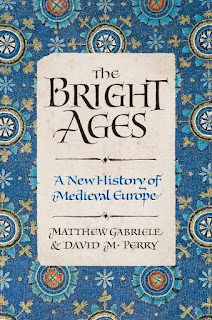
Lots of pixels are already being spilled on behalf of and about this book by people better acquainted with its subject matter than I, so I'm just going to focus on the sheer enjoyment and the new thoughts that The Bright Ages: A New History of Medieval Europe gave me during my brief turn with our public library's copy -- brief not only because I was enjoying it and so tore through it with my usual voraciousness, but also because I knew a lot of other people were waiting for it (shakes fist at Libby app). I hope it gets very widely read after I'm done.
Like Dan Carlin likes to say, I'm a fan of history rather than a student of it, and I'm such a wretched fan that I didn't know that my previous favorite history book about the period covered by David M. Perry and Matthew Gabriele was not in favor until I looked at some reviews of it prior to writing this post. I don't even recall how I got my hands on William Manchester's A World Lit Only By Fire: The Medieval Mind and the Renaissance, but once I did, I didn't let it go for years.* I read it so many times that lines or sometimes whole passages from it intruded on my thoughts when I was reading historical fiction. William Manchester lived rent-free in my head as I first read the great Dorothy Dunnett, for instance.
I think he was maybe squatting a bit in Perry's and Gabriele's heads, too, though; I didn't think of his book at all while reading this until a sly little reference to its title showed up in The Bright Ages. It comes about halfway through, in the midst of a discussion of gothic church architecture and how its system of buttresses and other tricks allowed for walls composed as much of beautiful stained glass as of stone:
In a world made of wood, stone impressed; but for a world before electricity, more important was light. This wasn't a world lit only by fire, but more important, one illuminated by the sun. Allowing that sunlight inside, allowing an interior to gleam, was to capture something of the divine. So heavy stone walls were replaced by translucent and radiant colored glass.**
Underlining mine; italics theirs.
Really, that passage is a thesis statement for this whole book. The period between the canonical Fall of the Roman Empire (but Philip K. Dick taught me that The Empire Never Ended...) and the start of the Renaissance is still most commonly described by the loaded phrase "The Dark Ages" but culturally, intellectually, politically, materially, that period of time was no darker than our own in a lot of key respects. In the literal terms the quoted passage begs us to consider, for example, the sun shone for the same number of hours per day as it does now (and through much cleaner air); it was only at nighttime or deep indoors in windowless rooms that the visible world shrank down to what could be lit by a flame.
And if one zooms back camera (and yes, I'm totally thinking of Alejandro Jodorowsky's last line in The Holy Mountain, here) and takes in all of the then-known world, civilization and all of the ideas and traits we associate with it wasn't suddenly extinguished when Alaric sacked the city of Rome; rather, like a balloon a bunch of kids take turns batting around a room to keep it from touching the carpet, its light was passed from place to place via trade and the travels of scholars and pilgrims and on the backs of war horses and yes, even in the minds of "ignorant" tribesman types gawking at the aqueducts and roads left behind by the classical Roman empire.
And the idea of Rome didn't die, either; people like Galla Placidia, daughter of one Roman Emperor, wife of another (and before that of a Visigothic king) and mother to yet another, never thought of herself as anything but Roman even though she had witnessed the famous sack and led a tumultuous existence that could make anyone agree with Gandhi that Western Civilization was something they should maybe try sometime. Following her the rulers of the Byzantine Empire called themselves Romans and still had chariot races (boy did they have chariot races) and adopted laws and customs from the classical empire even as they embraced this newfangled Christianity. And the idea persisted in some ways even until the Hapsburgs presided over something that by axiom was neither Holy, nor Roman, nor an Empire, except they themselves might have disputed it when they weren't busy keeping their subject kingdoms from trying to destroy each other and engendering cultural conflicts that are still affecting us even in this stupid 21st century that convinces me more every day that a whole lot of people who desperately cling to the idea that the Dark Ages were totally a thing because it props up their dumb culture war talking points also seem to think that it would be great if we could Make the Age Dark Again.
Oh no, Kate's getting political again, but Perry and Gabriele went there before I did; their whole point in writing this book is to debunk and deconstruct the hundreds of years of post-Renaissance bad history and to point out how that bad history has been used to justify everything from the 17th-19th century return to slavery as a justifiable institution despite being pretty un-Christian, to the 21st century talking head hobby of blathering about "clashes of civilizations" to justify Antisemitism, Islamophobia, sexism and, of course, racism. History is written by the victors, sure, but the losers had a habit of finding ways to record their existences and leave traces for us to read as well, and we ignore those traces to our cost.
And this is where the duo really shines. For the most part, they're using the same sources as Edward Gibbons and his heirs always have, but look at them with an eye to why people like Procopius wrote what he did, rather than just taking what he did write as face value, ignoring the fact that his public and private writings frequently contradicted each other, and picking out the bits that agree with a predetermined thesis. Look at the circumstances under which the man worked and what he said and why he said it can make more sense, especially if its backed up by archeological evidence or other primary sources or just the lived experience of standing in the Hagia Sophia even after centuries of alterations... to say nothing of the fruits of hundreds of years of scientific research that has yielded all kinds of insights into the daily realities of The Little People.
The two really do zoom back, by the way, to take in, as I said, the entire known world, including the rise of Islam and the importance of its scholars to what would come to be Europe's Renaissance but also their presence as ordinary residents of the Iberian peninsula where they lived alongside Christians of many kinds (one thing I like is the emphasis in this book on the fact that right from the start there were always many Christianities, plural) and Jews, and the odd pagan hangover in varying degrees of peaceful coexistence -- though Perry and Gabriele are very careful not to fall into the trap of romanticizing this coexistence as This is the Past That Liberals Want.
The Mongols, too, get a turn in the spotlight as carriers of goods and ideas (and, most likely, according to modern archeological and genetic research, probably the Black Death) back and forth, just as the Vikings did. Remember that, famously, one in 200 men now living have some of Genghis Khan's DNA, and not all of them are in Asia.
Hard to share chromosomes without sharing a few other things.
The book ends with a return to Ravenna a thousand years after Galla Placidia built her mausoleum with its marvelous interior sky of lapis lazuli and gold-infused glass tesserae, to consider Dante Aligheri, exiled from Florence by political strife and writing The Divine Comedy's quest for divinity, imagined as light -- and then considers Petrarch, the first great populizer of the idea that the thousand or so years that preceded his personal awesomeness had been universally ignorant, violent and dark (or, as a later scholar would describe the whole of human existence, nasty, brutish and short!), inviting us first to ponder why he found it necessary so to characterize the times that spawned him, and whose interests it has served later historians to perpetuate and intensify Petrarch's errors. As the authors conclude near the end of The Bright Ages, they were "not simple or clean, but messy and human, and that's as close as we can come to the truth."
I hope someday the same kindness is employed in talking about us.
*And while I absolutely see how Manchester's book merits criticism for perpetuating stereotypes about the period he covers, that book us how I first learned to see Henry VIII as more than a wife devouring monster (listen to the music he composed sometime!), to appreciate Magellan, and to empathize with Lucrezia Borgia. So I'll not abandon it wholly.
**And of course, any discussion of French cathedrals and the like always brings me around to my beloved Orson Welles and my single favorite few minutes of cinema yet created, this bit from his wonderful F for Fake in which he is moved to unparalleled eloquence as he contemplates Chartres:
Go on singing.
And speaking of singing, if you're a bi-sensuous reader like I am, who likes to listen to relevant music while reading a particular book, I bring you a few selections for your listening enjoyment. The first is some of the Byzantine Secular Classical music brought to us through time by composer and musicologist Christodoulos Halaris. I first found this stuff at a used record store in Central Square, Cambridge, MA when I was living in the area in the 90s and I still love it.
And here's some music composed by the six-wived Henry VIII that is good enough to make me sometimes feel like forgiving him a tiny bit for some of his bullshit:
Some people have unbelievably strange lives, and then there's Svetlana Alleluyeva, aka Svetlana Dzhukashvilli, aka Lana Peters, aka... but better known as
Her real life, even in a bare bones outline, is weirder than any novel or movie could convey, which is to say that author Rosemary Sullivan had something of an unfair advantage as far as writing a book which would absolutely rivet its audience. As a young girl, Svetlana watched* her family disappear like characters in an Agatha Christie novel, but only later on in life learned that this was usually because they'd either angered her father or in some way posed a threat to or just annoyed one of his advisors. Usually a combination of those. When her father died his weird lingering death surrounded by people who weren't sure if they should help him, she got to watch the bizarre power struggles to succeed him and got treated as a pawn in them. She had been forbidden to marry her first love, a screenwriter who had rather glowing biopics of V.I. Lenin on his resume, because whoops, he was Jewish, but then was later allowed to marry a Jewish man (the first of many husbands; how many depends on how you count them, because some marriages were more official than others because totalitarianism). She finally got out of the U.S.S.R. only to scatter the ashes of an Indian citizen (whom she considered her fourth (?) husband but wasn't allowed to actually marry) on India's Ganges River and managed to slip her minders and sneak over to the U.S. Embassy to defect. She became a successful author and earned a lot of money with sensational but honest books but lost a lot of it in, for example, another ill-advised marriage to a member of Frank Lloyd Wright's posthumous cult. She met everyone from Isaiah Berlin to Terry Waite. She defected back to the U.S.S.R. at one point, teenaged half-American daughter in tow, because she missed the children she'd left behind in her first defection. And so on.
Sullivan gives all of this an immediacy and a felt impact largely through intimate interviews and hard-won access to enough of Svetlana's private (?) papers to be able to share Svetlana's perspective on matters in her own voice. Wisely, Sullivan foreshadows very little; if we don't already know what Stalin and his cohort were really up to from sources other than this book, we are not enlightened, in the course of the narrative, until Svetlana is. So at first Joseph Stalin is just a weirdly distant daddy whose children enjoy (?) considerable privilege but don't understand that they do because they're so insulated from the rest of society and aren't even told the truth about why certain family members (including Svetlana's own mother) aren't around anymore, and only later do we come to see him in anything like the way the rest of the world does -- and we get to share Svetlana's whiplash as her home country goes through crazed cycles of revering and reviling her father's memory, sentiments that she bears the brunt of once her father is dead, both in the U.S.S.R. and in her other homes of India, the United States and the United Kingdom. As she observes of the cult of personality around Stalin even decades after his death, "Tragically, many, even in the Gulag, continued to insist that Stalin knew nothing. It was evil advisers who were responsible.."
In the process, we get a timely reminder, as the present moment has brought many socialist ideas back to the fore, that we can't blindly trust people who espouse them to stick to them or the credo behind them. Once upon a time, Stalin and Beria and Khruschev would have agreed that eating the rich and defunding the police are good ideas, but not for the reasons that most of those now proclaiming them (myself included) generally mean them. The price of freedom is vigilance, and if a second socialist revolution ever occurs here in the West, the revolutionaries will do well to keep each other in check and remain vigilant against power grabs, ideological purity tests, authoritarianism in the guise of fairness, and any notion that ends justify means. It's really, really hard work, and I hope that we are smarter than the poor, starved, hidebound Russian populace of 1917 were and can learn from their experience. Sharing this book widely can only help.
*Ok, "watched" isn't quite so much the word as something like "noticed week's later that it had been a weirdly long time since she'd seen a person", but hey. We don't have a word for that, do we?
History is always a spoiler for historical fiction, so I knew, as the virtual pages of The Mirror and the Lightdwindled, that I was about to lose a beloved friend and I emotionally braced for it, but even so, I cried when it happened... in the book. Of course it really happened over 500 years ago.
Hilary Mantel definitely fills the role left empty lo these many years by the late Dame Dorothy Dunnet, and Mantel is a more than worthy successor, but she hasn't aped the mistress' achievements so much as inverted them. Dunnett wants us mystified by her heroes, guessing at their motivations and what they're going to do next, unable to penetrate their facades. Thorfinn, Lymond, Niccolo, all are observed from the outside; we get accounts of their deeds from the point of view of everbody else they encounter, spending a bit exploring the interiority of each of their friends, enemies, lovers, employers, lords. And nobody does this better than Dorothy.
This is not where she and Hilary Mantel overlap. What they share is a commitment to research and to world-building (as my friend Connor Wroe Southard explores in his latest) and an utter lack of fear of going long to create as complete a portrait of their ages and milieus as they can. Mantel just assumes a bit less erudition and command of languages on the part of her readers, is all, which can make her seem a bit more accessible than Dunnett, but beware: Mantel doesn't suffer foolish readers either. The first and, to a degree, second books in this trilogy were famously difficult for many readers (and, at first attempt, for me as I discussed on this blog long ago) due to Mantel's commitment to the tightest possible focus on her protagonist that didn't require an out-and-out first person narrator; we hover practically on his shoulder for hundreds and hundreds of pages, a bit baffled at times until it dawns on us (or is explained) that in Hilary Mantel's Tudor England, "he" means Thomas Cromwell 99% of the time, even if he is not named in a sentence or paragraph and someone else, say, King Henry VIII, actually has been. I found this incredibly off-putting the first time I read Wolf Hall, but have come to not only embrace it but possibly prefer it to the first person narrator to which authors usually resort when they want to achieve this level of intimacy with a protagonist.
And intimacy there is, right up until the moment the axe falls, and throughout the account of the last, greatest and most troublesome act of Thomas Cromwell's career. He has been intimately involved in the getting of all of Henry VIII's replacement wives. Queen 2.0, Anne Boleyn, absolutely relied on him until she found, to her surprise, that she could not, and Cromwell took advantage of her fall to take down a whole bunch of men who had treated Cromwell's original Patron (Cardinal Thomas Wolsey) badly after Wolsey repeatedly failed to get the Pope to annul Henry's marriage to Queen 1.0. Anne's reign and downfall encompass the second novel Bring Up the Bodies, which ends more or less right as the headsman from Calais executes her publicly with a sword inscribed, as we learn in this third book, "mirror of justice, pray for us," the first of many references to mirrors and lights, here.*
The Mirror and the Light takes us through the reign of Queen 3.0, Jane Seymour, whose rise together with her family from Wolf Hall owes, again, a lot to Thomas Cromwell, and who might have proven a boon to the whole country had she survived after giving birth to Henry's only legitimate son, and then the campaign to find Queen 4.0 (who winds up being Anne of Cleves, but not with much success). But Queen Search is the least interesting plot here, as other events overtake the Henrician court, such as the famous Pilgrimage of Grace (the original astroturfing plot, generally thought to have been engineered by Europe's Catholics as a way to bully Henry back into the Roman fold), the future Bloody Mary's early stubbornness about her status, that of her mother, and whether or not her father could actually be the head of a church, and the continuous plots of various cadet branches of the English royal family to unseat the Usurper Henry and replace him with one of their own blueblood sons. Cromwell is in the thick of all of this, and his fierceness on Henry's, Mary's and also Margaret Tudor's (Henry VIII's niece, a princess of Scotland being raised in Henry's court) behalf earns him lots of new enemies and intensifies many old conflicts; many of his rivals, new and old, remind him throughout this book that since Cromwell owes all that he is and has (which has come to be quite a lot, as Cromwell even finishes his life with the title of Earl of Exeter -- a title that once was held by one of those cadet branches of the royal family until the last male of the line dies childless, and remember, Cromwell's dad was a scary drunken abusive blacksmith from the slums) to the king, if the king ever turns on him, he's done for. Cromwell basically just says, of course, and continues to do so right until the end, giving this book a greater air of tragedy even than the early scenes in Wolf Hall when the sweating sickness raged through his household and killed all the ladies and little girls.
Meanwhile, Anne Boleyn's family still seethes over her fate, for which they blame Cromwell, and they plant the final seeds of Cromwell's destruction with another daughter of the family, the vain and silly Kat Howard, who will be Queen 5.0 and gets married on the day of Cromwell's death. Queen 2.0 and 5.0 share an uncle in Thomas Howard (fabulously played by my beloved Bernard Hill in the TV adaptation, which showed that Hill is just as good playing a dick as he is a hero or a coward. Ahh, my Bernard!), who rages through the whole trilogy but has especially good scenes in this book as he and Cromwell occasionally seem on the verge of finally becoming friends, or at least calling a truce, until Howard's pride in his lineage always wins out; Cromwell is a Nobody and needs Put In His Place and nothing will be right in the world until he is.
Again, all of this is taking place in an immersively detailed world, which I was able to flesh out even more thanks to a lot of references to contemporary music of the time. There were enough of these for me to construct a pretty good playlist on Spotify, to which I added some other stuff that I'm reasonably sure would be familiar in Henry's court, and, of course, a selection of Henry's own musical compositions. Of course Henry composed music. He was a Renaissance Man if anybody was! Anyway, everything I could find that was mentioned by name is on there, along with some of my other favorites from Henry's lifetime in Venice, Florence, the Holy Roman Empire, etc. I listened to it a lot as I finished the book, and it was a great balm on my poor heart as I watched Cromwell arrested, imprisoned, questioned, impugned and executed.
Now, excuse me. I think I need some alone time.
*The overarching metaphor of the book is teased out there; before electricity and incandescent or LED bulbs, the light of a candle was often magnified by placing it in front of a mirror to bounce the rays back into the room. As Cromwell discusses often with his king, a ruler must serve as both things, mirror and light, setting a good example to his subjects and magnifying the benefits of good behavior into his realm. Um, about that...
More people, I imagine, recognize the Lewis Chessmen than realize that they do. They're the models for the set Harry Potter and pals use in their films. Some illustrations for Lewis Carroll's works draw on them. Etc. Or, like me, they heard of the set on the amazing History of the World in 100 Objects podcast and looked them up and spent untold hours just admiring them. The beserker rooks as they bite their shields, the elaborately enthroned kings with their swords on their knees, the knights astride their stocky little ponies, the queens with their faces resting pensively (or worriedly?) in their hands...
For such people, I wouldn't callIvory Vikings essential reading, as such, but it's pretty interesting nonetheless. The book explores the set -- or rather, sets, for bits of four sets of chessmen were dug up on that Scottish beach in 1831 -- piece by piece, beginning with the knights, modeled after late Viking warriors, and in the process makes a particular argument as to their nature and origin, a nature and origin intimately tied to some of the later and lesser read Bishop's Sagas of Iceland, as well as to some of the more famous Family Sagas, on which author Nancy Marie Brown draws for ideas of legendary/historical characters that might have inspired these personality-filled bits of walrus ivory and whalebone.
By the way, if you're not familiar with these sagas, you can pick them up pretty cheaply in "Saga Six Packs" over at Amazon, or, and I highly recommend this even if you're not going to read them (though you should read them!), go have a listen to the Saga Thing podcast, in which a pair of scholars summarize, dissect, and rate the sagas in terms of "best bloodshed" and "nicknames" and "notable witticisms" and such. Trust me. It's even more fun than it sounds!
But back to Ivory Vikings, which I wanted to like a lot more than I actually did. The problem is structural; while the idea of building the arguments as though one were slowly setting up pieces on a chess board is an intriguing one, the execution of same is very sloppily done, here. For instance, the final chapter, ostensibly considering the pawns, outlines the known history and provenance of the pieces since their discovery in 1831, and thus feels like it belongs at the book's beginning (especially since offhand references to stages in their journey from the island of Lewis' Uig Bay to various museum exhibits are made throughout the rest of the book, and phrased as though the reader is merely being reminded of something already discussed, to baffling and annoying effect). Too, and perhaps more irritatingly, anecdotes from the history of the North Sea in the ninth through 13th centuries are often repeated almost verbatim in several places, while others are fragmented and scattered throughout the book's chapters. The resulting narrative is rather more like a fever dream than a thoughtful work of non-fiction.
Still, these anecdotes and ideas -- that the famous/infamous Gunnhild the Grim may be the model for the queens (and now I can't but picture her holding her hand to her face as she considers what curse would be best for her lover Hrut, for instance), that Pall Jonsson not only might have commissioned the pieces but is also a living avatar of the modern chess bishop that was no bishop in the original Arabian game that became our modern chess, that a woman referred to briefly in a saga of his life might have been the carver of the set -- are fascinating and fun to consider, even as one realizes, through one of the more coherent threads in the book, that the mystery of these remarkable chess pieces might not ever be solved. Locations that might hold the answers to our questions are also locations of existing archaeological digs that would be damaged, if not destroyed, if we wanted to go deeper, as we'd have to, say, in Iceland's Skaholt, where an important 16th century site may sit right on top of the 11th or 12th century site we'd want to examine.
The reader who can be patient with the book's weird structure, and has an interest in chess, history, art history, commerce, archaeology, craftsmanship -- anything, really -- will enjoy this excuse to think about all of these things while admiring these whimsical, enigmatic, arresting little works of art. The reader who can't, will probably want to skip this one.
As for me, I'm off to read or re-read some sagas. Even as I shake my fist that a lot of the ones I'm now most curious about have not yet been translated into English. Ah, me.
Not since I first encountered Simon Schama's wonderful Landscape and Memory have I experienced a book that so powerfully evokes the power of place as Tim Butcher's The Trigger: Hunting the Assassin who Brought the World to War. For while the book is ostensibly concerned with Gavrilo Princip, whose murder of Archduke Franz Ferdinand in 1914 touched off the First World War, I would argue that the region itself -- the lands occupied by Princip's beloved "southern slavs" that would be united (more or less) as Yugoslavia for much of the 20th century -- is the real "trigger" for World War I and many subsequent conflicts.
It's Butcher's uniquely haunted perspective on the region that lets the brutal realities of the landscape eclipse the story of its most famous son. The result may disappoint seekers after a mere biography of Princip (but hey, details on the man's life are scant enough to where such seekers should be used to disappointment -- but should be delighted by Butcher's encounter, early in the book, with Princip's modern relatives, who cherish a sort of folk memory of their famous great-great uncle that is, as far as I know, all new-to-us material), but readers who can get over that small disappointment will still be rewarded by a remarkable book.
Butcher was a journalist on assignment in the Balkans during the horrific conflicts that broke out after the Warsaw Pact gave up the ghost and the nation of Yugoslavia (the name means essentially, southern Slavs, implying a union of same that might have been dear to Princip's heart, though one wonders what he'd think of Tito as a replacement for the Hapsburgs/Ottoman Turks/etc) dissolved into bloody ethnic conflict. As he follows Princip's journey from his poor and remote home village to Sarajevo, Belgrade and back to Sarajevo, Butcher can't help but recall how the vistas he encounters and the people he (re-) connects with in 2012 looked back in the 1990s, even as he tries to imagine his way back to the early 1910s.
This sounds like a recipe for maudlin mourning or peacenik preaching, but Butcher doesn't let either flavor spoil the dish. For every scene of survivor's guilt or tragic and harrowing story behind a destroyed building or a desecrated monument, there is a scene of enduring charm (Fishing with the Imams) or of newly adopted, moving and meaningful rituals (the march commemorating the escape of thousands of Bosnian Muslims from Srebrenica).
The result is a difficult but rewarding read, and one I would recommend to absolutely anyone.
It is one of the disaster's paradoxes, but the Zone's evacuation put a stop to industrialization, deforestation, cultivation and other human intrusions, making it one of Ukraine's environmentally cleanest regions - except for the radioactivity - Mary Mycio in Wormwood Forest
Reading Mary Mycio's Wormwood Forest: A Natural History of Chernobyl may be likened to spending several hours listening to the Talking Heads' hit song "Nothing But Flowers" over and over again, but that would be selling the experience a bit short.
I had no idea, before reading this book, that so many people had equated the disaster at the Chernobyl nuclear power plant with the biblical Book of Revelations. I was 16 at the time it happened, eyeball deep in Michael Moorcock and Piers Anthony and Jack L. Chalker and research for Lincoln-Douglas debates on the topic of: "Resolved: that the United States is morally bound to promote democracy in other countries." So I felt badly about the disaster, worried about the fallout, but didn't have time for the wingnuts.
I still don't, but I do find interesting the biblical/botanical coincidence that led to so many people, including, apparently, Ronald Reagan, to equate the accident with a Sign of the Apocalypse. The Russian name "Chernobyl" (actually "Chornobyl") is widely translated to mean "Wormwood" which is the colloquial English name for a plant common to that part of the Ukraine/Belorus/Russia, and also for the star that will shine like a torch at the beginning of the bibical apocalypse. But the plant we know as Wormwood is one they call Pollyn, Artemsia absinthium (so named because it is the source of the thujone that supposedly makes absinthe more than just another green liqueur), is not the plant they know as Chernobyl. That's Artemisia vulgaris, a related but less noxious plant that we know as Mugwort. Ain't the devil just in the details?
Wormwood Forest is full of interesting little nuggets like that as it describes how the natural world has overtaken and overgrown former towns like Pripyat, which town first came to my attention last year when I saw the film Land of Oblivion, set there 25 years after the disaster as stubborn former residents start coming home despite government warnings not to. And there are similarities to that film; the author's guide is a woman who lived there before the disaster, her memories haunting the account of Mycio's visit with a botanist at her side (Land of Oblivion's main character was a woman whose wedding day was the day of the accident, and whose bridegroom died in the first wave of emergency response efforts, and who comes to work, decades later, as a guide for foreign disaster tourists). Since that film affected me deeply, this book, which I believe was a primary inspiration for the film if I am remembering the director's Q&A after the screening I saw, too, bestowed chills along with its fascination and surprises.
Wormwood Forest explores not only Pripyat (actually it doesn't spend that much time there) but the town of Chornobyl, where some 2500 people, tour guides, maintenance workers (it takes a lot of minute and patient work to, for instance, keep pine saplings from growing on top of landfills full of radioactive debris and equipment sealed in clay to prevent leaks; tree roots would crack the clay and release the radiation back into the world) live on a rotating temporary basis; the Red Forest, where winds brought some of the most intense radiation and killed the trees, turning them red, now home to plenty of green "radiomorphic" ones that show bizarre growth patterns (the name Red Forest has stuck, though, and denotes one of the most radioactive places on the planet); villages where lawless squatters live in defiance of the government ban on permanent human habitation, who might take a fancy to attacking explorers like Mycio and her companions; the hidden cemetery of the small village of Novoshepelyechi, where oak trees show a higher incidence of Crown Gall disease than anyplace else and Mycio contemplates the hyphae of fungi thriving there, and how far those hyphae might carry radionucleotides because fungi can be pretty big, under the soil... and that's just in the Ukraine. And it was Belarus, now home to a thriving and diverse population of aquatic birds, that got the most radiation, possibly due to cloud seeding sending particles down in rainfall before they could reach Moscow.
Nor is it just plants and fungi that are now calling the Exclusion Zone (or the somewhat more poetically translated "Zone of Alienation") home. Moose and red deer (that North Americans call elk) and roe deer and wild boars are plentiful, and two endangered species, the European bison and the Przewalski's horse, have both been introduced there and are thriving, largely because human activity has all but ceased there.
And there are more surprises, like the news that actually, as far as insects that could survive after nuclear disaster go, cockroaches are pretty wimpy. And that you don't find a lot of mutant animals like the famous eight-legged pony that appeared on the cover of Time magazine, because in the wild, mutated animals mostly don't survive; a bunch of partially albino swallows, for example, aren't doing too well in the Darwinian sweepstakes because they can't attract mates.
Some people are doubtless going to find this book rough going. There is a lot of science, of almost every kind - nuclear physics, chemistry, classical physics, biology, biochemistry, geology, hydrology, anthropology, botany, mycology, soil science, heck, even astronomy if you want to count the odd mention of the biblical Wormwood star. And it's densely presented, this science; where other authors might (as I kind of wish Mycio had done) choose to define radiological and other terms in a handy glossary, Mycio informs the lay reader via digressions in the middle of her anecdotal narratives, a tic I occasionally found intrusive when she was in the middle of describing, e.g., weirdly growing pines in the Red Forest. I would urge those readers who do find the science daunting to stick with it, though; around and through the rads and curies and Grays and becquerels is a realm of strange beauty, wonder, tragedy and terror, a glimpse of another world existing within our own that stands as a warning to us all while still showing a small glimmer of hope.
Though not so much hope that we should continue ripping atoms apart willy nilly just to power our hair dryers and server farms. I was never a big nuclear power fan before (having grown up in the age of Three Mile Island, glimpsed smugly from afar in a way that only a hydroelectric power customer can) reading this, and I watched Fukushima** with as much horror as anybody, but now, now that I know, for instance, that particles of radioactive isotopes as cesium and strontium mimic nutrients that pretty much all life uses to build and maintain itself (cesium mimics potassium and strontium, calcium), there to sit inside of plant and animal and fungal bodies for years emitting alpha and beta and gamma rays that tear bodies apart slowly from the inside, and that they just keep circulating through the food chain for, in some cases, unimaginably long spans of time, well, I'm really not a fan of nuclear power now.
*I remember being shocked at all the houses and public buildings Land of Oblivion depicted, with large and healthy birch trees growing right in the middle of former living rooms and offices and storefronts. It didn't seem like 25 years was long enough for that kind of growth. Shows what I know about botany. Which is a severe failing on my part, especially given how much I know about and love insects and fungi!
**Which wasn't as bad, we're told, as Chernobyl was, but still plenty bad, thank you very much.
I'm still kind of making up my mind about whether or not I *liked* God's Philosophers. Its subject matter is very much up my alley and it's by no means a poorly written or unreadable book, but...
But...
On the one hand, I am not a fan of revisionist history, and this book at times feels like exactly that: a sometimes haranguing and opinionated effort to prove that "The Dark Ages" is a perjorative and misleading term for the historical period between the fall of the Roman Empire and the Renaissance, that the Renaissance couldn't have happened had not medieval thinkers prepared the way for it, that scholasticism shouldn't ever have been mocked.
On the other, well, I am keenly aware that I have reached a certain stage in life in which a lot of the stuff I was taught as fact in primary and high school is out of date, inaccurate, maybe just plain wrong. I speak not just of cherished juvenile memories of brontosaurs and a system of nine planets but also subtler matters like the characters of presidents and other leaders (many of whom we never even studied; shocking but true, we never talked about John F. Kennedy OR Martin Luther King in my elementary, middle or high school curricula). I like, whenever I can, to redress these defects, fill in these lacuna in my education, and so I deliberately seek out material like this that deliberately and systematically challenges something I've long taken as a given: in this case, that the almighty Catholic Church kept science down in various ways.
Of course, as Hannam is quick to stress, what we think of as science didn't really exist in the period his book covers; modern science with its rigorous schema of hypothesis, experimentation, analysis and peer review is a product of the last century or two at best (even the word "scientist" was only really coined in the 18th century). But, he asks, is it really reasonable to believe that those who would have been were just ground down by the ecclesiastical and secular powers that were? Was knowledge deliberately suppressed and kept from us and questions banned from being asked?
Well, Hannam says, yes and no.
A lot of names familiar to people who read a lot of Umberto Eco and his ilk surface all over the place here: Bernard of Clairvaux, Ansemlo d'Aosta (aka Anselm of Canterbury -- wink wink to those who love Foucault's Pendulum), Peter Abelard (of Abelard and Heloise fame, you fans of Being John Malkovich), the Merton Calculators, and of course Galileo and Paracelsus and Avicenna and Thomas Aquinas. Each gets a brief moment in the spotlight alongside some names unfamiliar to any but the dwellers in deep academe like Nicole Oresme, who discussed the notion that the earth rotates on an axis a hundred years before Copernicus did -- it's these little tidbits and new names that are the most attractive feature of God's Philosophers.
What is less attractive is, for lack of a better word, the tone of the book. While ordinarily I'm something of a fan of a certain kind of prickly cultural criticism (Paul Fusell is an old favorite), I find I don't like it nearly as well when it seems chiefly employed in the service of haranguing me about how grateful I should be to the Catholic Church; the implication appears over and over that had it not been for the Church and its hierarchy and its (grudging!) acceptance that Aristotle was right about a few things and maybe Plato was, too, the Renaissance could not have happened, but anyway, all of those ideas that our Renaissance heroes had, well, good little church boys thought of them first. Except for the fact that the Earth revolves around the sun -- Hannam lets Galileo keep that one. Mostly.
Hannam is especially down on the humanists, whom he describes as "incorrigible reactionaries" "bent on recapturing an imaginary past" in their focus on recovering nearly-lost Greek and Arabic knowledge. Not since the latest radio preacher rant against those nasty secular humanists have I seen that term used with such venom, and the book seems rather thin on evidence to support this characterization. Because they weren't interested in leafing through page after manuscript page of torturous arguments and reasonings trying to reconcile Aristotle's writings on mathematics and physics with Christian doctrine and scripture in quest of the odd scrap of something that may, possibly, sort of, kind of lead to a conclusion about how actual nature actually works, they were bad guys? Really?
That aside, there is still lots of fascinating stuff. Hannam and some of his colleagues are the first in a long, long time to actually be willing to comb through all of that scholasticism in quest of the germs of ideas our culture has embraced and let flower, and the truth about us as a species that it reveals, that mankind has always been curious and intelligent and interested in the real world no matter what the era, is an inspiring one. We didn't all drink the Christian Kool Aid in A.D. 700 and stop thinking for ourselves, even if most of us were illiterate peasants. The Kool Aid maybe wasn't a smart drug, but it wasn't a brain killer, either, and it the society it shaped did have a certain framework for investigating the natural world that kept our quest for knowledge moving forward, if slowly. I get it.
But man, sometimes this guy's attitude about it a lot to stomach.