Showing posts with label music. Show all posts

Tuesday, December 30, 2025

Jenny Hval's GIRLS AGAINST GOD (Tr Marjam Idriss; Narr Gabrielle Baker)

No one asks me why I hate, no one uses that word, they call me grumpy, not even angry, but grumpy, six letters, something inconsequential and self-inflicted, something powerless, insignificant, something small in a small person, not something that's about society, or about them, just something that means i'm ruining things for myself, something that's in the way of my potential as an object.

The unnamed narrator of Girls Against GodNorwegian Renaissance woman Jenny Hval's second novel to be translated into English, first takes us back to 1992, when she is a chronological latecomer to the heyday of the Norwegian black metal music scene. She invites us to look with, not compassion but comprehension, at her younger self standing apart in the back of the crowd at a show, dressed in black with dyed black hair, looking on from the vantage of "The gloomiest child queen."

We don't get to spend much time in this teenagers' court, though (yes, I mean to use the plural possessive here. You think there's only one child queen at this show? There are plenty. We're just called to observe the gloomiest one. And yes, I'm being extra fussy about language and usage here. As my queen demands), before we follow our heroine into high achieving yet frustrated adulthood, with a magisterial will, a titanic ambition, a talent to match, a haughty disdain for us lesser beings, and, yes, a hate, which she still feels powerless to enact and express, still trapped in a small and frail-looking and easily sexualized body.

But underestimate this fragile looking young woman at your peril. Her advanced degrees are in the 20th and 21st century art of film and video, but her soul and her desire and her power come from friendship and sisterhood and other older and deeper and wilder arts -- and maybe even the craft usually denigrated with a prefix of "witch-."


But instead of a coven, burning candles and calling down the moon and making stinky tisanes (though there's a fair amount of all of that, too), she forms a band with two friends, Venka and Terese, and here's the part where I link to any of Jenny Hval's stunning music videos for her unique and haunting and powerful songs and song-like compositions. Except I can't choose. Partly because I'm a neophyte (if a 55-year-old woman in her twelfth goddamned year of perimenopause can still be called a neophyte in any way) in terms of Jenny Hval's art. It's all hitting me at once. I'd only barely heard of her as a name from an episode in the back catalog of one of my favorite podcasts -- and those folks generally like way heavier music than I do so I hadn't gotten around to that one yet when I saw it was about a musician who, at the time, had written her first novel*. I'll get to it one of these days maybe, I said. But so my point is, you can probably pick a place to start with Hval's other art as well as or better than I can. Go. Explore. But not yet. Because I want to talk about this amazing fucking book about a goddamned metal music witch coven and their adventures with the poor, exploited, overexposed young girl depicted in Edvard Munch's Puberty -- and, via the expressionist surrealist whateverist magic of fictional time travel, the Scream painter himself.

But so, think for a moment what it must have been like to grow up as a tiny blonde girl in 1990s Norway (specifically southern Norway, a distinction that is lost on me but that I feel after reading this book like it might not be utterly dissimilar to the United States' own South vis-a-vis the rest of Norway, in a way?), surrounded, as our Hval stand-in complains bitterly (and narrator Gabrielle Baker lets us feel every vibration of the eyerolls that accompany Hval's speeches from her character's gloomiest child queen's perspective, as well as the adult's slowly growing anger, chilling patience, and diabolical creativity as she unleashes the art of her spells, or the spells of her art, on the dominant and still very narrowly Christian culture that keeps trying to trap her and her bandmate-sisters within its narrow limits on femininity) the same pious yet aggressive, destructive and vicious attitudes that the young males among her contemporaries attacked with unreadable band logos, corpse paint, body odor, sick guitar riffs and, oh yeah, church burnings.

All that looks like childish tantrum-throwing to her. She wants to do something that matters, not to the teen boys screaming from her mix tapes of yesteryear or the prison inmates they became, nor to the greater culture that made the boys and the girls feel so trapped, but to herself and her girls. Who hate God.

"For a brief moment, the Norns have surfaced," she says, as her band and their fans turn the decaying former site of the Munch Museum in Oslo into their own installation, replete with water damage, faded spots on the wall in place of faded paintings, blood-red graffiti and badly 3D-printed plastic babies. Or at least parts of them. Does that sound a bit lame? Well, it's just the sound check.

Women’s work becomes a crucial problem within capitalism because reproduction is seen as nonwork. Reproduction as mystery isn’t new, but in capitalist rhetoric the mystery surrounding reproduction is redefined in economic terms, so that childbearing becomes not necessary but personal, a private rather than public concern, something that ‘belongs behind closed doors’, not labour performed but a ‘natural resource’ (making women generally ‘natural resources,’ too).
GaG
is also a bit of a cyberpunk story, and not just because the band-coven could very easily have accomplished one of their highly effective rituals with a Flipper Zero. Though they totally could have. Except Flipper Zeros weren't really a thing yet when this novel was written. So, more than a bit cyberpunk, as the band members fuse deep web searches with chaos-magical something-or-others and joke about just using "witch ritual" as a search term and hitting "I feel lucky" and imagine "information streaming through the arteries" of their wrists. Pretending to use something like the internet back when computers were still exotic but unconnected was, our heroine realizes, her first ritual, an exercise in sending forth her will through "the cosmic internet.

I'm tempted to go on quoting from this novel, to go on enjoying the sometimes sweeping, sometimes transfixing, power of Hval's and translator Marjam Idriss' language, which so often sounds more like a Jimi Hendrix lyric than a narrative, as you've perhaps already noticed. Jimi was pretty in touch with his feminine side, I think. 

But so, that's one of the miracles of this book: even while the intense and implacable longing for feminine power and agency engulfs the text completely, it's never at the expense of men or boys. Even the humorless, pretentious black metal boys of yesteryear, and their more conventionally loutish counterparts who drive big junky cars through quiet Norwegian villages at top speed and volume, just to be disruptive, earn Hval's admiration, never her scorn. Even Edvard Munch, he of the Puberty painting that the band-members work passionately to separate from its subject so she can be free, gets off pretty lightly, to say nothing of the anonymous creator of a certain infamous and pornographic Japanese woodcut you'll have to read the book to find and identify. Hval engages in a fair amount of trenchant but never weaponized art criticism in these pages, too, but always with a positive goal even as she emphasizes that her greatest power is her hatred. But what she hates is never an individual or even a category of people. She hates forces, especially those that threaten her cherished values of freedom, agency, strength, expression -- these are none of them zero sum games, is the takeaway from this novel. And fuck anybody who insists otherwise.

Unless you're playing the aforementioned games against God.

The gloomiest child queen is my queen, too. She's a pretty good one. I stan.

*Girls Against God is, I think, Hval's third, though only her second to be translated into English? Or something like that? According to Wikipedia the other day? Which, do we still trust Wikipedia? My instinct says yes, but consider the demographic I copped to above.

Wednesday, January 15, 2025

Stuff I Loved in 2024

My Internet friend Ben Werdmuller had a lovely idea for wrapping up what has honestly been a pretty wretched year for those of us who don't coat our faces with weird orange makeup every morning. I had originally been persuaded by my Own Dear Personal Mom to do a favorite books of 2024 post when Ben shared this post of his on Mastodon (aka the best alternative to the cesspool that once was our beloved bird site). What a fantastic idea! After all, even I occasionally do things besides reading.

But let's be honest: this is mostly going to be about reading. Because I've given up most other forms of recreation for various reasons, many of them medical but many because I realized a few years ago that I'm well past the likely midway point in my lifespan and likely do not have enough time left, even if I gave up sleeping (which I already do very little of), to read everything on my ever-growing To Be Read list.
But anyway, enough preamble. On with what I liked from this year. 

Television 

What? A big long paragraph about how all I want to do is read and I'm starting with TV? Something I resentfully sit through while still sneaking a page or two, just for the sake of spending "quality time" with my family? Yes. The Imp of the Perverse built a mansion on my shoulder and is very hard to coax out of it. Almost as if it has been sentenced to house arrest there or something! Which, you'll see what I did there in a moment. 


Showtime's excellent adaptation of Amor Towles' wonderful novel was the only TV show I watched this year that I hadn't already seen before (the only other thing I watched, besides pretending to pay attention to some Buffalo Bills games with my mom and sister, was the BBC's 2000 adaptation of Mervyn Peake's Gormenghast trilogy) and I just watched it over the holidays with my family and I loved it. Ewan McGregor was in no way who I imagined as Alexander Rostov when I originally listened to the excellent audio edition of the novel narrated by Nicholas Guy Smith; as is usually the case when I imagine a Russian male character, my mind casts Anatoly Solynitsin in the role. But McGregor was great, as was his gorgeous and intelligent wife Mary Elizabeth Winstead as Anna Urbanovna and the young women who played Nina and Sofia. This story of a Russian count who escapes the fate of most of his peers in the Russian Revolution via a misattributed poem that convinced the new regime he would be useful to them if kept prisoner in Moscow's famous Metropole Hotel could easily have been dominated by the production design but the show's creators wisely focused very tightly on Towles' amazing cast of characters and their stories. The show is worthy of the novel, and of all the hype it has received.
 

Music

I'm a middle aged fuddy duddy who has tried to keep myself open to new music, but I'm afraid this year was very much dominated for me by "legacy acts" releasing brand new albums that kept true to why I originally loved them but don't sound like they came through a time portal from the eras in which these acts first gained fame.


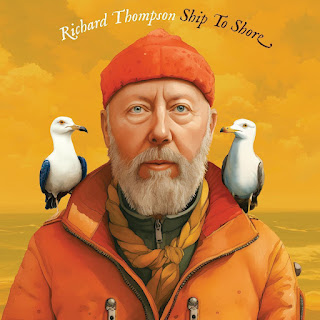
Richard Thompson - SHIP TO SHORE

I've loved Richard Thompson since my partner on our very amateurish college radio show first introduced me to Thompson's RUMOR & SIGH back in 1991. I kept up with his new output and happily explored his back catalog with Linda Thompson, Fairport Convention, etc and he's never once bored me. So color me not surprised that his 2024 output is still great. As the cover art conveys, the album has a very nautical feel. It never descends into just "Richard does sea shanties" though that would be fine. Thompson explores many themes that have little to do with the sea along with those that do, balancing the jaunty nautical stuff with his traditionally atmospheric guitar work and his unique and shiver-inducing voice.* My favorite track on here is "Singapore Sadie" but there isn't a skippable cut on here. 


John Cale is one of my favorite musicians of all time. The Velvet Underground without him feels incomplete; his solo work is spectacular and varied and he has impeccable taste in collaborators (his albums with Brian Eno, for example, are exceptional) as he demonstrated just last year with his album MERCY, which is how I discovered one of my new favorite singers, Weyes Blood. MERCY is so good that I took it as a capstone to an amazing career and was grateful to have it, but Cale isn't done yet. POPTICAL ILLUSION is loaded with absolute bangers that I can't stop listening to, especially "Shark-Shark" (which, check out this bonkers music video) and what I insist is a brand new classic, "How We See the Light." This. Is. Pop.


Laurie Anderson's art is always an event in my world, and her 2024 concept album dedicated to the story of Amelia Earhart is an exceptional example of how affecting her work can be. Even if you set aside her incredible cast of collaborators, the atmosphere of mystery, wonder, adventure and tragedy she conjures out of ordinary instruments and her deep and meditative voice as she narrates her version of Earhart's experiences is absolutely riveting. I'm guilty a lot of the time of using music as a secondary experience -- I blast really complicated prog rock as pain relief, filling my mind with other signals to block the constant neural spam my chronic illnesses constantly harass me with, and I also read a lot while playing music for similar reasons -- but stuff like Amelia occupies me entirely. And it's educational, too!


The Cure - SONGS FOR A LOST WORLD

I mean, you knew this was going to be on here, right? I'm a white Gen Xer from the United States. The Cure was my everything for the 1980s and 1990s.** And as everybody knows, they came into 2024 with an album destined to own it. I'm not going to spend a lot of time on this. The entire Internet is raving about this album. For good reason. 


I swear I'm not putting this here just to lay claim to a tiny sliver of hipness or prove that I actually do listen to music that comes from this century, but of course that's the message this really sends, isn't it? I only know of this album because Jordan Holmes, co-host of the Knowledge Fight podcast, mentioned this album as his "bright spot" on an episode -- which is how I've found a lot of "new to me" acts in recent years, including Godspeed! You Black Emperor and Helado Negro, to name two others.*** And yes, a member of G!YBE is in this ensemble. Anyway, this is just great, moody, atmospheric and noisy music that combines a wintry bleakness with environmental sounds, heavy distortion and a painful beauty that stays with me long after the last sounds of "White Phosphorus" fade out.

Books

Ok, I mostly write about books on this blog, and I only write about books that I really really love and that I either think haven't gotten enough attention from the general reading public or I'm obligated to write about in exchange for an advance copy (a habit I'm trying to break but having a hard time with), so really, if you want to know what books I loved in 2024 you could just read my 2024 entries and call it good, but I did read some other excellent books that I didn't write about on here either because I was too ill at the time or because I thought they were getting plenty of coverage elsewhere. So that's what I'm going to focus on here.


CAHOKIA JAZZ was on a few "most anticipated" and "best of early 2024" type lists but then sort of disappeared from discussions about what was an exceptional year for new books. I'd really hate to see this get lost in the shuffle because it is hands down my favorite book that was published this year. I like a good alternate history milieu and CAHOKIA JAZZ has a great one: It's the Roaring 20s in North America, but it's a North America in which the indigenous population largely survived the germ warfare imported by Europeans and went on to flourish, standing up to enough of the waves of settlement to establish urban centers like the city-state of Cahokia, and maintain a melange of Native culture while still adapting with the technological developments and other historical currents of the 20th century -- and welcoming other races and ethnicities. The world thus established is rich and convincing and a spectacular setting in which Francis Spufford enacts a classic crime noir plot that could hold its own against classics like Chinatown. Except instead of clueless white boy Jake Gittes, though, we get Joe Barrow, an accomplished Black jazz pianist who is also a detective on Cahokia's city police force. The grisly, possibly ritualized murder case he catches, in a city where an Aztec pyramid occasionally hosts human sacrifices, turns out to have huge implications for the city-state as a whole. I'd love to see this made into a prestige miniseries. It could be a season of Fargo. Don't skip this one.


Again, I'm one tiny voice in a global chorus of praise. It's a bestseller. It won the National Book Award for fiction. It should have won the Booker Prize. It retells a classic and makes it better and richer. You've probably already read it and loved it. So did I.


I've come to love Alan Moore's prose fiction as much as I do his graphic novels, comics and magazines (yes, I have a stack of early issues of Dodgem Logic and no, I'm not ready to share them with anybody yet), so I eagerly awaited this first novel in his new Long London series that is projected to be a quartet. His most expressly magical work since, say, Promethea, THE GREAT WHEN establishes a dual London slightly remeniscent of China Mieville's THE CITY AND THE CITY but Moore's other London that is contiguous-but-separate from the London we know is utterly bizarre and one hundred percent magical. Or rather, magickal, because this sphere owes more to the likes of Alastair Crowley and Austin Osman Spare than to Gandalf or Dumbledore.

Our hero is a lowly teen who rejoices in the utterly batshit name of Dennis Knuckeyard, who is only surviving post-WWII London through the grudging good graces of Coffin Ada, a second-hand bookshop owner who employs him and let's him live in a room in the flat above the store where she smokes, drinks and knows things. It's a mostly miserable life for Dennis and looks to be made only worse when a mysterious book that shouldn't exist turns up in some new inventory he's been sent to fetch. His adventures in both Londons are bizarre, creepy, fascinating and occasionally tug at the heart, if one still has one. And Coffin Ada is even more magnificent than she sounds.

Audio Dramas & Podcasts


This "found audio" drama in which a  broadcaster, who just might be the last human alive on earth after a weird comet's disastrous fly-by, tries to reach out to his missing friend, is also a cool exploration of many alternate earths. Does that make it an anthology series? Kind of.

The comet, in addition to disrupting ordinary life on what I *think* is meant to be our good old ordinary planet Earth but might not be, also has somehow thinned the boundaries between different universes just enough for our broadcaster to receive bursts of radio signals from alternate Earths that all slowly seem to be succumbing to some kind of slow invasion. Our man has started recording these intercepted transmissions and shares curated segments of them as he tries to reach a friend? lover? mentor? relative? whom he believes might still be out there and listening and willing to help figure out what the hell is going on. 

Meanwhile we learn of the existence of worlds in which the entire world is an oligarchy still firmly in control of historic dynasties like the Hapsburgs, who routinely enact elaborate assassination plots against one another; in which Christmastime is known only as The Holiday and involves the military mobilization of a child army known as The Naughty to defend the U.S.' northern border from the annual incursion of an eldritch horror that says "ho ho ho"; and, my favorite episode, in which large language models have been allowed to take over entertainment, municipal and emergency services and pretty much everything else, with entertainingly horrible consequences. I'm still waiting for my Paper Street Psychics tour tee shirt.
The show has a large, diverse and ever growing cast of terrific voice actors and singers to play out the collection of snippets of news broadcasts, advertising and recorded proceedings of the government and corporate bodies that make all of these worlds the bizarre, tragic, fascinating and occasionally funny ones they are, while the frame narrative maintains the air of tension and mystery that makes all of this cohere. I've listened to every episode multiple times and I'm still discovering little details in this lovingly crafted weirdness.


I have to really, really love a show to put up with I Heart Media's terrible, terrible advertising, so Molly Conger's fascinating little show had a huge strike against it from the start. And I still sometimes let the new episodes pile up on my podcatcher just because I can't face the awfulness, which, the subject matter is bad enough! But Conger is such a throrough researcher, a candid and self-reflective presenter, and a pleasant and thoughtful personality that Weird Little Guys has become can't-miss listening for me. It just sometimes takes me a few days to steel myself to listen.

Sort of a companion piece to the famous Behind the Bastards, Conger goes small where Robert Evans goes big. She's interested in the lesser known but often just as awful people without whom most of the big bads Evans covers would be much less damaging and dangerous. Conger digs deeply into the backgrounds of the kind of guys who haven't yet made headlines, or have only made very niche headlines for things like burning crosses on other people's property or building pipe bombs for terror projects or creating small but terrible media ecosystems that celebrate mass murderers and urge viewers and listeners to join their ranks and become terror "saints" by planning and executing their own attacks on the unsuspecting public. She's the kind of woman who knows her way around a courtroom and a court filing hundreds of agonizingly dull pages long, and has a true storyteller's instinct for the illustrative details and anecdotes that bring these weird little guys to life and remind us that they live among us and maybe, just maybe, we can prevent one or two of them from going postal on us with a little more kindness and empathy? Maybe? But probably not. By the time they're on Conger's radar, we probably need to duck and cover on sight. 


Hosted by two "noided" lawyers podcasting under the pseudonyms of Dick (as in Cheney) and Don (as in Rumsfeld), this show is as weird and disturbing as its title suggests. The general premise of the show is that the much-imagined Fourth Reich (as in the successor to Hitler's Third) is not a thing of the future but of the past and present, and Dick and Don are here to dig out from under decades of propaganda and obfuscation as many clues as they can to prove that the Fourth Reich is an almost seamless continuation of the Third and is better known to us as the international corporate regime that is what really governs the so-called Free World. It's a notion that seems far-fetched and overly paranoid to many, even today, but this pair has a lot of information on their side and are both, as one might expect, very good not only at constructing complex arguments but at effectively communicating them as well.

So far, the gents are focusing on making their case through the lens of the life and career of our 38th President of the United States, Gerald R. Ford. You know, the one nobody outside of the state of Michigan ever got to cast a vote for until he was running for re-election as POTUS and got beat by the late, much lamented, Jimmy Carter. Ford had a much more interesting life than I had ever imagined, as did his wife Betty, who is much more than just a name on rehab chain. While Ford was the first president I was old enough to know my name (just barely!), I knew next to nothing about him except that he'd pardoned Nixon. I now know that this is one of the less interesting facts about the guy. 

The show -- which also boasts a killer playlist of interstitial music skillfully deployed to drive home various points -- is currently taking a bit of a detour into a deep, deep dive into the Warren Commission and the men who served on it, one of whom was one Gerald Ford. It gets a bit out there at times but it's never not interesting and, like I said, it's full of facts that I have encountered nowhere else except maybe in Gravity's Rainbow.

There's more, and doubtless stuff I'm forgetting, but it's already 15 days into 2025 and I'm tired. BUT, is there something you think I missed? Let me know over on Mastodon!

*The first song of his that I ever heard was "Psycho Street" and so I always feel echoes of that in his voice.

**I'm one of those weirdos who prefers KISS ME, KISS ME, KISS ME to DISINTEGRATION, by the way.
***Both of whom also released new albums this year, by the way. They're great, but I'm trying to keep this listing on the short side.

Monday, December 13, 2021

Annalee Newitz' THE FUTURE OF ANOTHER TIMELINE

It's been a while since I indulged myself in some fun time travel shenanigans, and my trusted guides to all things cool, the maginificent Prince Jvstin and the ever-correct Popqueenie, have often mentioned Annalee Newitz as a trusted source for the kind of shenanigans we like, so I kind of feel some egg dripping down the deepening crevices in my face that it took a big fat sale at Audible to get me to finally actually read them.

Better late than never. Even if it's time travel. Or especially if it's time travel?

The Future of Another Timeline starts off the way more cool science fiction adventures should, at a great big punk rock/riot grrl concert in the late 20th century. As described by narrator Laura Nicol, it's a thrashing good time that takes no prisoners or bullshit and just brings back all the great memories of wishing I had grown up somewhere where things like that actually happened in the late 20th century, instead of somewhere they have both kinds of music, country and Christian. It's so on the nose that at first one could easily not notice that this scene is not taking place in our world. My first clue was the Wonder Woman tee shirts celebrating the terrific Tim Burton Wonder Woman film that came out in the late 80s.

Oh. Oh...? Oh!

Before we know it, we have a woman folding herself -- well, not exactly, but she is observing the trail of effect caused by her own younger self in a world where time travel is not only real but also not a secret -- and in an incredibly intriguing way. Machines that make time travel possible are buried deep in ancient geological features in several out-of-the-way locations all around the Earth, including one on the border between Manitoba and Saskechewan, and another in the nation of Jordan, and are the subject of general knowledge. Nobody has to have that awkward conversation in which they have to try to persuade someone that no, really, they're from the future, not even in the late 1800s. AND... Nobody has to make the same tired observation about something being bigger on the inside. Etc.

I think this is a first, for me.

But, somewhat more conventionally -- because cool world building and neat set pieces do not a novel make, one needs a story -- there is a sort of temporal cold war between at least two factions over how much "editing" can happen and what kind of world that editing is to try to make for everyone. Agents from each side keep meeting up at different points in a history that is not, as currently understood by the "geoscientists" of this world (delightfully, since the time machines are buried in shield rock, time travel and its various academic offshoots are the province of geologists), governed by the "Great Man" theory -- someone once traveled back and killed off the tyrant who originally conquered almost all of Europe in the early 19th century, only to see some other guy named Napoleon rise up and take his place and do pretty much the same thing, for instance -- but can still be altered through patient nudging of social movements. A well-executed leaflet campaign can do more, in this world, than a well-aimed shot from a gun, whether that gun be period or anachronistic. I like this. So much.

But so, does this mean that Annalee Newitz has found a way to make the bog standard "time police" motif of science fiction into a fresh and new... metaphor for Culture War? In fact, they have. Meaning this is a hell of a novel to have been reading right when the United States Supreme Court is poised to overturn Roe vs Wade, the law of the land for most of my adult life that has established abortion as a Constitutional right and done the most since the 19th amendment to uphold in no uncertain terms the right of a little over half of the human race to enjoy a certain standard of basic humanity to a greater degree than any generation born before us.

Which, along with other pesky ideas like offering education to all regardless of whether or not they have functioning uteruses, letting such people vote, choose their own marriage partners (or none at all) on their own terms, etc. (to say nothing of the rights of people who are not white, cisgender, heterosexual, or Christian) are very much in the crosshairs of one of the factions involved in this version of the Time War, the Comstockers (named for and kind of led by Anthony Comstock, of Society for the Suppression of Vice fame).*

I think he's rather well represented in this, the best book trailer, maybe ever, by the way. I'd like to think the real Comstock had nightmares just like this.


But, back to the Temporal Culture War. Its other faction, to which our time traveling concert goer, Tess, belongs, call themselves the Daughters of Harriet (as in Harriet Tubman, who in this world was once a U.S. Senator). Headquartered in California in the year 2022, they meet in secret to plan operations to preserve the freedoms they have gained, to extend them to other marginalized people, and to expand them. Operations in pursuit of this goal include missions such as sending Tess back to the famous Columbian Expedition of 1893 to hook up with some sort-of-Algerian belly dancers getting ready to take the Midway by storm and open a lot of closed minds -- unless the Comstockers can succeed in persuading the Respectable White Ladies of Chicago that the dancers are a threat to the good moral character of their city and must be shut down. While there, Tess befriends a dancer, a crusading young muckraker, and no less a personage than Sol Bloom, who all enthusiastically join her cause.

Meanwhile, there are shenanigans going on in the sixth century, BCE that have the potential to render all of the Daughters' efforts moot forever. DRAMA BUTTON PUSH ALL THE DRAMA BUTTONS YOU GUYS.

In lesser hands, this could be an awful, hectoring, didactic bore of a read, or a chaotic mess, or both, but Newitz maintains a high standard of storytelling, especially character drama, focusing on Tess's adventures in time but also on the somewhat ordinary suburban life of her younger counterpart, Beth, the Riot Grrl who originally went to that great punk show in 1992 but whose teenage years seem destined to have rather a higher body count than any teenager since J.D. met Veronica and all the Heathers in suburban Ohio back in 1989, if you know what I mean. How very.

The novel comes especially to life as an audio book, by the way; Nicol has just the right kind of California cool to her delivery to sell Beth's story especially, but imparts just enough gravitas to Tess's chapters to help us see her as the kind of woman Beth might could become if wibbly wobbly timey wimey all works out. As an extra treat we get something that only an audio edition can bring us -- a sound clip from fictional band Grape Ape's hit single from another timeline "What I Like to See", and an interview between Newitz and Desi Lopez about the making of the book trailer and the writing of the seriously catchy song featured in it. Popqueenie and I agree, if Grape Ape had been a real band in the 90s, we would have moved heaven and earth to be at every show.

All in all, The Future of Another Timeline is one of the most amazing balancing acts I've ever seen in book form. There are so many things that could go wrong with it, and none of them do, and it still has plenty of surprises for even the most jaded time travel reader. It's a tremendous accomplishment and has definitely turned me into a Newitz fangirl. Which, I really already should have been, because of Io9 and Charlie Jane and all...

I would (ahem) read any number of sequels to this if (cough) certain parties felt like making those a thing. As such.

*That jerk's best appearance in literature since his side-cameos in various Robert Anton Wilson joints in the 70s and 80s.

Wednesday, June 3, 2020

Best Translated Book Nominees: Burhan Sönmez' LABYRINTH: A NOVEL (Translated by Ummit Hussein)

I've never been less certain that the people who wrote the jacket copy for a novel read the same book that I did than in the case of Labyrinth: A Novel, my latest read from the long list for the Best Translated Book Award.*
The marketing for Labyrinth describes it variously as a crime novel and a heady political tale, but I see neither in this rather nice and moving story of a young semi-famous blues singer/songwriter/guitarist in Istanbul, Turkey who wakes up from an apparent suicide attempt with a wicked case of amnesia. Intriguing premise for a crime or political novel, right? I mean, was it a for- real suicide attempt or attempted murder? If it was really a suicide attempt, what brought this young, well off, good looking young musician to such a pass? Something terrible on his conscience to do with crime or politics because this is, you know, a crime novel? If it was a murder attempt made to look like suicide, who wanted him dead and why? Did he witness something he shouldn't? Was he a bad guy himself? Or a political dissenter the current regime in Turkey wanted quashed?

But, uh, nope. None of this really gets asked or, really, even answered in the text of the novel (and I'm a Gene Wolfe fan, so I'm used to really really having to pay attention when mysterious things get mysterious in fiction). Well, maybe a little bit about why our man, Boratin, would suddenly decide one night to exit his taxi while it was stuck in a traffic jam on the Bosphorus Bridge and jump right off said bridge to his suddenly intended death, but only a little bit. Like, nobody he asks has any idea, his therapist isn't much help, and then Boratin is more interested in figuring out what to do with his life moving forward than in solving this mystery of his past. 

The only clue we're given is that two of Boratin's favorite musicians, pre-swan dive,were Kurt Cobain (who committed suicide at age 27) and a Turkish guitar god named Yavus Çetin (who committed suicide at age 30). And yes, I looked up Yavuz Çetin and wow is he a revelation. See below where I'll link to a playlist I made for this novel.

Anyway, so unless I really, really read this one wrong (not impossible!) this is neither a heady political nor a crime story, but that's fine, you guys. Because it's a good book, a fine story, and worth reading on its own merits and not only because it will lead you to the discovery of some kickass Turkish pop music. 

Boratin as we get to know him (and he gets to know himself) via his friends and family, emerges as a very kind and generous young man who inspires considerable loyalty in his friends and bandmates and whose widowed sister really misses him and loves him devotedly even though he's not been to visit her and her son in years. There might well be something to this last bit -- why has he avoided his family for so long? -- and maybe his friends are lying to him about what he was like before the Bridge, but what about the neighborhood people who fall all over themselves to extend affection and gratitude to him when he happens by? Was he like, actually some kind of gangster or police informer or something and they're actually all scared of them?

That question, that idea, only occurs to me because of the jacket copy, I must emphasize. There is no textual evidence to support or even suggest it, no furtive glances, no signs of fear on the part of other characters, no unexplained suggestive imagery bubbling up from Boratin's subconscious... Without this crime/political designation I would have read Labyrinth as an elegant and moving account of an amnesiac coming to terms with his condition, deciding whom to trust with the truth of it, choosing how much effort he wants to put into recovering his memory, and determining his best course forward. That's more than enough for a good novel right there, and this is a good novel, especially since it also vividly depicts a place not a lot of us are ever going to experience any other way. Even if we get to 21st century Istanbul or have already been many times, we're not going to experience it the way a hot young Turkish musician is going to.

And that, my friends, is what I read for. And listen for: here's the promised playlist. Yavuz, man. Dayum.

*The winners have been announced for this, so now I know what to save for last!

Friday, May 29, 2020

Hilary Mantel's THE MIRROR AND THE LIGHT

History is always a spoiler for historical fiction, so I knew, as the virtual pages of The Mirror and the Light dwindled, that I was about to lose a beloved friend and I emotionally braced for it, but even so, I cried when it happened... in the book. Of course it really happened over 500 years ago.

Hilary Mantel definitely fills the role left empty lo these many years by the late Dame Dorothy Dunnet, and Mantel is a more than worthy successor, but she hasn't aped the mistress' achievements so much as inverted them. Dunnett wants us mystified by her heroes, guessing at their motivations and what they're going to do next, unable to penetrate their facades. Thorfinn, Lymond, Niccolo, all are observed from the outside; we get accounts of their deeds from the point of view of everbody else they encounter, spending a bit exploring the interiority of each of their friends, enemies, lovers, employers, lords. And nobody does this better than Dorothy.

This is not where she and Hilary Mantel overlap. What they share is a commitment to research and to world-building (as my friend Connor Wroe Southard explores in his latest) and an utter lack of fear of going long to create as complete a portrait of their ages and milieus as they can. Mantel just assumes a bit less erudition and command of languages on the part of her readers, is all, which can make her seem a bit more accessible than Dunnett, but beware: Mantel doesn't suffer foolish readers either. The first and, to a degree, second books in this trilogy were famously difficult for many readers (and, at first attempt, for me as I discussed on this blog long ago) due to Mantel's commitment to the tightest possible focus on her protagonist that didn't require an out-and-out first person narrator; we hover practically on his shoulder for hundreds and hundreds of pages, a bit baffled at times until it dawns on us (or is explained) that in Hilary Mantel's Tudor England, "he" means Thomas Cromwell 99% of the time, even if he is not named in a sentence or paragraph and someone else, say, King Henry VIII, actually has been. I found this incredibly off-putting the first time I read Wolf Hall, but have come to not only embrace it but possibly prefer it to the first person narrator to which authors usually resort when they want to achieve this level of intimacy with a protagonist.

And intimacy there is, right up until the moment the axe falls, and throughout the account of the last, greatest and most troublesome act of Thomas Cromwell's career. He has been intimately involved in the getting of all of Henry VIII's replacement wives. Queen 2.0, Anne Boleyn, absolutely relied on him until she found, to her surprise, that she could not, and Cromwell took advantage of her fall to take down a whole bunch of men who had treated Cromwell's original Patron (Cardinal Thomas Wolsey) badly after Wolsey repeatedly failed to get the Pope to annul Henry's marriage to Queen 1.0. Anne's reign and downfall encompass the second novel Bring Up the Bodies, which ends more or less right as the headsman from Calais executes her publicly with a sword inscribed, as we learn in this third book, "mirror of justice, pray for us," the first of many references to mirrors and lights, here.*

The Mirror and the Light takes us through the reign of Queen 3.0, Jane Seymour, whose rise together with her family from Wolf Hall owes, again, a lot to Thomas Cromwell, and who might have proven a boon to the whole country had she survived after giving birth to Henry's only legitimate son, and then the campaign to find Queen 4.0 (who winds up being Anne of Cleves, but not with much success). But Queen Search is the least interesting plot here, as other events overtake the Henrician court, such as the famous Pilgrimage of Grace (the original astroturfing plot, generally thought to have been engineered by Europe's Catholics as a way to bully Henry back into the Roman fold), the future Bloody Mary's early stubbornness about her status, that of her mother, and whether or not her father could actually be the head of a church, and the continuous plots of various cadet branches of the English royal family to unseat the Usurper Henry and replace him with one of their own blueblood sons. Cromwell is in the thick of all of this, and his fierceness on Henry's, Mary's and also Margaret Tudor's (Henry VIII's niece, a princess of Scotland being raised in Henry's court) behalf earns him lots of new enemies and intensifies many old conflicts; many of his rivals, new and old, remind him throughout this book that since Cromwell owes all that he is and has (which has come to be quite a lot, as Cromwell even finishes his life with the title of Earl of Exeter -- a title that once was held by one of those cadet branches of the royal family until the last male of the line dies childless, and remember, Cromwell's dad was a scary drunken abusive blacksmith from the slums) to the king, if the king ever turns on him, he's done for. Cromwell basically just says, of course, and continues to do so right until the end, giving this book a greater air of tragedy even than the early scenes in Wolf Hall when the sweating sickness raged through his household and killed all the ladies and little girls.

Meanwhile, Anne Boleyn's family still seethes over her fate, for which they blame Cromwell, and they plant the final seeds of Cromwell's destruction with another daughter of the family, the vain and silly Kat Howard, who will be Queen 5.0 and gets married on the day of Cromwell's death. Queen 2.0 and 5.0 share an uncle in Thomas Howard (fabulously played by my beloved Bernard Hill in the TV adaptation, which showed that Hill is just as good playing a dick as he is a hero or a coward. Ahh, my Bernard!), who rages through the whole trilogy but has especially good scenes in this book as he and Cromwell occasionally seem on the verge of finally becoming friends, or at least calling a truce, until Howard's pride in his lineage always wins out; Cromwell is a Nobody and needs Put In His Place and nothing will be right in the world until he is.

Again, all of this is taking place in an immersively detailed world, which I was able to flesh out even more thanks to a lot of references to contemporary music of the time. There were enough of these for me to construct a pretty good playlist on Spotify, to which I added some other stuff that I'm reasonably sure would be familiar in Henry's court, and, of course, a selection of Henry's own musical compositions. Of course Henry composed music. He was a Renaissance Man if anybody was! Anyway, everything I could find that was mentioned by name is on there, along with some of my other favorites from Henry's lifetime in Venice, Florence, the Holy Roman Empire, etc. I listened to it a lot as I finished the book, and it was a great balm on my poor heart as I watched Cromwell arrested, imprisoned, questioned, impugned and executed.

Now, excuse me. I think I need some alone time.

*The overarching metaphor of the book is teased out there; before electricity and incandescent or LED bulbs, the light of a candle was often magnified by placing it in front of a mirror to bounce the rays back into the room. As Cromwell discusses often with his king, a ruler must serve as both things, mirror and light, setting a good example to his subjects and magnifying the benefits of good behavior into his realm. Um, about that...

Friday, September 7, 2012

VINYL - Frank Zappa's "You Didn't Try to Call Me"


Many thanks to the brilliant Walter Hawn for the heads up about this new-to-me track. It has everything I love Frank Zappa for -- bizarre and quirky lyrics, complex instrumentation that still manages to sound like good old stripped-down rock'n'roll, and just a hint of sentimentality.

Zappa comes off as a condescending jerk sometimes, but all is always forgiven for the way he tickles my brain and my earholes. I speak in the present tense, for he is with us always in the grooves of vinyl and memories of the first time we heard something like Lumpy Gravy and demanded to know: "What the Snape was that?"

Back in my extra-contrarian twenties, when I was a state Libertarian Party official in Massachusetts, I kept lobbying the rest of the crew to get bumper stickers made up that read "Frank Zappa: He may be dead, but he'd still make a better president than you."

Thursday, September 6, 2012

VINYL - Willie Nelson "The Sound In Your Mind"


I just had a crazy dream which I absolutely blame on Tamaranorbust and Jeff Gordinier. And on all the cold medicine I've been having to take this week. In it, my high school band teacher, who was absolutely this kind of guy, had assigned us to listen to an album side a day on vinyl and note down our thoughts on it for something we had to hand in at the end of the year. For my first album side I chose Willie Nelson's The Sound in Your Mind off of which the song in the [VINYL] video embedded above was a single, which somehow had transported itself into my parents' record collection in that way things do in dreams (in real life, I don't think my parents ever had any Willie Nelson -- even before his braids and tax problems, he wasn't really their style. Just a hippie who played country instead of psychedelic rock). I woke up really, really wanting to do my band homework!

Alas, I don't have a turntable or any vinyl anymore. I have plenty of vices taking up plenty of space in my house, but analog audio collecting hasn't ever been one of them. But then I remembered how the world's favorite jukebox, YouTube, features rather a lot of videos like this one, of someone playing an analog vinyl favorite with the camera just focused on the turntable. It's a whole thing that I've only peripherally noticed and appreciated as a sort of protest against Mp3s, which my readers are all pretty much the sort of people who know are compressed to hell and sound terrible compared even to audio CDs, which themselves sound pretty awful compared to vinyl, but yannow.

Anyway, so I really liked the idea of a time-compressed version of that band homework (not sure how many of us have time to listen to a whole album side every day as busy grown-ups), so I thought of doing it this way, and blogging it, for a while, just as an experiment.

Furthermore, rather than impose just my tastes on everybody, I thought maybe I'd open up the floor to suggestions for tracks to include this way. Maybe if it turns out to be something I like I'll spin it off as a separate blog, but for now, just think of it as another KateOfMind.

Hook up your computer to the best speakers you've got in the house (me, I've got some Harmon Kardon Soundsticks, which aren't exactly my brothaman's giant vintage Monsoons, but have always served this non-audiophile's purpose well enough) and give this tune a spin.

Monday, September 3, 2012

100 Books #83 - Jeff Gordinier's X SAVES THE WORLD


My best friend from college and I were just across the Hudson River from Saugerties, NY the weekend of Woodstock '94, snarling and sneering the whole time at what we'd been very, very sure was going to be a mountain of suck, the Baby Boomer Generation having yet another stab at putting us in our place. We passed around a cartoon that his co-worker had drawn of what Woodstock '94 should really be like: mohawked punk stick figures stomping hippies into the ground, black helicopters spraying machine gun fire, a mushroom cloud detonating on the horizon. It gave us even greater satisfaction than the news that came over local and national media as that foolish weekend wore on that it was exactly the giant corporate suckfest we'd figured it would be, that we were right.

The first third or so of Jeff Gorinier's book is a lot like that, a litany of memories and realities that fueled a bitterness that I had kind of forgotten I'd had.* And for that reason I almost put it aside, despite the recommendations of someone for whom I have more respect than just about anyone on the internet, the blogger who tweets as TamaranOrBust, who has quite an inspiring and interesting post on this topic (actually a series of posts, but the one I link to here is possibly her finest).

Man, am I glad I stuck with this book, though. For the rest of it is an eye-opening, bumptious, raucous, giddy celebration of what we have done while being ignored and what we might still have in us to do. I poured a glass of wine, cranked up a '90s alternative music "station" on Slacker Radio, and smiled my way through the rest of it.

I've been hearing bits here and there of late about how it's time my generation (born in 1970, I'm an Xer by pretty much every measure anyone has suggested) came out of hiding and started taking another stab at keeping what we care about alive in this world: authentic culture, new and old; the right to live a life on the margins without giving up having a say in matters (the analogy of hypermodern chess comes to mind); the right not to be Boomers or Millennials eagerly participating uncritically in a hive mind serving interests that really aren't our own.

But rather than a call to arms or a lecture about the need to start new causes or take on the Boomers who, let's face it, aren't ever going to let go of their economic and cultural dominance while they're on this side of the dirt (but are perfectly willing to finish throwing our parents, the Silents, under the bus, and have found in Paul Ryan the perfect GenX patsy cheerleader to help them do it), Gordinier is more interested in pointing out to us that what we're already doing is (cough) changing the world, by saving the best bits of everything that has come before it it, one hyperfocused hobbyist at a time (like, say, that wonderful soul who put all of that Byzantine Secular Classical Music on YouTube -- to say nothing of those wonderful souls who invented YouTube!), and continually innovating ways to keep bouncing forward all that good stuff AND making new stuff of our own.

And yes, part of what made reading this book such a pleasure for me was the way it forced me to look at how I'm conducting myself through my early 40s, especially as an artist, and to realize that what I'm doing really does matter, even if mass culture doesn't understand or respect it. You guys do. And that's plenty! Which is how this sonnet, describing a rare chance meeting with a fellow beneficiary of my idyllic footnote below, came about.

Really, all I can think of right now, sipping wine and bouncing around my room to Nirvana and Soundgarden, is in The Two Towers (film or book, it doesn't matter, but the moment in the film is nicely done) when Gandalf talks about how the Ents are about to wake up and realize they are strong.

Might just be that we need to pay a little more attention to what our peers are doing and tune out the screech of the Boomillenials a bit more. I've gotten really, really good at the latter, but I could do so much better with the former.

*I had an idyllic, out-of-sync childhood in rural Wyoming, the land the Boomers kind of forgot. That's not to say there weren't any of that age group, far from it, but in a place that takes pride in slogans like "come to Wyoming and turn your clock back 30 years" even the 30-somethings of my childhood were pretty much just Silent Generation types with less grey hair and fewer wrinkles. Us kids had it really, really good in Saratoga, WY in the 1970s, beneficiaries of a sort of Silent Generation conspiracy to filter out most of the crap of the larger world and bring us the good stuff. The Utah Symphony played concerts in our crappy school gymnasium. An amazing old-timey historical tent show called Chatauqua came through every summer. The Texas Opera company staged full on performances in that same crappy gym where the Utah Symphony played and where from time to time mid-level touring ballet companies performed, too. I had an almost-complete collection of Horizon magazines at my disposal. We had a river to splash around in, bike trails to get us anywhere but keep us (mostly) out of car traffic, and a series of truly extraordinary schoolteachers who taught us how to make stone-age hunting tools and build snow caves along with our three Rs. So I was ill-prepared for the real world of the East Coast, where the hostility of Boomers was waiting to dump bucket after bucket of freezing, stinging salt water over my head before I'd even gotten my bearings. I endured it for almost a decade before deciding I'd had enough and moved back to Wyoming, where I was welcomed back with open arms. I tried to give a new generation the kind of advantages I'd enjoyed in my same hometown, but I didn't have enough co-conspirators to achieve the critical mass to pull it off. Ah, me. But now, here I still am, and now there is the internet. Sing praise, Gaudeamus.

Friday, July 20, 2012

100 Books #67 - Simon Reynolds' RETROMANIA


"History must have a dustbin, or History will be a dustbin, a giantic, sprawling garbage heap." - Simon Reynolds in Retromania
Well, Mr. Reynolds, you surprised me. I tucked in to Retromania expecting a nice, long, curmudgeonly rant, about how pop finally has eaten itself, but what I got was a history lesson as much as anything, and a case made for the notion that pop has been eating itself all along.

I must admit I felt as though I was clinging on to the tail end of Reynolds' arguments with my fingernails through much of this book. I've heard of maybe half of the bands he mentions, and have actually heard the music of maybe a third of said bands. This is a book that could have benefitted from the very technology that he somewhat decries; I would have loved to be able to just click on a band name and play some samples. As it was, I found myself throwing down the Kindle and taking up the laptop to hit Blip.fm or YouTube to get an idea of what he was talking about. Which was very educational, but also very inconvenient.

I thought, too, that 496 pages was rather a lot to spend with any writer who was basically telling me something I already kind of knew: that popular music has largely stopped trying for the fresh and new and has instead gone the way of sartorial fashion, raiding its closets and collections for old stuff that can be tweaked and reworked a bit and presented as something hot and new. What I hadn't counted on, though, was Reynolds' thorough and thoughtful approach to figuring out why and how that had come to be.

A lot of the usual culprits come up, of course: the quest to step out of or stand athwart the mainstream (just because the Music Industry says this is what I should like now doesn't mean I have to), the advent of Mp3s and digital music players that mash everything up and level out the playing field (it's fun to hear a brand new Magnetic Fields Track one minute and Cleoma Breaux and Joe Falcon the next; no music ever goes away just because it's old, now), in general the sheer weight of the past of recorded music (the Industry's decades-long strategy of throwing up everything to see what would stick means there is a hell of a lot of old music still around on vinyl, just waiting to see a turntable again), and of course the roots of nostalgia and that longing for times that seemed free and full of possibility instead of fettered with responsibility, infirmity and age.

But of course the music that makes you feel that way again is different for every age group, isn't it? Because that's just an accident of what was popular when you were young -- or, in many later cases, what wasn't popular. I still run screaming from a bar if I hear too many hair metal songs in a row, because to me, that's the music of my oppressors, most often heard from the trunk of a car or the interior of some frasshat upperclassman's locker. I clung to my parents' music, to Andy Williams and Pete Seeger and Johnny Cash and the Kingston Trio, stuff that is now regarded as timeless and classic and is all but revered but in the '80s was considered worse than passe.

Your mileage may vary.

Where Reynolds really gets interesting on this subject, though, is when he takes up the idea of "curation." Curation is a much-used term these days. All the hip kids are doing it. You're probably doing it, if you have a blog or a YouTube page or are a DJ on something like Blip.fm. And it's being done at the highest levels by people with real resources, too, of course. The people who plan all those revival and reunion tours, the brain trust behind the "I Love the ___" shows, the issuers of B-side compilations and deep track collections marketed to those who want to think of themselves as real connoisseurs of style X or period Y. It's all very interesting, because, of course, rock 'n' roll started out as deliberately primitive and barbarous, a Whitmanesque yawp, cacophonous and sexy and loud and parent-frightening, the very antithesis of highbrow. But somewhere along the way, the people who loved it weren't satisfied with things as they were and wanted to get highbrow, and by the time that impulse was born, there was plenty of raw material over which to paw and put down or praise, to classify and connect into geneaologies, to resurrect and revive...

...And the thing is, with so much recorded music out there in the world*, still perfectly playable, and with so many would-be experts and appraisers out there, too, for every single that only got pressed one time in a run of a dozen copies that no one originally wanted, there is somewhere a small tribe of people who will, if given a chance, drone on at one for hours about how it is the greatest record ever and how only the elect can appreciate it.

And, as Reynolds points out, some form of this has been going on for pretty much as long as there has been recorded music. People latch on to something and won't let it go, or dig up something old from the dustbin and since it's new to them they don't think it's retro if they borrow from it for something of their own.

That's the key right there, I think: everything, however old, is always new to somebody.** And sometimes that somebody is very brave to stick to his or her original enjoyment and enthusiasm in the face of the many who can't wait to jump in on the party and tell him or her that the music they've just found is stale or used up or just plain bad. And every once in a while, that somebody finds a way to make their old find feel new for other people, usually people who are younger than the ones who yawn and say "been there, done that, bought the tee shirt."

But has pop, or rock'n'roll, ever been for the kind of people who are capable of saying that?

Meanwhile, there is more old music in the world than there ever has been before. Every day there is more. And maybe it's like a teetering stack: to put something new on top, one has to make the effort to climb up past all the old stuff at the bottom, in the middle, near the top. And maybe not everyone has the energy to make that effort.

And then of course there are those who insist that originality is overrated anyway. My parents are kind of like that: both of them still insist on finding it bewildering when we speak of "a Clash song" or "a Cure song" or (my sister, lord love her) "a Quarterflash song". They're just songs, Mom and Dad have told us, again and again. When they were young, singers and bands played each other's songs all the time. If a song was good, lots of people wanted to perform it.

Now people talk about covers and samples, some sneeringly, some adoringly. My parents would just say again, if a song is good, lots of people want to perform it.

If a style is good, lots of people want to get in on it. And in this day and age, doing so is easier than ever. It's almost easier than not doing so. People might not even realize what time machines their iPods, their CD or vinyl or (me!) cassette collections are. It's all music that we like, which is why we have it. And maybe the only thing it all has in common is that we like it.

So is it "retro" or "nostalgia" or is it just the recognition that music is music, whenever it was made?

So yeah, I have some problems with Reynolds, though I lack his staggering erudition on the subject of pop to go toe to toe with him, I am sure. But as you'll see from the second footnote below, I have rather a longer view of musical history than he does. At least I suspect so.

But he does have a point about the fin de siecle nature of the 21st century so far. The petroleum economy is running out of steam, but its impact on our climate and health is only beginning to be felt. A lot of the systems our ancestors built for running the world have proven to be less robust and trustworthy than we thought (though if one insists on kicking all the pins out from under them *cough* Ronald Reagan and Alan Greenspan *cough* should one be surprised when they collapse?). The space program that inspired so much innovation in high and pop culture has also gone into decline, as Reynolds does rather eloquently describe. The future's brightness probably still requires us to wear shades, but that brightness is proving to be glare off the deserts we're creating. In such a time, how innovative do you feel like being?

Especially when there's still all that old music out there that you haven't listened to yet, just a click away...

*There is, too, an elephant in Reynolds' room, I think: the Baby Boomers. Now, Reynolds was born in 1963 (and thinks, not out of narcissism or so he claims, that that's the year that rock'n'roll really got started as something that could be considered art, blah blah blah ma gavta la nata), which makes him one of the early Gen Xers but, well, he's a lot closer to those Boomers than I am. He remembers the Moon Landing, which I only experienced a gleam in Dad's eye (or more likely Mom's), at any rate. And he does go on, Reynolds does, about how much innovation the '60s and '70s saw, musically. Well, of course it did. There were more young people than ever before, then, all wanting to define themselves against their biological and musical ancestors as much as possible. There was a critical mass, then, that may never happen again. And it's just possible that all the possibilities that rock had to offer all got explored at once, then. Every permutation imaginable is on a 45 somewhere. So of course everything afterwords looks derivative. Add to this discussion the fact that the Boomers have categorically refused to let go of popular culture -- it was for them, not my parents, that "oldies radio" became the unstoppable hose truck that it is -- and thus have forced both their immediate successors (us Xers) and their own children to grow up in their musical shadow, listening to their records and constant reminiscences and assertions that we're nothing compared to their greatness and is it any surprise that most musicians today sound a lot like those of decades past?

**I'm as guilty of this as anyone. In the '90s I lived in Boston and jumped into the "third wave" ska revival with both dancing feet. I never went as deep as some of my friends, who were constantly striving to outdo each other with rare finds from flea markets and record stores, where Skatalites 45s seemed to have been seeded just in time to part these new young fans from their money; competing, too, in pedantry about old two-tone bands and how they didn't need the subtitles to understand the dialogue in "The Harder They Come." I got bored with that pretty quickly, though, because at one trip to a cool old record shop that I'm sure no longer exists in the gentrified replacement for Cambridge's Central Square, I found and fell in love with... are you ready for this?

Byzantine secular classical music.


I swear I wasn't trying to outdo anyone, be the most retro or anything like that. I just thought it was the most amazing, haunting, beautiful, sexy and strange music I had ever heard. I still do. I listen to these discs of Christocoulos Halaris' interpretations (oh you should see the liner notes, all about the reconstruction and musicological effort that was undergone to produce these recordings. I've never managed to read all the way through them. I'm not a musicologist. I just want to hear the tunes) all the time, probably more than any other music I own or have access to. In a world where the latter category consists of everything, ever, now, that's saying something.

I'm still waiting for some mad genius to come along and bust some of these moves in something "new" and "fresh." Of course, there's always Arab hip-hop until then.

But see, I've just pretty much proved all of Reynolds' points, haven't I?

Thursday, January 5, 2012

An Honest Top Ten Songs List

My good pal Mike Oliveri threw something interesting onto his blog today. Based on the number of times something has been played on your personal music system, what are your genuine top ten songs. I mean, you must like them if you play them that often, no?

So here they are, in classic countdown style. Where I've been able to find embeddable/playable links, I have included them, but in some cases YouTube/Blip/etc are letting me down.

 I'm less embarrassed by the results than I thought I would be, but I think I'm revealing that at heart I'm a bit of a sentimental sap.

10. Yell,  by Robin Danar (feat. Jesca Hoop)

This is a nice, spaced out bit of electronica with rather a sexy beat to it, and then the lyrics start sinking in. What it really is, is a crie de cour against injustice that just gets more relevant with each passing year, protest break-up or Republican debate. All delivered in Jesca Hoop's unique, soft and funky vocals. I can't follow every word when she launches into the odd bit of Indian raga-style, but it sure sounds good.

9. Manic Moonlight, by King's X


This is a live version of the song. Wish I could have been there for it (I have seen King's X live and talked briefly with drummer Jerry Gaskill, who is exactly as kind and thoughtful a guy as I expected). I'm a big King's X fan from way back and listen to them a lot, but I was surprised that this, of all their amazing tunes, was in my top most played. I think I like stuff like "We Were Born to be Loved" more, but maybe all of those dazzling time signature changes exhaust my brain too much? And maybe most of their other songs are just too passionate for me sometimes, while this one is always ok when it comes up in the shuffle. It's still heavy as hell, both in terms of the meh-tal and the meaning, but it's one of the band's smoother and more reflective numbers.

8. He Doesn't Know Why, by Fleet Foxes


Fleet Foxes' tagline is "we like to sing" and it really shows in songs like this one. Really just a series of long arpeggios sort of slapped together into a song, it's the vocals that sell it. In a lot of ways, what they're doing shouldn't work: Robin Pecknold breathes audibly and in the middle of lines, which should annoy the hell out of me but instead charms me: I think of a little kid singing his heart out but not planning ahead for when he should breathe (and now I'm thinking of Negativland's crazy "Over the Hiccups" in which a little kid struggles cutely to sing "Somewhere Over the Rainbow" through an epic case of hiccups). And since I'm seeing this official video for the first time ever, LOOK! GOATS! Goats are cute.

7. Tiger Mountain Peasant Song, by Fleet Foxes


So wow, yes, I listen to Fleet Foxes a lot. Especially when I'm writing, and especially when I'm writing sonnets (you do know I write sonnets, right?). Their poetic lines spill over like mine do, plus, their music is just pretty. Really pretty.

6. When Smokey Sings, by ABC


I like absolutely everything about this song, but funnily enough, I was largely indifferent to it when it was popular in the '80s. I liked "Be Near Me" better, and the video for "The Look of Love" with its faux Ren Faire and Punch and Judy puppets was more fun. This was a song I had to grow into. What I first noticed was the classic Motown bariton sax lines (I have always liked a good, goaty bari sax bit -- why my favorite David Bowie song, against all comers except maybe, sometimes, "Queen Bitch" is "Blue Jean"), and by around 2005 this was my default choice whenever it was my turn to feed the Jukebox of Everything at my local dive bar. I'm surprised its play number isn't a bit higher, actually!

5. All Over the World, by Electric Light Orchestra

There is comfort food, so why wouldn't there be comfort music? I grew up roller skating with my little sister round and round and round and round in my dad's garage, to a select few LP's playing on my portable record player. The skates were the metal kind you fit on over your shoes, the accoustics in the garage were awful and the speakers on the record player were, well, speakers on a kid's portable record player quality, but when you're ten years old, what do you care? And one of the records we loved best was the original soundtrack album to Xanadu. My sister liked the Olivia Newton John songs (because of her, we also had to skate a lot to Grease), while I preferred the ELO. It was a good compromise. And so, to this very day, the opening bars of this song make me smile, and never once to I hit "skip" to shuffle on to the next tune. (Oh, and do yourself a favor and click on the link I made above. YouTube wouldn't let me embed the film clip but you just have to go love on Gene Kelly being his smooth, fantastic self amidst all of the kitsch flash of 1980 crap culture).

4. Shake Your Hair, by Ditched by Kate


This song just freaking rocks and it shot way up in my number of plays when the EP was released last year. I just can't stop listening to it. It's only partly because the lead singer of Ditched by Kate (and no, I am not the Kate what ditched 'em, but when I finally make it to one of their gigs we're going to pretend) is a much-loved friend, Phil Rossi (who is quite a renaissance man. Check out his website and get a load of his books and other creative endeavors, all of which I recommend). This video is a stripped down version of the song, with, I think, not the entire band (but there's my friend Chooch on bass!), played at a science fiction convention because geeks like to get down, too.

3. Waterloo Sunset, by Ray Davies (feat. the Crouch End Festival Chorus)


Don't get me wrong, I love the original Kinks recording of this lovely, melancholy little ditty, but for some reason therecording Ray Davies made a few years ago with the Crouch End Festival Chorus is what halts me during shuffles. This live version is pretty nice but I have to say, the studio version is freaking exquisite.

2. We Are Going to Fuck Some Shit Up, by Gyrating Bhtch

This is one of the most gloriously ridiculous songs ever recorded by the most gloriously ridiculous band you've never heard of (unless you're a personal friend of mine or of one or more of the band members). I've listened to it hundreds of times and it still makes me laugh like a loon, but I have no idea if it will have that effect on other people. For me, it's the lyrical absurdity combined with the hilariously creative vulgarity combined with my dear friend Mark Delsing's totally deadpan delivery. How about you?

1. Sax and Violins, by The Talking Heads


This song was originally developed for the soundtrack of one of my favorite films of all time, Wim Wenders' Until the End of the World. It was the soundtrack I fell in love with first, though, and this song had a big part in that. It's totally typical Talking Heads, but it was new Talking Heads at a time when we weren't expecting anymore, and while it was in no way a departure from what they'd done before, it still felt like the future (the film came out in 1991 and imagined, among other things, New Year's Even 1999 in a wholly original and unforgettable way). It's danceable (I like to take dance breaks when I'm writing), it's smooth, it's emotional, and, obviously, I play it all the freaking time.

So there's mine. What are yours? List in comments (share with Mike Oliveri, too, since this post is his fault), or link back to a blog post like this that you write. This was fun and a little weird 8)