Kate Sherrod blogs in prose! Absolutely partial opinions on films, books, television, comics and games that catch my attention. May be timely and current, may not. Ware spoilers.
Sunday, January 30, 2022
John Ware's I AM IN ESKEW
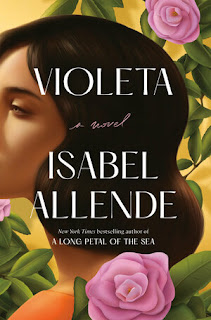
Isabel Allende's VIOLETA (tr by Francis Riddle)
It's not hard to make me cry these days -- one of the many reasons I've pretty much stopped watching television is that I bawl uncontrollably, even at commercials, so we won't even talk about sporting events or scripted dramas like Call the Midwife.* Or, say, The Expanse, which, we all know the last time a book made me cry; it wasn't that long ago, was it?
So it should come as no surprise that I've spent the last few days peering at my ebook reader through a film of tears, because I've been reading Isabel Allende, a writer whom I haven't read since I had to read her debut novel for a class in college, long before my cry-at-everything problem surfaced in my life, but yeah, I cried then, too. So I should have been prepared for Violeta.Sometimes our fates take turns that we don't notice in the moment they occur, but if you live as long as I have they become clear in hindsight. At each crossroads or fork we must decide which direction to take. These decisions may determine the course of the rest of our lives. That's what happened to me the day I recovered Torito's cross.
The passage I quoted above occurs quite late in the novel and wasn't the first bit that elicited the waterworks, but it's the most important to the plot, so I'm going to talk about it and yeah, you guys don't pay attention to the tagline on this blog anymore so spoilers except, of course, this being historical fiction, history itself is the greatest spoiler of them all.
The title character, Violeta, is a member of the same clan readers first encountered in Allende's first novel House of the Spirits(which I read for a class in college when it was still pretty new), whose life spans an entire century in her native land (a never-named Chile but come on, it's obviously Chile) with excursions to the United States and to Europe over the course of an extraordinary life that begins in the Great Depression with her family's fall from upper class splendor to living off the charity of the kindly back-of-beyond family of Violete's governess' lover Teresa, continues through a tepid marriage to a German veterinarian that brings her within a whisker of getting involved in a fictionalized Colonia Dignidad, a scorching love affair with a dashing criminal pilot with ties to all of the right-wing evil that South America and the United States have to offer (and it is he who fathers her two children and madly complicates her life for decades while she is still technically married to the German), a nice one with the guy whom she originally meets when her criminal lover hires him to keep track of their wayward daughter in 1960s Las Vegas, and finally a delightful autumnal relationship with a Norwegian diplomat and bird watcher.
The love of her life, though, as we are told early on, is someone named Camilio, whose actual relationship to her is kept secret until quite late; two other men loom large and protective and helpful in her life in the form of her brother, Jose Antonio, and the Torito mentioned in the passage I quoted above. Her brother shares his business acumen with her early on in life, allowing her to develop a powerful skill set that lets her support herself as an independent woman in a time and place when that was a unicorn; Torito is a family retainer whom she has always known, something of a father figure, not conventionally intelligent or intellecutal and huge, so commonly thought of as developmentally disabled (the novel uses the R word), who comes through for her at a desperate time and pays the ultimate price for it.
I have defined Violeta so far through her relationships with men, but there are also incredible women in her life, starting with her Irish governess, who comes to her as a nanny dressed like a flapper in the 1920s, young and pretty but already damaged by a devastating past as an orphan girl in Ireland but determined not to let that stop her; her relationship with another woman, the aforementioned Teresa, not only governs the early course of Violeta's life as the source of her family's refuge after their fall in the Great Depression, but also involves them all in radical politics from the movement for women's suffrage through the election of Chile's first Socialist president and the sweeping reforms that were utimately his downfall.
In addition to the governess are two extraordinary maiden aunts, a pair of itinerant schoolteachers who train up Violeta to maybe someday join their ranks, a cook who becomes her family's link to the indigenous population in the south of the nation, and so many more. If a character gets a name, they get a full story, relayed in intimate, chatty detail by narrator Violeta, who is recounting the whole of her life and her evolution from spoiled only daughter of a rich family to wayward wife of a German immigrant to conservative, self-supporting savvy businesswoman to radical founder of a social justice organization that looks poised to outlive her -- all for the benefit of her beloved Camilio.
All this means that, yes, Violeta lives through the brutal military dictatorship led by Pinochet. At first she doesn't think it's going to be so bad -- she has thriving businesses, plenty of money, and government contracts that look like they're going to be honored -- and her awakening to the actual nature of the right-wing dictatorship that takes over her country, the finding of a wooden cruxifix she carved as a little girl for her big, strange friend Torito, is sudden, shocking and emotionally wrenching -- and absolutely organic. Allende was great back in the 1980s and has only gotten better, so fluid and natural now that I don't even notice her, which I can also say for translator Francis Riddle.
I mean it as a tremendous compliment to observe that I didn't notice either of them as I was absorbed completely into the story. And crying.
*To name a show that all of the women in my life love passionately and honestly, I don't know how they do it. Every damned episode I've seen has left me sobbing uncontrollably for, like, days? And I have enough to cry about in real life? But there you go. God damn that show.
Wednesday, January 26, 2022
Rebecca Solnit's ORWELL'S ROSES
The above passage from Rebecca Solnit's Orwell's Roses could serve as a thesis statement for the book as a whole, for while I've seen this book described as a sort of biography of George Orwell, it's really only a tiny bit that, as I'll discuss below.Thinking about Orwell's roses and where they led was a meandering process and perhaps a rhizomatic one, to deploy a word that describes plants such as strawberries that send out roots or runners to spread in many directions. The word was adopted by the philosophers Gilles Deleuze and Felix Guattari to describe a decentralized or nonhierarchical model of knowledge. "Any point of a rhizome can be connected to anything other, and must be," they declared. "This is very different from the tree or root which plots a point, fixes an order."
Eric Blair, aka George Orwell, is a foundational writer for me, for all that the only fiction of his that I had ever read until unusually late in life for a lit major was Animal Farm*. For me, what I've always loved him for the most has been his essays, many of which I can quote almost word for word. I've enjoyed pseudo-biographies of him before, especially Emma Larkin's hyper-focused and fascinating Finding George Orwell in Burma, which does just what it says on the tin: locates important experiences and settings from Orwell's well-known years as a member of the British government's Indian Imperial Force as inspirations for a lot more of his work than just his first novel. Among its more interesting insights came from Larkin's conversation with a local on a visit to what is now Myanmar in which at first her conversation partner didn't know who she was talking about when she mentioned Orwell by either his pen or actual names, but then realized she was talking about "the prophet."
Orwell's name is on every tongue in this dumb century of ours, usually as a shorthand way of demonizing one's political opponents. Wearing masks to contain the spread of a killer virus is somehow Orwellian (though I really doubt he'd agree). Insisting that counterfactual insanity is still somehow true despite mountains of actual evidence that the crowd wasn't that big, and that your guy is in photographs with Jeff and Ghislaine, too, is Orwellian. Vaccine requirements are Orwellian? People wishing it was maybe a little harder for unhinged teenagers or mentally ill spouse-abusers to get access to automatic weapons is Orwellian? Insisting that you can't trust anything you hear in the press is pretty Orwellian. Orwellian, Orwellian, Orwellian.**
So while I still think everybody who uses his pen name in vain should have to read Larkin's book if not re-read Orwell directly***, it's a pretty interesting time for something like Orwell's Roses to make an appearance.
Right as I started reading it, I was brought back to one of my favorite reads from last year (you know, 2020 And Some Months), Dean King's Patrick O'Brian: A Life Revealed, a biography of another of my favorite writers of all time that focused quite a lot on O'Brian's cozy-sounding yet strenuously laborious domestic arrangements over the years. Here, too, quite a lot of attention is paid to its subject writer's housing, focusing on his house in Wallington, Hertfordshire, England, where he lived from 1936 to 1940 when he wasn't off at the Spanish Civil War, and where he planted the roses that first captured Solni'ts imagination.
*A first American edition of which is still one of my most cherished possessions, one of those things they'll have to pry from my cold dead fingers.
**Late in the book one of Solnit's companions in travel and exploration for the book wonderis "whether the word Orwellian should perhaps mean something other than ominous, corrupt, sinister, deceitful, a hypocrisy or dishonesty so destructive that it is an assault on truth and thought and rights" because Orwell, the actual man, was as concerned with beauty and pleasure (Solnit embarked on a re-reading of 1984 for this project and found, to her surprise that even in his totalitarian horror story there is beauty and pleasure throughout, for Winston's entire rebellion is an effort to hold on to these, and one can't depict something being clutched at without describing what is being clutched) as with brutality and deceit, but they ultimately conclude that Orwellian has become too useful a word, and too embedded in our culture, to try to change now.
***Except even back when Animal Farm first appeared, to say nothing of 1984, right-wingers were already misunderstanding the point so hard that Orwell felt he had to issue a declaration more or less from his deathbed that no, dummies, "My novel Nineteen Eighty-Four is notintended as an attack on socialism, or on the British Labour party, but as a show-up of the perversions to which a centralized economy is liable, and which have already been partly realized in Communism and fascism."
Sunday, January 23, 2022
Samuel R. Delaney's BABEL-17
Thursday, January 20, 2022
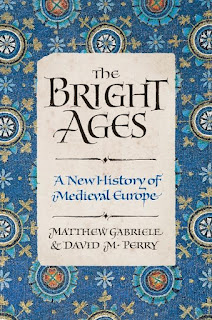
David M. Perry's and Matthew Gabriele's THE BRIGHT AGES: A NEW HISTORY OF MEDIEVAL EUROPE
"It's always the historian's job to say 'it's more complicated than that.'
Lots of pixels are already being spilled on behalf of and about this book by people better acquainted with its subject matter than I, so I'm just going to focus on the sheer enjoyment and the new thoughts that The Bright Ages: A New History of Medieval Europe gave me during my brief turn with our public library's copy -- brief not only because I was enjoying it and so tore through it with my usual voraciousness, but also because I knew a lot of other people were waiting for it (shakes fist at Libby app). I hope it gets very widely read after I'm done.
Like Dan Carlin likes to say, I'm a fan of history rather than a student of it, and I'm such a wretched fan that I didn't know that my previous favorite history book about the period covered by David M. Perry and Matthew Gabriele was not in favor until I looked at some reviews of it prior to writing this post. I don't even recall how I got my hands on William Manchester's A World Lit Only By Fire: The Medieval Mind and the Renaissance, but once I did, I didn't let it go for years.* I read it so many times that lines or sometimes whole passages from it intruded on my thoughts when I was reading historical fiction. William Manchester lived rent-free in my head as I first read the great Dorothy Dunnett, for instance.
I think he was maybe squatting a bit in Perry's and Gabriele's heads, too, though; I didn't think of his book at all while reading this until a sly little reference to its title showed up in The Bright Ages. It comes about halfway through, in the midst of a discussion of gothic church architecture and how its system of buttresses and other tricks allowed for walls composed as much of beautiful stained glass as of stone:
In a world made of wood, stone impressed; but for a world before electricity, more important was light. This wasn't a world lit only by fire, but more important, one illuminated by the sun. Allowing that sunlight inside, allowing an interior to gleam, was to capture something of the divine. So heavy stone walls were replaced by translucent and radiant colored glass.**
Underlining mine; italics theirs.
Really, that passage is a thesis statement for this whole book. The period between the canonical Fall of the Roman Empire (but Philip K. Dick taught me that The Empire Never Ended...) and the start of the Renaissance is still most commonly described by the loaded phrase "The Dark Ages" but culturally, intellectually, politically, materially, that period of time was no darker than our own in a lot of key respects. In the literal terms the quoted passage begs us to consider, for example, the sun shone for the same number of hours per day as it does now (and through much cleaner air); it was only at nighttime or deep indoors in windowless rooms that the visible world shrank down to what could be lit by a flame.And if one zooms back camera (and yes, I'm totally thinking of Alejandro Jodorowsky's last line in The Holy Mountain, here) and takes in all of the then-known world, civilization and all of the ideas and traits we associate with it wasn't suddenly extinguished when Alaric sacked the city of Rome; rather, like a balloon a bunch of kids take turns batting around a room to keep it from touching the carpet, its light was passed from place to place via trade and the travels of scholars and pilgrims and on the backs of war horses and yes, even in the minds of "ignorant" tribesman types gawking at the aqueducts and roads left behind by the classical Roman empire.
And the idea of Rome didn't die, either; people like Galla Placidia, daughter of one Roman Emperor, wife of another (and before that of a Visigothic king) and mother to yet another, never thought of herself as anything but Roman even though she had witnessed the famous sack and led a tumultuous existence that could make anyone agree with Gandhi that Western Civilization was something they should maybe try sometime. Following her the rulers of the Byzantine Empire called themselves Romans and still had chariot races (boy did they have chariot races) and adopted laws and customs from the classical empire even as they embraced this newfangled Christianity. And the idea persisted in some ways even until the Hapsburgs presided over something that by axiom was neither Holy, nor Roman, nor an Empire, except they themselves might have disputed it when they weren't busy keeping their subject kingdoms from trying to destroy each other and engendering cultural conflicts that are still affecting us even in this stupid 21st century that convinces me more every day that a whole lot of people who desperately cling to the idea that the Dark Ages were totally a thing because it props up their dumb culture war talking points also seem to think that it would be great if we could Make the Age Dark Again.
Oh no, Kate's getting political again, but Perry and Gabriele went there before I did; their whole point in writing this book is to debunk and deconstruct the hundreds of years of post-Renaissance bad history and to point out how that bad history has been used to justify everything from the 17th-19th century return to slavery as a justifiable institution despite being pretty un-Christian, to the 21st century talking head hobby of blathering about "clashes of civilizations" to justify Antisemitism, Islamophobia, sexism and, of course, racism. History is written by the victors, sure, but the losers had a habit of finding ways to record their existences and leave traces for us to read as well, and we ignore those traces to our cost.
And this is where the duo really shines. For the most part, they're using the same sources as Edward Gibbons and his heirs always have, but look at them with an eye to why people like Procopius wrote what he did, rather than just taking what he did write as face value, ignoring the fact that his public and private writings frequently contradicted each other, and picking out the bits that agree with a predetermined thesis. Look at the circumstances under which the man worked and what he said and why he said it can make more sense, especially if its backed up by archeological evidence or other primary sources or just the lived experience of standing in the Hagia Sophia even after centuries of alterations... to say nothing of the fruits of hundreds of years of scientific research that has yielded all kinds of insights into the daily realities of The Little People.
The two really do zoom back, by the way, to take in, as I said, the entire known world, including the rise of Islam and the importance of its scholars to what would come to be Europe's Renaissance but also their presence as ordinary residents of the Iberian peninsula where they lived alongside Christians of many kinds (one thing I like is the emphasis in this book on the fact that right from the start there were always many Christianities, plural) and Jews, and the odd pagan hangover in varying degrees of peaceful coexistence -- though Perry and Gabriele are very careful not to fall into the trap of romanticizing this coexistence as This is the Past That Liberals Want.
The Mongols, too, get a turn in the spotlight as carriers of goods and ideas (and, most likely, according to modern archeological and genetic research, probably the Black Death) back and forth, just as the Vikings did. Remember that, famously, one in 200 men now living have some of Genghis Khan's DNA, and not all of them are in Asia.
Hard to share chromosomes without sharing a few other things.
The book ends with a return to Ravenna a thousand years after Galla Placidia built her mausoleum with its marvelous interior sky of lapis lazuli and gold-infused glass tesserae, to consider Dante Aligheri, exiled from Florence by political strife and writing The Divine Comedy's quest for divinity, imagined as light -- and then considers Petrarch, the first great populizer of the idea that the thousand or so years that preceded his personal awesomeness had been universally ignorant, violent and dark (or, as a later scholar would describe the whole of human existence, nasty, brutish and short!), inviting us first to ponder why he found it necessary so to characterize the times that spawned him, and whose interests it has served later historians to perpetuate and intensify Petrarch's errors. As the authors conclude near the end of The Bright Ages, they were "not simple or clean, but messy and human, and that's as close as we can come to the truth."
I hope someday the same kindness is employed in talking about us.
Now excuse me; this would be a very interesting time to finally read The Cheese and the Worms: The Cosmos of a Sixteenth Century Miller, which I've owned for 20+ years but never finished.
*And while I absolutely see how Manchester's book merits criticism for perpetuating stereotypes about the period he covers, that book us how I first learned to see Henry VIII as more than a wife devouring monster (listen to the music he composed sometime!), to appreciate Magellan, and to empathize with Lucrezia Borgia. So I'll not abandon it wholly.
**And of course, any discussion of French cathedrals and the like always brings me around to my beloved Orson Welles and my single favorite few minutes of cinema yet created, this bit from his wonderful F for Fake in which he is moved to unparalleled eloquence as he contemplates Chartres:
Wednesday, January 19, 2022
Leonora Carrington's THE HEARING TRUMPET
Houses are really bodies. We connect ourselves with walls, roofs, and objects just as we hang on to our livers, skeletons, flesh and bloodstream. I am no beauty, no mirror is necessary to assure me of this absolute fact. Nevertheless I have a death grip on this haggard frame as if it were the limpid body of Venus herself.Did you dig One Flew Over the Cuckoo's Nest but kind of wish you could read it gender-flipped? Did you adore the television series Waiting for God but wish you could actually observe all of Tom Ballard's tall tales but as directed by someone like Lindsay Anderson? Leonora Carrington, my new other favorite sculptor-turned novelist, whom I might end up loving even more than sculptor-turned-novelist B. Catling, has you covered and then some.
Tuesday, January 18, 2022
Michael Shea's MR CANNYHARME: A NOVEL OF LOVECRAFTIAN TERROR
"If he's sinking to hell, it's definitely to a poet's inferno."
I first encountered the weird fiction stylings of Michael Shea in an anthology, which included his short story "Fat Face" - but that tale is probably my least favorite entry in Cthulhu 2000 and my least favorite Michael Shea as well. While it contains most of the elements of Shea's oeuvre that people love -- seedy downtown life, inexplicable horrors, bizarre monsters and lots of moisture -- there was something about it that just made me say "eh," and move on.
Enter the venerable, the wonderful H.P. Lovecraft Literary Podcast, in which Chad Fifer and Chris Lackey have been conducting their "Strange Studies of Strange Stories" for over a decade (and it took them most of it to come up with that tagline, bless them), one of the few shows out there of which I never skip an episode, teamed up with Patton Oswalt to evangelize the hell out of Michael Shea's explicitly Cthulhu Mythos fiction, collected now in a terrific volume called Demiurge: The Complete Mythos Tales of Michael Shea and I became a believer!
And yeah, "Fat Face" is not a good example of this stuff.
With Mr. Cannyharme, we get to see if the combination of Michael Shea and the Cthulhu Mythos can sustain a whole novel. Spoiler: it totally, totally can.The novel is written as an homage to one of Lovecraft's own stories, "The Hound." You know the one. The one in which the characters are terrified to discover that "the apparently disembodied chatter was in the Dutch language" (Italics very much HPL's). Mr. Cannyharme isn't just "The Hound but 1960s San Francisco," though. He employs "The Hound" as inspiration, as a springboard rather than a model to slavishly copy.
If anything, Mr. Cannyharme makes me think more of Fritz Leiber* than of Lovecraft, specifically Leiber's Our Lady of Darkness, which pits a moderately successful but down-on-his-luck writer of novelizations of TV shows against a dead wizard whose magic was woven from the very geography of the city of San Francisco.
Mr. Cannyharme takes place in that same city, several social classes down from the beautiful art deco apartment building of Leiber's tale. Shea's characters inhabit an old-fashioned transient hotel. Most of them are closer to death than they are to life with a few dazzling exceptions -- a pimp, Razz and especially his employee DeeAnn, who considers sex work to be the best work and has a good "tight five" of witticisms about it to break the ice and change the mind of anyone who thinks otherwise, are particularly fun to read about -- and none more so than the title character, a little old man bent almost double who shuffles around the city during the day handing out weird little tracts to people of his choosing, but otherwise keeps to himself. Or does he?
Pitted against the horrors, along with Razz and DeeAnn, are Jack, the hotel's graveyard shift desk clerk who is pounding out a novel on an old Olympic typewriter and pining for his ex-wife between calls to buzz in the hotel's residents after hours and to supply them with illegal drugs; a very haunted and lost young woman named Brittany who trades sexual favors for her rent (but only with Jack) and is in turn one of Jack's best customers for her comforting "blankie" of drugs that let her hide for a little while from the horrors of her abused childhood and her growing awareness that something really, really isn't right about their building; and a few side characters, such as the barely teenaged daughter of the hotel's perpetually bickering husband and wife managers, the Patels, who run the place on behalf of some richer Patels and turn a blind eye to the rest of the goings-on in the building.
Shea loved San Francisco, lovee especially its seedy underbelly, and it shows on every page. Street scenes full of hustlers and junkies and every other kind of low-life bring out the lyric poet in him for paragraph after paragraph of rhapsodies that are as intoxicating as the contents of Jack's little baggies.
But the drugs Jack is slinging these days are mostly uppers, so even when we're just enjoying the scenery, it's energetic and invigorating:
Down in the street outside the Hyperion, Jack just stands there a moment, taking in the early evening. The candy- colored neons are coming on, the signals blaze, all the tail-lights and headlights river and roar, and above it all a first shy star or two gleams in the purple sky. The sidewalks throng, the working stiffs -- many Latins and Easterners -- threading through the low-lifes... He's right where he should be.
But this is no Visit Beautiful San Francisco tourist copy. Zoom in on individuals and it's even more, ah, vivid:
Below the man's gaping mouth a second bloody mouth gapes still more widely. Sliced meat its lips, and gore its pendant spittle, hanging in crusty drapes down both the man's shoulders.
I mean, yuck, but I've also got to admire the craft, here. And it's this craft that is at the heart of the novel; Cannyharme first ensnares his victim-accomplices by means of poetry, possibly tailored to each reader, and some of those he so ensnares, if they've artistic pretensions already, themselves reach new heights of expression. And Shea doesn't just settle for telling us that their output has improved; he shows us exactly what they've written, indulging in even crazier word-lust and imagery in whole passages of demented verse that would be the best thing about this novel of everything else weren't so good.
And yes, I cried happy little tears for the little world of resistance the novel's handful of survivors build for themselves in the last chapter. Their victory is hard-won and temporary, but as in the denouement of almost all of Shea's Mythos stories, they know they have a fighting chance if they stick together. And keep an eye out for a being in a wildly patterned Hawaiian shirt. Oops, that last bit didn't age super duper well, but c'est la guerre.
So yeah, Shea gives good novel. And my resolve is redoubled to keep seeking him out. I hear good things about this fella Nifft, for instance.
*But, of course, Leiber was inspired by Lovecraft. He just hated the world a lot less than cranky, prejudiced misanthrope Howard did.